Chapter 5:
Episode Five: The Black Swallow
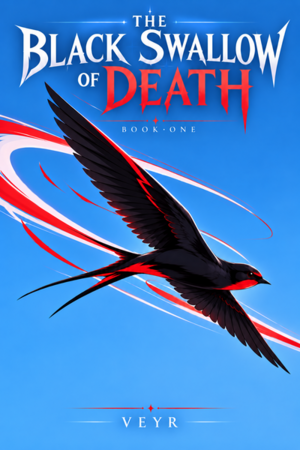
The Black Swallow of Death: Book One
The camp quieted before Roland heard the footsteps.
It wasn't complete silence. Somewhere a hammer continued striking metal, and a wounded man coughed in the room beyond the wall. But the voices outside stopped. A chair scraped. A guard who had spent the last hour leaning against the corridor straightened.
Roland set down his water cup.
The man entering the doorway wore black armor fitted closely enough to move without the clatter Roland expected. A bird's narrow wings had been worked into the breastplate. His helmet covered his face, leaving a dark slit for the eyes.
Kaelen followed him in.
For one terrible instant Roland thought the armored man was the rider from the sky. Then he noticed the differences: no lance, a different shape to the helmet, gloves thin enough for the fingers to close precisely around the doorframe.
The man paused there as though the short walk had required more effort than he wanted anyone to see.
He looked at the coat, the bandages, and Roland's face.
Kaelen began an explanation. Roland understood most of it now, including the parts that described him as either exceptionally ignorant or exceptionally prepared. He wanted to object. He waited because the armored man hadn't taken his eyes off him.
“Did he ask for me?” the man said.
“No.”
“Did you use my name?”
“Only the title.”
The man nodded once. “Leave us.”
Kaelen hesitated. “If this is an attempt—”
“Then you will be close enough to interrupt it.”
Kaelen looked at Roland, making the interruption feel considerably less comforting, and stepped into the corridor. Droven left with him. The door closed.
Roland sat with his hands visible on his knees. The armored man took the other stool. He didn't ask for a name or examine the authorization. He rested one gloved hand on the table and spoke.
“What year was it?”
The words were English.
Roland looked. The man's mouth was hidden, but Roland could hear the familiar shapes, the unremarkable it, the ordinary question asked in an ordinary language.
“On Earth,” the man added. “When you left.”
Roland tried to answer and found he couldn't get enough air to do it.
“Take your time.”
“Twenty twenty-six.”
The hand on the table tightened. The man remained still for several seconds. Then he raised both hands to the helmet, released a fastening beneath the jaw, and lifted it away.
His hair was white. Deep lines crossed his face, and an old scar had pulled one eyebrow slightly higher than the other. He was Japanese. Roland recognized the fact with a relief so violent it seemed shameful, as though a familiar face could excuse everything else.
“My name is Kenji Tanaka,” the man said. “The last year I knew there was nineteen forty-three.”
Roland looked at him. The window let in a square of gray light. Outside, somebody moved a cart. All of it continued while the numbers refused to fit together.
“You came from Japan?”
“Yes.”
“During the war?”
“During the war.”
Kenji placed the helmet on the table. Without it he looked older and less certain, though Roland couldn't tell whether that uncertainty belonged to him or to the news he'd just received. “Do you remember leaving?”
Roland told him about the engine. He described the hoist, the sound, and the bench. This time he didn't have to simplify what had happened into something that might pass through a language he couldn't hear himself speaking.
He got as far as Mara calling his name. Then he stopped. Kenji waited.
“I died,” Roland said.
He had been avoiding the word because saying it seemed like choosing it. Now it stood between them, and he couldn't pull it back.
“That is what I think happened to me,” Kenji said. “I cannot prove it for either of us.”
“But you woke here.”
“In the air. In a machine I did not recognize.”
Roland leaned forward despite his ribs. “The same way?”
“Similar isn't the same. We will be careful about that.”
It was the first thing anyone had said here that made Roland feel the possibility of an answer rather than another accusation.
“How long have you been here?”
“About fifty years. By their calendar.”
“Then how can it be—”
“I don't know.”
Kenji gave the reply without embarrassment. He had evidently spent longer learning to say it than Roland had spent alive.
“Have there been others?”
“Yes. Some I met. Others I heard about and could never find.”
“Americans?”
“One taught me much of the English I use now. We wrote down words when we couldn't remember them. There was no one to ask if we got them wrong.”
Roland's eyes moved to the window. The bars divided the gray sky into three strips.
“Is he still here?”
“No.”
He didn't ask the next question. Kenji's face answered enough of it.
The commander reached for the water pitcher. Halfway there, a tremor passed through his hand. He held it still until the shaking stopped, poured himself a little water, and drank.
Roland noticed. Kenji noticed him noticing. Neither spoke about it.
“You were a pilot?” Roland asked.
“I was.”
“You still are.”
“Sometimes.”
“And this army?”
Kenji glanced at the black bird on his armor. “I came to it long after it began. People remember my part more than the rest. That has been useful, and dangerous.”
Roland looked at the helmet. The frightening thing that had entered the room was an old man who'd waited fifty years to ask what year it was.
“What happened to Japan?” Kenji said quietly.
Roland had expected another question about the crash. He stared down at his hands before answering.
“The war ended in nineteen forty-five. Japan surrendered.”
Kenji closed his eyes. Roland didn't continue. He knew enough history to understand that he could hurt this man very badly with a careless summary, and not enough of the man to know what he needed to hear first.
After a while Kenji opened his eyes again. “Is it still there?”
“Yes. It's still there.”
Kenji nodded, slowly. He held the cup in both hands now. “We will talk more. Not all at once.”
Roland thought of his mother's message. She would call when he didn't answer. Someone would have to tell her why.
He leaned forward, gripping the edge of the stool.
“Can you send me back?”
Kenji looked at him fully. There was no attempt to misunderstand the question and no promise made to soften what followed.
“I have never found the way.”
Roland lowered his head. He'd known this man for minutes. He had given him every hope he possessed anyway.
Outside, the hammer stopped. Someone called for a part, and another voice answered from farther away. People were working. They would keep working whether he could go home or not.
Kenji set down his cup.
“I can have you moved out of this room. Your injuries can be treated. Kaelen will still ask questions, but he will ask them while you eat.”
“Why would you do that?”
“Because someone did it for me.”
He stood carefully, leaving the helmet where it was. Roland looked up. He wasn't ready to trust the army, the strange words in his vision, or a sky with two suns. But he could accept food. He could accept a man speaking English without trying to turn it into a confession.
“I'm an engineer,” he said, then corrected himself. “I restore aircraft. I study their history. That's what I know.”
Kenji nodded toward the sound of work beyond the window.
“We have more broken aircraft than historians. You may find something you can do.”
He opened the door and spoke to Kaelen in the other language. Roland caught a few of the meanings, but he no longer forced himself to catch them all.






Please sign in to leave a comment.