Chapter 39:
Scrap Men
Spider-Man: Template System
New chapter is on the board.
Suit up. Queens is not getting quieter.
✦
"That is not a gun," the man on the box truck shouted.
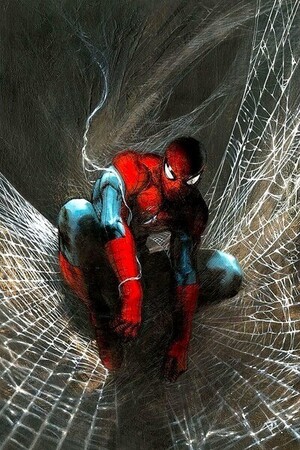
Spider-Man looked at the metal barrel clamped to the man's shoulder, the cable running into a battery pack that still wore half a Stark return sticker, and the way every person under the elevated tracks in Brooklyn had decided to stop breathing at the same time.
"I love optimism," Peter said, because the alternative was screaming. "Big fan. Really worried about your definition of not-a-gun."
The man was in a construction vest over a hoodie. His boots were muddy. His gloves were the cheap kind Peter had seen at hardware stores, gray on the palms and already burned dark around the fingers. The man beside him carried a cutting rig made from a road flare housing, two stolen industrial lenses, and something Peter was almost sure had started life as a portable heater.
Behind them, a dented box truck idled between a tire shop and a check-cashing place. The plates were stolen. The disposal tags on the side were Oscorp tags, peeled off badly and slapped on crooked, as if the people using them knew just enough to get past a guard who hated his job.
Normal clothes did something ugly to weapons. A uniform told the street where to point its fear. Hoodies and work boots made everyone search faces instead. The mother near the laundromat door clutched her stroller and looked from one man to another, trying to guess which desperate person would become the disaster first.
Peter had been trying very hard not to think like the dinner table at Norman Osborn's house. Men there had made danger sound polished. Here danger smelled like hot metal, old fries, and panic sweat.
Two nights ago Jonah had made Spider-Man a punchline with legs. Yesterday Harry had looked at him like he wanted to ask three different questions and had swallowed all of them. Six minutes before the call came in, Peter had stared at the Atlas notes again: the bait number quiet, the wiped phone quiet, the van tablet anything but quiet. Quiet things made him nervous now.
Now a man with a welded shoulder cannon was pointing at a crowd while the train above them squealed into a slow curve.
"Nobody moves," the man on the truck shouted.
Several people immediately moved, because people were people and fear had terrible coordination.
Peter shot a web to the traffic light and swung low enough that his heels almost clipped a delivery rider's helmet. "Tiny note, if your plan requires New Yorkers to obey a shouted instruction, you may want to workshop the plan."
The cutting-rig man snapped the tool toward him. A blue-white line spat across the air. Peter twisted. Heat licked the side of his suit and bit through the fabric over his ribs.
"Ow. Okay. Less note, more running commentary: very illegal flashlight."
The blast hit the tire shop sign behind him and turned two plastic letters into black rain. Civilians scattered. A boy in a school jacket lifted his phone with both hands, filming because someday evolution needed to have a stern meeting with teenagers.
Peter landed on the truck roof. The metal flexed under his feet. The shoulder-cannon man tried to pivot up, but the backpack was too heavy and the cable snagged under his arm.
Not trained, Peter thought. Not steady. Not safe.
The thought wanted to keep going. It wanted tidy labels, categories, a clever map with the shooter in one corner, the cutter in another, the driver behind the wheel, the train above, the stroller by the curb, the delivery rider bleeding from his cheek. It wanted to turn fear into a diagram because diagrams did not cry or miss.
Peter made himself stop at one sentence a scared kid from Queens could follow.
Track first. People first. Catch the hand after the fall is stopped.
The shoulder cannon fired.
Peter yanked the traffic light down just enough to change the angle of the shot. The beam slammed into the underside of the elevated track instead of the crowd. Steel screamed. Sparks poured over the street. Above him, the train brakes shrieked, hard and late.
"Okay," Peter said, voice thinner than he wanted. "That is a gun."
The truck driver panicked and lurched forward. Peter webbed both front tires, then webbed the bumper to a lamppost, then webbed the lamppost again because he had seen what one bad weld could do tonight and did not feel like trusting city maintenance with his life.
The box truck stopped with a noise like a giant choking. The driver slammed his shoulder into the door and spilled onto the asphalt with a pistol in his hand.
Peter snapped a web over the weapon before the man could raise it. "Thank you for choosing the express version of bad decision theater."
The driver stared at his wrapped hand. He looked younger than Peter expected. Everyone did tonight.
Another blast tore above them. The stopped train shuddered on the tracks. Faces filled the windows, pale behind scratched glass. A little girl pressed a stuffed rabbit to her mouth. A conductor leaned out two cars back, yelling into a radio that Peter could hear only in clipped bursts.
The cutter used the chaos well enough to be dangerous. He did not chase Spider-Man. He went for the fallen web cartridge Peter had cracked on the truck roof during the landing. Tiny silver cylinder, no bigger than a marker. Peter saw the man's glove close around it right as a shower of sparks dropped toward the mother with the stroller.
For half a second Peter split into every direction at once.
Cartridge. Cannon. Track. Stroller. Train. Driver. Camera. Ruiz would need evidence. Tony Stark's people would need evidence whether they admitted it or not. Oscorp tags would matter. Atlas mattered. The quiet number mattered.
The baby in the stroller did not cry. The mother did not know why. Peter did: the blast had punched sound out of the child's world for a second, maybe longer, and the mother was still reaching down instead of running.
Peter let the cartridge go.
He shot two webs, one to the stroller frame and one to the woman's coat, and pulled both under the tire shop awning as molten grit pattered where they had been. His shoulder hit the sidewalk hard enough to flash white across his vision.
"Hi," he told the baby, because the baby blinked at him with deep offense. "You are absolutely right. Terrible service. One star."
The mother grabbed his wrist. "Can she hear? Can she hear?"
"I do not know yet." Peter kept his voice soft and hated the words. "Ambulance. Keep her looking at you. Big faces, big breaths, okay?"
He wanted to say more. He wanted to fix that sentence until it became a promise. The shoulder cannon whined again.
Peter rolled away as the shot chewed a line through the awning and punched into the tire shop wall. The man wearing the backpack screamed, not in rage now but in pain. The battery pack had begun to overheat. Blue light crawled through the gaps in the taped casing.
"Take it off!" Peter shouted.
"You think I can?" the man yelled back. His eyes were huge. "He said it would lock only if somebody tried to steal it!"
He. Peter felt the word catch. Not a buyer. Not a bunch of amateurs stumbling into a warehouse. Someone had given frightened men machines that punished them for trying to survive the machines.
"Who said?" Peter asked.
The cutter was already gone into the laundromat alley.
The backpack man laughed once, sharp and broken. "You people ask names like names save anybody."
Peter fired webbing across the pack in a cooling lattice, then another line to yank the man backward off the truck and onto a stack of flattened cardboard. The impact knocked the breath out of him. It also moved the barrel away from the train.
The pack flared.
Peter threw himself over it.
For one brutal second his whole world became heat, pressure, and the knowledge that Aunt May would recognize the burned-rubber smell in his laundry no matter how much detergent he used. The webbing held. The blast burped sideways, shattered the truck windows, and kicked Peter into the street.
He landed badly. He knew it from the bright spike in his ankle and the immediate, humiliating certainty that he had just invented a new way to limp.
"Still alive," he muttered into the asphalt. "Great data point. Hate the collection method."
People were screaming again. People screamed after danger, too. Peter pushed himself up and scanned by habit before pride could talk him into pretending nothing hurt.
The train was still in place. The mother and baby were under the awning. The delivery rider was sitting with a nurse kneeling beside him, her hands red where she pressed cloth to his scalp. The driver was webbed to the lamppost and crying through clenched teeth. The backpack man was tangled in cardboard and webbing, conscious, breathing, swearing in three languages, which Peter counted as medically encouraging.
The cutter was gone.
So was the cracked cartridge.
Peter stared at the alley mouth. His fingers twitched. A clean chase would feel better than standing in the wreckage with everyone looking at him. A clean chase would let him pretend he had not lost evidence because he had chosen a stroller and a train over a vial-sized mistake.
The elevated track popped above him. One support bracket, heated and stressed, sagged by a fraction of an inch.
Peter did not chase.
He jumped, bit back a sound when his ankle objected, and webbed the bracket to the neighboring crossbeam in six fast passes. Then he webbed two more supports because his first repair was ugly and he did not trust ugly tonight. The conductor shouted something that might have been thanks or might have been a lawsuit.
"You are welcome or I am sorry," Peter called back. "Whichever gets the train moving slower."
Sirens arrived in layers: ambulance first, then NYPD, then a fire truck whose driver looked at the webs on the elevated supports with the expression of a man who had not signed up for modern art.
Detective Ruiz came out of the first patrol car with her coat half-buttoned and her hair pulled back like she had done it in the car. She took in the truck, the tags, the smoking backpack, the civilians, and finally Spider-Man balancing on the side of a column with one foot tucked behind the other.
"You," she said.
"Me," Peter agreed. "I brought you a truck. It may be angry."
"Did you take anything from it?"
"Emotional damage."
Ruiz did not blink.
Peter exhaled. His ribs hated it. "No. One of them took something from me. Web cartridge, cracked casing. Maybe fluid. I had to choose the stroller and the track."
Her eyes moved to the awning, then up to the train, then back to him. The suspicion did not leave. It changed shape.
"These men connected to the warehouse?" she asked.
Peter looked at the Oscorp disposal tags. He looked at the Stark sticker half-melted onto the battery pack. He thought of Norman smiling like every word had a lock on it. He thought of Harry asking him if he ever got tired and then pretending he had not.
"Yes," Peter said. "Not cleanly. Someone is handing little pieces of big companies to desperate men and letting the street take the blast."
"That is a speech."
"It is a bad week."
Ruiz crouched near the driver's wrapped pistol without touching it. "Names?"
"I heard an empty pronoun and a lot of pain."
"Spider-Man."
"I am not being cute." He paused. "Okay, I am almost always being a little cute, but not about this. The backpack locked on him. He said somebody told him it would only lock if someone tried to steal it. That means the person who built it expected fear, theft, or betrayal. Maybe all three."
Ruiz looked toward the laundromat alley. "And the one who ran?"
"Cutting rig. Took my cartridge. Moved like he had practiced the grab, not the fight."
"You let him go."
Peter swallowed the first answer, because the first answer had teeth. "I saved the people in front of me."
Ruiz held his gaze for a second. Then she nodded once, not forgiveness, not approval, just a mark placed on the page. "Do not leave town."
"I live in Queens. Leaving town requires train fare and emotional preparation."
"Do not leave the evidence scene."
A camera lens flashed from the roof across the street.
Peter saw it because his neck prickled before his eyes found it. Long lens. Black sleeve. Gone the instant he looked straight at it.
He hated that more than the blast. The blast at least had the honesty to be loud.
"I have to," he said.
Ruiz's mouth tightened. "Of course you do."
"There was a watcher."
"There are fifty watchers."
"This one knew when to leave."
He fired a web upward, then hesitated long enough to point at the backpack. "Do not let anyone with a company badge remove that before your people photograph the casing from every angle. Especially the lock."
"You giving police procedure now?"
"No. I am begging you to make it harder for someone expensive to call this garbage."
Ruiz looked at the pack again. Her jaw moved once. "Go before I change my mind."
Peter went.
He did not go far. Two rooftops over, he crouched behind a water tank and pulled his mask up just enough to breathe cold night air against his teeth. His hands shook after fights sometimes. Usually he could blame adrenaline. Tonight they shook because he could still feel the moment the cartridge left his reach.
He checked his ankle with two fingers, winced, and decided future Peter could have a full medical opinion after present Peter stopped bleeding through the suit. Then he looked back toward the elevated line.
The train lights stayed on. The civilians stayed alive. Ruiz had the truck. Those were not small things.
They were not the only things.
In the laundromat alley, three blocks away, the cutter had not run like a man escaping a crime. He had run like a courier making a deadline.
Peter found the first trace on a rusted pipe: a smear of gray web fluid where the cracked cartridge must have leaked through the glove. He touched the pipe with two fingers, smelled solvent and sweat and cheap detergent, and followed the marks to a back door hanging open by one hinge.
Inside, the laundromat was closed and humming. Machines turned with nobody watching them. A sock slapped wetly against a round glass door over and over again, patient as a clock.
On the folding table near the rear exit, the cutter had left a strip of burned glove and one shaving of silver cartridge casing. No man. No rig. No clean trail beyond the door.
Peter picked up the shaving with webbing, sealed it against his palm, and heard Aunt May's voice in his head telling him to stop touching mystery metal with open cuts. He promised imaginary May he would disappoint her more carefully next time.
A dryer buzzed.
Peter flinched hard enough to hate himself for it.
Under the buzz, faint but real, a phone vibrated somewhere behind the vending machine.
He moved it aside one inch at a time. Pain lanced through his ankle. The phone was a burner, screen cracked, battery low. A message sat open because whoever had owned it had either been rushed or wanted it found.
Sample acquired. Holds under stress. Organic-adjacent.
Below that: Manhattan pickup confirmed.
No name. No signature. No company logo for Peter to punch. Just a sentence neat enough to make the whole night feel measured.
Peter stared at the words until the screen dimmed.
He thought of the baby blinking in silence. He thought of the man screaming under the backpack. He thought of Ruiz asking if he had taken anything and the bitter answer he had not given: everyone kept taking pieces of him before he knew what they were worth.
Then he copied the message, webbed the burner to the underside of the folding table for Ruiz to find if she followed his next call, and swung back toward the sirens with one ankle singing pain up his leg.
The city below him did not look saved. It looked paused.
Peter could work with paused.
✦
✦
✦
Want more after the credits?
Patreon is already ahead with early chapters, previews, and extra story updates.
www.patreon.com/c/capeafterhours




Please sign in to leave a comment.