Chapter 1:
Bloodlines and Bitter Iron
Bloodlines and Bitter Iron
The dawn over Caer Vance rose the color of wet slate and bruised plums.
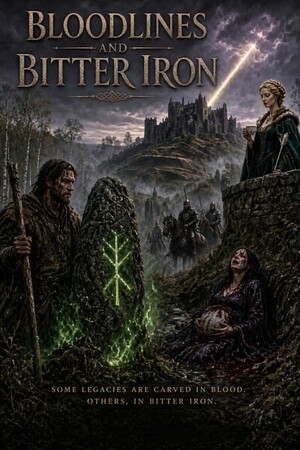
In the lower bailey, where the rough-hewn Celtic ringwork met the squared limestone of the newer Tudor additions, Connell Vance stood before a fractured menhir with an iron chisel balanced between his scarred knuckles. The stone was cold enough to bite through leather. He blew a breath into his cupped palms, the peat smoke clinging to his wool tunic, and traced the line of an Eihwaz rune he had carved three times since the autumn rains turned the ditch into a slurry of clay.
“If you strike that rock with any more melancholy, Vance, the masonry will collapse out of pure secondhand embarrassment.”
Connell didn’t turn around. He didn’t need to. The sharp, clipped vowels floating down from the second-story terrace belonged exactly to one woman, as did the scent of bergamot and dried elderflower currently cutting through the crisp air.
“Morning, Aurelia,” Connell said, testing the groove of the rune with the flat of his thumb. “The frost expanded the seam. If I don’t seat the copper binding before noon, the outer ditch wards won’t hold back a stray badger, let alone anything with iron on its hip.”
Aurelia von Riven rested her elbows against the carved balustrade of the Elizabethan gallery. Her pale honey-gold hair was gathered in an intricate braided crown that defied both the morning breeze and the laws of gravity, and a heavy, fur-trimmed mantle of deep emerald velvet sat draped over her shoulders like an imperial coronation robe. Between two slender fingers, she held a delicate porcelain teacup, steam rising in a thin, immaculate ribbon.
“Let the badgers come,” Aurelia said smoothly, taking a measured sip. “At least a badger possesses the courtesy to groom itself before presenting its visage to society. You, on the other hand, smell of a bog fire that someone put out with wet hay. Did you sleep in the ash-pit again?”
“The flue in the low hearth was drafty,” Connell grunted. He picked up his wooden mallet. “Jacki’s boots needed tallow. I was multitasking.”
“You were loitering.” She arched a pale brow, peering down with that imperious, devastating gaze that had once terrorized three dormitories and half the faculty of the scholastic halls they both barely survived. “And you have neglected my hot water kettle. The domestic staff in this castle is profoundly incompetent.”
“There is no domestic staff, Aurelia. It’s just me, you, and the kid.”
“Then the master of the house should consider flogging himself for dereliction of duty.”
From the shadows beneath the arched gatehouse, a small, pale face poked out.
Ten-year-old Jacki sat perched atop an overturned cider barrel, her bare legs swinging back and forth in rhythmic, hypnotic sweeps. In her small hands, she cradled a surgical scalpel with a mother-of-pearl handle, turning the blade against an oiled whetstone with terrifying, whisper-quiet efficiency. Scritch. Scritch. Scritch.
“Mother is right, Father,” Jacki piped up, her voice light, airy, and entirely innocent. “Your posture is crooked. When you lean like that, the fourth thoracic vertebra rubs against the tendon. It would be very easy to sever. Just a little snip, like a string.”
Connell sighed, rubbing the bridge of his nose where an old scar pulled at the skin. “Thank you, Jacki. Very helpful diagnostic. Put the scalpel away before breakfast, please.”
“I was cleaning the bursae of that hare you snared,” Jacki said sweetly, holding up the gleaming edge to catch the dull grey dawn. “The marrow was so pretty. Can I keep the hip bone? It looks like a little chair for a beetle.”
“Ask your mother.”
“Absolutely not,” Aurelia snapped from above, through her gaze softened by an imperceptible fraction as she looked at the girl. “No vermin furniture at the dining table, Jacki. We are not wild Picts living in a ditch, regardless of what your father’s grooming habits suggest. Now, Connell –“
The air cracked.
It was not thunder. It was the sound of a violent, resonant snapping of glass beneath twenty fathoms of water.
Connell’s posture vanished instantly. The relaxed, slouching woodsman dissolved into the low, coiled stance of a hound catching the scent of wolves. His ash-wood staff, leaning against the menhir, leapt into his right palm before the mallet had even hit the flagstones.
Along the outer perimeter – half a mile down through the birch woods, where the ancient concentric ramparts guarded the approach – a pillar of green fire flared toward the overcast sky. The earth shuddered. The heavy runic stone Connell had been carving hummed with a vicious, metallic shriek.
“Someone crossed the boundary ditch,” Connell said, his voice dropping into the flat, dangerous cadence of a battlefield commander.
Aurelia did not scream or spill her tea. With terrifying elegance, she set the porcelain cup upon the stone balustrade. Her right hand slipped into the slit of her cloak, drawing an eleven-inch wand of polished white yew tipped in engraved electrum.
“Whoever it is,” Aurelia said, her eyes flashing with cold, aristocratic fury, “they have broken the tranquility of my morning tea. Jacki, stay within the bawn.”
“Can I come, Mother?” Jacki asked, sliding off the barrel in an instant, three scalpel blades already fanned between the knuckles of each small hand like chrome claws. “I can help peel them.”
“Stay at the iron yett,” Connell ordered, not breaking stride as he sprinted toward the postern gate. “Aurelia, take the upper parapet. If they’ve brought cavalry, break the timber bridge.”
“Do not presume to command my firing arcs, Vance,” she shot back, though her boots were already clicking with rapid, lethal precision along the stone ramparts.
Connell cleared the low stone wall in a single leap, hitting the mossy incline on the dead run. He didn’t need horses; he knew the hillfort’s throat. Beneath his boots, the roots of ancient oaks thrummed with the mana he had fed into the dirt year after year. He reached into his belt pouch, flicked two flat river stones carved with the Kenaz runes between his fingers, and vaulted onto the crest of the earthen bank.
Through the mist of the birch grove, someone was fleeing.
It was a woman. She was stumbling through the blackthorn briars, her velvet riding dress torn to ribbons, heavy with freezing mud and dark, thick stains that were not mud. She was clutching her swollen belly with one arm, her breath tearing from her throat in jagged, wet sobs.
And she wasn’t just injured – she was starving. Connell could smell it from twenty paces away: the unmistakable, sharp copper reek of violent blood-hunger, mixed with the sweat of high fever and terror.
Behind her, five horsemen burst through the tree line.
They wore blackened breastplates and heavy iron morions, riding hard on Hungarian chargers. Crossbows were braced in their stirrups, their pennants bearing the divided teeth and royal crest of Báthory.
“Bring her down!” the lead rider bellowed in rough Magyar. “Before she reaches the stones! The King wants her throat cold!”
A steel bolt ripped through the air, shearing through the birch branches and thudding into the woman’s shoulder. She screamed – a raw, animal-like shriek that carried a strange, vibrating frequency that made Connell’s teeth ache – and collapsed violently against the base of the outer menhir, rolling into the ditch.
“Hey,” Connell’s voice cut through the damp wood like an axe blade through pine.
The horsemen reined in hard, iron horseshoes churning the loam. The lead tracker looked up, sneering at the lone man standing on the rampart with a wooden stick and peat-stained wool. “Out of the way, peasant, by order of the Crown of – “
Connell didn’t wait for the title.
He drove the butt of his ash staff two inches into the frozen turf. A circle of Ogham characters flared white-hot around his boots.
“Brann.”
The earth didn’t shake; it tore open. Thick, fibrous briars and ash roots erupted from beneath the lead charger’s hooves, coiling around its hocks like iron chains. The horse shrieked and went down, pitching the rider headfirst into the muck.
The other four men raised their crossbows, but the air above them fractured with a high-pitched, crystalline ping.
From seventy yards away, standing atop Caer Vance’s high parapet, Aurelia von Riven swept her yew wand through the air with the casual dismissiveness of an empress waving away a fly.
“Confringo.”
A beam of pale, blinding gold light lanced down from the tower. It struck the second horseman squarely in the breastplate. The steel buckled inward with a thunderous detonation, blowing the man backward clean out of his saddle and splintering two birch trees behind him into kindling.
“Barbarians,” Aurelia’s voice echoed faintly from the walls, carrying the pristine acoustics of a private concert hall. “Wiping your filth upon my threshold. Vance, kill the rest. Their horses are trampling my wild garlic.”
The surviving two mercenaries scrambled to wheel their mounts, terror breaking through their discipline, but Jacki was already standing at the ditch’s lip.
The little girl smiled, her head tilted at an unnatural, sweet angle. “Are you the one making the lady bleed?” she whispered, slipping forward like a wisp of river fog.
“Jacki, no disemboweling on the bridle path!” Connell yelled, already dropping down into the muddy ditch beside the fallen woman. “Bring the horses to the stable!”
He dropped to his knees in the freezing mire.
The woman was curled on her side, clutching her pregnant belly protectively against the damp earth. Her skin was the color of skimmed milk, drenched in sweat, her dark hair tangled with pine needles and brambles. Blood bubbled through the wool of her torn gown where the quarrel had struck her collarbone.
Connell reached out with rough, calloused hands, gently turning her shoulder. “Hold still. You’re past the ward line. You’re safe.”
Her eyes snapped open.
They were wild, dilated, and rimmed with broken red veins – the unmistakable gaze of vampiric delirium, driven mad by blood loss, terror, and the desperate agony of her unborn child.
She looked up at Connell. Her gaze caught on the broad line of his jaw, the ash-smear across his cheek, and the steady, unflinching warmth of his bare hand as he pressed his fingers against her carotid artery to check her racing pulse. For a second, the manic trembling in her limbs seized. Her lips parted, parched and blood-flecked, her chest heaving as she stared into his calm, unbothered eyes.
“Stephen…” she rasped, her voice trembling with hatred and exhaustion, her fingers weakly clutching the rough wool of Connell’s sleeve. “Ferenc…they took…they tried to take my blood…”
“They won’t take anything here,” Connell said quietly. He placed his thumb over her collarbone, tracing a quick, soothing Sowilo rune directly onto her skin, burning away the poison on the iron bolt. “Easy now, Countess. You’re at Caer Vance.”
Countess Elizabeth Báthory exhaled a shuddering, broken breath, her knuckles white where she gripped his arm, before the world went black.
________________________________________________________________________________________________
The mud in the ditch was already soaking through Connell’s trousers by the time Aurelia reached the outer rampart.
She descended the slope without so much as hitching the emerald velvet of her mantle, her boots stepping over the roots and frost-slick loam with the brisk, furious elegance of someone inspecting a botched renovation. Her yew wand was back in the sleeve of her coat, though the electrum ferrule still gave off a faint, vanishing thread of ozone.
“Is she dead?” Aurelia asked, stopping at the edge of the ditch and looking down with a sharp, clinical squint. “Because if she is dead, Vance, she is decomposing on our ditch-bank, and I will not have royal carrion souring the spring well.”
“She’s breathing,” Connell said. His hands were already moving over the Countess’s sodden skirts, checking the alignment of her pelvis, the tension across her abdomen, the sluggish pulse beating at the crook of her elbow. “The quarrel took her high – clipped the subclavius, missed the lung. But she’s lost enough blood to kill a plough-horse, and she’s running a heat like a dry kiln.”
Aurelia’s gaze flicked down to the woman’s swollen middle, beneath the torn velvet and clotted mud. For a fraction of a second, the aristocratic sneer vanished, replaced by the narrowed, calculating focus that usually preceded a duel.
“The womb?”
“Intact,” Connell said, his thumbs pressing light and firm against the curve of the belly. “The child’s kicking. Weak, but kicking. She took the fall on the shoulder to shield it.”
Aurelia made a small, contemptuous noise through her teeth – not directed at the woman in the mud, but at the birch woods behind them where two dead chargers lay tangled in briars. “Her own kin. Stephen Báthory sits on the throne of Poland while his bloodline dies in a ditch like an unruly sow. Typical continental boorishness. Jacki!”
“Here, Mother,” a small voice sang from the crest of the ditch.
Jacki appeared silently, her little boots making no sound in the muck. In her right hand she carried four crossbow bolts she had neatly extracted from the corpses; in her left, she held a clean linen handkerchief she had scavenged from the lead officer’s doublet.
“Did you secure the perimeter, little bird?” Aurelia asked without looking up.
“The two who ran made it past the second ford,” Jacki said, tilting her head with sweet regret. “I wanted to peel the fat one’s calf so he couldn’t run so fast, but Father said no disemboweling on the bridle path. So I only took their quiver pins.” She held up the handkerchief. “This one smells of lard and cloves. Can we wash the Countess with it?”
“We are not using pig-fat linen on an open wound,” Connell grunted. He slipped his forearms beneath Elizabeth’s shoulders and knees, shifting his balance into his heels. “Aurelia, take her head. The neck needs to stay straight.”
“I am an aristocrat, Connell, not a pack mule,” Aurelia retorted, but her gloved hands were already behind the Countess’s dark, bramble-tangled hair before the sentence ended, cradling the skull with surprising gentleness as Connell lifted.
Elizabeth Báthory was shockingly light – hollowed out by weeks of flight, her bones like dry lath beneath the ruined court dress. As Connell stood, her head lolled back against Aurelia’s wrists. A single, dark smear of blood ran from Elizabeth’s cracked lips down the hollow of her throat. Even unconscious, her brow remained locked in a vicious, patrician knot of fury and terror.
“To the vaults,” Connell muttered, turning back toward the inner ward. “The high rooms have too much morning light. With her condition, the brightness will send her into fits before the fever breaks.”
“You smell of horse sweat and peat,” Aurelia remarked, walking stride-for-stride beside him up the grassy bank, her mantle snapping in the damp wind. “And now you are carrying a fugitive countess into my linen stores. My mother warned me about men with Celtic accents and dirt under their fingernails.”
“Your mother tried to poison my terrier with powdered emeralds, Aurelia.”
“It was an exquisite vintage of poison, and you know it. The dog had no pedigree.”
They passed beneath the heavy iron yet of the bawn. Jacki trotted ahead, her mother-of-pearl scalpel tucked neatly into her apron band, singing a nursery tune about an apothecary who dropped his shears in a well.
________________________________________________________________________________________________
The under-crypt of Caer Vance was cool, dry, and lime-washed to a pale bone-gray. Built directly into the slat bedrock beneath the Gaelic keep, it stayed fifty degrees year-round, shielded from the mountain winds and the glare of the eastern sun.
Connell kicked open the heavy oak door to the stillroom vault. The room smelled of dried yarrow, crushed rowan bark, and the sharp, coppery sting of vinegar.
“The trestle,” he said.
Jacki had already pulled the sheepskin pallets flat. Connell laid Elizabeth down, her soaked skirts spreading across the clean wool like spilled ink. The moment her head hit the bolster, her eyelids fluttered violently – the rapid, shuddering twitch of someone trapped in a waking convulsion.
“The bolt,” Aurelia commanded, stepping to the brass washbasin. She didn’t bother rolling up her lace cuffs; with two flickers of her yew wand, a kettle of spring water on the hearth boiled violently in three seconds flat, and a roll of clean linen bands unspooled themselves across the table like obedient ribbon. “Tergeo.”
The dried muck and leaf mold vanished from Elizabeth’s face and neck, revealing the stark, aristocratic bone structure beneath – high cheekbones, a sharp, imperious nose, and skin so translucent that the blue traceries of her veins showed like ink on parchment.
“She has the royal jaw,” Aurelia noted, inspected the Countess’s profile with critical detachment. “Weak chin in the men, but the women inherited the Transylvanian stubbornness. Look at that brow. She would have had someone flogged over cold porridge.”
“Jacki, the iron snips,” Connell said.
He didn’t use a wand. He took an iron knife from his hip, ran the flat of his thumb along the blade while murmuring three syllables of the old tongue – a brief Thurisaz warmth flaring across the steel – and sliced Elizabeth’s sleeve from collar to wrist in a single clean motion.
The wound was ugly. The quarrel’s iron point had splintered against the clavicle, leaving blackish, oxidized edges where the King’s huntsmen had greased the head with tallow and verdigris.
“Verdigris poison,” Connell said, sniffing the wound. “Common mercenary work. Meant to fester if the drop didn’t kill.”
Elizabeth’s eyes cracked open.
The irises were not the dark brown recorded in Hungarian ledgers; they were blown wide, flooded with deep, feverish crimson around the rims. The scent of her own blood in the enclosed chamber hit her like a lash. Her throat worked convulsively, a low, dry rasp vibrating in her chest.
“Vér...” she whispered, the Magyar syllable thick with agony. Her hands – long-fingered, nails broken to the quick – clawed weakly at the sheepskin. “Add ide…nekem…”
“She wants the blood,” Aurelia said, her golden eyes narrowing as she stepped closer to the trestle. “The thirst. Look at the tremors in the wrists. Her nerves are firing like dry straw.”
“She’s starving for iron,” Connell said calmly. He reached for a heavy stoneware flagon on the wall shelf, pouring a dark, pungent draught into a horn cup. The liquid was thick, boiled down from nettles, dock root, crushed bone marrow, and a heavy pinch of rusted bog-iron filings. “Here. Drink this.”
He sat on the edge of the pallet, sliding a thick arm behind Elizabeth’s shoulders to raise her.
The Countess flinched, teeth bared, ready to snap like a cornered bitch* in a pit. But as Connell’s bare forearm touched the nape of her neck, the violent shuddering in her frame abruptly died.
His skin was hot – not with fever, but with the steady, elemental hearth-heat of a man whose veins ran with runic fire. He smelled of wood smoke, wet earth, and something heavy, solid, and utterly immovable. In Elizabeth’s delirium, after weeks of running through freezing forests, hunted by the men who had promised her courts and dynasties, this man’s grip felt less like captivity and more like the roots of an ancient oak embracing her gently.
Her breath hitched. Her lips parted, parched and trembling, brushing against the horn rim.
“Drink it, Elizabeth,” Connell said, his voice low, steady, and entirely devoid of the bowing deference or treacherous smooth-talk she had known since childhood. “It tastes like swamp water, but it will settle your marrow.”
She swallowed. The draught was bitter, metallic, and hot enough to scorch her throat, but the heavy iron in the brew struck her ravenous blood like rain on scorched loam.
Her gaze locked onto Connell’s face.
She took in the gray eyes, blunt and unhurried; the faint scatter of freckles across the bridge of a nose that had clearly been broken in an older fight; the careless way his dark hair fell into his collar. He wasn’t noble. He held her with the practical, unceremonious care a shepherd might give an ewe pulled from a bramble.
A hot, strange spike of feeling pierced the fog of her madness – something furious, possessive, and wildly displaced. Her bloody fingers weakly reached up, curling into the coarse wool over his chest, feeling the heavy, rhythmic thud of his heart beneath.
A man who does not bow, her fevered mind whispered through the red haze. A man who does not flee.
“Connell,” Aurelia’s voice chimed from across the table, dangerously sweet.
Connell didn’t look up, still holding the horn to the Countess’s lips. “Aye?”
“If she clutches your tunic any tighter, the wool will stretch,” Aurelia said, leaning against the timber bench with folded arms, her wand tapping a slow, lethal rhythm against her forearm. “And since I am the one who has to cast the mending charms because you insist on using bone needles like a troglodyte, I suggest you pry her fingers loose before I transfigure them into radishes.”
Elizabeth’s eyes flicked to Aurelia.
Even through the haze of blood loss, the Countess recognized the posture: highborn, tyrannical, radiant as spun brass, and radiating the unmistakable stench of absolute territorial possession.
Elizabeth didn’t let go of Connell’s tunic. If anything, her fingernails dug a fraction deeper into the rough wool.
“My uncle…” Elizabeth rasped, her Magyar accent cutting sharp through the cellar chill as she stared down Aurelia without blinking. “…King Stephen…he sent forty horsemen. He thinks I am…broken.”
“He sent five,” Aurelia said coldly, looking at her fingernails. “Two are fertilizing my garlic patch. Three are currently walking back to the Danube without their breeches, if Jacki followed my instructions.”
“Jacki,” Connell sighed, “did you take their breeches?”
Jacki looked up from the basin, where she was meticulously wiping the verdigris from the crossbow bolt with a scrap of fleece. “Only the leather ones, Father. The wool ones had lice.”
Elizabeth’s head sank back against Connell’s arm, her chest heaving as the iron draught began to work against the fever. A terrible, brittle smile pulled at the corner of her blood-stained mouth.
“Ferenc…” she whispered, her voice dropping into the cold, bottomless dark of the Báthory line. “My husband…gave them the keys to Ecsed. He told them…where to strike.”
She looked back up at Connell. Her fingers slid from his chest to the crook of his wrist, feeling the pulse thrumming beneath the scarred skin. The obsession in her red-rimmed eyes was no longer just the delirium of the thirst; it was the cold, hungry clarity of a woman who had found the anvil upon which she intended to break two dynasties.
“Fix me,” Elizabeth breathed, her nails pressing into his pulse point. “Heal the child. Make me whole…and when I take their heads, I will give you whatever you name.”
“I don’t want your heads, Countess,” Connell said dryly, setting the empty cup aside and reaching for the bone forceps. “I want you to hold still. This is going to hurt like hell.”
The extraction of the splintered bolt was neither swift nor merciful. Connell did not reach for spirits to dull the pain; in Elizabeth’s condition, alcohol would have thinned what precious little blood remained in her veins. Instead, he dipped a scrap of clean linen into a basin of boiled willow water, wedging it firmly between her back teeth.
“Bite,” Connell said simply.
Elizabeth did not flinch from the rag. Her jaw locked onto it with a ferocity that threatened to crack the linen, her knuckles blanching white against the edge of the sheepskin pallet. Yet her dark, fever-struck eyes never drifted from Connell’s face. Even as his scarred fingers palpated the swollen, discolored tissue around her collarbone, feeling for the shattered barbed iron beneath the clavicle, she stared up at him through her lashes, drinking in every hard line of his jaw and the calm, unhurried precision of his breath.
“Aurelia,” Connell said, his voice level. “Cautery stone.”
From the hearthside, Aurelia did move with haste, but her wand was already weaving a sharp, geometric sigil through the air. A smooth, black river stone resting upon the slate mantle began to glow with a dull, cherry-red incandescence. With a languid flick of her electrum-tipped yew wand, the scorching stone lifted from the shelf and drifted across the vaulted chamber, hovering motionless above the basin like a captive ember.
“Do not splatter my cuffs, Connell,” Aurelia said, her voice dripping with aristocratic indifference. “That lace was brought from Antwerp, and unlike you, I have no desire to wander about looking like a slaughterhouse apprentice.”
“Your cuffs are three feet away, Aurelia.”
“And your technique is remarkably pastoral,” she replied smoothly, her pale golden eyes tracking the subtle tremor in Elizabeth’s throat. “If you snap that bone, I shall be forced to listen to her screeching all through supper, and Jacki’s broth will curdle.”
“Jacki’s broth doesn’t curdle,” the little girl remarked softly from the foot of the pallet.
Jacki had set aside her whetstone. She stood with her chin resting on the wooden edge of the trestle, peering with wide, luminous eyes at the countess’s swollen abdomen. Her fingers reached out, light as thistle-down, brushing the heavy velvet where the child moved beneath the fabric.
“The little brother is angry,” Jacki murmured, her tilting in that curious, unnatural angle. “He feels like a knot of cold wire. Does it hurt when he stretches inside the dark?”
Elizabeth’s breath hissed out through the linen rag, her chest shuddering. She could not speak, but the furious, aristocratic pride in her stare flickered for a heartbeat – softening into something fiercely protective as her gaze darted toward the girl.
“Don’t crowd her, Jacki,” Connell murmured.
With his left hand, he pressed his thumb hard against the subclavius to stem the pressure. With his right, he introduced the bone forceps into the tear.
The sound was wet, sickening crunch of lead-tallow and gristle.
Elizabeth’s back arched violently off the sheepskin. A muffled, guttural shriek tore behind the bitten rags, veins standing out along her neck like cords of blue whipcord. Sweat cascaded from her temples, drenching her tangled hair against the bolster. The madness of the iron-hunger flared hot across her senses – the metallic tang of her own opening flesh filling the cellar air, threatening to tear her nervous system to ribbons.
Connell did not waver. His large, work-worn hands were entirely devoid of pity or hesitation. He found the iron barb, twisted the jaws of the tongs to dislodge the split fluke from the bone, and drew the bolt free in a single, unwavering pull.
A thick spurt of dark, verdigris-tainted venous blood welled to the surface.
“Aurelia. Drop it.”
Aurelia swept the wand down. The superheated river stone descended into Connell’s waiting hand – wrapped in ash-leaves to shield his palm – and he pressed the burning stone directly against the wound.
The hiss of scorching meat and steam filled the stillroom. The sharp, bitter scent of burnt elder-sap and blood rose to the stone vaulted ceiling. Elizabeth’s fingernails dug so deeply into Connell’s leather bracer that the stitching groaned, her hips thrashing once before the agony shattered her consciousness. The rag dropped from her slackening jaw, her head rolling back against the pallet as she fell into dead, merciful exhaustion.
Silence settled over the under-crypt, broken only by the steady dripping of willow water into the tin basin.
Connell dropped the bloodied forceps and the blackened iron barb onto the flagstones with a hollow clatter. He held the cooling stone in place until the weeping wound sealed beneath the blistered ash-crust, then drew a slow, heavy breath through his teeth.
“Wound’s clean,” Connell said, wiping his brow with the back of a blood-smeared wrist. “The verdigris didn’t take the bone. She’ll keep the arm.”
“How thoroughly pedestrian,” Aurelia observed, though the tension coiled in her shoulders subtly eased. She lowered her wand, allowing the lingering golden spark at its tip to dissipate into the cellar’s damp chill. Her sharp gaze lingered on Elizabeth’s hand, which even in unconsciousness remained tightly clenched around Connell’s sleeve. “And yet, the stray appears entirely unwilling to release her salvage.”
Connell looked down, prying Elizabeth’s blood-crusted fingers away from his tunic one by one. The skin of her wrist was burning hot, her pulse racing with the frantic, erratic rhythm of a starved hound.
“She’s dehydrated, and her blood wants salt,” Connell muttered, standing up and rolling down his sleeves. “She won’t survive the week on well-water and bread. The hunger in her is physical. Aurelia. It’s eating her own marrow.”
“Then she may feast upon wild hare until her teeth turn blue,” Aurelia replied, turning on the heel of her soft riding boots and heading toward the cellar stairs. “Jacki, fetch the salt-crock from the larder. If your father insists on acting physician to every doomed royal who falls into our ditch, he can at least salt the broth properly. My tea has gone cold twice, and my patience is rapidly approaching the same temperature.”
“Yes, Mother,” Jacki chirped, giving Elizabeth’s belly one final, affectionate pat before skipping after Aurelia, her little scalpels chiming softly in her apron pocket.
Connell stayed behind for a moment in the dim, stone quiet.
He pulled a heavy, coarse wool blanket over the Countess, tucking it beneath her bruised chin. Elizabeth’s face, pale as tallow under the lime-washed walls, seemed smaller in sleep, stripped of its aristocratic venom. Yet even in the depths of her stupor, her parched lips parted, murmuring the same broken litany:
“Ferenc…the gate…Stephen…I will drink the well dry…”
Connell shook his head, blowing out the tallow candle on the trestle. “Rest, Countess,” he muttered into the gloom.
________________________________________________________________________________________________
Five days of bitter iron tonics and peat smoke burned the verdigris from Elizabeth’s veins. Under the rhythmic pulse of Connell’s Kenaz runes, the cauterized wound sealed clean, and the child settled quietly in her womb. Through every fevered convulsion, Elizabeth’s blood-hunger had fixed upon Connell – clutching his rough leather sleeves as if his quiet, stubborn heat were the only anchor left in the world.
By the fifth evening, Connell climbed into the Great Hall, wiping dried yarrow from his hands.
Aurelia sat in the high-backed hearth chair, draped in midnight wool and ermine, running the top of her yew wand over a frontier map pinned beneath silver salt cellars.
“The fever broke,” Connell said, sinking onto the oak bench. “She’ll keep the arm, and the boy is kicking strong.”
“A triumph of rustic medicine,” Aurelia remarked with languid disdain. “And how fares her temperament? Still attempting to devour your throat, or has she resumed behaving like an imperial terror?”
“She asked who holds the northern passes,” Connell replied, working a whetstone against his hunting knife.
“She looks at you like a siege engine she means to requisition, Vance.” Aurelia arched a brow, continuing as if Connell hasn’t spoken. “The Báthory blood does not seek shelter; it seeks a weapon. She sees twenty stone of Celtic stubbornness and a man foolish enough to pull iron from her flesh without asking for half of Hungary in trade.”
“She said Father’s hands are very warm,” Jacki piped up from beneath the trestle table, happily cleaning a wheel-lock spring. “She asked if they every get cold like Uncle Stephen’s.”
Connell groaned, pinching the bridge of his nose. “Jacki. No interrogating guests.”
“I’m leaving tomorrow,” a voice rasped from the shadows of the archway.
Countess Elizabeth Báthory stood braced against the stone jamb. Clad in one of Aurelia’s spare dark wool gowns corded over her swollen middle, her face was bone-pale, but her eyes held the pitch-black clarity of an unsheathed blade.
Connell rose. “The subclavius hasn’t set against a hard ride.”
“My son breathes because of your hands, Vance,” Elizabeth said, her Magyar cadence sharp and biting as she stepped toward the fire. Her gaze locked onto Connell with an intense, unshielded heat – openly drinking in the breadth of his shoulders – yet walled behind a frost of lethal intent. “The Báthory line does not forget a blood-debt. Nor do I leave Stephen and Ferenc breathing while I rest beside another man’s fire.”
Aurelia delicately tapped her wand against a salt cellar. “Ferenc commands the black cavalry at Sárvár, Countess. You have a borrowed horse and a collarbone stitched with sap. How, exactly, do you intend to take their heads?”
A venomous smile touched Elizabeth’s lips. “They believed I died in your ditch. They expect mourning robes. They do not expect the well-water at Csejte to turn sour before winter.”
She halted before Connell, tilting her chin up. “I will drain Ferenc until he knows the measure of blood he stole from me. And when the snow thaws over their graves, Connell…I will return to Caer Vance, and claim what is owed between us.”
Aurelia rose in a single, fluid sweep, stepping between them with her wand leveled squarely at the Countess’s throat, her sneer dripping royal contempt.
“Ride wherever you like, Báthory,” Aurelia purred. “Provided you wipe your boots before the bawn. But look upon my husband with that hunger again, and remember: Connell’s runes mend flesh, but my curses leave nothing behind to bury.”
Elizabeth met the wand without flinching, letting out a dry laugh before offering a mocking court curtsy. “Until the snow thaws, Lady of Vance.”
Connell rubbed his temples, exhaling weary peat smoke. “Jacki, saddle the bay. Pack the iron tonic.”
“Yes, Father!” Jacki beamed, darting toward the stables.
At dawn, Connell and Aurelia stood atop the ancient ramparts, watching the lone, black-cloaked rider vanish into the misty eastern birch grove.
Aurelia drew her furs close, leaning faintly into Connell’s shoulder. “She will slaughter them both, Vance.”
“Aye,” Connell said quietly. “She will.”
“Good,” Aurelia said, turning back toward the hall. “It spares me having to burn Poland myself. Now inside, Vance – the kettle is stone cold, and our daughter is attempting to dissect the breakfast ham.”








Please sign in to leave a comment.