Chapter 5:
The things we keep
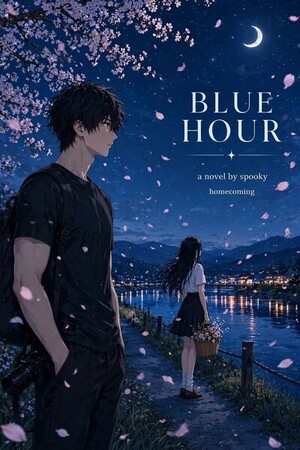
Blue hour
CHAPTER 5 — THE THINGS WE KEEP
Akito woke to the sound of a bird arguing with the world.
At least, that was what it sounded like.
The bird sat somewhere outside his window, repeating the same three notes with enough determination to suggest it had a personal problem with the morning.
Akito opened one eye.
The room was bright.
He closed it again.
The bird continued.
“I'm going to start charging you rent,” he muttered.
The bird, apparently unconcerned by the threat, sang louder.
Akito sat up.
His camera rested on the desk beside his notebook. The photograph was still there, turned facedown.
He looked at it for a moment.
Then he deliberately looked away.
Today, he had decided, would be different.
No examining strange photographs before breakfast. No searching the camera for images he couldn't remember taking. No staring at the sky until it did something impossible.
A normal day.
That was all he wanted.
He got dressed, picked up his camera, and went downstairs.
Hana was already in the kitchen.
“Good morning.”
“Morning.”
“Did you sleep well?”
“Better than yesterday.”
“That's good.”
She placed breakfast on the table.
Akito sat down, glanced at the food, and began eating.
For several minutes, the only sounds were chopsticks against bowls and the occasional bird outside.
Then Hana spoke.
“Miko said you went to Tsukasa's shop yesterday.”
Akito looked up.
“News travels quickly.”
“In a village like this? Faster than you can imagine.”
“Should I be concerned?”
“Only if you do something embarrassing.”
“Then I should be perfectly safe.”
Hana smiled.
He returned to his breakfast, hoping that would be the end of the conversation.
It wasn't.
“She also said you thanked her.”
Akito stopped chewing.
He slowly looked at his grandmother.
“Why is that news?”
“Because she sounded surprised.”
“I thanked her once.”
“Apparently, it was memorable.”
Akito sighed.
He was beginning to understand why his mother had sent him here without explaining how long he'd be staying.
It was a conspiracy.
A very quiet, very well-organized conspiracy.
---
By the time Akito stepped outside, the morning had warmed considerably.
The village was awake now. Shop shutters rattled open, bicycles passed along the road, and the smell of freshly cooked food drifted from somewhere nearby.
He took a photograph of the mountains.
Then one of the river.
Then one of a cat sitting on a wall.
The cat looked directly into the lens with an expression of deep disappointment.
“Don't judge me,” Akito told it.
The cat turned away.
He checked the photograph.
Good lighting. Sharp focus. A surprisingly expressive subject.
He saved it.
“Are you talking to cats again?”
Akito looked up.
Miko stood a few steps away, holding a paper bag in one hand and her usual tote bag in the other.
“I'm not talking to cats.”
“You were just having a conversation.”
“It was a disagreement.”
“With a cat?”
“It started it.”
Miko stared at him.
Then she laughed.
“You know what? I'm not even going to ask.”
“Good decision.”
She held up the paper bag.
“Want one?”
Akito looked inside.
Small pastries, still warm.
“What are they?”
“Sweet buns.”
“Where did you get them?”
“From the bakery.”
“I assumed you made them.”
Miko narrowed her eyes.
“Was that sarcasm?”
“Possibly.”
She handed him one.
“Try it before I change my mind.”
Akito took a bite.
The outside was lightly crisp, while the inside was soft and sweet.
He took another bite.
Miko watched him with a pleased expression.
“Well?”
“It's good.”
“Just good?”
“Very good.”
“Better.”
She took a bun for herself.
They started walking.
“Where are we going today?” Akito asked.
“Somewhere you haven't seen.”
“That's not very specific.”
“It's a surprise.”
“I don't like surprises.”
“Then it's fortunate that I do.”
Akito glanced at her.
She was smiling again.
He had the unpleasant feeling that he was going to spend most of his vacation losing arguments he hadn't agreed to participate in.
---
The road climbed gradually beyond the houses.
They passed a vegetable garden, a small wooden shed, and a fence covered in flowering vines. The houses grew farther apart until the village began to give way to fields and trees.
Miko walked ahead, occasionally turning to make sure he was following.
Akito was.
Mostly because he didn't know the way back.
He wasn't going to admit that.
“Do you come here often?” he asked.
“Sometimes.”
“For what?”
“Thinking.”
Akito glanced at her.
“You come all the way up here just to think?”
“Sometimes I come to do absolutely nothing.”
“Sounds productive.”
“You should try it.”
“I do.”
“No, you take pictures of things while doing nothing.”
“That's different.”
“How?”
He considered the question.
“I have a camera.”
Miko shook her head.
“Your logic is incredible.”
“Thank you.”
They continued up the hill.
Eventually, the trees opened onto a grassy slope overlooking the village.
Akito stopped.
Below them, the rooftops spread between patches of green. The river curved through the landscape, catching sunlight in long silver streaks. Beyond the houses, the mountains rose in layers, each one a little paler than the last.
A train line cut through the distant greenery.
From here, the railway looked almost delicate.
A thin line connecting one place to another.
Akito lifted his camera.
Click.
He adjusted his position.
Click.
Then he lowered it and looked at the view directly.
For once, the photograph could wait.
“It's beautiful,” he said.
Miko sat in the grass.
“I know.”
“You could at least pretend to be modest.”
“I've lived here long enough to know when something is beautiful.”
Akito sat a little distance away.
The grass was warm beneath his hands.
For several minutes, neither of them spoke.
A breeze passed over the hill, carrying the scent of leaves and distant flowers. Somewhere below, a dog barked. The sound reached them faintly, as though it belonged to another world.
Miko leaned back on her hands.
“When I was younger, I used to think the world ended at those mountains.”
Akito followed her gaze.
“And now?”
“Now I know there's more beyond them.”
“Very philosophical.”
“Thank you.”
“But I also know that you still come up here.”
She turned toward him.
“Maybe some places don't stop mattering just because you learn there's more to see.”
Akito looked at her.
For once, he couldn't find a sarcastic response.
Miko seemed satisfied with that.
She reached into her tote bag and pulled out a small notebook.
Its cover was worn at the edges, and several pressed flowers were tucked between the pages.
Akito glanced at it.
“What is that?”
“My notebook.”
“I gathered that.”
“Then why did you ask?”
“I didn't.”
“Good point.”
She opened it carefully.
Inside were sketches of flowers, little notes about the weather, and short descriptions of places around the village.
Some pages contained nothing but a few lines.
Others were filled with small drawings.
Akito leaned closer.
“You drew these?”
“Most of them.”
He studied a sketch of the river.
The lines were simple but expressive. The water had been captured with a few careful strokes, and the trees along the bank looked almost as though they were moving.
“You're good.”
Miko looked up.
The compliment seemed to surprise her.
“Really?”
“Would you prefer me to lie?”
“No. I'm just not used to people saying it.”
Akito looked at the notebook again.
“Why do you do it?”
“Draw?”
“Keep all this.”
She ran a finger along the edge of one page.
“I don't know. I guess I like remembering things.”
“Why not take photographs?”
“Because photographs remember what something looked like.”
She paused.
“A drawing can remember what it felt like.”
Akito said nothing.
He looked toward the village again.
The sunlight had shifted slightly, moving the shadows across the rooftops.
He thought about the photographs in his room.
The blue flower.
The girl beneath the strange sky.
The boy by the river.
He had taken hundreds of photographs because he wanted to keep things exactly as they were. He trusted the lens to preserve details he might otherwise forget.
But what if the things he wanted to remember weren't the things the camera could capture?
He wasn't sure he liked that question.
Miko closed her notebook.
“Your turn.”
“My turn for what?”
“Show me something you care about.”
Akito looked at his camera.
“It's a camera.”
“I can see that.”
“Then you've already seen it.”
Miko groaned.
“Do you ever make things easy?”
“Occasionally.”
“When?”
“When nobody asks questions.”
She laughed, but she didn't give up.
“Come on. There's got to be something.”
Akito considered the question.
He could show her his photographs.
But which ones?
The mountains? The river? The streets?
Or the pictures he kept hidden away, the ones he never showed anyone?
He reached for his camera and scrolled through the images.
A cat.
A bicycle.
A shop sign.
The railway station.
The village rooftops.
Then a photograph of Hana standing on the porch, feeding birds.
He paused.
Miko leaned closer.
“Your grandmother?”
“Yeah.”
“She looks happy.”
Akito studied the image.
Hana's face was turned slightly away from the camera, but her smile was clear. One hand held a small bowl of birdseed while a sparrow perched on the railing nearby.
He hadn't taken the photograph because he thought it was important.
He had taken it because the light was good.
At least, that was what he had told himself.
“It's a nice picture,” Miko said.
Akito locked the camera.
“It's ordinary.”
She looked at him.
“What's wrong with ordinary?”
He didn't answer.
Miko returned her notebook to her bag.
“Nothing,” she said. “Sometimes ordinary things are the ones you miss the most.”
The words settled between them.
Akito looked toward the village.
He wondered whether he would miss this place when he returned to the city.
He wondered whether he would miss the hill, the river, the shop, and the sound of Miko laughing at his terrible jokes.
He wondered why he was thinking about leaving when he had barely arrived.
He decided not to examine that, either.
---
They stayed on the hill until the sun began to move lower.
Miko showed him a few more sketches, including one of a small blue flower growing beside the railway fence.
Akito stared at it.
The shape was familiar.
Five delicate petals. A narrow stem. A slight bend toward the light.
He remembered crouching beside the flower on the day he arrived.
The world had gone quiet.
The light had changed.
For a moment, the flower had seemed to glow.
“Where did you see this?” he asked.
Miko looked at the page.
“Near the railway.”
“When?”
“Last year, I think.”
Akito's fingers tightened around the edge of the notebook.
“Last year?”
“Maybe earlier. I'm not sure.”
She looked at him.
“Why?”
He studied the drawing.
The flower was ordinary on paper. No strange light. No unusual colors. Just a flower beside a railway fence.
“Nothing,” he said.
Miko watched him for a moment.
Then she gently took the notebook back.
“You really do say that a lot.”
“It's a useful word.”
“It's an annoying word.”
“You've mentioned that, too.”
She smiled.
But Akito noticed that she didn't put the notebook away immediately.
Instead, she looked at the sketch for a little longer.
Almost as if she were trying to remember something.
Then she turned the page.
---
They returned to the village as the afternoon began to cool.
At the foot of the hill, Miko stopped beside a narrow path leading toward the river.
“I have to go this way.”
Akito nodded.
“See you later?”
“Maybe.”
She frowned.
“You've started doing that on purpose.”
“Doing what?”
“Giving vague answers.”
“Maybe.”
Miko pointed at him.
“That's exactly what I mean.”
He almost smiled.
She shook her head, then started down the path.
After a few steps, she stopped.
“Akito?”
He looked back.
“Yeah?”
“I'm glad you came here.”
For a moment, he didn't know what to say.
The words were simple.
There was no dramatic expression, no mysterious warning, no hidden meaning he could identify.
Just Miko standing on a quiet path, holding her bag of flowers.
He looked toward the village.
Then back at her.
“Me too,” he said.
This time, the words came more easily.
Miko smiled.
Then she turned and disappeared between the trees.
Akito remained where he was for a moment.
The afternoon breeze moved through the grass.
He could hear the river nearby.
Somewhere in the distance, a train sounded its horn.
He looked toward the railway.
The sky was still blue.
Ordinary.
He raised his camera.
Then, after a moment, lowered it without taking a picture.
Some things, he thought, could wait.
---
That evening, Akito sat on the porch outside Hana's house.
The air smelled of damp soil and leaves. The last of the sunlight rested on the rooftops, and the mountains had begun to fade into the distance.
Hana sat nearby, sorting through a basket of laundry.
“You seem quieter today,” she said.
“I'm always quiet.”
“Not like this.”
Akito looked at her.
She continued folding a shirt.
“Did something happen?”
He thought about the hill.
Miko's notebook.
The blue flower.
The photograph of Hana feeding the birds.
“Nothing bad.”
Hana paused.
“That's good.”
He leaned back against the wooden post.
For a while, they listened to the sounds of the evening.
Then Akito spoke.
“Grandma?”
“Hm?”
“Did I ever keep a notebook when I was little?”
Hana looked up.
“Why do you ask?”
“Just curious.”
She studied him for a moment.
“You used to collect all sorts of things. Leaves, stones, little drawings. You'd put them in boxes and forget where you left them.”
Akito frowned.
“I don't remember that.”
“You were young.”
“Did I come here often?”
The question lingered in the air.
Hana folded the shirt in her hands.
“Sometimes.”
Akito waited.
She didn't say anything else.
“Grandma.”
“Yes?”
“Why does everyone act like I should remember things I don't remember?”
Hana's expression changed.
Not dramatically.
Just enough for him to notice.
“Because sometimes,” she said quietly, “people remember different parts of the same thing.”
Akito looked at her.
“What does that mean?”
Hana placed the folded shirt into the basket.
“It means you should finish your homework before dinner.”
“I don't have homework.”
“Then you have no excuse.”
He stared at her.
She smiled.
The conversation was over.
At least, for now.
Akito looked toward the mountains.
The sky was slowly darkening, but nothing unusual happened. No strange silence. No impossible light. No figure waiting beside the trees.
Just evening.
He found himself grateful for it.
---
Later, in his room, Akito opened his notebook.
He wrote down the date.
Then he wrote a few lines about the village.
The hill.
The view of the river.
Miko's sketches.
The blue flower.
He stopped there.
For a moment, he considered taking out the photograph from the previous night.
He could examine it again. Search for details he had missed. Try to understand why the boy looked like him, or why the words on the back seemed to know what was coming.
Instead, he closed the notebook.
The photograph remained where he had left it.
Tomorrow, he told himself.
He would think about it tomorrow.
Outside, the wind moved gently through the trees.
Somewhere beyond the village, a train passed along the railway line.
Akito listened until the sound disappeared.
Then he turned off the light.
For the first time since arriving, he fell asleep without looking at the photograph.
He didn't know whether that meant he was beginning to forget.
Or whether, for one ordinary day, he had simply found something else worth remembering.
To be continue




Please sign in to leave a comment.