Chapter 6:
That's Cheating
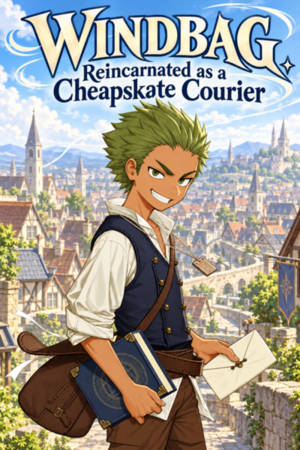
Windbag: Reincarnated as a Cheapskate Courier
"I need to return a basket out past the old mill," Mara said. "End of the week. You can come."
"Is it a job?"
"It's a basket."
"Does it pay?"
"It pays in me not leaving you home with your father and a stack of handwriting drills."
That was a fair rate. I took it.
The two days before that were Dad's consequences, and I'll go through them quickly, because they were exactly as fun as they sound.
Day one was aiming. A prepared spell comes out whichever way the page is facing, so the trick is to aim the book the way you'd aim a flashlight. Dad held a paper wheel over his head, walked laps around the kitchen table, and said "Now" whenever he felt like it. I had to turn in my chair and point the book at the wheel before he got any farther.
Day two was the word "only." I'd expected a short lecture. What I got was the whole morning: the court rule for apprentices, and then why it existed. It involved a library, a curtain, and a young man whose name Dad wouldn't say, because "his family still lives in the capital."
"What if there's a fire?"
"Then she will say."
"What if--"
"Xavier. The word is 'only.' It has no 'what if.' That's the entire virtue of the word."
It stuck for about a day.
◇◇◇
On the morning of the basket, I did my circuit ten times and charged the book. Dad held the page up to the window and checked the binding.
"One charge."
"One charge."
"And?"
"Only," I said.
He looked at me a second longer than he needed to. Then he gave the book back.
The lane to the mill had hedges thick enough to hide a cow, and at one point one did.
The lane ended at a house with yellow shutters, the bright kind that had been painted that spring and wanted you to know it. A woman sat on the porch with a lap full of mending. She had dark hair tied back with a strip of cloth and freckles all over her face, and she looked up at us with the expression of a customs officer.
"Finally brought it back?"
"You told me to keep it until I came this way!"
"And did you fill it first?"
Mara lifted the cloth off the basket. Inside was the cake from my birthday, or its cousin, and a jar of honey.
The woman put her sewing down.
"Honey," she said. "Honey's cheating."
"There's no rule against honey!"
"It's a basket, Mara, not a war."
"You sent it back last time with plum jam and a pie!"
"The pie was small."
"The pie had a damn lattice!"
It was the least efficient trade route I'd ever seen, an arms race conducted in cake.
I respected it enormously.
The woman was Wenna. She held the honey up to the light like she was checking it for counterfeits. Then she leaned down to look at me.
"You must be Xavier."
"Yes, ma'am."
I can be polite. I just don't waste it.
"Tomas is at the stream. Go on. He'll be glad of the company. He's been talking to his boats."
I didn't move.
Mara's hand landed on my head and turned it gently toward the stream, the way you'd aim a book.
In the shows, this is where the reincarnated guy meets his first friend. It's usually a cute girl getting picked on, and he saves her, and she follows him around for the rest of the series.
I got Tomas.
He was crouched on the bank of the stream at the bottom of the yard, by a narrow footbridge, with his sleeves rolled to the shoulder. As I came down the yard, a paper boat shot out from under the bridge, and he caught it against a stone with one hand, like he'd done it a thousand times. He had messy brown hair and a muddy knee, and a crease between his eyebrows that belonged on a forty-year-old engineer.
"Don't step there," he said, without looking up.
I stopped with one foot in the air. Under it, in the grass, sat a second boat.
"Bold place to park it."
"It wasn't there when I started."
"Where was it?"
"In the water. Then it got out."
He moved it to a flat stone. Then he looked up, and the crease went away. "You're the one who tried to sell Renn his own job."
"I offered him a service."
"Bors said you were six."
"Bors can't count."
"I'm eight." He said it like he'd personally built the extra year.
"Congratulations."
Beside him on the stone was a row of torn paper scraps covered in tiny numbers.
"Times," he said, before I could ask. He pointed at a flat rock maybe fifteen steps downstream, where the water split around it. "From the bridge to there. I count."
He'd been keeping data on paper boats. I counted things too. It was different when I did it.
He gave me a boat. It had one side higher than the other and a leaf for a sail that was already going brown.
"This one floats."
"Does it go anywhere?"
"Sometimes."
That was the most honest product description I'd heard in either life.
He laid a stick across the water and held both boats behind it so they'd start even. Then he moved mine back a finger's width, because the point was over.
"It's a damn paper boat."
"The point was over."
He lifted the stick. His boat went straight down the middle. Mine turned left, as if it had somewhere better to be, and parked itself in the reeds.
"Mine won," Tomas said from the flat rock.
"Mine took the scenic route."
He laughed. It was a big honking laugh, way too big for him, the kind that makes other people laugh just from hearing it. I didn't. I pointed at the reeds.
"Go get it."
He went and got it. He was happy to.
We raced four more times, and I lost four more times.
"This boat is shit."
Tomas blinked at me. "It floats."
So I did what I'd have done back home. I tried to buy the competition.
"I'll buy that one off you." I pointed at his.
"It's not for sale."
"Everything's for sale."
"Not that."
He didn't even ask how much.
I raised the stakes instead.
"Let's make it interesting."
"It's already interesting."
"Interesting with money."
Tomas sat back on his heels. "I don't have money."
"Nobody has money. Do you have access to money?"
He thought about it, very seriously, with the crease. "I've got two copper. From my birthday. I'm saving for a knife."
"Put one up."
He dug in his pocket and put a copper on the flat stone, just like that. You're supposed to think about it.
I put mine next to it. My only copper. The king with the scratched nose looked up at the sky like he couldn't believe what I was doing to him.
"Winner takes both."
We shook on it. His hand was wet.
I had a charged breeze in my book.
I thought about it for maybe three seconds.
First: it was a boat on a stream. Nothing there could catch fire. There was no shop and nobody carrying eggs.
Second: if I asked Mara, she'd say "keep it dry" and "from the bank," and she'd probably say yes. Then Tomas would know, and it wouldn't count.
Third: there were two coppers on that stone, and one of them was mine.
I looked up at the porch. Mara and Wenna were back on the pie, with their backs to the yard.
I didn't think about the word "only."
That's not true. I thought about it, and I decided it applied to shops.
While Tomas lined up the points, I slid the satchel onto my lap and undid the clasp under the flap, where he couldn't see. The book fell open to the right page, because it was the only page with anything on it. I tilted it until the page pointed straight at my little brown leaf.
I'd learned.
He lifted the stick. I touched the key.
The breeze came out of my lap so smoothly I barely felt it go. My leaf filled out, and my lopsided boat, which had never gone anywhere on purpose in its life, shot forward. It passed his before the halfway stone. Tomas made a noise like a stepped-on goose.
My boat hit the flat rock first, bounced off it, and spun around in triumph.
"Pay up!"
Tomas got to the coins first and put his whole hand flat over both of them. "That's cheating."
"You never said no magic."
"It's a boat race!"
"And my boat got there."
"The wind came out of your bag!"
"The wind came out of my book. The book was in the bag. Those are different."
He opened his mouth and closed it again. He was the kind of kid who has to find the exact flaw in an argument before he'll admit it's wrong, and he couldn't find the flaw in mine, because it was made entirely of flaws.
"There weren't any rules about magic."
"There weren't any rules about anything!"
"Exactly. So I won."
He kept his hand on the coins, and I kept reaching.
He took both coppers off the stone and put them in his shoe, where neither of us could get at them. Then he fished the boats out with his stick and set his own down in front of me.
"Do mine."
"What happened to cheating?"
"We're not racing now. It's a test."
"Tests cost a copper."
"You want to show me."
I did. I hated that he knew.
The page was dark. I had one charge left for the day under Dad's rule, so I sat in the grass with the book across my knees.
Pale yellow light followed my finger along the channels. The binding pushed back the way it always did, and I held it shut until the key lit up, last of all.
"You filled it," he said, very quietly, like we were in church. Then he pointed at the lines. "How do you know which way it goes?"
"My dad taught me."
"No, but--" He held a dirty finger just above the page and moved it along the line. "How do you know it goes that way? And not that way?"
I opened my mouth to say Dad had taught me that too, and shut it again. Dad had taught me the names and the order. Which way it went, I'd known since the first time I ever saw a diagram, lying in a stranger's arms in a room I didn't recognize.
"It just goes that way. The lines lean."
Tomas stared at the page for a long time, his whole face screwed up.
"They don't lean. They're just lines."
"You're not looking right."
"I'm looking right." He sat back. "That's not fair."
"Probably not."
So much for not telling anybody what you've got until you know what it's worth.
We set his boat behind the stick, and I touched the key. It went fast. Then it went sideways. Tomas ran along the bank beside it, yelling, "Look at it! LOOK AT IT!" until the current turned the hull, the sail took the last of the wind side-on, and the whole thing rolled over and floated there belly-up.
"Oh, come on," Tomas told the boat, with real betrayal.
The hull sagged across his palm, soaked through. He poked a finger through the bottom. The hole got bigger.
"Too much sail and not enough bottom." He was already pulling the leaf off. "Two sheets. Two sheets, pressed flat."
We spent the next hour building boats. Tomas folded. I found a good rock to sit on and told him what he was doing wrong. Back home, that's called management.
The fourth one was two sheets thick, pressed flat with the back of a spoon he'd stolen from the kitchen, and it sat in the water like it meant to be there.
He held it up. "Real race. No wind. You take this one, and I'll take the old one. Then it's fair."
I could make a breeze by hand without the words on most days, and he'd be watching the boats, not me.
"Double or nothing. If I win, you owe me three copper and that boat."
"I've only got two copper."
"Then you'd better win."
He chewed on that. "If I win, you owe me a knife."
I didn't have a knife, or the money for one. I had a plan.
"Deal."
He set the old lopsided boat in the fast water by the far bank. I put mine in the middle, where his had won all afternoon.
"And sit on your hands."
"What?"
"You cheat."
I sat on my hands. He'd known me for one afternoon.
He lifted the stick. Mine went straight and steady, the way a good boat should. His wobbled, found the fast water, and stayed in it, and it hit the flat rock first by about the width of a fingernail.
"I WON."
"Your point was over the stick."
"It was NOT!"
"It was a tie anyway."
"By this much!" He held up his finger and thumb, barely apart.
"That's a tie. Margin of error."
"What's a margin of error?"
"It's when you win by so little that it doesn't count."
He thought about it. "That's made up."
"Everything's made up. Somebody made up boats."
He laughed his enormous honking laugh, so hard he had to sit down in the grass. I didn't laugh. I lay down next to him, but that was because my hands had gone numb.
I'd been seventeen when I went to sleep in my old room. By the birthday math I was twenty-four, and I was lying in the grass arguing with an eight-year-old about whether a paper boat had won.
It was the most annoying afternoon of either life. I didn't think about the phone number once.
Somewhere in there he took the coppers out of his shoe and gave me mine back. Neither of us thought that settled anything.
"Boys!"
Wenna stood at the end of the porch with a plate and didn't let us near it until we'd washed our hands. Mara was on her second slice.
Tomas started talking before he'd finished his first bite.
"And the wind came out of his bag," he finished.
"Out of my book," I said.
"Which was in his bag."
Mara put her slice down.
"You bet?" said Wenna.
"He started it, ma'am."
"No, you did."
"He does that," Mara said.
"And he talks different to you," Tomas told his mother.
"Different how?"
"He says shit."
"TOMAS."
Mara looked at me. "Language."
Then she turned to Tomas, pleasantly. "How many times did the wind come out of his book?"
"Twice. The cheating one and the test one."
"Twice," said Mara, and picked her cake back up.
When it was time to go, Tomas walked us to the lane. He'd saved the two-sheet boat, still a little damp, and he held it out to me with both hands.
"Take that one."
It was the best boat either of us had made, and he'd made it.
"How much?"
He frowned at me. "It's yours."
"Nothing's free."
"This is," he said, like it was obvious, and pushed it into my hands.
We'd only just met, and he'd handed me something that good for nothing. I stood there holding it and waited for the catch.
"Bring it back. So I can beat it." He turned to Mara. "Can he come tomorrow?"
"After his lessons."
"How long are his lessons?"
"Long," I said.
Wenna called him back for the cups. He ran up the path, turned around halfway, and yelled, "AND YOU OWE ME A KNIFE!"
"YOU OWE ME THREE COPPER AND A BOAT!"
I carried the boat home in both hands.
Halfway up the lane, Mara said, "You didn't ask me."
"It was a boat."
"Mm."
Dad opened the door before we got to it. He took in the boat in my hands first, and then Mara.
She shook her head very slightly. Not now.
"He made a friend," said Mara. "The miller's boy."
Dad looked at the boat again, the way he looked at a page when the binding was drawn well.
After dinner I put the boat on my windowsill, next to the paper wheel, and did the books on a sheet of practice paper.
Tomas owes me: 3 copper and a boat
Mara owes me: 2 copper
I owe Tomas: nothing (he says a knife)
I couldn't work out which side the boat on the windowsill went on.
Through the wall, Mara and Dad were talking quietly.
◇◇◇
Mara walked me down the lane after lunch. I carried the two-sheet boat in both hands again. I tried her on the weather, and on the beans, and she answered both, very politely, like I was company. She didn't say "Mm," either. By the time we passed the mill I'd started to miss it.
"Are we okay?"
"Go race."
Wenna was on the porch with the empty basket in her lap, frowning into it.
"I'm still thinking."
"Think faster," said Mara, and joined her on the porch.
Tomas was waiting at the bottom of the yard with a new boat.
"Bet the boat."
"No."
"Winner keeps both."
"It's not for sale."
"Everything's for sale," said Tomas. The smartass had been saving that one.
"Not that."
He grinned at me. I lifted the boat out of his reach.
"Then double or nothing on the rest."
"Deal," we said, at the same time.
He eyed my satchel.
"I'm going to ask."
"Ask what?"
"If I can use it."
He frowned. Asking was new. He didn't know where to put it.
Mara and Wenna were on the porch with their tea. Neither of them had their backs to the yard this time. I walked all the way up to do it properly.
"Can I use the book? For the race."
Mara watched me over her cup. "No."
"I asked, though."
"You did."
"I'd like it noted that I asked."
"Noted!" said Wenna.
I headed back down the yard. Asking hadn't cost me a thing, and it was going to look great later.
"What'd she say?"
"No."
Tomas reached for the satchel. I gave it to him. He set it on the grass, sat on it, and laid the stick across the water.
"SIX COPPER AND TWO BOATS!"
I held out my hand. Tomas studied his boat, turning slowly in the eddy by the rock, and showed me his finger and thumb, barely apart.
"By this much."
"That's a win."
"Margin of error."
I opened my mouth and shut it again.
"That's made up."
He laughed so hard he fell off the satchel sideways into the grass, and I took the satchel back while he was down there.
We raced all afternoon.
By my math, the ledger now stood at six copper and two boats in my favor. By his, the first race didn't count, and I owed him two knives with bone handles.
Mara came down for me late in the afternoon.
On the way home I told her about the race, from the start.
"I saw," she said.
We were past the mill before she said anything else. "Xavier." She said it quietly, the way she had in the bookshop. "At the stream yesterday, you didn't ask me."
"No."
"Today you asked."
"Yes." I walked a little taller. This was the part where the asking paid off.
"You asked today because you knew I'd say no."
I'd been ready for a lot of things, and that wasn't one of them.
"And yesterday you didn't ask," she said, "because you knew I'd say yes."
I went looking for a loophole in that. I spent the rest of the lane on it. There wasn't one.
"I'd have said yes," she said. "And I'd have watched."
She looked back down the lane, toward the yellow shutters. "Instead I was eating pie."
◇◇◇
In the morning Dad held my page up to the window and didn't give the book back. I could tell he was picking a number, because I was picking one too.
"One charge a day," he said. "Into the book. Nothing by hand."
"What about the shelves?"
"Not even for the shelves."
"For how long?"
"Until I say otherwise."
He'd said that about the two charges, too. I'd thought it meant the number could only go up.
I didn't haggle. He was still holding my book.
"I'm going to Tomas's today," I said.
"If you ask," said Mara, from the stove.







Please sign in to leave a comment.