Chapter 12:
A day that felt familiar
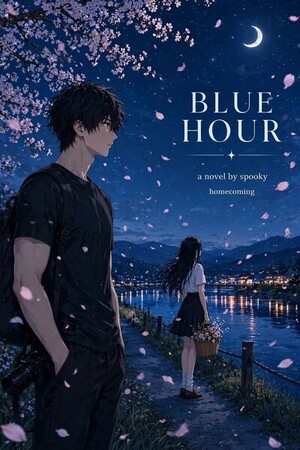
Blue hour
Blue Hour
Chapter 12 — A Day That Felt Familiar
Arc 2: Homecoming
1. An Ordinary Morning
“Why does Monday exist?”
Akito Kazama stared at his alarm clock as though it had personally ruined his life.
The clock continued displaying the time.
“Don't look at me like that. You're the reason I'm suffering.”
He reached over, switched off the alarm, and sat up.
Morning sunlight entered through the curtains of his apartment. His camera rested on the desk beside a half-finished cup of coffee, a notebook filled with photography ideas, and several memory cards arranged in a small box.
Akito rubbed his eyes.
He had planned to wake up early, take photographs, finish editing yesterday's work, and prepare breakfast.
Instead, he had spent the first five minutes of his morning arguing with an alarm clock.
A promising beginning.
He stood, stretched his arms, and glanced at the calendar.
Another ordinary day.
He liked ordinary days. They gave him time to practise photography, work on his assignments, and occasionally visit places that caught his attention.
There was only one problem.
He had run out of coffee.
Akito stared at the empty cup.
“Now that's a real tragedy.”
Ten minutes later, he was outside with his camera hanging from his shoulder and enough money in his pocket for breakfast.
The morning was bright. Cars moved along the road, shopkeepers raised their shutters, and students hurried towards their schools.
Akito stopped beside a small flower shop.
A yellow flower had grown between two cracks in the pavement.
He crouched, adjusted his camera, and took a photograph.
CLICK.
He checked the result.
The flower looked small against the surrounding concrete, but sunlight had illuminated its petals beautifully.
Akito smiled.
“Not bad. You've got potential.”
A passerby glanced at him.
“Are you talking to a flower?”
“No. I'm giving professional feedback.”
The passerby continued walking, probably deciding that asking another question would only make things worse.
Akito stood up and continued towards the café.
His day had officially begun.
And, for reasons he couldn't explain, the morning felt unusually pleasant.
Perhaps it was the weather.
Perhaps it was the photograph.
Or perhaps he simply needed coffee.
He decided to blame the coffee.
It was the most reasonable explanation.
2. The Girl at the Counter
“Welcome! What would you like?”
Miko Aizawa looked up from the counter as a customer entered the small café.
“An iced coffee, please.”
“Coming right up!”
She prepared the order, placed the cup on the counter, and accepted the payment.
“Thank you. Have a nice day!”
The customer left.
Miko turned towards her coworker.
“How many more hours?”
“Three.”
Miko slowly placed both hands on the counter.
“Three?”
“Yes.”
“Are you absolutely certain?”
“I checked the clock twice.”
Miko looked towards the ceiling.
“Wonderful. I shall grow old here.”
Her coworker laughed.
“You said the same thing yesterday.”
“And I meant it yesterday, too.”
Miko had grown accustomed to her part-time job. She knew which customers preferred quiet service, which ones asked too many questions, and which ones needed three minutes to decide between two nearly identical drinks.
She was learning to manage her time and handle responsibilities without complaining quite as much.
Quite as much.
Her phone vibrated inside her bag.
She checked it during her break.
ALISA: Emergency.
MIKO: What happened?
ALISA: I have an assignment.
MIKO: That's not an emergency.
ALISA: It is when I have absolutely no intention of doing it.
MIKO: You're attending university. What did you expect?
ALISA: Education without the educational part.
Miko laughed.
MIKO: Good luck.
ALISA: You're supposed to support me.
MIKO: I support your right to suffer.
ALISA: Our friendship is a crime.
Miko put the phone away, still smiling.
Then she noticed a photograph displayed beside the café's entrance.
It showed the town during early spring. Pale flowers lined the road, and sunlight fell across the rooftops.
She had seen the picture many times before.
Yet today, she found herself studying the distant railway crossing in the background.
Something about the view felt familiar.
She couldn't identify what it was.
“Miko?”
Her coworker called from the kitchen.
“Could you help me with these orders?”
“Coming!”
She turned away from the photograph and returned to work.
There was no point standing around analysing a picture when customers were waiting.
Besides, she had a perfectly good reason to think about something else.
She was hungry.
3. A Photograph of the Town
By noon, Akito had taken forty-seven photographs.
Forty-seven.
He considered that a respectable number, although he had deleted twelve of them already.
He sat on a bench near a small park, reviewing the remaining pictures on his camera.
Buildings.
Trees.
A bicycle leaning against a wall.
A child chasing a ball.
A shopkeeper arranging flowers outside his store.
Nothing extraordinary.
And yet, Akito liked these photographs more than some of the impressive landscapes he had captured recently.
They felt alive.
He opened his notebook and wrote:
Beautiful things don't always need to be rare.
He looked at the sentence.
Then he added another line.
Sometimes, noticing them is enough.
Akito nodded with satisfaction.
“That's pretty good.”
A dog barked nearby.
He looked up.
A small brown dog was staring at the sandwich in his hand.
Akito stared back.
“No.”
The dog tilted its head.
“I know that expression. It won't work.”
The dog moved closer.
Akito moved the sandwich farther away.
“Listen, my friend. We all have financial problems.”
The dog barked.
“Exactly. You're not getting my lunch.”
A woman called the dog over, apologised, and walked away with it.
Akito watched them leave.
Then he looked at his sandwich.
“Congratulations. You've survived.”
He took a bite.
His phone vibrated.
It was a message from his mother.
REINA: Are you coming home for dinner?
AKITO: Depends. What's for dinner?
REINA: Food.
AKITO: Very informative.
REINA: Then make your own.
AKITO: I'll be home at seven.
REINA: I knew you'd make the right decision.
Akito laughed and put his phone away.
He packed his camera, stood up, and looked towards the far end of the park.
A narrow road led between the buildings. Beyond it stood a railway crossing, partially hidden by trees.
For a moment, he considered walking that way.
He didn't know why.
The road wasn't particularly interesting, and he had already taken enough photographs for the day.
Still, he found himself looking at it longer than necessary.
Then his phone vibrated again.
ALISA: Akito would probably have finished my assignment by now.
Akito blinked.
He read the message twice.
Alisa.
He hadn't heard from her directly in a long time.
He opened the conversation and typed a reply.
AKITO: Then why aren't you asking him?
He stared at the words.
His thumb hovered above the screen.
After a moment, he deleted the message without sending it.
He didn't know whether Alisa was still using the same number. He didn't know what she was doing these days, either.
He hadn't spoken to her in years.
Akito locked his phone and placed it inside his pocket.
“Right. Lunch first.”
He turned towards the café district.
The railway crossing could wait.
4. Two Friends and One Terrible Idea
“I'm going to fail.”
Alisa Toaka dropped her notebook onto the café table.
Miko sat opposite her, carefully moving her drink away from the notebook's landing zone.
“You haven't even submitted the assignment.”
“That's why I'm going to fail.”
“You could finish it.”
Alisa looked genuinely offended.
“Why would you suggest something so unreasonable?”
Miko laughed.
They had met after Miko's shift, and Alisa had arrived carrying enough books to convince everyone that she was preparing for an examination of national importance.
Unfortunately, most of the books remained closed.
Alisa stirred her drink.
“How was work?”
“Busy.”
“Any interesting customers?”
“One man asked me whether our iced coffee was cold.”
Alisa stopped stirring.
“Was it?”
“Alisa.”
“I'm asking a serious question.”
Miko shook her head, laughing.
For a while, they discussed university, work, and the usual collection of minor problems that seemed enormous when experienced on an empty stomach.
Then Alisa glanced towards the window.
“It's a beautiful day.”
Miko followed her gaze.
The afternoon sky was clear, and the sunlight had softened into a warm golden colour.
“Yeah,” Miko replied.
Alisa rested her chin on her hand.
“We should go somewhere.”
“Where?”
“Anywhere.”
“That's not a destination.”
“Then let's find one.”
Miko considered the idea.
She had no plans for the evening, and the weather was too pleasant to spend the entire afternoon indoors.
“Fine. But you choose the place.”
Alisa immediately stood up.
“Excellent.”
Miko gathered her things.
“Where are we going?”
Alisa smiled.
“I have absolutely no idea.”
Miko stared at her.
“You're unbelievable.”
“Thank you.”
“That wasn't a compliment.”
“I accept it anyway.”
They left the café and began walking through the town.
Neither of them had a particular destination in mind.
Sometimes, that was the nicest way to spend an afternoon.
5. The Road Beside the Railway
Akito had finished his work earlier than expected.
His photographs were organised, his assignments were complete, and his camera battery was charging at home.
He should have been satisfied.
Instead, he found himself standing near the railway crossing he had noticed earlier.
A train passed in the distance.
The warning bell rang, and the barriers lowered.
Akito took a photograph of the tracks.
CLICK.
He checked the screen.
The composition was simple, but the lines of the railway disappeared beautifully into the distance.
He took another picture.
Then another.
When the barriers lifted, he crossed the road and continued towards the nearby shopping street.
He was thinking about dinner when he noticed two women walking towards him.
One had lavender hair.
The other wore a red ribbon.
Akito slowed down.
Not because he recognised them.
He didn't.
He simply noticed that the woman with the red ribbon was laughing at something her companion had said.
There was something familiar about the sound.
A strange, fleeting impression.
He stopped walking for half a second.
The woman glanced in his direction.
Their eyes met.
Akito looked away first, feeling slightly ridiculous.
He didn't know her.
There was no reason to stare.
He adjusted his camera strap and continued walking.
Behind him, Miko slowed down.
Alisa took two more steps before noticing.
“What happened?”
Miko looked towards the man disappearing into the crowd.
“Nothing.”
Alisa followed her gaze.
“Someone you know?”
“No.”
“Then why are you looking at him?”
Miko hesitated.
“I don't know.”
Alisa studied her for a moment, then shrugged.
“Maybe he owes you money.”
Miko looked at her.
“Why would you think that?”
“It's the only explanation I can think of.”
“You need help.”
“I need better grades. Help is optional.”
Miko laughed and followed her friend.
The man had already disappeared around the corner.
Neither of them knew his name.
Neither of them knew how close they had come to something that would change their ordinary lives.
For now, they were simply two people who had crossed paths on a busy afternoon.
Nothing more.
6. Dinner at Home
“You're late.”
Akito entered the house and found Reina standing near the dining table.
He checked the clock.
“It's seven-oh-three.”
“Exactly.”
“Three minutes?”
“Three very important minutes.”
Akito removed his shoes.
“I'm sorry. I'll make sure to inform the government before my next arrival.”
Reina gave him a look.
“Wash your hands.”
“Yes, ma'am.”
“And put your camera away before dinner.”
“Yes, ma'am.”
“And stop calling me ma'am.”
Akito paused.
“Would 'Your Majesty' be acceptable?”
“Akito.”
“Understood.”
He hurried towards the washroom before she could find another task for him.
Dinner was simple: rice, vegetables, soup, and a dish Reina had prepared that morning.
Akito ate quietly for a few minutes.
Then Reina looked at him.
“How was your day?”
“Good.”
“Just good?”
“I took some nice photographs.”
“Anything interesting?”
Akito considered telling her about the railway crossing.
He decided against it.
“Not really. Just ordinary things.”
Reina smiled faintly.
“Ordinary things can be interesting.”
He looked at her.
“That sounds suspiciously like something I'd write in my notebook.”
“Perhaps you inherited something from me.”
“Hopefully not your habit of making me wash dishes.”
“You inherited that from your father.”
Akito nearly choked on his rice.
Reina laughed.
For a moment, the conversation drifted towards his work, his photography, and whether he was getting enough sleep.
He answered each question with his usual mixture of honesty and unnecessary commentary.
Yet Reina noticed something.
Every so often, Akito's attention wandered.
He would pause in the middle of a sentence, glance towards the window, and return to the conversation a moment later.
It wasn't dramatic.
It was barely noticeable.
But she had known her son for twenty-two years.
She could tell when something occupied his thoughts.
“Akito?”
He looked up.
“Hmm?”
“Is something bothering you?”
He blinked.
“No. Why?”
“You've been distracted today.”
Akito considered the question.
“I think I need a holiday.”
“You took three days off last month.”
“Those were working holidays.”
“You spent one entire afternoon photographing clouds.”
“Exactly. Very demanding.”
Reina shook her head.
“Finish your dinner.”
Akito smiled and returned to his meal.
She didn't question him further.
But she remembered the look on his face.
7. The Evening Sky
Later that night, Akito stood beside his apartment window.
The city lights stretched across the distance, and the sky had turned a deep shade of blue.
He held his camera in both hands.
He had taken hundreds of photographs of the sky over the years.
Sunrises.
Sunsets.
Clouds gathering before rain.
The last light slipping behind distant buildings.
Yet he never seemed to grow tired of it.
He raised the camera.
Then paused.
For some reason, he remembered the girl with the red ribbon.
Not her face clearly.
Not her name.
Just the brief moment when their eyes had met near the railway crossing.
It was a ridiculous thing to remember.
He had passed thousands of people throughout his life. Why should one stranger remain in his thoughts?
Akito lowered the camera.
“Maybe I'm getting weird.”
He opened his notebook and searched for a blank page.
Then he wrote:
Today, I saw someone who felt familiar.
He stared at the sentence.
After a moment, he added:
I don't know why.
He closed the notebook.
There was no reason to investigate every passing thought.
Tomorrow, he would wake up, take photographs, complete his work, and probably argue with his alarm clock again.
Life would continue.
And that was enough.
Akito placed his camera on the desk and turned off the light.
Outside, the city remained awake beneath the evening sky.
Somewhere across town, Miko stood beside her own window, looking at the same shade of blue.
She had no reason to think about the stranger from the afternoon.
Yet when she closed her eyes, she remembered his camera.
The way he had held it.
The way he had looked at the railway tracks as though there were something worth discovering in every ordinary detail.
She smiled faintly.
“Strange guy.”
Then she drew the curtains and went to bed.
Tomorrow would bring work, messages from Alisa, and another collection of ordinary problems.
Neither Akito nor Miko knew what the coming days would bring.
For now, the city slept beneath a peaceful sky.
And somewhere between the last light of evening and the approaching night, two lives that had travelled separately for years had begun moving towards the same place.
Neither of them knew it yet.
But their story was changing.
Quietly.
One ordinary day at a time.







Please sign in to leave a comment.