Chapter 1:
Part I — Chapter One: Ashes in the Kettle
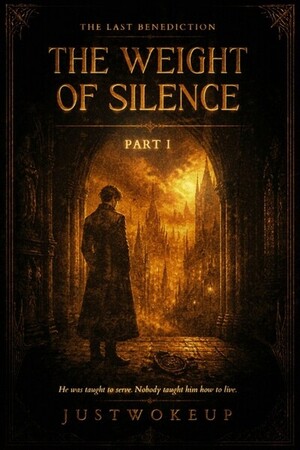
The Weight of Silence
There was a quarter of an hour before the first bell that belonged to no one.
The Order had annexed the rest of the day with great thoroughness. It owned the hours and the halves of hours, the syllables of every prayer, the length of every candle, the turning of every stair. But this one small parcel of the night had gone unregistered, through oversight or indifference, and Cassian Severin had been using it for years the way a man uses a coat he has not paid for: carefully, and with gratitude.
He woke before it began. Fourteen years of bells had trained the waking out of him entirely; he surfaced from sleep the way the house surfaced from night, silently and all at once. He lay still for the space of ten heartbeats and listened to the building. Wind at the shutters. The long complaint of the north wing's timbers as the cold leaned on them. Somewhere below, a bucket set down on stone, and a man coughing who was probably Hake, who swept the yard before anyone could see how much of it he did leaning on the broom.
His cell was narrow and the bed was narrower, and the floor in November was a religious experience. He dressed in the dark without error. No one had ever asked him to learn that; it was simply what became of a boy corrected for fumbling at seven, and again at eight, until the correction went in and never came out.
The stair down to the scullery was stone, worn into shallow bowls by two hundred years of feet, and the wear was not even. Every man favored his right foot going down and his left coming up, and so the stair recorded, in its small way, the private habit of generations. Cassian had read deeper arguments in less. He went down it without noise. That was not stealth, and it was not pride; quiet walking had been taught to him alongside letters, and he had proved the better at it.
The kitchen held its banked fire like a secret it was bad at keeping. He fed it two splits of kindling, no more. He knew precisely what the fire needed, and precisely what the cook would notice, and the space between those two quantities was where a good deal of his life was conducted.
He took the water from the stone jar, cold and tasting faintly of the jar, and set the kettle on its trivet over the rebuilt coals. Then he took down the brown pot, the chipped one, its glaze worn to the bare clay at the lip, and warmed it with a first measure of the water, swirled and emptied, so the leaves would not be shocked into silence. A spoon and a half, leveled with the spoon's own edge. The tin was small and dented and smelled of smoke and of summer, which was as close to a garden as his life had so far come.
The leaves were lawful. That is, they were entered in the dispensary book against his name in his own hand, a half-ounce at a time, and the Order's idea of luxury was so austere that no one had ever thought to forbid the entry. Everything in this house was written down somewhere. He had signed for the leaves as he had signed for everything else, and thought nothing of it. Then.
He took the kettle off at the murmur, before the shout. Water that has been bullied makes bitter tea; Brother Matthias had said that once, in the only lesson Cassian had ever heard him give on the subject of food, and then went back to correcting his Latin. He let the leaves steep the length of a psalm. A Miserere, said slowly, was very nearly four minutes.
He drank standing at the yard door, which stood open a hand's width to the cold. Beyond the wall the valley lay in fog, stitched with the lights of the farm grange, and far off, where two rivers met, the smear of the city's smoke against the low cloud: a world he had read about, priced, mapped, and never entered. For the length of the cup he thought about none of it. He was aware of warmth, of bitterness, of the pot's small good weight in his hand, and of the frost making its lace on the doorstep in a pattern no one had instructed it to follow. He had no theory about any of this. It was the one thing he did each day for which no reason had ever been issued, and none had ever been demanded.
The Waking Bell went at half past five, three strokes and a pause and three again, and the house turned over in its sleep like a ship. Cassian rinsed the pot and the kettle, banked the fire to the exact measure he had found it, and left the kitchen as he had come to it: minus one scald of water and a spoon of leaves, plus the smell of them, which no ledger recorded.
Lauds was cold enough that the cantor's pitch sat a quarter-tone sharp, which the cantor blamed on the season and everyone else blamed on the cantor. Cassian had his place in the choir, second bench, north side, where the draught from the sacristy door found his neck with monastic punctuality. The windows above the altar were black. By night, stained glass was only lead and weather; he liked them better that way, honest about being just a lattice holding the dark in order, waiting for the light to make the doctrine in them visible.
He prayed the office and meant the words, insofar as the words were his to mean. What he believed about God was quiet, settled, and his own. What he believed about the men who sang beside him he kept in a separate ledger, and that ledger showed a small, patient, accumulating loss. He had never shown either account to anyone. The first lesson the Order taught its children was that they had no selves worth mentioning; it was called the Silence of the Self, and it was printed in the little grey catechism the novices carried, and he had read it at eight with the terrible docility of the well-made instrument, and at twenty-one he could recite it and no longer believed one sentence of the doctrine and every word of the God it pointed at, which was, he had privately concluded, the precise shape of the trouble.
Afterward, in the cloister, the light came down in long grey ribbons between the arches, because the old masons had built twice as high as wide, and had known what they were about; the proportions were a kind of music, and Cassian had been taught to notice load-bearing things, and mostly he noticed this. Brother Matthias crossed the cloister with an armful of the novices' exercise books going badly, saw him, paused half a step, and gave him a nod that contained, as it always did, several sentences, none said, all delivered. Cassian returned it with interest. Neither of them stopped walking. That was the whole of their conversation that day, and it was not a small one.
The house woke in its order, and the order was the house. Novices swept the walks in pairs, the way they did everything, so that one could learn and one could inform. From the bakehouse door the heat came out in a wall, and within it Brother Alber was singing to his loaves in a language that had never been a language; Alber could not carry a tune in a bucket, and the bread rose anyway, which Cassian had privately considered the strongest theological argument the house produced. At the almoner's gate the poor were already in their line of hoods, and the almoner knew most of them by name and cheated none of them. Whatever else was true of the Order, this also was true of the Order. He had learned young to hold both facts, and to let neither cancel the other. It was the first honest arithmetic he knew.
The Office of Records lay two rooms deep in the north range and smelled of tallow, paper-dust, and cold iron. The copyists worked the front room in their rows, eight of them, bending to the great work of making the world's handwriting worse at four copies an hour. Cassian kept the back room, the registry of seals. When the house put its authority into wax, the record of the act came through his hands.
A seal was a sentence in wax. It said who, and when, and with what right, and it said whether the hand that pressed it was calm or hurried, fresh or tired, certain or afraid; wax records pressure the way faces record weather. He could read a matrix's age, a pressing's honesty, a forgery's excessive virtue. It was the one skill the Order had given him that he was sure would be his wherever he kept it, and on most days it did not feel like a gift so much as a trade, which he preferred. Gifts in this house came with hooks in them, like everything else it raised children on.
Brother Wend came before nine with the day's docket out of the Procurator's office: the sermon to be transcribed, two letters patent to copy fair, the dispensary quarter-reckoning. And at the bottom, in the formal hand, an instruction out of the ordinary.
An inventory of the sealed shipments received during the present year, drawn complete and by shelf, against a coming visitation. The visitor not yet named. The registry of seals to attend it.
Cassian read it twice. The sealed shipments lived in the Sealed Archive, the vaulted range beneath the chancel, and no inventory of them had been asked for in the three years he had kept the registry. It was unusual. He noted the fact as he noted the stair, as a thing that had been worn by more feet than he had been told about, and then he did what the docket said, because he had not yet been given a reason to do otherwise, and the year to wonder in had not arrived. He took the archive key from its board, signed for it in the access book in his own steady hand, and went down.
The Sealed Archive was consecrated and cold, and the cold had a religious quality, as though the stone were observing some fast of its own. Two locks, two keys, kept apart; the house was not a place that trusted one man with both halves of anything, and this was, Cassian judged, the soundest of its instincts. He worked the shelves with the inventory sheets, matching crate marks to the registry, seal to counter-seal, wax to record. There had been more shipments this year than the shelving expected. The year had been heavy with them; he had carried some of the crates up the ramp himself on delivery days, and had never once wondered what was in them, in the way one does not look at doors one has no key to. Wax, cord, lead, a number, a shelf. He did not wonder now. He was being paid in permissions and fed in silence, and wondering was not on the docket.
Novice Pell brought the clerks their bread and cheese at noon, and news, which was not on the tray. Pell was thirteen and made almost entirely of questions.
"There's a man coming," he announced, laying the board down as though it might go off. "From the city. A canon. An auditor. The gatekeeper heard it from the carrier who heard it in a public house, so it's certain."
"What does an auditor do?" asked one of the copyists, in the voice of a man asking what weather does.
"He counts things," Cassian said, without looking up, "that would rather not be counted."
Pell laughed as though this were very funny. It was not a joke; it was the plain description of the profession. Cassian had noticed some years ago that the distinction did not much matter to the people who laughed, and had decided, in the interest of accuracy, to leave it uncorrected.
"Are you afraid of him, Brother Cassian?" Pell asked, with the delicacy of the thirteen-year-old.
Cassian considered the question seriously, because he considered everything seriously, which was his first defect and his best disguise. "I have signed for everything I have ever touched," he said. It was true, and it was meant as reassurance, and it did not entirely sound like one. Pell looked thoughtful, and one of the copyists looked at his desk.
Going back down the passage that afternoon he passed the schoolroom door, behind which the novices were singing their exercise, a morning hymn in four mostly flat parts. He stood for the length of a verse. The flatness was concentrated in the middle parts; the melody was a good one, older than the Order and used to worse treatment. He had no voice to speak of and had been told so, kindly, once, and never kindly again. It had not prevented him from listening through doors for thirteen years, at an average of three doors a week. He filed the hymn where he filed the cloister's proportions and the frost on the doorstep, in the small warm room of the mind where the Order kept nothing, because it did not know the room existed.
At four o'clock Brother Wend found him again, out of breath, with a letter under the Procurator's black wax.
Cassian read the seal before he broke it. That was the whole of his trade, and he could no more help it than the reading of a face. Black wax, the Procurator's own matrix, pressed hard, centered, fresh, the cord-tails cut clean: no hurry anywhere in it, which told him more than the letter did.
By order of the Father Procurator. Let it be known to all offices of this house that on the third day hence there will arrive in visitation the honorable Canon Armand Tallow, auditor of the Consistory, deputed to the examination of goods held under seal and of the transfers of the same. The Sealed Archive is to be made ready in all its parts: registers entire, shelves in order, keys accounted to the last. To the office of attendant upon the auditor's examination is designated the brother Cassian Severin, of the registry of seals, for his knowledge of the records and his aptitude in them.
Given under seal. Othmar Vale, Procurator.
He read the designation twice. It was sensible. He had a clean hand, a quiet reputation, no faction worth the name, and the only thorough knowledge of the seal registry in the house. It was an honor, of a modest and biddable kind, the sort that is given to a man precisely because he will not make a parade of it. It was also the sort of task that falls to a man whose absence from his usual duties inconveniences nobody, and the Order did not always distinguish between trust and convenience, having so little use for the difference.
Twice that day the sealed shipments had been mentioned, by the docket and by the boy; now a stranger was coming three days hence to count them, and Cassian was to stand at the stranger's elbow while he did it. He noted this without alarm. The house had rhythms. Some years it was visited, as some houses have weather. He put the notice in his breast pocket, carried the archive key back to its board, and signed it in again, in his own steady hand, and thought nothing of it. Then.
Compline rang the day down. He sat through it in his place on the second bench, the sacristy draught at his neck, the windows above the altar black again and honest about it, and he sang the office with the rest, and meant it, insofar as it was his to mean.
Afterward the kitchen belonged to the fire and the mice, so he went down quietly, out of respect for the arrangement, and put the pot to rights for the morning. He tapped the spent leaves out into the ash bucket. They came away in the shape of the pot's floor, a small dark raft, and lay on the grey keeping their shape for a moment, a moment longer, before the edges gave and the whole of it settled into the general grey.
Ash keeps nothing, he thought, and raked it level with the back of the poker.
He set the pot on its hook and the kettle beside it, and the tin in its wooden box on the shelf, and, because his cell had no lock and the shelf was dry, he folded the Procurator's notice and placed it under the tin. He looked at the arrangement for the length of a breath, which for him was a long time: the dented tin, the black wax, the thing he had chosen for himself resting on the thing the house had chosen for him. Then he went up to bed, and slept, as he did everything, quietly.
In three days there would arrive a man whose profession was the recovery of things that did not wish to be counted. The bells kept the hour, and the house kept its rhythms, and the house, which had weathered visitations before, supposed it was only weather coming. The ash lay flat in the bucket in the dark, keeping nothing, least of all what had been written on it.
End of Chapter One.




Please sign in to leave a comment.