Chapter 7:
Act II: Scene III
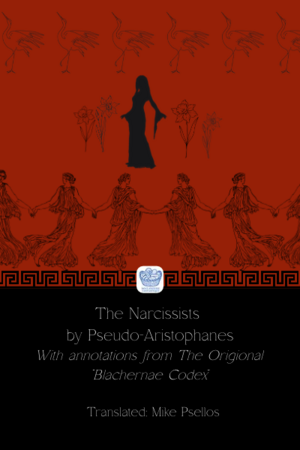
The Narcissists by Pseudo-Aristophanes Feat. Original Annotations found in The Blachernae Codex
Scholastikos Notes: On Humor.
This section may seem cryptic to you, your majesty, as I understand most innuendo among the Franks and Latins are animal based. However our Ausonian ancestors seemed to prefer euphemisms related to travel. Thus the quality of a "road" or a walk, could be interpreted erotically. Mercantile euphemisms were also common, and many writers would use the act of shopkeeping and trading as a substitute for sexual acts. A practice still maintained by the Venetians, I am told.
[The inside of Narkissos' house. The door is wide open.
Gothika and Narkissos are lying together in bed]
Narkissos: The feeling I have, as I look into thy eyes. It still has not left me.
Even as my lower half pulls away. My top is drawn to thee.
Gothika: Give your lower half a moment, We'll see.
There's still time for carnal act three.
Though I admit the build up took some time.
Your rising action was divine.
Narkissos: And for the climax of my performance?
Gothika: For your first run, its fine.
[Enter The Chorus of Perverts who surround the outside of the house to leer through the open door.]
Philagynos [Chorus]: For once it does a Greek Heart glad
To see Germanics on top, and Greeks below.
To the victrix, the booty's been had
Gothika: Good to see you again.
But you missed the show.
You arrive now for pillow speak and afterglow.
Chorus of Perverts: Missed it?
We never.
Us Greeks we are always a witness to history.
The door was open, we need not wait till act three"
Narkissos: You perverts observed us in this gloom?
To have such well travelled men, look upon my first walk.
And to see it only by the light of the moon?
Were I another, perhaps I'd be impressed rather than balk.
But speak now chorus, what did you see?
For it seems all saw myself, save me?
Chorus: Two paths for her diverged down this forest.
And while we are sorry we should not travel both.
Philanthropos [Chorus]: Be one traveler, long she stood"
Gothika: And looked down one as far as I could
To where he bent in the undergrowth.
Chorus of Perverts: Then took the other, as just and fair,
And having perhaps the better claim,
Philanthropos [Chorus]: Because it was grassy and wanted wear;
Gothika: Oh, I kept the first not another day!
Chorus of Perverts: And both that morning equally lay
So Somewhere ages and ages hence:
We shall be telling this with a sigh
Narkissos: And what was I?
Gothika: The road less travelled by.
Triva: (Shouting across the stage} And you think that makes a difference?
[Triva enters with The Chorus of Ghouls behind.]
Evone Tennebrae Corax, I've found you at last?
For so long you slunk off, The second waking is almost past!
The last hour for our hunt for today.
Gothika: Hunt for yourself mother, I've found my prey.
Chorus of Ghouls: One can not speak of open paths, without paying the toll
The Most Serene Succubus now graces your scene, so invite her to stay.
Let the road less travelled meet the well worn way.
Chorus of Perverts: A tragedy, a triumph I fear.
Is it consolation? Our Clytemnestra has so fine a rear?
Chorus of Ghouls: Look if you must, lewd locals, and seethe,
It's all you shall see when our dark lady leaves
Our mistress has goods when she gives out the store,
But the orgy is full, there is space for no more.
Narkissos: I know not these voices, nor this Evone.
I'm beside myself, and now another. She begs me I shant invite thee.
Shame has already left my house! There’s room enough for company.
To forgive my transgression? I can not repent.
I admit temptation mayhaps, I laugh at her plea.
Yet as I bask in the glow of your eyes... I relent"
Triva: Oh foolish immortal of mine, you seek an honest man to trust,
wandering so naively, these roads of lust?
In Hellas, poor Teuton, your cause I find fallow..
In romance men are odysseus: mad with their plough.
You may think there's no sorrow as they seek fertile ground,
But once the seed has been planted? A philosopher's found.
Chorus of Ghouls: Think of Plato's great tutor, who Xanthippe would rue.
Went down to the Piraeus, just to talk of what's true.
Your myth-man will despise you, like a master a slave.
These small shames overshadow them as they are trapped in your cave.
Chorus of Perverts: Slaves know servitude, Oimoi! this is bad.
Save but women and roosters; sex makes all sad.
Goth-girl, your partner, do not let him grieve.
Chorus of Ghouls:
Any who thinks different are fools.
Against his nature, there is no reprieve.
Triva: Enough, slaves, the've been bested. Further conquest is cruel.
And now that the mood's suitably darkened, We leave.
[Triva departs with the chorus of ghouls]
Gothika: Helja thuk nimai, that damnable qinokalkjo!
Dare I sleep happy one day? That harlot says no!
Oh sweet, lover. Please look in my eye.
Tell me the truth, do you regret that we lie?
Narkissos: There was a moment, I hoped through thee, I had at long last I wring
That ancient curse that beset us, that of echo I sing.
A lament. For in dark I fear nothing, but come dawn its true.
I'll see everything clearly, and my reflection shall too.
Gothika: I'm outnumbered, I'm outflanked. I'm defeated at dawn.
A nymphomaniac, my mother, and a man's face in bronze.
To gehenai arete, and dead gods guest right.
Its barbarity, vulgarity, that earned me this night.
Chorus of Perverts: Have we ever seen post-coital gloom.
Infect not just the man, but all near the room?
What shall we do?
Philanthropos [Chorus]: Save Narkissos!
Philgynos [Chorus]: Avenge Gothika!
Philxenoi [Chorus]: Send those ghouls below!
[The Chorus Departs]
Gothika: I hear no furies, my own rage, my resolve!
My cursed form created this, and this it will solve!
Your reflection seeks vengeance? Before dawn, he’s doomed.
Narkissos, my lover! Forgive me! this wound.
Here mother! Be pleased now, for this I was groomed.
There is one wisdom, from Athens, I now shall respect.
I will close the door now, no need to see what comes next.
[Gothika closes the door]
Scholastikos Notes: On Socrates
I am not going to discuss Socrates here, as he is a figure I am certain even you are familiar with. However, it is perhaps time for a brief digression about The presumed author of the piece. Aristophanes, the comic poet, was known for his many eccentric and ridiculous characters, which he used to critique the political and social climate of the time.
One such figure is Lysistrata, the woman who ends a war by forcing men to default on the marital debt. Another is Pisthetaerus, whose frustration with Athenian taxes encourage him to build a new kingdom with The Birds. Then of course is Aristophanes’ cunning villain, Socrates, who corrupts the youth of Athens with the ideas found in his thinkporium.
Now of course, Socrates, we know to be a real man thanks to the tireless efforts of his exceptional students, while the rest of Aristophanes characters are presumed to dwell only in the imagination of the author. Now, my colleague Christopher Akratatrophos, is fond of pointing out, that were it not for Plato or Xenophon, we might easily assume Socrates too is a fictional character.
This of course introduces a question. We would accept it as possibility that women would seek creative methods to end a war? Could one's name have been Lysistrata? And while it might be fanciful to assume there is a land of speaking birds, we have men from drab northern lands, who come here seeking escape from their fated misery. The Kentarchos Ælfric, our mutual friend, would be one such example of this. Would it be so far fetched to believe there was a Pisthetaerus, an Athenian man with Varangian mentality? It is certainly an interesting parlor game, to speculate on whether Aristophanes’ comic creations may in fact be caricatures rather than characters.









Please sign in to leave a comment.