Chapter 4:
Part I, Chapter Four: The Locked Archive
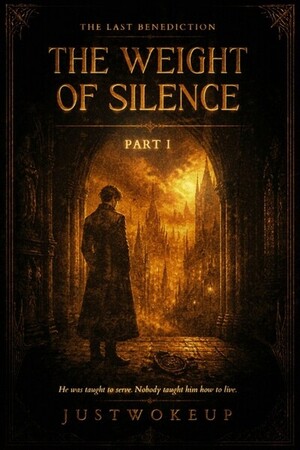
The Weight of Silence
The fourth day arrived by bell, as arranged, and the fog held off long enough to be punctual about it.
The Procurator's notice had gone back to its office the evening before under Wend's receipt, so that the shelf in Cassian's cell held now the tin and the folio and nothing else, and even the house's weather, it appeared, was signed for at both ends. He drank the cup standing at the yard door with the foundations chapter still in him from the night, and gave the morning back, and went down at first bell to open a vault in the company of the man whose trade was everything the vault had been built to outlast.
---
The Sealed Archive had two locks, and the house's whole theory of man was written in the fact of them. His key opened the first. The second belonged to the Procurator's office, and Wend came down the ramp with it at his own pace, breathing his condition, and the two of them signed the access book standing, shoulder to shoulder, in the light of the lamp Cassian had lit, and the locks went back in the order the rule required, first his and then the office's, so that neither man was ever alone in the cold with the house's authority.
Canon Tallow watched the whole of it from the foot of the ramp with his clerk at his shoulder, and did not help, and did not ask to.
"Everything down there," he said, when the second lock gave, "will prove to be exactly where somebody put it. I said as much yesterday. I have been wondering since yesterday evening about the somebody."
The vault received the observation the way the vault received everything, which was without comment at a temperature just above freezing. Cassian fetched down what the demand had named: the register of transfers, entire, in its original binding; the shipment ledgers as they stood on their shelves; the counterfoil book of the seal, in which every pressing of the house's authority was entered against its date and document; and the matrices themselves, wrapped in felt, carried two at a time like something between relics and ordnance. The rib complained on the stairs in its administrative way. The lip had scabbed over and been promoted to an itch.
It was on the last trip, passing the Veil shelves with the felt rolls against his chest, that he saw the case.
The spring's retained case stood where the register said it stood, which was the Veil shelving, grey-wrapped, second-sealed, minding its own custody. The register's entry gave its mark as twelve-V. The Veil index, which he had copied out in a fair hand two winters ago and knew the way one knows a psalm, gave twelve-V to a wrapper of restricted correspondence that had sat in that bracket since before his voice broke. The case before him bore its mark freshly lettered, and under the fresh lettering, where the lamp's angle crossed it, the scar of an older mark showed through the paint like a bone through skin: a letter scraped and another pressed down over the wound of it.
He stood in the cold for the length of four heartbeats and looked at the case and did not open it, because the rule for the Veil shelves was take, carry, return, do not look, and because he had been given an hour of instruction in being unreliable and had learned from it exactly one thing so far, which was that he did not know what he was looking at.
He carried the matrices up. The stairs recorded his feet. The case stayed where somebody had put it.
---
The anteroom received the originals at half past eight, and Tallow began at once to be older than them.
He worked the way frost works, and the room stiffened by degrees. The abstract of the Procurator's office he set aside face down, which was its review. The register he read in order, cross-checking the shipment ledgers against the release folio, the release folio against the counterfoil book, and where the counterfoil book spoke, he went to the matrices and took his own impressions into a little travelling press of his own, and blew on the wax like a man testing soup he did not trust.
Cassian attended. That was the whole of his office: to stand at the elbow of the examination, fetch what was asked, sign what was put to him, and say only what he had decided to say. The morning taught him that the last of these was the hardest, because Tallow's questions were built like the chalk stair in the shed: small, and load-bearing.
"Brother. The April release. The docket went out under the house's seal."
"It did, Canon."
"The counterfoil is entered against it."
"It is."
"Bring me the pressing. And before you read it to me, brother, remember whose name is first in the case."
Cassian brought the counterfoil book to the lamp and read the April pressing the way he had been taught to read anything, which was twice. The wax was of April, honest, well kept, the matrix true, the pressure calm; a seal pressed by a steady hand on a settled day. All of which was the answer to the question that had been asked.
Under the pressure of it, fainter than the lamp wanted, there was a ghost.
A double press. The wax had been melted and struck twice: once, and then again, over the scar of the first, the second impression laid down with care exactly inside the lines of the first so that at a glance the counterfoil read as one clean pressing, and at a lamp's angle, at the end of a morning, it read as a document that had been sealed, unsealed, and sealed again to the same effect by a hand careful enough to make the second look like the only.
He could not tell, looking at it, what it meant. Wax is melted and re-struck for a hundred innocent reasons: a cold day, a bad first pour, a clerk's tremor, a cord set wrong. The vault was cold in April. The vault was cold in every month the calendar offered. He stood with the answer to the question that had been asked ready in his mouth and the answer to the question that had not been asked sitting behind it like the ghost sat behind the wax, and he had been trained, fourteen years, to say only what he had decided to say.
"The pressing is genuine, Canon," he said. "The matrix is true. The wax is of April, and the hand was steady."
"Steady," said Tallow, not looking up. "Yes. I see that it was."
And that was all, and the morning went on, and somewhere in the back of the unaudited ledger of himself an entry opened that he did not total, because totalling it would have meant deciding what it was an entry of, and he had been left, at half past three of a Thursday, unable to tell a knot from a splice.
---
The exchange came in the middle of the afternoon, and he heard it the way he heard most true things in that house: in fragments, through a door he was on the wrong side of.
Tallow wanted the two superseded matrices, retained under rule, and Cassian was sent down for them, because the auditor did not leave the originals unattended and the registry brother knew the shelf. He was gone perhaps six minutes. Coming back up the vault stair with the felt rolls, at the last turning before the anteroom door, he heard the voices, and stopped, because the house had taught him to stop at doors, and because the voices had stopped being courteous.
"...the arrangement predates us both, Canon, and the Consistory ratified it. There is nothing irregular in a warrant under cipher. The Crown sends the house four or five in a year. You will find them all entered."
"The Consistory ratified what it was shown," said Tallow, and the frost in his voice had a blade's temperature in it now. "I am not auditing the Crown's correspondence, Father Procurator. I am auditing what left this house under seal. And I am finding that it left under two seals, and that one of the two is a seal I have not been shown, and that the abstract your office prepared for me does not contain it."
"Canon. You are tired, and the vault is cold, and it is the hour when documents look like conspiracies. Take the evening. The house is glad of you. The register will keep."
"The register," said Tallow, "is the only thing in this building that has kept, in my professional opinion, and I intend to find out from what."
The floor of the north range had never once in recorded history permitted an unannounced approach, and Cassian had not attempted one. He came around the turning with the matrices against his chest, and the conversation closed in front of him the way a ledger closes, both parties arriving at their entries simultaneously, Othmar's face settling into warmth like a fire drawn to perfection, Tallow's into the folded-document neutrality of a man who has said a thing once and does not say things twice.
"The superseded matrices, Canon," Cassian said, and set them down, and signed for their removal from the vault in the access book, in his own steady hand, and the afternoon resumed its shape, and nobody in the room looked at anybody else in any way that a record could have entered.
---
At the end of the working day Tallow stood, pulled his coat down with the two-fingered economy of forty visitations, and issued the day's last requirement to the room at large, in the voice that carried exactly as far as courtesy and no further.
"I will have an access record. From tonight: every hand that opens that vault while I am in this house, entered, dated, and signed, keeper and authority both, and the book to lie where I can put my own hand on it. I have been shown a great deal of good order in this building, Father Procurator. Good order is a story. A book of names is a fact. I will have the fact."
"You shall have it within the hour," said Othmar, warmly, "and I commend the requirement to the Consistory's memory. The house is glad of a guest who improves its practice."
Wend brought the book before Compline: a fair record ruled and headed in the office's best hand, *Register of Access to the Sealed Archive, Being the Period of Visitation*, with columns for the day, the hour, the purpose, the key, and the name. Cassian signed it first, as keeper of the registry, for the day's entries: the morning's opening, the carrying, the superseded matrices, the closing of the vault at dusk, two locks, both keys, all in order. Othmar signed beneath him as the authority under whose seal the access ran. Tallow countersigned at the foot, requiring, and the ink of all three signatures dried in the same cold.
It was the fourteenth signature of his year, in a book that had held a hundred of them, and he wrote it as he wrote them all, steady, legible, without thought, the way the house had taught him to write everything: as though a name were a small thing, done daily, meaning no more than the task it served.
He thought nothing of it. Then.
---
Matthias was at the chapel door after Compline, putting out the last of the candles, which was an office he had performed for thirty years and performed like a man tuning an instrument he did not play in public.
"I noticed a thing today," Cassian said, "that I could not read."
Matthias did not ask what the thing was. He looked at the candle in his hand while it went out, and then at Cassian, and the look was the one from the cloister, the one that contained several sentences and delivered them all.
"Then leave it unread," he said. "Noticing is the Eye's work, and yours is good. Understanding is the Heart's, and yours is still sitting its examinations. Do not confuse the noticing of a thing with the understanding of it; half the wickedness in this house is done by men who noticed something at breakfast and understood it by noon, when what they had was a shelf mark and a mood." He set the candle stub in its box. "And do not carry it to the auditor until you know what it weighs. A thing noticed can be taken from you. A thing understood cannot. The house knows the difference, brother, even where its brothers do not."
"Is that the house speaking, or you?"
"It is me," said Matthias. "The house does not speak. That is the whole difficulty with it."
He went out into the cloister with the candle box under his arm, and the cold came in behind him and took his place, and Cassian stood a moment in the dark church with the offices said and the windows black and honest, and then went up to his cell, and read the foundations chapter a third time without retaining a word of it, and slept.
---
The bell woke him.
It was wrong in every particular a bell can be wrong in. It was not the Waking Bell, which was three strokes and a pause and three; it was not the bell for fire, which was rung hard and even; it was not the bell for a death, which was not rung at all but tolled, by the sexton, from the rope, in his own time. This was the gate bell, rung by hand, fast and flat and repeating, the bell that said *come, come now, whoever is slept*, and under it, after a moment, the lesser bell of the north range adding its small voice, and under both of them the house turning over not like a ship this time but like a man struck in his sleep.
For the first time in fourteen years, a bell had woken Cassian Severin. He was on his feet in the dark with his boots in his hand before the thought of being on his feet had finished arriving, and the corridor outside his cell was already full of lamplight and half-dressed brothers and the sound of the infirmary wing shaking itself awake, and somewhere in it all Pell's voice, awake and, for the first time in the history of the house, asking no questions at all.
He went down the dormer stair with the crowd of them, and the crowd thinned at the north range door as brothers peeled away toward their offices, and he did not thin, because the north range was his range, and the vault was his vault, and the access book with three signatures drying in it was his book.
The north range door stood open. Torches were already below. And at the bottom of the stair, where two locks had kept two keys apart for three hundred years so that no one man could ever be alone in the cold with the house's authority, the vault of the Sealed Archive stood open, both doors back, the lamp inside it still burning, and the cold was coming up the stairs to meet him like a tide.
*End of Chapter Four.*



Please sign in to leave a comment.