Chapter 4:
The Angle Someone Else Saw
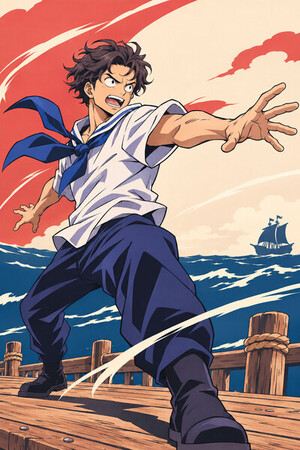
One Piece: A Marine Beyond the Admirals
Thanks for reading. Enjoy the chapter!
✦
The harbor let go of the P-17 one line at a time.
Bram had expected departure to feel like a door opening. Instead, it felt like six people shouting different names for rope while the quay slid away behind him.
"Stern line clear."
"Bow line clear."
"Hold that sheet where it is."
Bram held it.
The P-17 turned toward the harbor mouth under a pale morning sky. Its deck rose beneath his boots, paused, and settled somewhere slightly different from where he had left it. On the quay, warehouses and cranes kept their shapes. On the cutter, even standing still required small decisions.
The sailor who had taught him the two half hitches planted one bare foot against the rail and hauled beside him.
"Don't pull at the sail," the sailor said. "Pull with it."
"It hasn't told me what it wants."
"That's because you're listening to yourself."
Ahead of them, the navigator watched the harbor flags and the strip of open water beyond the breakwater. She did not look at Bram when she called for two hands to ease the line.
He gave it half an arm's length.
"Two hands," she said.
"That was two."
The sailor beside him grinned. "Dockworker's hands. They use a different measure."
Bram paid out the rest.
The sail filled without snapping. P-17 leaned, gathered speed, and crossed the line where harbor water became coastal chop. Bram's stomach remained at the line for a moment before reluctantly following the rest of him.
He tightened his grip.
"Knees," the sailor reminded him.
Bram bent them before the next roll. The motion still felt wrong, but it stopped feeling personal.
By midday, the harbor had become a bruise on the horizon. Bram had coiled three lines, carried meals without dropping them, and learned that every task on a small ship shared space with another task already happening.
He could not cross the deck because someone was trimming a sail. He could not move the spare cask because the cook had claimed the passage. He could not stand where the view was best because the navigator needed the view more.
It was an efficient system for insulting his freedom.
A second probationary recruit crouched beside the mast, checking a lashing under the warped-clipboard Marine's supervision. He glanced at Bram's hands.
"Is it true you can shove air?"
"Only air that deserves it."
"Could fill the sail for us."
The Marine did not look up from the lashing. "And you could finish checking that turn before it fills your mouth with rope."
The recruit returned to his work.
Bram looked up at the canvas. A pulse against open air would be easy to imagine. The sail was broad. The direction was obvious.
Then the navigator called a change before Bram felt anything. The crew shifted the sheet, the helmsman gave them a few degrees, and the sail's smooth belly softened without collapsing.
What had looked obvious stopped being true in less than a breath.
"Still want to help it?" the sailor beside Bram asked.
"I was considering the safety of the experiment."
"Consider it from somewhere that isn't my brace."
"You could move."
"I could also let the boom cross loose and collect both our heads. I'm staying here."
He said it without challenge. His place mattered more than Bram's demonstration.
Bram had spent years on docks where the strongest back often decided the next move. At sea, strength belonged to a position. Leave the position, and the strength went with it.
He stayed on the line.
The first day passed in short orders and repeated corrections. By sunset, Bram's palms burned despite old calluses, and the muscles between his ribs felt drawn tight. He had not used the fruit. That no longer felt like restraint for its own sake. It felt like completing the work actually assigned.
The navigator marked their position on a chart he was not invited to touch.
"Weather holds through first watch," she said. "After that, we earn whatever comes."
The sea was dark glass under a clean strip of stars.
Bram decided it was showing off.
By the next afternoon, the stars had been replaced by a low gray ceiling, and the sea had lost all interest in glass.
Rain crossed the deck sideways. P-17 climbed each swell with its bow lifted and came down hard enough to make the water casks complain in the hold.
Bram worked the port line with the same sailor as the day before. The rope was wet, swollen, and eager to escape his hands.
"Wrap once around the pin," the sailor called.
"I know."
"Then do it before the line learns you don't."
Bram took the turn. The pull eased from murderous to merely hostile.
The navigator stood braced near the helm, one hand gripping the cabin edge. She watched the water ahead, not the rain striking her face.
"Wreckage to port," she shouted.
Bram saw nothing but broken white water.
"Two points forward of the beam. Long spar."
The helmsman answered. Someone at the bow rang a warning against the rail.
Then Bram saw it.
A length of dark timber rode between the swells, thick as a mast and jagged at one end. Rope streamed behind it in a pale, twisting tail. The wreckage rose on the next swell and turned across P-17's course.
The helmsman changed their angle, but the sea changed the wreckage's angle too.
"Port sheet ready," the navigator called.
The sailor beside Bram shifted to take the strain. The trailing rope from the wreckage slapped across the water, vanished, and came up beneath one of P-17's working lines.
Both lines jumped.
The sailor's feet left the deck.
He struck one knee, kept both hands on the rope, and slid toward the rail.
Bram caught the line behind him.
The pull drove heat through Bram's palms. He planted his boots, and the deck rolled away from the posture he had chosen.
"Don't cut it," the sailor gasped. "Lose this and the sail goes wild."
At the next station, the Marine with the warped clipboard held the brace in both hands. He looked once toward them and did not move.
"I leave this, the boom crosses," he shouted. "You're getting my sympathy from there."
It was exactly the right refusal.
The other recruit started toward Bram.
"Secure yourself first," the navigator ordered. "Then secure Caldero."
The recruit looped one arm through a rail lashing and came low across the deck.
The jagged spar rose beside them, close enough for Bram to see iron nails jutting from its broken end.
"Caldero," the navigator called. "Keep the line. Short pulse on the timber. High side, aftward. Not the water. Not my hull."
Bram locked the rope beneath his forearm.
The air around his free hand tightened.
Wind and rain were already moving everywhere. His power did not tell him where they would go. It gave him pressure, not wisdom.
He picked the spar's high face and drove a short burst across it.
The pulse struck with a flat crack.
The timber rolled instead of turning away.
Its trailing rope snapped taut beneath P-17's line.
The sailor lurched another foot toward the rail.
Bram's shoulder hit the stanchion. Pain flashed along his ribs, and the rope burned through one layer of skin.
"Wrong angle," the navigator shouted.
He knew.
Knowing did not loosen the line.
The other recruit reached him from behind and hooked an arm across Bram's chest. His weight stopped Bram's next slide by inches.
"I've got your belt," the recruit said.
"That is not a reassuring sentence."
"It's the part of you I could reach."
The sailor on the line twisted onto one hip. Rain ran off his chin. He looked at the spar, then at Bram's feet.
"Your left boot," he said.
"Busy."
"Put it against the scupper ridge. You're aiming from the roll. Brace against the deck."
The P-17 dropped into a trough. Bram moved his boot before the rise, wedging it against the low ridge at the deck's edge.
The sailor pulled the line down, changing the space beneath Bram's arm.
"Lower on the timber," he said. "Across the break. Let the next wave lift it."
The navigator heard him.
"Do that," she called. "On my mark."
Bram drew breath.
His chest resisted halfway in.
The spar vanished behind a wall of water.
The recruit behind him tightened his hold. "If you go over, I'm not jumping after you."
"Finally, a sensible friend."
"I didn't say friend."
The swell lifted P-17. The spar rose with it, broken end turning toward the rail.
"Now!"
Bram kept the line pinned, aimed across the split grain, and released one short pulse.
The air struck low.
The wave supplied the lift Bram could not. The pulse supplied the sideways shove the wave would not.
The spar kicked outward. Its trailing rope scraped under P-17's line, caught for one terrible instant, and tore free.
The sailor slammed backward onto the deck.
Bram followed.
The recruit's arm kept him from following farther than the deck.
The wreckage passed astern, close enough for one jutting nail to rake a bright scar along the outer rail. It did not strike the hull. It did not take the line or the sailor with it.
"Hold stations," the navigator called. "The weather did not end because Caldero fell down."
No one applauded.
The helmsman kept P-17 on its corrected heading. The warped-clipboard Marine held the brace until another sailor relieved him. At the bow, two hands cleared the remaining loose rope. The crew finished the emergency while Bram lay on his back tasting rain and trying to persuade his arms to stop shaking.
The sailor he had helped sat up first.
"You tightened it," he said.
Bram closed his eyes. "I noticed."
"Then you listened."
"You shouted directly into my face."
"Best place to put advice in weather like this."
He offered Bram a hand.
Bram took it. Neither of them managed to stand on the first try.
The other recruit stayed behind Bram until they were both upright.
"You can let go of my belt now," Bram said.
"I'm waiting to see whether your knees agree."
They did not.
The recruit kept hold.
By dusk, the worst of the rain had moved east. P-17 carried a scored rail, one chafed line, and a crew too busy replacing both to treat survival as a ceremony.
Bram sat beneath the cabin overhang with a blanket around his shoulders. His hands had been cleaned and wrapped. Each deep breath found the same sore line along his ribs and added a broader ache across his chest.
The sailor sat beside him while someone else spliced the damaged section of rope.
"First pulse was bad," Bram said.
"Yes."
"You could pretend to think about it."
"I was there."
Across the deck, the other recruit was helping reset the rail lashing Bram had nearly pulled apart. He caught Bram looking and tapped two fingers against his own belt.
Bram raised one wrapped hand in acknowledgment.
Two debts in one storm. Neither had a number written on it.
The navigator passed beneath the overhang long enough to check that Bram was awake.
"We make the outer approach tomorrow if the wind behaves," she said. "You will not practice tonight."
"I wasn't planning to."
"Good. Your plans have had enough air for one day."
She moved on before he could decide whether that was a joke.
P-17 continued through the evening swell. The deck still shifted under Bram, but now he could feel other people's work inside the motion: the helmsman's corrections, the navigator's call, the hands trimming sail, the recruit's grip, the sailor changing the line's angle.
His power had mattered.
So had the first mistake.
Tomorrow, there would be a report.
The wrong angle belonged in it.
✦
✦
✦
Want to read ahead?
More chapters are available on Patreon.
www.patreon.com/c/thehakilog



Please sign in to leave a comment.