Chapter 8:
The Signal That Was Not an Order
One Piece: A Marine Beyond the Admirals
Thanks for reading. Enjoy the chapter!
✦
At first light on L-80, P-17 had too much weight, too little deck, and six people convinced the problem belonged to someone else.
Bram stood beside a painted strip that ran from the passenger bench to the stern ladder.
"Nothing stays on the yellow line," the coxswain said.
A deckhand looked at the two cargo stacks.
"Then one of those stays ashore."
"That decision belongs to the load officer," the coxswain replied. "Your decision is whether you can clear the line without dropping anything on my passengers."
Bram liked her immediately.
His partner was already moving loose rope coils into a rack beneath the rail. The superior who had crossed with them stood at the gangplank, assignment sheet in hand, watching both recruits without offering to rescue either one.
The passengers had not boarded yet.
That was why the coxswain allowed the exercise.
An empty wooden float sat inside a chalk square on the open deck. It weighed less than Bram's boot and had no person, medicine, cargo, or useful secret inside it.
"One pulse," the superior said. "Low output. Move it toward the rail mark, not beyond it."
"The rail is behind it."
"Then direction matters."
"That feels like a lesson disguised as geometry."
"Begin when the coxswain confirms the deck is clear."
The coxswain looked forward, aft, and up at the rigging.
"Clear."
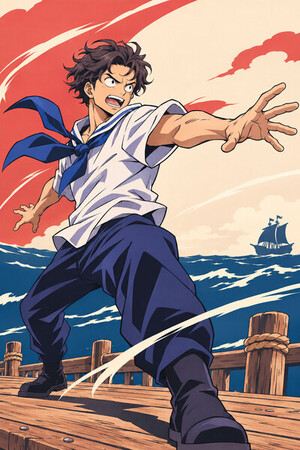
Bram planted his feet outside the yellow lane. He opened one hand and kept the breath small.
Pressure left his palm with a soft thump.
The float scraped across two planks and stopped short of the painted rail mark.
No one applauded.
That was becoming his preferred kind of success.
The coxswain put the float back in the chalk square with her boot.
"Again. Same place. Same mark."
"I thought the first one counted."
"It did. This one tells us whether counting it was foolish."
Bram repeated the breath, the angle, and the restrained release.
The float crossed almost the same distance and turned half a handspan to port before stopping.
The superior marked something on the exercise card.
"Within the first criterion," he said. "Not exact. Not ready for a live deck."
"There will be no live-deck demonstration," the coxswain added.
"I had gathered that from the passengers not being disposable."
"Good. Gather your float."
Bram picked it up with his hands.
The exercise ended there.
No heavier object replaced it. No civilian was invited to stand near the line. The coxswain closed the card, and Bram's ability returned to its assigned place: available for a real emergency, not for solving every inconvenience with pressure.
The first inconvenience arrived wearing spectacles and carrying a map case.
The older copyist stopped at the gangplank and pointed to a narrow wooden chest beside the passenger bench.
"That is where the crew put my tools."
His partner faced him before answering.
"Yes. Secured and dry."
"Also inaccessible."
The copyist lifted the brass hearing tube from his collar and set it against one ear.
"My magnifier, ink knife, dividers, and current work are in that chest. If we are delayed, I work. If a chart is damaged, I repair it. If you put the chest behind three crates, you have converted my livelihood into ballast."
Bram looked from the chest to the yellow route.
The easiest place to keep the tools accessible was directly beside the bench.
It was also directly across the evacuation lane.
"We cannot leave it there," Bram said.
"Then I do not board without it."
The copyist did not raise his voice. He did not need to.
The guardian and child waited behind him. The apothecary stood farther back with the medical case looped to her wrist. Every person on the manifest had become a line held still by one wooden chest.
Bram's first impulse was to move it himself and announce the result.
His partner crouched instead.
"Which tools must stay within reach while we are underway?"
The copyist opened the chest.
Inside lay rolled sheets, two flat cases, a wrapped lamp, and a small leather kit.
"The leather kit and the active chart tube. The rest can be secured."
The coxswain joined them.
"There is a dry bracket behind the bench. It holds one tube. The leather kit can strap beneath the seat if it clears the hatch."
"Can I reach both without crossing the deck?" the copyist asked.
"Sit down and test it."
They did not test with the child in the lane or the gangplank full. The guardian waited ashore while the copyist boarded under the deckhand's hand signal.
He sat. His fingers found the tube behind his shoulder and the kit beneath the bench.
Then he stood and walked the yellow line to the stern ladder.
"Clear," he said.
"Clear," the coxswain agreed.
The larger chest went into a lashing bay selected by the load officer. The copyist kept the key and watched the knot tied.
No one confiscated his tools. No one blocked the way out to preserve them.
The solution took eight minutes.
The child considered this an unforgivable misuse of a ship.
"Are we going now?"
"After everyone boards safely," the guardian said.
"That is what they said before the old man sat down."
The copyist adjusted his hearing tube.
"I am old enough to delay a vessel properly."
The child looked impressed.
The apothecary boarded next. She fastened her medical case beneath the bench, pulled the security line twice, and kept the key.
"I need the lid to open without untying the case," she said.
The deckhand shifted the line through a lower ring.
"Try it."
She opened the lid a handspan, reached the top tray, and closed it again.
"Acceptable."
Bram's partner marked the arrangement on the passenger sheet.
The guardian and child boarded last. Bram pointed to the yellow route, then made the child walk it once while holding the guardian's hand.
"If the alarm sounds?" Bram asked.
"Stay with her, follow the yellow line, do not touch ropes."
"And if you see something interesting?"
"Ask before touching it."
"That answer may save several adults today."
Cargo came aboard after the passengers were seated.
Bram did not inspect it.
He helped where the coxswain directed, carrying sealed water tins and shifting a bundled awning to the forward rack. The load officer watched P-17's draft marks and told the crew where weight had to go.
Bram did not pretend the angle of the hull had spoken privately to him.
One square box required four hands and a short wheeled board.
It was dark wood bound with iron at the corners. A cargo tag hung from one handle. Red-brown wax closed the cord, round and partly hidden beneath the tag.
Bram saw it.
He also saw the yellow lane narrow when the board stopped.
"The corridor," he said.
The load officer glanced over.
"Temporary stop."
"It is blocking the only marked route."
"Then help us move it to the port cradle."
Bram took the rear handle when told. The box pulled harder than its size suggested, but that told him only that it was heavy.
Heavy was not illegal.
Wax was not guilt.
He kept those facts separate while the four of them moved the box.
The load officer rejected the first cradle after checking a draft mark and ordered two water tins shifted forward before the box was lashed farther inboard.
"Is it safe there?" Bram asked.
"It is within the load plan there," the officer said. "If the sea changes, the coxswain changes the plan."
It was not the absolute answer Bram wanted.
It was an answer from the person responsible for giving it.
By noon, the yellow lane ran unbroken from bench to stern ladder. The copyist could reach his working kit. The apothecary could reach her case. The child could recite three rules and was inventing a fourth about sea monsters.
P-17 left the dock under crew command.
Bram remained beside the passenger bench.
The box remained in its cradle.
L-80 ended with both of them aboard and neither one explained.
On L-79, the coastal channel narrowed between black rocks and a line of pale buoys.
The civilian pilot stood beside the coxswain with one hand near the wheel and the other on a folded route card. She had accepted the morning tide at the cost of a delayed delivery south.
"Transfer point is Beacon Four," she told the crew. "We hold east of the green buoy until the support boat comes alongside."
Bram heard because the order was repeated for everyone with a station.
His station remained the passengers.
The support boat appeared before Beacon Three.
It came out from behind the northern rocks, low in the water, with a white square raised above a red strip.
The coxswain looked at the route card.
"That is a request to transfer here."
The pilot did not turn the wheel.
"Our boarding order says Beacon Four. Blue chevron over white."
The support boat repeated the white-and-red signal.
A deckhand near the bow said, "Maybe Four is fouled."
"Maybe," the pilot replied.
She still did not turn.
The support boat sounded one short horn blast and angled closer.
The child stood on the bench to see.
Bram put a hand on the bench back, not on the child.
"Sit, please."
"Are those pirates?"
"They are a boat asking for something. Sit with your guardian."
The guardian drew the child down without waiting for a second request.
The copyist removed his hearing tube and watched faces. The apothecary tightened the security loop at her wrist.
Bram's partner checked the stern route and gave Bram a clear-hand signal.
The support boat pointed toward P-17's port side.
One of its crew held up a slate.
TRANSFER AUTHORIZED.
Bram could read the words.
He could also remember the superior's instruction: if command changed his task, he would hear it from command.
He did not hear it.
"Our written point is Four," Bram said to his partner.
"I see it."
"Their signal is different."
"I see that too. Hold here."
His partner went no farther than the superior at the forward station. He delivered the discrepancy without adding a theory.
The superior carried it to the coxswain.
The coxswain signaled the shore relay for confirmation.
Bram stayed beside the bench.
The box was ten steps away.
The support boat was close enough that a strong swimmer might have covered the gap.
Neither fact changed his post.
The pilot reduced speed.
"If we wait, we lose the southern tide window," a deckhand warned.
"I know what waiting costs," she said.
"They have the transfer slate."
"They do not have the signal in my order."
The support boat sounded its horn again.
The pilot held P-17 east of the green buoy.
That choice belonged to her.
She had no Marine rank, no interest in Bram's seal, and no reason to enjoy delay. She waited because a changed place required a changed order, not because Bram had persuaded her that the other boat was guilty.
The shore relay answered after four long minutes.
The signalman read the flags, checked twice, and turned toward the coxswain.
"No amendment confirmed. Transfer remains Beacon Four. Support boat identity pending verification."
The coxswain raised the suspend signal.
No one boarded the support boat.
No line crossed between the vessels.
No crate moved.
The other boat held its course for three breaths.
Then it lowered the slate, turned north, and increased speed toward the rocks.
The white square above the red strip disappeared first.
The hull followed.
The pilot watched it go.
"That turn costs them more than our wait cost us," she said.
Bram looked at the dark gap between the rocks.
"Does that prove anything?"
"It proves they changed course."
The answer was almost severe enough to sound like the sergeant.
Bram accepted it.
Behind him, the child whispered, "So they were pirates?"
"No," Bram said. "So the transfer did not happen."
The coxswain ordered P-17 back onto its assigned line.
The passenger corridor remained clear. The copyist's tools stayed within reach. The apothecary kept her case. The heavy box stayed lashed in its approved cradle.
Nothing aboard had been taken.
Yet somewhere beyond the northern rocks, a boat had abandoned the planned point after failing to collect it.
Bram kept his place beside the people he had been assigned to protect.
He wondered who would come next for the box, and whether the next request would bother pretending to be an order.
✦
✦
✦
Want to read ahead?
More chapters are available on Patreon.
www.patreon.com/c/thehakilog






Please sign in to leave a comment.