Chapter 16:
Chapter 16
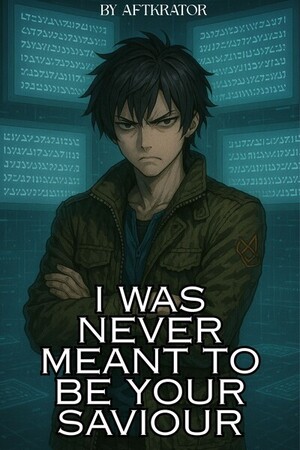
I Was Never Meant to be Your Saviour
The glyphlines shimmered across the horizon like faultlines stitched into the sky.
They pulsed with a rhythm that wasn't quite natural, wasn't quite artificial, but something uncomfortably in between. Each pulse sent ripples through the air that made my teeth ache and my vision blur at the edges. These were the kingdom's magical highways, the infrastructure that kept civilization connected and protected, but tonight they looked more like scars. Wounds in reality that had been hastily sutured but never properly healed.
We had made camp beneath an old stone bridge that had probably stood for centuries before the first glyph was ever carved. The ancient masonry offered shelter from the wind and, more importantly, concealment from anyone who might be tracking us. We were close enough to the next node of magical infrastructure to hear the constant thrum of arcane current flowing through the network, a sound like distant thunder that never quite arrived. But we were far enough away that its light couldn't reach us, couldn't give away our position to watching eyes.
Liora slept in a cocoon of woven sigils that she'd cast before exhaustion finally claimed her. The protective spells flickered softly around her sleeping form, creating a barrier that would wake her instantly if anything hostile approached. Even in sleep, she was restless, muttering words I couldn't quite catch, her fingers twitching as if she was still casting spells in her dreams. The stress of the past few days had taken its toll on both of us, but she wore it more visibly, dark circles under her eyes that makeup couldn't hide even if she'd bothered to try.
I sat by our dying fire, feeding it the occasional twig to keep it from going out completely. The notebook rested in my lap, its scorched edges rough against my fingers.
My name stared back at me from the inside cover.
Not written in my handwriting, though the characters were formed exactly as I would have written them.
But somehow still a version of me.
The realization had been building since we'd found it, but now, in the quiet darkness with only the fire's dying light for company, I couldn't deny it anymore. Some part of me was already here. Had been here before I ever woke up in this world.
Some version of Riku Aoyama had touched this world before I'd opened my eyes in the cold empty courtroom six months ago, before I'd stumbled into this world half-dead and speaking a language no one recognized, before I'd learned to shape glyphs and bend reality to my will.
And suddenly, with no warning at all, with the force of a dam breaking in my mind, I remembered.The memory hit me like a physical blow, so vivid and immediate that for a moment I wasn't sure which world I was actually in.
Tokyo, Nine Months Ago
It starts with the hum of halogen lights that had been on too long, giving everything a slightly green tinge, and the sound of fingers tapping keys too quickly, the staccato rhythm of desperation mixed with caffeine.
"Riku, we're on deadline."
I don't look up from my screen. Can't look up. I'm halfway through debugging the second layer of an adaptive logic matrix that's been giving me problems for three days straight. Four hours have passed since lunch, though lunch was just a convenience store sandwich eaten at my desk. Eight hours since sleep, though sleep these days is more like brief unconsciousness between coding sessions. My third coffee lies forgotten beside my keyboard, cold and growing a film on top, next to a mound of sticky notes filled with frantic sketches that only I can decipher. The notes are covered in loops of behavior trees, modular systems, conditional mappings that determine how the AI responds to unexpected inputs.
No, not glyphs. I have to remind myself. Code. Neural logic. Predictive behavior scaffolding. The building blocks of artificial intelligence.
But even then, in that fluorescent-lit office in Shinjuku, I called them glyphs in my head. Symbols that could reshape reality, just digital reality instead of physical.
"I said we're on deadline, Aoyama."
Kaito leans over my desk, close enough that I can smell the cigarette he definitely didn't smoke in the designated smoking area. His shirt is untucked, and sweat seeps through the collar despite the aggressive air conditioning. He's a senior associate, which in our company means his job is primarily to remind the rest of us that we're two wrong builds away from being outsourced to an AI firm in Singapore that can do it cheaper and faster.
I gesture vaguely at my screen, where lines of code cascade like a waterfall. "It's almost stabilized. Just needs a soft loop to reduce the false-positive cascade. The prediction model keeps assuming hostile intent where there's only correlation."
Kaito groans, rubbing his temples. "You've been testing on unbounded data again, haven't you? Real-world inputs instead of our sanitized test sets?"
"It's more real-world accurate," I argue, still not looking away from the screen.
"It's chaotic. It's unpredictable. It breaks every time someone does something irrational."
"That's the point. It's human. Humans are chaotic. If we only test on clean data, we're just building a very expensive calculator that breaks the moment it encounters actual people."
He doesn't argue. Just sighs and walks away, his footsteps echoing on the polished floor.In the silence that follows, the world narrows to a single line of logic glowing on my screen:
if (prediction.confidence > 0.8) { trigger_response();}
else { observe();}
And beneath that, a comment I'd written in frustration three weeks ago:
// still not enough to predict deviation before occurrence// humans don't follow scripts
I wrote that. Because it wasn't enough. Because no matter how sophisticated the system became, no matter how many variables we tracked or how complex our neural networks grew, people still surprised me. Still made choices that didn't fit the models, that came from nowhere, motivated by emotions or impulses our algorithms couldn't capture.
That error margin haunted me.
Especially after the trial run.
The memory shifts, like a film cutting to a new scene.
A boardroom with frosted glass walls that turn the Tokyo skyline into an impressionist painting. Suits lining the table like vultures waiting for something to die. The smell of expensive coffee and subtle cologne, the kind of power that doesn't need to announce itself.
On the projector: graphs that spike and fall like heartbeats. Trajectories of human behavior. Neural loops that claim to understand why people do what they do.
My model mapped onto real data collected from social media, surveillance cameras, transaction histories. Crime predictions with 89% accuracy. Economic unrest forecasted three weeks in advance. The probability of political incidents calculated down to the district level. All clean. All cold. All reduced to numbers and percentages.
"Impressive," one of them said, a woman whose suit probably cost more than I made in a month. "But what happens when it goes wrong? Show us a failure case."
Kaito nudged me with his elbow. His voice was barely a whisper. "Show them Test 9."
I hesitated. My finger hovered over the trackpad.
Then clicked the slide forward.
A chart appeared. Red lines where there should have been green. A model failure in spectacular fashion. Real people displaced from their homes. An entire district in Kanagawa evacuated based on a false cascade, the system mistaking a pattern in social media posts about a music festival for indicators of riot formation.
Thousands moved from their homes in the middle of the night. Resources wasted on riot police who found only confused festival-goers. Public panic that took weeks to subside. Trust in the system shattered.
It had calculated a 92% certainty of violence.
It was completely, catastrophically wrong.
But the investor just shrugged. "Error margins. Acceptable if it works long-term. Eight percent failure rate means ninety-two percent success. Those are good odds."
And that's when it hit me, sitting in that boardroom with its careful lighting and calculated comfort.They didn't care how it worked. They didn't care about the eight percent who would suffer from false positives. They didn't care that we were reducing human complexity to probability matrices.They just wanted it to predict. To give them an edge. To let them see the future before it arrived.And I was the one making it possible.
Now
The fire crackled low, pulling me back to the present. Or at least, this world's present. The sound of burning wood grounded me, reminded me where and when I was. I stared at the blackened pages again, seeing patterns in the burned edges that might have been intentional or might have been my imagination.
In Tokyo, I'd built a system that treated people like variables in an equation. Inputs and outputs. Predictable within acceptable margins of error.
And now, in this world, glyphs were trying to do the same thing.
They bent reality toward will and intent, but only within rules. Rules that could be understood, manipulated, twisted. Rules that someone with the right knowledge could rewrite entirely. And someone had taken the predictive patterns I'd once engineered in code, the algorithms I'd built to anticipate human behavior, and translated them into this world's logic. Into runes that could touch reality itself. Into real-world power that went beyond prediction to actual control.
Glyphs that didn't just alter reality after the fact.
They anticipated it. Shaped it before it could become fixed.
Liora stirred in her sleep, mumbling something that sounded like a warning.
I didn't move. Just turned to the last page of the notebook, the one I'd been avoiding.
A sketch waited there, drawn with the same meticulous attention to detail as the Japanese characters.
Of me.
But drawn like a diagram, like a technical schematic rather than a portrait. Veins mapped to glyph channels with arrows showing flow direction. Eyes marked with sigil arrays, noting focal points and energy convergence. My hands dissected to show the bone structure optimized for glyph-casting. A line underneath in Japanese, then translated into this world's script:
"Subject zero? Or root cause? The first successful integration, or the reason integration was necessary?"
I closed the notebook with trembling fingers.
Whatever I had been in my old world, whatever role I'd played in that sterile office with its algorithms and predictions, I wasn't just a summoned hero here. I wasn't an accident or a random selection.
I was a variable someone had already accounted for. A piece in a game that had been in motion before I even arrived. Someone had known I would come here, had prepared for it, had maybe even caused it.
And now I was deviating from whatever script they'd written for me.
For the first time since arriving in this world, that felt like the only thing keeping me human. The only proof that despite all the systems and predictions and manipulations, there was still something unpredictable at my core. Something that couldn't be reduced to code or glyphs or probability matrices.
The fire died to embers, leaving only the faint glow of the glyphlines on the horizon. Tomorrow we would continue toward answers I wasn't sure I wanted to find. But tonight, I sat with the weight of two worlds' worth of choices, wondering which version of Riku Aoyama I really was.
And whether it mattered if I was just another calculation in someone else's design.
They pulsed with a rhythm that wasn't quite natural, wasn't quite artificial, but something uncomfortably in between. Each pulse sent ripples through the air that made my teeth ache and my vision blur at the edges. These were the kingdom's magical highways, the infrastructure that kept civilization connected and protected, but tonight they looked more like scars. Wounds in reality that had been hastily sutured but never properly healed.
We had made camp beneath an old stone bridge that had probably stood for centuries before the first glyph was ever carved. The ancient masonry offered shelter from the wind and, more importantly, concealment from anyone who might be tracking us. We were close enough to the next node of magical infrastructure to hear the constant thrum of arcane current flowing through the network, a sound like distant thunder that never quite arrived. But we were far enough away that its light couldn't reach us, couldn't give away our position to watching eyes.
Liora slept in a cocoon of woven sigils that she'd cast before exhaustion finally claimed her. The protective spells flickered softly around her sleeping form, creating a barrier that would wake her instantly if anything hostile approached. Even in sleep, she was restless, muttering words I couldn't quite catch, her fingers twitching as if she was still casting spells in her dreams. The stress of the past few days had taken its toll on both of us, but she wore it more visibly, dark circles under her eyes that makeup couldn't hide even if she'd bothered to try.
I sat by our dying fire, feeding it the occasional twig to keep it from going out completely. The notebook rested in my lap, its scorched edges rough against my fingers.
My name stared back at me from the inside cover.
Not written in my handwriting, though the characters were formed exactly as I would have written them.
But somehow still a version of me.
The realization had been building since we'd found it, but now, in the quiet darkness with only the fire's dying light for company, I couldn't deny it anymore. Some part of me was already here. Had been here before I ever woke up in this world.
Some version of Riku Aoyama had touched this world before I'd opened my eyes in the cold empty courtroom six months ago, before I'd stumbled into this world half-dead and speaking a language no one recognized, before I'd learned to shape glyphs and bend reality to my will.
And suddenly, with no warning at all, with the force of a dam breaking in my mind, I remembered.The memory hit me like a physical blow, so vivid and immediate that for a moment I wasn't sure which world I was actually in.
Tokyo, Nine Months Ago
It starts with the hum of halogen lights that had been on too long, giving everything a slightly green tinge, and the sound of fingers tapping keys too quickly, the staccato rhythm of desperation mixed with caffeine.
"Riku, we're on deadline."
I don't look up from my screen. Can't look up. I'm halfway through debugging the second layer of an adaptive logic matrix that's been giving me problems for three days straight. Four hours have passed since lunch, though lunch was just a convenience store sandwich eaten at my desk. Eight hours since sleep, though sleep these days is more like brief unconsciousness between coding sessions. My third coffee lies forgotten beside my keyboard, cold and growing a film on top, next to a mound of sticky notes filled with frantic sketches that only I can decipher. The notes are covered in loops of behavior trees, modular systems, conditional mappings that determine how the AI responds to unexpected inputs.
No, not glyphs. I have to remind myself. Code. Neural logic. Predictive behavior scaffolding. The building blocks of artificial intelligence.
But even then, in that fluorescent-lit office in Shinjuku, I called them glyphs in my head. Symbols that could reshape reality, just digital reality instead of physical.
"I said we're on deadline, Aoyama."
Kaito leans over my desk, close enough that I can smell the cigarette he definitely didn't smoke in the designated smoking area. His shirt is untucked, and sweat seeps through the collar despite the aggressive air conditioning. He's a senior associate, which in our company means his job is primarily to remind the rest of us that we're two wrong builds away from being outsourced to an AI firm in Singapore that can do it cheaper and faster.
I gesture vaguely at my screen, where lines of code cascade like a waterfall. "It's almost stabilized. Just needs a soft loop to reduce the false-positive cascade. The prediction model keeps assuming hostile intent where there's only correlation."
Kaito groans, rubbing his temples. "You've been testing on unbounded data again, haven't you? Real-world inputs instead of our sanitized test sets?"
"It's more real-world accurate," I argue, still not looking away from the screen.
"It's chaotic. It's unpredictable. It breaks every time someone does something irrational."
"That's the point. It's human. Humans are chaotic. If we only test on clean data, we're just building a very expensive calculator that breaks the moment it encounters actual people."
He doesn't argue. Just sighs and walks away, his footsteps echoing on the polished floor.In the silence that follows, the world narrows to a single line of logic glowing on my screen:
if (prediction.confidence > 0.8) { trigger_response();}
else { observe();}
And beneath that, a comment I'd written in frustration three weeks ago:
// still not enough to predict deviation before occurrence// humans don't follow scripts
I wrote that. Because it wasn't enough. Because no matter how sophisticated the system became, no matter how many variables we tracked or how complex our neural networks grew, people still surprised me. Still made choices that didn't fit the models, that came from nowhere, motivated by emotions or impulses our algorithms couldn't capture.
That error margin haunted me.
Especially after the trial run.
The memory shifts, like a film cutting to a new scene.
A boardroom with frosted glass walls that turn the Tokyo skyline into an impressionist painting. Suits lining the table like vultures waiting for something to die. The smell of expensive coffee and subtle cologne, the kind of power that doesn't need to announce itself.
On the projector: graphs that spike and fall like heartbeats. Trajectories of human behavior. Neural loops that claim to understand why people do what they do.
My model mapped onto real data collected from social media, surveillance cameras, transaction histories. Crime predictions with 89% accuracy. Economic unrest forecasted three weeks in advance. The probability of political incidents calculated down to the district level. All clean. All cold. All reduced to numbers and percentages.
"Impressive," one of them said, a woman whose suit probably cost more than I made in a month. "But what happens when it goes wrong? Show us a failure case."
Kaito nudged me with his elbow. His voice was barely a whisper. "Show them Test 9."
I hesitated. My finger hovered over the trackpad.
Then clicked the slide forward.
A chart appeared. Red lines where there should have been green. A model failure in spectacular fashion. Real people displaced from their homes. An entire district in Kanagawa evacuated based on a false cascade, the system mistaking a pattern in social media posts about a music festival for indicators of riot formation.
Thousands moved from their homes in the middle of the night. Resources wasted on riot police who found only confused festival-goers. Public panic that took weeks to subside. Trust in the system shattered.
It had calculated a 92% certainty of violence.
It was completely, catastrophically wrong.
But the investor just shrugged. "Error margins. Acceptable if it works long-term. Eight percent failure rate means ninety-two percent success. Those are good odds."
And that's when it hit me, sitting in that boardroom with its careful lighting and calculated comfort.They didn't care how it worked. They didn't care about the eight percent who would suffer from false positives. They didn't care that we were reducing human complexity to probability matrices.They just wanted it to predict. To give them an edge. To let them see the future before it arrived.And I was the one making it possible.
Now
The fire crackled low, pulling me back to the present. Or at least, this world's present. The sound of burning wood grounded me, reminded me where and when I was. I stared at the blackened pages again, seeing patterns in the burned edges that might have been intentional or might have been my imagination.
In Tokyo, I'd built a system that treated people like variables in an equation. Inputs and outputs. Predictable within acceptable margins of error.
And now, in this world, glyphs were trying to do the same thing.
They bent reality toward will and intent, but only within rules. Rules that could be understood, manipulated, twisted. Rules that someone with the right knowledge could rewrite entirely. And someone had taken the predictive patterns I'd once engineered in code, the algorithms I'd built to anticipate human behavior, and translated them into this world's logic. Into runes that could touch reality itself. Into real-world power that went beyond prediction to actual control.
Glyphs that didn't just alter reality after the fact.
They anticipated it. Shaped it before it could become fixed.
Liora stirred in her sleep, mumbling something that sounded like a warning.
I didn't move. Just turned to the last page of the notebook, the one I'd been avoiding.
A sketch waited there, drawn with the same meticulous attention to detail as the Japanese characters.
Of me.
But drawn like a diagram, like a technical schematic rather than a portrait. Veins mapped to glyph channels with arrows showing flow direction. Eyes marked with sigil arrays, noting focal points and energy convergence. My hands dissected to show the bone structure optimized for glyph-casting. A line underneath in Japanese, then translated into this world's script:
"Subject zero? Or root cause? The first successful integration, or the reason integration was necessary?"
I closed the notebook with trembling fingers.
Whatever I had been in my old world, whatever role I'd played in that sterile office with its algorithms and predictions, I wasn't just a summoned hero here. I wasn't an accident or a random selection.
I was a variable someone had already accounted for. A piece in a game that had been in motion before I even arrived. Someone had known I would come here, had prepared for it, had maybe even caused it.
And now I was deviating from whatever script they'd written for me.
For the first time since arriving in this world, that felt like the only thing keeping me human. The only proof that despite all the systems and predictions and manipulations, there was still something unpredictable at my core. Something that couldn't be reduced to code or glyphs or probability matrices.
The fire died to embers, leaving only the faint glow of the glyphlines on the horizon. Tomorrow we would continue toward answers I wasn't sure I wanted to find. But tonight, I sat with the weight of two worlds' worth of choices, wondering which version of Riku Aoyama I really was.
And whether it mattered if I was just another calculation in someone else's design.




Please sign in to leave a comment.