Chapter 5:
Chapter 4 — Whispers on the Edge of Fields
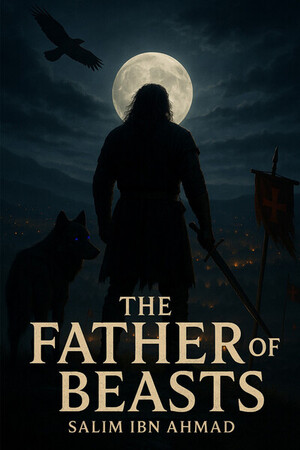
The Father of Beasts
— Ibn al-Athīr, al-Kāmil fī al-Tārīkh “In Ma’arra our troops boiled pagan adults in cooking-pots; they impaled children on spits and devoured them grilled.”
— Radulph of Caen, Gesta Tancredi Chapter 4 — Whispers on the Edge of Fields
Ahmad didn’t ride so much as cling to the horse while Adham chose the way. The stallion kept his steps sure and slow, carrying his master with a patience that came from long years together. Ahmad’s hands barely held on. When his head dipped, Adham shifted to keep him steady.
The world reached Ahmad in fragments. Smoke in his throat. The sour stench of burned grain. The clean bite of frost over stubble. He told himself only one thing: forward.
Nahhas trotted close to the stirrup, brushing against the leather, steadying the horse with his presence. Every so often the wolf nudged Adham’s belly as if to remind him: keep him safe, keep him alive. Above, Reeh circled against the paling sky, riding faint air currents, always near.
Fields stretched around them, broken by walls and the bare bones of fig trees. A stream gave itself away first by its sound, then by a silver gleam on stones. Adham waded in, pawed once, and drank deep.
After a short time, he tried to tell the horse “Forward,” but the word caught and died. His skull throbbed like a struck bell.
Dawn came. Behind him, out of sight, Ma’arra was a dark bruise against the horizon. Ahead, the ordinary world still existed: thorn and dust, spider webs strung with dew, goat pellets scattered on the earth. Life that had survived the night. It felt wrong, almost indecent, that it had.
Ahmad meant to ride farther, to find shelter, to let the fever leave him. But the body has its own will. Somewhere between one stride and the next, his grip loosened. His cheek dropped onto Adham’s mane, then slid. The stallion stopped, bent his knees carefully, and let his master down as gently as a pot being lowered to the ground.
Nahhas stood over him at once, body braced, ears up, eyes sweeping the field. Reeh swept low, checked, and settled on the horse’s tack, feathers ruffled but watching.
That was how the villagers found him.
Shepherds were already in the fields at first light. Boys with firewood, women at the ovens, men pushing goats toward pasture. Bells jingled faintly. Then they froze, their rhythm broken, when they saw the black horse with a fallen man at its feet and a wolf guarding him.
“Back,” a woman said sharply, pulling a child behind her. Dogs that had been lazy by the walls scrambled up, barked, then shrank away, sensing what stood before them.
On a rise, an older man shaded his eyes. His back was bent from a life of labour. He studied the horse, the bird, the wolf — and the man on the ground. “Be still,” he told the others. “Look first.”
They looked. The stallion stood without tether. The hawk perched calm, as if it had always belonged there. The wolf’s gaze passed from one villager to another, then back to the fallen man, as if counting every breath between them.
“It is him,” the old man said at last. “Father of Beasts.”
The name passed among them like a secret. Some had heard he had fought lions in the hills, or taken down a mountain bear. Others said he spoke to strays until they followed him.
“Mind the wolf,” someone muttered. Still, they came down the slope, slow and careful, staves low, palms open. Nahhas bared his teeth once — not a challenge, but a warning. The old man knelt first, lowering himself cautiously.
“Peace on you, hunter,” he said. He offered the back of his hand for the wolf to scent. Nahhas sniffed, sneezed, and ignored him. That was enough.
Together they lifted Ahmad, careful as if they carried a man they’d be judged for dropping. He was lighter than he looked. They laid him on a mat in the shade of a goat-hair tent. Nahhas lay across his legs; Reeh claimed the lintel and did not move.
They brought water, wrung cloth until the bowl turned pink, loosened his belts, freed his breath. Old hands checked his nails, young ones brought goat’s milk, setting it down within reach. By afternoon his fever broke into sweat, and he fell into a deep, heavy sleep.
Outside, life pressed on. Grain ground into meal. Nets were mended. Water poured into jars. Men spoke in low voices.
“They burned Ma’arra. I saw the sky from the ridge.”
“Do we run to Hama? Or hide here?”
“They promised safe passage. Then butchered those who trusted them. Mercy is bait in their mouths.”
Heads nodded. Ahmad did not stir, but the words cut into him all the same.
“What of Aleppo? Damascus?” another man muttered. “Their amirs (leaders) sit safe behind their walls. Do you think Ridwan will come? Do you think Duqaq will ride out?” Silence answered.
That night, Ahmad opened his eyes to steady lamplight. Wood smoke, wool, goat’s milk, onions. The ordinary smells of the living. A woman noticed, gave a soft cry, and others gathered. They did not crowd him. In villages that see death often, people learn how to give space.
“You are among your people,” the elder said. “Allah brought you out.”
In half-sleep, Ahmad muttered. Even in dreams he heard the cries of the Franks — “Deus vult, Christe”. He did not know the meaning yet, but the sound clung to him like smoke.
Ahmad managed a rough “My thanks.” Nahhas pressed his head into his hand. The wolf’s warmth steadied him. A woman lifted a cup to his lips; he drank, and it eased his throat. Warm bread came next, and he broke the first strip for Reeh, who took it without sound.
“Tell us of Ma’arra,” a man asked quietly. “We hear… there was eating.”
Ahmad said nothing. His silence was enough. They understood.
From the shadows of the tent, one of the villagers spat into the dirt.
“It wasn’t only the Franks who broke us,” he said bitterly. “There were men of our own who turned away. Promises of help that never came. Bread and water sold to the enemy while our children starved. We all know who.”
Another nodded, voice low but steady. “Cowards with authority, safe behind walls, while Ma’arra burned.”
The air in the tent grew heavier. No names were spoken, but every man and woman there seemed to hear them just the same.
Ahmad did not smile, but his gaze swept across them.
A woman wept soundlessly. The elder covered his face and whispered, “Allah is sufficient for us, and He is the best Disposer of affairs.”
That night, they spoke around him while he slept. They shared stories they’d heard — of the lion in the wadi, the bear in the orchards, the wolf that walked at his side. Not to boast, but to hold onto hope.
By morning, stiffness had set in but his strength returned. He stood slowly, buckled a borrowed cloak, and slid his lion-hide hawk glove over his left hand. Its worn leather steadied him more than water had.
The elder waited at the doorway. “There is food.”
“Others will need it more,” Ahmad said. He checked his bowstring, then whistled Reeh down to his glove. Nahhas rose and stretched, ready.
Outside, the village gathered. Ahmad spoke short and sharp:
“Hide your grain in two places — one that can be found, one that can’t. Move your women and children at night, not by the road. Do not trust the people of the cross and their broken promises. If they come, shut your gates. If they take one hostage, they’ll take ten. Fight only where the ground makes a man stumble — in lanes, between walls. Save arrows. Stones on slings work just as well.”
The words carried weight. The old man nodded once.
“Will you go to the amir?” someone asked.
“No, I will go where I can help,” Ahmad said.
He added only: “You fed me. May Allah reward you.”
He raised his hands briefly. “Allah, keep their homes hidden from the enemy, and turn harm from their doors.”
They brought Adham forward, brushed free of soot. The stallion pressed his head against Ahmad’s chest and blew a long breath, checking his master’s strength. Ahmad leaned his forehead to the horse’s, a moment of quiet before the road called again.




Please sign in to leave a comment.