Chapter 6:
Chapter 5 — The Raid of the Red Crosses
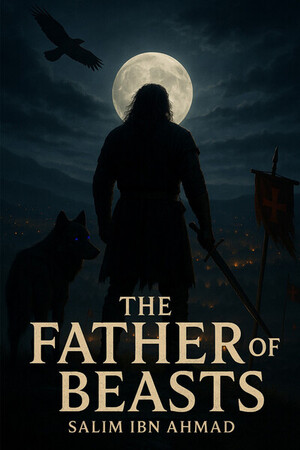
The Father of Beasts
He saddled Adham, the black stallion swiftly. The wolf, Nahhas, stood close by, and the hawk, Reeh, shifted restlessly after landing on his glove.
A shepherd came running down the slope, breath steaming in the dawn.
“They took women,” he gasped. “South track, past the tamarisks. Six of them, with red crosses on their tunics. Drinking, laughing. They camped in the dry riverbed.”
Ahmad’s hand froze on the strap. “How long ago?”
“Before dawn. They tied the women in twos.”
Ahmad nodded once. He tightened the girth. “Stay here. If you hear shouting, don’t come.”
Reeh lifted into the pale sky. He took off at such a speed, as if flying on his horse. Nahhas moved at Adham’s side, silent, ready.
They went at a hunter’s pace through scrub and thorn, down a dry channel where hooves left no dust. Ahmad read the ground as he went: dragged ropes, boot-scuffs, the rim of a shield pressed into sand. He smelled wine before he saw it spilled black in the dust.
He stopped at the ridge. Below, in the hollow of the riverbed, the Franks were camped by a fire. Six men, careless. Their tunics were stained, their crosses roughly stitched. One wore mail half-laced. Two sat with shields dropped. One leaned against a spear. The women lay bound, ankles and wrists tied together by a single rope. One stared at nothing, one rocked and muttered, one watched the men with a hawk’s eyes.
Two Franks made a show of keeping watch. One poked the fire with a stick. The other swayed with a wine skin, head back, laughing at nothing.
Ahmad sent Reeh high with a flick of his hand. Then he slid from the saddle, touched Nahhas’ ruff, and moved down into the cover of tamarisk. He crawled until he could smell meat in the pan and hear the wine gurgle. The sword lay along his arm, its blade wrapped in cloth to kill the shine.
He whistled once, low and sharp.
Reeh dropped like a stone. Her talons raked the face of the wine skin guard. The man screamed, clutching his eyes. The other turned to shout—Ahmad slid from the shadows and cut his throat. The body fell into the fire, spilling embers.
The camp erupted. One man lunged for a knife, another for a spear. Nahhas hit the spear man at the calf, teeth locking to the bone. The man howled and fell. Ahmad stepped past him and drove his sword into the one with the knife. Blood spattered the fire.
A third Frank came up with a hatchet. Ahmad blocked the swing on his forearm, shoved in close, and stabbed twice—belly, then throat. The man dropped where he stood.
“Help us!” a woman cried in Arabic.
“I am,” Ahmad said.
Another Frank, quick with his mail still half-done, rushed at him. Ahmad struck low, cutting his knee. He collapsed screaming. Reeh raked his face and he threw the shield over his head like a child hiding from rain. Ahmad ended him with one stroke.
The nasal-helmed Frank tried to kick Nahhas. He overbalanced. Ahmad’s sword caught him as he fell.
The wine skin guard staggered away, blood in his eyes, trying to run. Ahmad snatched the dropped hatchet and threw. It hit square in the back. The man spun and crashed into the dust.
Then silence. Only the fire crackled, and Nahhas’ growl faded as he released the calf he had ruined.
Ahmad moved to the women. The rope binding them was one long cord. He cut each knot clean, slow, careful. One woman flinched at his touch. He showed her the knife in his palm. “Here. You’re free.”
The oldest one among them, pointed at the fire. “They boiled—” She stopped. Another whispered, “They ate our dead. And before that…” Her voice broke. “They defiled us.”
“I know,” Ahmad said, his face set. “I was in Ma’arra.”
They looked at him then as if he had walked out of the nightmare itself. One woman wouldn't stop weeping, another stared at the wolf sitting calm then at the hawk on its perch in amazement.
“We must move,” Ahmad said. He pointed to the ridge. “Go there. The ground will hide your sound. Travel slow. Drink from the shaded spring, not the open pool.” He poured water into a shallow cup and held it while the oldest drank first.
She then caught his sleeve. “Who are you?” she asked. “Are you a jinn?”
“Only a hunter,” Ahmad said. “Go.”
He cut strips from dead men’s cloaks to bind their ankles. He gave them knives and showed them how to slash, not stab. He told them where to find shepherds by dusk, and what words to use so they would be believed.
When they were gone, he turned back to the dead. He dragged them into place around the fire. He propped shields in a circle, crosses facing up. He hung one cross-marked tunic high in a tamarisk, where the wind would shift it. He scored the sand with claw-marks from a hook of bone, so the ground looked cursed. He crumbled black ash over the red crosses until they looked stained by fire.
Reeh clicked from the shield rim. Nahhas watched, head tilted.
When the women reached the ridge, they turned once. He lifted his hand and pointed them onward.
Ahmad gathered what he could use: two knives, rope, a bowstring knotted into a sling, stale bread, salt. He found a small wooden cross near a dead man’s hand. He set it back on the chest and left it where it could be seen.
“Let them fear,” he said quietly.
He whistled. Reeh came to his fist. Nahhas padded to his heel. He climbed out of the riverbed. On the ridge he stopped and looked south. Dust hung far on the horizon. A great host was moving.
He touched the earth. “O Allah, guide me to those I can save.”
Adham blew hard through his nose. Ahmad mounted, set the hawk loose to circle, and rode at an easy pace along the ridge.
By noon the women would be safe among shepherds. By evening the fear-scene in the wadi would be found. By dawn the story would spread: of a man with a hawk and a wolf who turned crosses into omens.
Ahmad did not look back. He rode south, toward the road where the banners of the enemy would soon stand still before another city’s walls.




Please sign in to leave a comment.