Chapter 10:
Chapter 9 — You bring us a gift
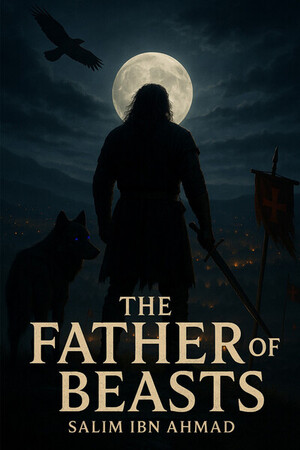
The Father of Beasts
Epigraphs
“They marched from Ma’arra through our lands, leaving ruin behind them. Villages were emptied, fields stripped bare, and no tree remained uncut for their fires.”— Ibn al-Athīr, al-Kāmil fī al-Ta’rīkh “So great was our want that we boiled horses’ flesh and even the skins of beasts. Many among us perished on that march.”
— Fulcher of Chartres, Historia Hierosolymitana
Chapter 9 — You bring us a gift
Winter still clung to the hollows. Dirty snow sat in the shade like old cloth. The rest was mud and smashed grass—weeks of wheels and boots had turned the tracks into trenches. Ahmad kept to the high ground where rock and scrub gave cover. Adham climbed without fuss. Nahhas moved ahead, head low, a shadow with ears. Reeh traced slow circles until she was only a fleck.
He read the ground as he went. A wide path of deep ruts and hoof holes—main column. A lighter offshoot veering toward a line of tamarisks—runners or messengers. Fresh mule sign, one shoe split, heel dragging. He knelt and pressed two fingers into a print. Soft at the edge. Not an hour old.
He tied Adham in a fold of rock and went on with Nahhas. The wolf stalked from bush to bush. Voices reached them first—men speaking in the harsh music of the invaders, then a thinner voice answering in the tongue of the land.
Ahmad slid behind a boulder and looked down into a shallow field camp. A dozen Franks sat around low fires, helmets off, steam blowing from their mouths. A priest with a cut-down cross hung at his neck moved between cook pots. At the edge, under a leaning pine, a local man waited with his hood up. He spoke with his hands, showing turns in a road, pinching fingers to mark a spring, tapping three times toward a ruined orchard. A Frank with a black bird painted on his shield listened, nodded, then pointed south with two fingers and drew a curve in the air to show a detour.
No coins changed hands. Bread did. The collaborator ate it like a dog that expects a kick. When he turned to go, the Frank gripped his shoulder, said something short, and pressed two fingers to his own eyes, then pointed to the north ridge. The meaning was clear enough: watch there.
Ahmad slid back and circled to meet the man on the way out. He found the place without thinking—the kind of crease in the ground where sound dies and men go missing.
The collaborator came alone, hood down now, checking behind him every twenty steps. Ahmad let him pass, rose, looped a cord over his mouth, and pulled him backward into the scrub. Nahhas was there already, a breath at the man’s ear, teeth close enough to chill skin. The man stiffened, tried to shout into the cord, and made only a wet grunt.
“Quiet,” Ahmad said.
He tied the wrists. He didn’t hit him. He didn’t need to. He set the man on his knees with his back to a stone, then crouched close so the man could see the wolf and the glove and the calm in his eyes.
“You walk with them,” Ahmad said.
The man nodded so fast the cord twitched in his teeth.
“You’ve done it before.”
Another desperate nod.
Ahmad loosened the cord a finger’s width. “Speak.”
Words tumbled out. “Don’t kill me. I can help. I can help.”
“You’ve helped them,” Ahmad said, flat. “You’ll help us now. Start with this: the road south. How many on the forager lines? Where do they draw water? Who watches at night?”
The man swallowed air. “They split by threes. Dawn and last light. They carry empty skins from the lower stream, under the two broken figs. Their sentries—north side is thin after midnight, by a burnt orchard with five stumps. They don’t like the ground there. They say it eats feet.”
“Signals?”
The man glanced at Nahhas and found honesty. “Horn calls—one short for carts, two long for men down, three long and one short for fire. Hands too—open palm for ‘hold,’ two fingers for ‘move.’ I can show them.”
“Where next?”
“South and a little east after the next new moon. Timber first. They’re short. They’ll cut in the high grove above the cisterns.”
Ahmad let the silence sit. The man kept talking to fill it.
“They use a dark path through the thorn this side of the hill—no one watches it. And the officer with the bird on his shield keeps his own guard lazy. He trusts the priest to watch the fires. He—”
Ahmad lifted a hand and the words stopped.
“Say their words,” Ahmad said. “The ones they shout before they move, the ones they use for counting, for water, for bread.”
The man repeated a handful of sounds, clumsy and proud—bread, water, tomorrow, devil. He pointed as he said each, mimicking the invaders’ mouths. Ahmad repeated them under his breath once, marking the shapes like cuts on wood. Not to understand—not yet—but to hold them.
“You know routes, habits, and a few of their words,” Ahmad said. “You’re good at staying alive.”
The man nodded too hard. “I can help you. I can tell you when they march, who leads which pack, where they keep the oxen—”
“You’ll tell someone,” Ahmad said. “Not me.”
Fear flashed again. “Please—”
Ahmad took an arrow from his quiver and stood it upright by the man’s ear. He drew, aimed at the earth to the left, and loosed. The point struck so close the spray of grit salted the man’s cheek.
Nahhas leaned and closed his teeth gently on the man’s trouser leg. Not skin, not blood—just enough to let him feel the skull behind the eyes.
“You lie once,” Ahmad said, low. “I let him finish.”
“I won’t. I swear.” The man shook. “By Allah. By—”
“Save that,” Ahmad said. He tugged the cord back into the man’s mouth and stood. “Walk.”
He put the rope around the man’s waist and tied it to Adham’s saddle horn. They moved by broken stone and scrub, staying off the road, sliding across frost at the edge of the fields. Twice Ahmad froze and dropped to a knee while a forager pair crossed below them. Once Reeh stooped short to draw a sentry’s eye away from the line they travelled.
They reached a shepherd’s camp as the light thinned. Ahmad asked, said little, and learned that men from Arqa had been seen riding a ridge the day before, looking north with hard eyes. Scouts. He moved again, pushing the pace until the prisoner stumbled and went to his knees. Ahmad yanked him up by the rope and kept going.
On the second night, a glow showed on the next ridge—a small, careful fire where no Frankish camp sat. Ahmad whistled once for Reeh to take height, waited, then sent a stone into the dark below the glow. A hiss answered, then a short rasp no Frank would use: two small strokes of steel on stone, then silence.
He stepped into the circle of low light with the rope in his hand. Two riders stood up from the rocks as if pulled by strings. Lean men, cloaks dark, bows strung. One had a scar like a hook at the corner of his mouth.
They looked at the wolf first, then at the hawk, then at Ahmad.
They greeted with Peace be upon you.
“Hunter,” the scar-cheeked one said. “You bring us a gift.”
“From your neighbours,” Ahmad said, and pushed the prisoner forward. “He’s a path into their camp. He knows their habits, their signals, their weak turns. Alive, he’s worth more than dead.”
The second rider stepped close to the collaborator with open contempt. “What did you sell for bread?”
The man mumbled into the cord.
Ahmad didn’t look at him. He looked at the two riders. “Who commands you?”
“Arqa,” the man said. “The amir’s riders. Name’s Qays.”
Ahmad nodded once. “Then take him to your amir. Say to him from me: keep this coward breathing. Squeeze him for routes, words, and timing. The invaders’ tongue will be a weapon if someone sharpens it.”
Qays watched Ahmad with the kind of attention men reserve for tools they’ve wanted for a long time. “The amir’s name is Abdullah,” he said, almost testing how it sounded in Ahmad’s mouth. “He’ll want to hear from you as well.”
Ahmad’s answer was simple. “When I have something that uses the ground better than talk, I’ll bring it.”
Qays’s partner cut the cord and the collaborator flooded the air with promises. Qays shut him up with a fist on the shoulder—not hard, just enough. “You lie, you die,” he said without heat. “You don’t lie, you live a little longer.”
The man nodded until it seemed his neck might break.
Qays tied him to a pack saddle and tossed a cloak over his head. “What did he give you?” he asked Ahmad.
“Thin watch after midnight by a burnt orchard with five stumps. Foragers at dawn and dusk. Water under two broken figs. Horn calls—one short carts, two long men down, three long and one short for fire. A quiet path through thorn. A lazy captain with a bird on his shield who trusts a priest to watch the flames. Timber next, then south-east on the new moon.”
Qays’s eyes shifted as he turned each piece in his head. “We’ll use it.”
“Use him too,” Ahmad said. “Teach someone his words. Make a list. When I come to Arqa, I’ll hear them.”
Qays nodded once. “You’ll be welcome at our fire.”
Ahmad glanced at the tied man. “If he tries to run, hold him in the dark and let him listen to the wolf breathe. He’ll learn faster.”
For the first time, Qays laughed. “I’ll remember that.”
They doused the small fire with a palm of dirt. The night took shape around them again. Reeh shifted on her perch and settled. Nahhas stared at the collaborator until the man looked away and kept looking away.
Qays swung up into the saddle. “There’s a place two ridges over where the ground eats hooves. If you want to hurt them without losing men, you’ll find it.”
“I know it,” Ahmad said. “I watched a cart break there today.”
“Then we’re already reading the same page,” Qays said. He touched a heel to his horse and moved off, his partner behind him, the collaborator tied between.
Wind moved over the ridge, dry and cold. Down in the dark, a horn sounded once in the invaders’ camp—short and bored. Ahmad listened, then repeated the sound in his mind until he could have drawn it with a knife.
He set a hand on Adham’s neck and felt the horse’s steady warmth. He whistled once to the hawk and she lifted, then drifted back to his glove for a breath before taking height again.
There was work now that wanted a map in the head: a thin picket at a burnt orchard; water under two broken figs; a hidden path through thorn; horn calls with meaning; a road that would carry an army at the dark of the moon.
Ahmad turned his face toward the hills and moved. He didn’t look back. He didn’t need to. Behind him, a coward would reach Arqa alive. Ahead of him, the ground was already telling him where to cut.



Please sign in to leave a comment.