Chapter 4:
The Siege of the Dead
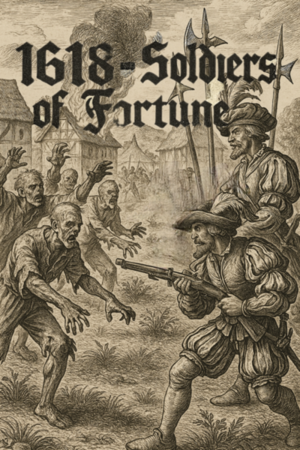
1618 - Soldiers of Fortune
In the light of day the empty eyes and twisted bodies were yet more plainly to be discerned.
Happily, I was still far enough from the camp that the dead had not taken notice of me.
As my stunned gaze wandered, I beheld the same dreadful sight along every stretch of the city walls that I could see: ranks of shambling corpses as far as my eye might reach.
My breath caught in my throat, and the doubt to which I had so stubbornly clung turned swiftly into bitter certainty.
When at length I had somewhat digested the first shock, I strove to consider what course remained to me.
Should I turn away and ride toward some farther town, trusting it had been spared?
Should I return to the estate and barricade myself there, in the vain hope that four walls and a stout door might avail against such a scourge?
I pondered long and found little comfort in any thought.
It seemed, in truth, as though God Himself had now loosed His wrath upon mankind for its manifold sins.
Had I taken Father Gerlach’s words too lightly?
Was I already tasting the torments of purgatory?
I looked down at my hands.
They trembled, yet I felt no fire upon my skin, no iron upon my flesh.
Though the dead walked among the living, I still drew breath, still felt the wind upon my face.
“No,” I murmured. “This is no purgatory… not yet.”
“It must be a trial,” I said softly to myself, “a test from God, to prove whether we remain faithful Christians even when death itself riseth up against us. It must be so.”
Perchance I simply would not own myself a sinner after so many years of dutiful attendance at Mass and whispered prayers.
Or perchance these were but words with which I sought to comfort my mind, for to admit aught else would have been to surrender both my life and the very notion I had of myself.
And that I could not do.
I looked once more to the walls and the mass of wandering dead that pressed before them, and I wondered whether any living soul yet remained within the city.
I gave my horse a cautious nudge and rode a little nearer that I might gain a clearer view.
At the battlements of a watchtower beside the eastern gate I fancied I espied two figures.
Yet were they living men, or but more of the accursed?
Despite the danger of drawing the attention of the horde below, I urged my horse a few paces closer and raised my arm.
After a moment one of the figures above halted and, as if in answer, lifted his own arm and waved.
So there were still survivors!
A small spark of hope rose within me, though I knew not yet how it might profit me; for between myself and that gate there stood a very substantial obstacle.
Somehow I must win my way through the shambling multitude.
I told myself they could not overtake a horse at full gallop; they moved but slowly, after all.
Yet if this mount were to take fright, and cast me amidst them, then all would be lost.
I laid a hand upon the animal’s neck.
“Steady now. Keep your wits about you, do not throw me.”
Drawing a deep breath, I pressed my heels to his flanks and set him to the gallop, only to turn back almost at once, my courage failing me.
“Coward,” I hissed under my breath.
For some minutes I rode to and fro, seeking some wiser plan, but none would come.
At last I gathered what remained of my resolve, set the horse to a brisk trot, and then to the gallop.
We thundered toward the mass of the dead.
The nearer we drew, the more violently my heart beat within my breast.
I bade the horse keep to his full speed, and to my relief he did not falter; the dead only marked our presence when we were already rushing past them.
When I glanced back, however, I saw a great number of them turning and following, drawn after us like a sluggish but relentless tide.
“Damnation,” I muttered.
As we came within earshot of the watchtower and I could clearly discern the men upon it, I lifted my voice and cried, breathless and half-mad with fear:
“Open the gates!”
The men above peered down upon me for a few moments.
“Were you bitten?” came the shouted reply.
I stared up, scarcely believing my ears.
The dead were almost upon me, and the guards would bandy questions.
“Open the accursed gates, in God’s name!” I cried. “Does it not suffice that I am no such wretched creature as they!?”
The men exchanged a brief glance.
Then one nodded to the other.
The Wiedergänger were nearly at my heels when at last the gate creaked open.
I drove the horse forward and darted through.
A bolt hissed past my ear and buried itself in the skull of one of the creatures directly behind me.
“Gate!” the shooter bellowed, and the heavy doors slammed shut at my back.
I had not often passed through the eastern gate, yet even so I scarcely knew the place that now lay before me.
The streets seethed with Landsknechts, their armour dented and stained, their doublets torn and spattered with blood.
Some wore broad-brimmed felt hats with drooping feathers, others went bareheaded.
Among them moved townsfolk and fugitives from the surrounding farms.
Many crouched in corners, staring before them with empty gaze, or clutching rosaries between trembling fingers, mumbling prayers that stumbled over one another in their haste.
Strangely, I saw no wounded; whether that were a hopeful sign or a grievous one, I could not yet say.
Near the gate, the eyes of many had turned toward me, and in a short while a small crowd pressed in around my horse.
“Whence come you? Are there any survivors abroad?”
“Bring you word from the king?”
“Have you seen our daughter, I pray thee?”
Their voices rose together in a desperate confusion.
A squad of soldiers forced the people back and came toward me.
At their head strode a tall man with pointed beard and receding hairline, clad in a long black coat and bearing himself with a composure that, given the hour, seemed almost unnatural.
“Were you bitten?” he asked.
There was that question again.
I had dismounted and now stood before him.
“Bitten? I am...”
“I care not who you are,” he broke in. “Not yet, at least. Bitten, lad. Did they lay teeth upon you anywhere?”
He seized my arm roughly and examined it for wounds.
“No,” I said. “I am unharmed. Why is that of such weight to you?”
At this he seemed somewhat astonished, then a little more at ease.
“You do not know?”
“What is it that I do not know?” I asked, my confusion growing.
“Tell me first, what knowledge have you of the walking corpses?”
“I know they are hard to kill,” I answered slowly, “unless one strike the head.”
I spoke as best I could, though now that I stood within the walls a great weariness fell upon me, and I longed for nothing so much as rest.
The man nodded.
“Aye, they may be slain. That is the chief matter.”
All at once I recalled the letter I had taken from the dead rider and drew it from my coat.
“I found this upon a rider, not a mile west of here,” I said. “Perchance it is of more use to you than to me.”
He took it with evident interest.
“Do you know what it contains?” I asked.
“No,” he replied, “and I shall not be the one to learn it.”
He handed it back to me, to my surprise.
“The Obrist¹ will. You shall place it in his hands at once.”
He gestured to the soldiers around us.
“He is clean. Back to your posts. You!” he pointed to a young Landsknecht, “take this man’s horse to the stables and see that it is well cared for.”
The youth took the reins and led the animal away.
Only then did I mark that several of the soldiers had kept their crossbows and muskets levelled at me all this while.
Better such caution than a careless welcome, I thought.
As the men lowered their weapons and dispersed, I asked, “Why crossbows?”
“They serve us better than muskets,” the tall man replied, “at least against these foes. The Obrist had them drawn from the old city arsenals and placed in our hands.”
He waved the matter aside.
“Enough of that. I am Hauptmann Caspar von Rundstedt. I oversee the city’s stores and look to the newcomers.”
“The newcomers?” I asked. “Then others have reached the city alive?”
Von Rundstedt inclined his head.
“At first, aye. But now scarce any. There are too many of them abroad. How came you hither? None has entered by the east gate since yesterday. None living, that is, not since those creatures overran our camp.”
“When I left the city the day before yesterday,” I said, “they had already fallen upon our estate to the west. Yet come the next morning, all of them were gone.”
The soldier’s mouth tightened.
“They were not gone,” he said. “Only moving on. It began at dawn upon the market square. At first but a few, here and there; and then…”
He clenched his jaw.
“When the city watch could no longer hold them, they called us in. Many of the townsfolk fled to the churches, trusting that our Lord would stay these monsters.”
Von Rundstedt spat upon the ground.
“Either God hath a strange humour,” he said darkly, “or He has turned His face from us. Most of the churches were overrun at once. Hardly a soul lived through the slaughter.”
He drew a breath.
“Only when we learned that they were not immortal could we drive them back into the western quarter, though at grievous cost. Through the forenoon we blocked every passage and barricaded what we could. Yet it was only the culling that truly stayed their spread.”
“The culling?” I repeated. “What culling?”
Von Rundstedt’s expression hardened.
“Come,” he said. “I shall show you.”
Glossary
1) Obrist (Eng.: Colonel) in a mercenary army was a senior military contractor who raised, financed, and administered entire regiments on behalf of a ruler, combining strategic command with significant economic and judicial authority.






Please sign in to leave a comment.