Chapter 6:
The Obrist
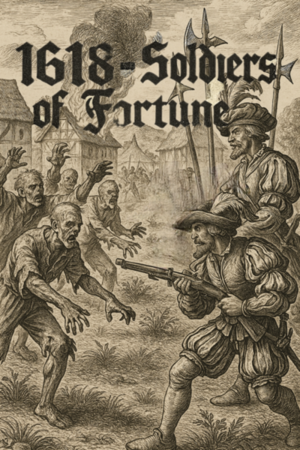
1618 - Soldiers of Fortune
I followed the soldiers through several narrow lanes until we reached the northeastern quarter of the city, the upper town.
Once the district of wealthy nobles and patricians, it now served as the stronghold of a Landsknecht host.
It stood upon a hill, crowned at its highest point by a stone keep.
The city lord had dwelt there until his death, childless, some fifty years before.
Thereafter the trading consortium had purchased the seigneurial rights and placed them under the direct authority of the council, whereby the castle had fallen largely into disuse, the affairs of the town being conducted thenceforth in the hall of the magistrates.
I wondered why they did not avail themselves of the castle as a refuge against the dead.
Yet its isolated situation and want of supply would render it fit for no more than a last resort, I concluded.
Below the keep lay two broad squares, lined with elegant merchant houses, each centred about an imposing fountain.
Streets ran along the edges of the plazas, flanked by tall townhouses.
We turned into a side street and came out upon the smaller of the two squares.
Here the remains of the Tross ¹ had gathered: chiefly the women and children belonging to the soldiers, but also those camp followers, entertainers, and itinerant hawkers who had fled hither for safety.
Though commanders commonly despised such folk for slowing the march and consuming provisions, their presence did, at times, raise spirits.
But how so many mouths were to be fed, I could not see.
I noticed a long line forming before one of the emptied houses.
It stretched nearly to the centre of the plaza and grew with every moment.
“What do they queue for?” I asked.
“Mustering,” replied one of my escorts.
“Mustering? You mean… you are recruiting? At such a time?”
“Aye. Many offer up all they still possess merely that they may join our ranks.”
“I see,” I murmured.
In such a calamity, there seemed little safety anywhere, save perhaps among armed men, if any safety remained at all.
At the far end of the square, before one of the largest and finest townhouses, we halted.
My escorts exchanged a few words with the guards at the door, and we were admitted.
Aside from a few guards, only the Obrist and his officers were within, assembled in a large hall upon the upper floor.
When the soldiers brought me in, a heated dispute was already in progress.
“This is madness! I shall not send my men to their deaths again!” one officer cried.
“What alternative have we?” another retorted. “No messenger has returned to us. This is our sole chance of learning aught!”
“And who, pray, will volunteer for such a venture?” the first demanded. “Most have scarce recovered from their first encounter with those creatures, and you would fling them at them again?”
He turned toward a figure seated at the long table, poring over a map spread wide upon it.
“Sir, it is a suicide mission. There must be another way. Are there truly no other dovecotes ² in the uninfested part of the city?”
The Obrist looked up.
His wavy black hair was streaked with grey, his temples receding; his deep-set, grey-blue eyes held a certain melancholy and yet a sober gravity.
He frowned.
“There is only one dovecote in this damned town. If you have no better counsel we have no choice but...”
He broke off when he noticed me.
“And what do you seek now?”
I stepped forward and drew forth the scroll I had found upon the dead rider.
He looked up at me.
“You are a courier?”
“No, sir. The man who bore the letter lies dead. I found him a mile outside the town.”
“You came from outside? Today? And you have not read it?”
“I cannot read at all,” I admitted.
The Obrist regarded it with a mixture of disbelief and hope, before he tore the seal open and angled the message toward the firelight.
All in the room watched him, scarcely daring to breathe.
At first his expression remained stern, then, faintly, the corner of his mouth twitched.
“This letter is addressed to one Peter Dämmerer. It bids him, I quote, ‘…come to Kernstett with all haste, that the agreed exchange of goods may be concluded. In light of recent events, prompt settlement at the customs house is required. My personal courier shall accompany you and explain the remainder.“
He cast the letter into the hearth, where the flames consumed it in moments.
A general deflation ran through the chamber.
All that effort for a message that could scarcely have been of less consequence?
Nothing about the Wiedergänger.
No news from other cities.
“And I thought we should at last receive answers,” the protesting officer muttered. “Damn shame.”
“Yes,” the Obrist said quietly. “Indeed.”
He noted the disappointment in my face.
“Leave us,” he said. “I would speak with this man alone.”
When the others had gone, he studied me for a while in silence, his jaw tight.
“Do not trouble yourself,” he said at last. “You acted in good faith and could not know what it contained.”
“I thank you, sir,” I replied, though the words gave me small comfort.
“I must ask you a few questions.”
I nodded.
“You appear healthy and well-fed. Your clothing is of decent quality. You are no peasant. Yet you are not one of my Landsknechts either. Are you a merchant?”
“My father is a breeder and trader of horses nearby, our estates lay south” I said.
“And how did you reach the city,” he asked, “with that host of dead before the gates?”
“I forced my way through. At full gallop they marked me late and could not catch me.”
He nodded with a faint gleam of approval.
“You are a bold fellow. And it seems you have already gained some experience with these creatures. I could make use of such a man.”
“You mean that matter the officers were quarrelling over? The… suicide mission?”
The Obrist allowed himself a weary smile.
“Hauptmann van Arens has many qualities. Courage is not among them. Do not let his fear master you. Considering what befell his company, one might even pity him.”
The whole prospect made me uneasy.
I had scarcely found refuge, and now I was to be cast back toward peril?
Whatever the Obrist said, the thought of it sat ill with me.
Besides I had my own arrangement with Hauptmann Harrer already, so I resolved to raise it.
“Sir,” I began, “I… in truth, I am already among your officers. Of a sort.”
He stared at me.
“I do not mean to presume,” I added quickly. “One of your men, Hauptmann Harrer, appointed me lieutenant two days ago. If he is here, he will confirm it.”
The Obrist’s face grew unreadable.
When he spoke again, his tone was cold and even.
“Then you are not so clever as I had thought.”
He leaned back.
“Master Harrer kept his purse well lined enough, whilst presenting me with one incompetent officer after another. But his little trade in commissions is finished. Before I could call him to account, the swine was taken by a revenant harlot yesterday. Believe me, I did not mourn him.”
His gaze hardened.
“Coin once opened many doors,” he said. “So do favours. But Death itself has come among us, and with it other measures. I shall not stake the lives of my men on the pride of one who mistakes his purse for worth.”
I cursed my own folly and feared I had overstepped my place.
But the Obrist was not as angered as I had thought.
He sighed, closed his eyes, frowned, then regarded me again with a steadier expression.
“Listen,” he said. “You seem spirited and bold. If you would gain my favour, you must first prove yourself. Seek out Hauptmann van Arens and tell him I have sent you to assist him in the matter of the dovecote. If you distinguish yourself under him, we shall speak again.”
“Then I am to serve under him?” I said.
He shook his head.
“No. Consider it rather as a… factotum. As a local, a merchant’s son, you know this city better than any of my men. Your knowledge may be of use to him.”
For a moment I thought I had misheard him.
The idea pleased me little.
A page, then. A glorified servant.
Yet refusal was no true choice, and service, however mean, was safer than standing alone.
”Very well,” I said, and inclined my head.
The Obrist nodded.
“Hauptmann van Arens cannot have gone far. You may yet catch him. Good day.”
He turned back to the wide map upon the table.
I had almost reached the door when he spoke again.
“One thing more.”
“Yes, sir?”
“Pay no heed to the prattle about the world’s end,” he said. “A few weeks past the Elector of Brandenburg granted me a patent to raise this regiment. ³ A great war was coming, that much was certain. Whether we be crushed by shot and steel or devoured by Death himself matters little. In the end, the result is ever the same.”
I inclined my head and left the room, thinking about his grim words.
Glossary
1) A Tross was the camp follower contingent of a mercenary army, comprising women and children, craftsmen, labourers, sutlers, entertainers, and other non-combatants who lived and travelled with the army.
2) A dovecote was a structure for keeping carrier pigeons, used to send messages when roads were unsafe or cut off. Control of a dovecote meant control of long-distance communication.
3) A patent was a formal commission issued by a ruler, authorising a military contractor to raise soldiers in his name and command them.









Please sign in to leave a comment.