Chapter 41:
Chapter 41: The Spectrum's Eyes
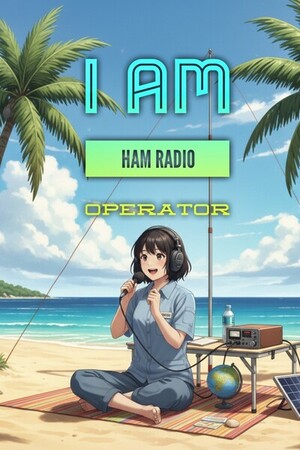
I am Ham Radio Operator
The glowing monitors in my shack are the only source of light in the room, casting long, dancing shadows against the walls. It is a Friday night, the end of a grueling week at the aerospace lab designing waveguide filters for a new satellite bus. My brain should be tired. It should be begging for sleep or a mindless movie. Instead, it is humming with a specific, quiet frequency of curiosity.
"So, explain this to me again," Ashley says. She is sitting in the spare chair I have pulled up to my desk, her eyes wide as she stares at the second monitor. She is the high school student I met at the convention, the one who is now a regular on our local repeater. "You are listening to the radio, but you are not using your radio?"
"Exactly," I say, leaning forward to adjust the window on the screen. "Or rather, I am using someone else's radio. Look at the URL."
I point to the browser address bar. It reads kiwisdr.com. The page displays a waterfall much like the one on my own SDR software, but the signals are different. The noise floor is different. Even the static sounds different.
"This is a KiwiSDR," I explain, my voice dropping into that comfortable, teaching cadence I have developed over the years. "It is a web-based receiver. This specific one is located in a small town in northern Finland. Right now, we are listening to the 20-meter band, but we are listening with ears located inside the Arctic Circle."
Ashley watches the screen. A bright yellow streak appears on the waterfall. Audio bursts from the computer speakers—a rapid-fire stream of Morse code.
"That is a Russian station," I say, decoding the dits and dahs in my head without even thinking about it. "He is calling CQ. He is loud in Finland. Now, look at my radio."
I gesture to my own high-end transceiver sitting on the desk next to us. The same frequency is tuned in. The waterfall on my local screen is dark blue, empty. The speaker is silent save for the gentle hush of local noise.
"I cannot hear him here," I say. "Propagation is not open between Russia and my apartment right now. But in Finland? He is booming. This is the power of remote monitoring. It gives you ears all over the world."
Ashley nods slowly, processing this. "So, you use it to spy on bands?"
"I use it to see myself," I correct her. I reach for my Morse code key. "Watch this. I am going to transmit. My antenna is beaming towards Europe. If the path is open, that receiver in Finland should hear me, and the sound will come back to us over the internet."
I press the key. Dit-dit-dah-dit. My callsign, 9W8ABC.
We wait. There is a latency, a delay caused by the internet routing the audio data from Finland back to my computer. One second. Two seconds.
And then, from the computer speakers, clear as a bell, comes my own signal. Dit-dit-dah-dit.
Ashley gasps. "That is... that is you. But it is you in Finland."
"It is me in Finland," I agree, smiling. "It is a way to test your signal. To see if you are getting out. To hear exactly what you sound like to a person on the other side of the planet. It removes the guesswork."
I switch tabs. "And this," I say, pulling up a different program, "is the other end of the spectrum. Literally."
I pick up a small, rectangular dongle sitting on the desk. It looks like a cheap USB flash drive. "This is an RTL-SDR. It costs about twenty dollars. It was originally designed to watch digital TV on a laptop. But some clever hackers figured out that it is actually a wide-band radio receiver."
I plug it into a spare USB port and launch a program called SDR#. The screen fills with a chaotic mess of signals. FM radio stations, police dispatch frequencies, local pagers, aircraft transponders.
"This is the local RF environment," I say. "This is the invisible soup of radio waves we are swimming in right now. With this little dongle, you can see it all. You can monitor the local repeater input to see who has a stuck microphone. You can track airplanes flying overhead by decoding their ADSB signals. You can even download weather images directly from NOAA satellites as they pass over the house."
Ashley picks up the dongle, turning it over in her hands like it is a precious jewel. "Twenty dollars?"
"Twenty dollars," I confirm. "Ham radio does not have to be about expensive transceivers and giant towers. It is about understanding the spectrum. It is about knowing how to listen. Sometimes, the most powerful tool in your shack is just a little piece of plastic and some curiosity."
"I want one," she says instantly. "I want to see the airplanes."
"We can build an antenna for it this weekend," I promise. "A simple ground plane. It will work great."
Later, after Ashley leaves, I sit alone in the shack. I switch off the room lights, letting the glow of the monitors wash over me. I bring up the map of KiwiSDR receivers again. Hundreds of green dots scatter across the globe—receivers in Brazil, in New Zealand, in Japan, in South Africa. Each one is an open ear, waiting.
I think about the sad-hams, the ones who tried to drive me out of this hobby. They are stuck in their ways, stuck in their local geography. They only hear what hits their own antennas. They are deaf to the rest of the world because they refuse to use the tools available to them.
But I am not deaf. I have the spectrum's eyes. I can see the propagation paths opening and closing like breathing lungs. I can hear the whisper of a signal in the noise floor of a receiver five thousand miles away. I am connected in ways that my grandfather, Kenji, could never have dreamed of, yet the spirit is exactly the same. It is the desire to reach out. To know. To connect.
I tune the Finland receiver back to the CW portion of the band. The Russian station is still there, working a pileup of Europeans. I close my eyes and listen to the rhythm, the music of the code. It is peaceful. It is orderly.
But I know this peace is temporary. Samuel has been messaging me all week. The calendar on the wall has a date circled in red marker. Next weekend is the last weekend of November.
The CQ World Wide CW Contest.
Samuel calls it "The Big One." He calls it "War." And for the first time, our team—W1Z—is entering the Unlimited Multi-Operator category. We are not just dipping our toes in. We are diving into the deep end.
I open my drawer and pull out my heavy, Bencher iambic paddle. I adjust the spring tension, making it tight, responsive. I plug it into the radio and switch on the side-tone.
Dit-dah-dit-dit.
My fist is good. My speed is up. I have been practicing at 35 words per minute. But is it enough? Contesting is not just about speed. It is about endurance. It is about processing chaos. It is about managing panic.
I look at the SDR screen one last time. The waterfall is calm tonight. But I know that in a few days, this screen will be a solid wall of fire.
"Bring it on," I whisper to the empty room.







Please sign in to leave a comment.