Chapter 6:
Chapter 6 Middle Island high school (中嶋高校)
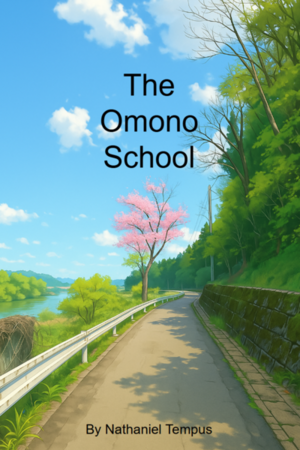
The Omono School
Thursday 07-04-2022
I began today like I had the day before. Early in the morning and with birds chirping in the background. I once again slipped into my suit and tie. The translation device still had some battery left, largely because I had used it only intermittently yesterday. After all, I already possess a modest understanding of the Japanese language. and I do not want to become dependent on something that could so easily fail. After I finished getting ready I began to make my way to the school. Just like yesterday, the elderly residents watched me and my classmates as we made our way to school.
Justin then a couple of my classmates Rimi and Miai caught up to me. Miai whispered to me in a quiet voice “Daniel, don't you think this is just kind of weird? The way the elderly residents casually watch us on our way to school?”
Rimi followed up by whispering “Yeah, they watch us as if we are some kind of spectacle on TV… I was hoping you might know why they're doing this.”
I stood there for a second, caught off guard by the question. After about 30 seconds I responded with “They might just be nostalgic, thinking about when this town was more populated, back before it became so old and quiet.” I looked back at Rimi. She had a perplexed look on her face.
“Rimi, is Something wrong?”
The perplexed look on Rimi's face then snapped away. “What do you mean by ‘when the town was more populated’? Because when I left in the 1980s, Japan was still crowded. You couldn’t walk down a single street in Osaka without bumping into a dozen people. Now…” She looked around the quiet road, the rows of aging houses, the elderly faces watching from their doorsteps. “Now it feels like a ghost town. What happened?”
Her voice wasn’t angry, just uncertain, as though she couldn’t quite understand what time had done to her country.
I took a slow breath. “It’s… complicated, Japan’s population peaked in the late 2000s. Since then, it’s been falling year after year. Fewer children, more retirees. Whole towns like this one just aged. Young people moved to the cities, and the countryside emptied out.”
Rimi blinked. “So you’re telling me that in forty years, Japan went from overcrowded to… this?”
“Basically yes, a lot of rural towns never recovered. Some places even merged with neighboring towns to survive. Others were just abandoned.”
Miai frowned, looking back over her shoulder. “That’s kind of sad, isn’t it? The people left behind they just… stay here? Watching us go by like it’s something new?” She then gestured toward the quiet street, where an old woman swept her porch in deliberate, careful strokes.
At that moment Rieko caught up to us; she was just as weird out by the locals as everyone else. After Rimi informed her of Japan's population decline she was shocked. “Maybe they just want to see some youth again. Can’t really blame them for that.”
We continued walking. The morning air was cold, as is typical for Daisen in spring. The nearby fields were barren and smelled unpleasant. When we made it to the school, we were greeted by the deputy headmaster, and beside him was the school's old nameplate. It was made of brass and was clearly quite old. It bore the school's old name, Nakajima High, its letters dulled by time. The metal caught the faint light of the morning, reflecting it unevenly, like an old memory refusing to fade completely.
Once we made it to our class. I glanced out of the window back outside. My homeroom class looked out onto the Omono River. Its waters flowed like the passage of time. A single drop of water may only pass through that river once in its entire existence. That is the natural order of things I suppose. The world changes, people leave, towns empty, but somehow, everything keeps its rhythm. The way the act is being carried out might be different, but the act itself, walking to school under the same pale sky, has probably played out here a thousand times before.
The teacher’s voice broke through my thoughts.
“Good morning, Today will be the first day of medical sciences: specifically, How to be as resourceful as possible when on a mission with limited resources.”
His voice carried the kind of quiet authority that demanded focus and respect without ever raising his volume.
He then gestured towards the shelves at the back of the class. On the shelves were rows of compact black cases. “Before we begin, each of you will take one of those, they are standard rehearsal Field Medical Kits.”
Once the professor finished his instructions, we all got up out of our seats and made our way to the back. When my turn came, I lifted one. It was heavier than I expected, cold to the touch and the surface was smooth like polished stone.
“Inside, you’ll find tools adapted for use across multiple centuries. Some of what you see will be familiar: splints, gauze, thermal injectors. Others are products of the 21st century. You will learn each of them by heart before you ever deploy into the field.”
He walked to the board and pulled down a projector screen, then he went to his computer from which he was able to turn on the projector. On the screen was a diagram of the human body, color-coded by systems.
Then he began. “Being a time traveler is a dangerous occupation. One of the many dangers a time traveler may face is not being able to have access to adequate Medical Supplies. As well, the past is a dangerous place and the future is no different. By being a time traveler you put yourself in severe medical danger from both injury and infection. A small wound in the wrong century could turn fatal, and a simple fever might become untreatable without the proper tools. That is why medical knowledge, even at a basic level, is considered essential to survival. Any questions?”
Aya Raised her hand. “When time travelling to various points in history are we permitted to treat locals?”
“That’s a good question, Aya. The short answer is: no, not without authorization. When traveling to another time period, your primary responsibility is the safety of your team and the preservation of the timeline. Treating locals, no matter how minor the injury, can have unforeseen consequences. You see, the introduction of modern medicine, even something as simple as antibiotics or a sterile dressing, could alter the course of local medical development or even save someone who was meant to die.”
He continued, pacing slowly in front of the screen. “However there are exceptions. If your mission commander explicitly grants permission, or if your inaction would result in unnecessary loss of life directly or indirectly tied to your operation, or if the injury is deemed too minor to seriously impact the timeline, you may intervene. You should think of it as controlled interference. You’re healers, yes, but also custodians of history. Sometimes, compassion means restraint. All right, are there any more questions?”
From the back of the class, Miai raised a hand. “Doctor, is the kit designed for all species of humans? Say, pre-industrial populations with different immunity levels?”
“Excellent question, The kit is adaptable. Its systems are designed to calibrate to the subject’s genetic baseline. However, if you are treating someone native to another century, you must avoid modern antibiotics or nanofibers. They could introduce pathogens or knowledge into a time period where they do not belong.”
He paused, letting the implication hang in the air. “Every act of healing must also be an act of restraint.”
He opened one of the kits and withdrew a thin translucent patch. “Observe.” Pressing it to a mannequin’s forearm, the patch shimmered faintly, then hardened, forming a transparent membrane. “This bio-gel bandage closes wounds by stimulating temporary cell cohesion. It is not a cure, merely a delay. It buys you time, nothing more.”
He moved to a second mannequin. “If you need to treat someone suffering from hypothermia, you can use this.” The teacher then pulled out a plastic bag filled with some kind of powder. Then he crushed it with his right hand before putting it on the chest of the mannequin.
“You use the thermal stabilizer. It releases a controlled burst of heat that could be used to keep somebody warm for a short period of time. Like with the bandage it is only a temporary solution and only buys you time, however time is valuable and if you're able to use it effectively you could essentially guarantee survival.”
For the remainder of the class, we practiced basic procedures: wound closure, Fracture management and chest compressions. The mannequins emitted faint beeps that simulated vitals. Each mistake was logged automatically on our terminals.
Takahashi paced up and down the room, muttering “Remember you're not surgeons yet you're stabilizers. Your job is not to heal, but to preserve. The difference is the difference between life and death”
When the bell rang, he stood at the door, nodding as each of us left. “Good work today. Tomorrow, we test under pressure.”
Archery
When we entered the Security and Defense classroom the next morning, we all stopped short. Overnight, the place had changed entirely.
The racks of swords and rifles were still there, but the desks had vanished, replaced by straw targets lined along the far wall, each marked with concentric red and white circles. A faint scent of cedar and string wax hung in the air. The polished tile floor had been covered by long mats of woven reed, and bundles of bows rested neatly on a table at the front.
Colonel Masaru Shimazu stood at the center of the room, hands folded behind his back, surveying us with the calm intensity of a man who had already seen every possible mistake his students might make.
“Good morning,” he said, his tone clipped but steady. “As you can see, our classroom has undergone a small transformation. For the next several sessions, we will be studying archery, not merely as a sport, but as art, discipline, and history.”
He gestured to the rows of bows. Some were the short recurve design favored by nomadic horse archers; others the elegant, asymmetrical longbows of the Japanese kyūdō tradition. A few looked startlingly modern, sleek, composite-limbed instruments of precision.
Shimazu then spoke. “Every age has known the bow. It is a weapon older than iron, older than empires. The man who masters it does not rely on brute strength, but on patience, calculation, and calm.”
He stepped toward one of the stands and lifted a traditional yumi, a tall Japanese bow nearly as long as he was tall. Its curve caught the light like polished bone.
“In my youth, before the rifle replaced the bow, a samurai’s skill with this weapon was a matter of pride, not for the killing (though it killed well) but for the focus it demanded. Every arrow set loose was a measure of one’s spirit.”
He turned to face us. “Today, you will each fire five arrows. Your goal is not merely accuracy, but composure. If your hand shakes, your mind wavers, your arrow will betray you.”
Rimi Chikara, in a bout of overconfidence was the first to step forward. “Sounds easy enough,” she said, grinning. “Just point and shoot, right?”
Shimazu’s eyes narrowed slightly. “We shall see if your confidence matches your aim, Miss Chikara.”
We lined up, ten of us at a time. Emiko Tanaka adjusted her posture with calm precision, her every movement deliberate. I remembered from yesterday that she had competed in archery before; she held the bow as though greeting an old friend.
Ibrahim stood beside her, studying the bow’s grip as though it were a puzzle. Meanwhile, the head banchō from Tokyo, whose name I’d learned was Kenta, slouched in line with the delinquent girl from Yokohama. Both were whispering jokes, trying to hide their nerves beneath forced bravado.
When Colonel Shimazu gave the signal, the room filled with the soft thwap of strings and the hiss of arrows. The first volley struck the targets unevenly, some hit dead center, others glanced off the edges. Rimi’s first arrow hit the wall two meters wide of her mark, the second hit the outer ring of the neighboring target, both earning muffled laughter from the Kanto delinquents.
Shimazu said nothing. He simply walked along the line, observing, adjusting stances with a tap of his wooden practice sword. When he reached me, he said only, “Lower your shoulder. Do not fight the bow; let it fight you.”
Emiko, as expected, was a natural. Her first arrow hit near the center; by the third, she had found her rhythm, each release smooth and almost meditative. The string thrummed, the arrow flew, and silence followed, the type of silence that comes from respect.
Rimi, not to be outdone, clenched her jaw and adjusted her stance. “All right, let’s see how that feels.” Her next shot struck near the inner ring. She turned to the others with a victorious grin.
“That was luck,” Kenta said. “Try doing it again.”
Rimi’s grin sharpened. “Gladly.”
The colonel allowed their rivalry to unfold, saying nothing, merely pacing behind them. His silence was its own form of instruction.
By the third round, competition had broken out in earnest. Rimi and Kenta exchanged taunts with every shot. Ibrahim, quiet as ever, focused with almost meditative calm, adjusting his grip between each draw. His arrows grouped tightly near the center, earning a few impressed looks.
In the fourth round came the modern bows. Colonel Shimazu handed them out like testaments from a different era. They were still recognizable as a bow yet equipped with tension pulleys and digital sights. “Now, we bridge centuries. The principle remains the same: precision through stillness. Yet technology tempts you to trust the tool more than the mind. Do not.”
Emiko volunteered first, and her shots were decent, not as impeccable as with the more traditional bows. But by all means Impressive. still landing the majority of her shots In the innermost ring. However, for many other students the compound bow felt alien, their balance different and their pull heavier but smoother.
When Kenta’s arrow split one of Rimi’s already-embedded shafts, the room erupted into laughter “Bullseye!” he shouted. “That’s how Tokyo does it!”
Rimi stomped her foot. “That doesn’t count, you used my arrow as a guide!”
“Then stop missing,” Kenta replied, grinning.
Even Colonel Shimazu allowed himself a faint smile. “Competition is a fine teacher. So long as it does not blind you. Remember: an enemy in the field will not applaud your precision. He will return it.”
By the fifth round, we were all drenched in sweat. Shimazu instructed us to retrieve our arrows and gather in a semicircle. He set the yumi down carefully before speaking.
“In time travel, you will encounter weapons like these in many centuries. From the English longbowmen at Agincourt to the samurai of the Genpei War, the bow changed the balance of power again and again. But do not forget the principle is eternal. Distance and patience are the archer’s shield.”
He looked at us, one by one. “You may think of yourselves as students. In truth, you are soldiers of knowledge. You are not here to glorify violence, but to understand it, to master it and to dominate it. This is so that when you face it, you may choose restraint over chaos.”
For a long moment, no one spoke. Even Kenta and Rimi had gone silent, their earlier rivalry cooled into respect.
Then Shimazu gave a sharp clap. “Very well, that should be it for today. Tomorrow will be more of the same but starting next week things will begin getting more complex. You will learn to shoot at moving targets, while walking and eventually from horseback.
When we left the room, the scent of cedar lingered on our clothes. We all wore it like a badge of honor: That for the first time as time travelers we had handled the great weapons of History.
Lunch – Thursday, 07-04-2022
By the time the clock struck 12:00, I was starving after a solid hour of archery, my arms ached fiercely from drawing the bow.
As students streamed into the hallway in uneven waves, some laughing, others slouching under the weight of their bags. The scent of cooking rice and grilled fish drifted faintly through the air, guiding everyone toward the cafeteria like a current. I followed along, moving through the crowded hall. The noise of voices bounced off the walls. Despite the chaos, it all carried a strange harmony, the rhythm of people settling into a shared routine.
The day’s menu was handwritten on a chalkboard: Grilled mackerel with miso glaze, rice, daikon soup, and matcha or black tea.
As I moved through the line I noticed that the cafeteria was filling up at quite a fast rate and I might not be able to find a seat. So after I finished up with my meal, I decided to eat somewhere different. Balancing my tray, I slipped toward the far side of the cafeteria then I walked out, heading to the hallways.
However it didn't take long for me to find a spot. Just outside the cafeteria there was a door that read: ‘Rooftop Access. Authorized students and staff Only.’” But the latch wasn’t locked. So I took that as an invitation. I nudged it open with my shoulder and climbed the stairs. The stairwell smelled faintly of concrete dust and sun-warmed metal. As I climbed, the hum of the school faded behind me, replaced by the soft whir of the rooftop fans and the distant caw of crows. When I finally pushed open the metal door, a gust of wind met me. The air was clean, sharp, carrying the scent of pine.
The rooftop was wide and open, surrounded by a tall chain-link fence. Several benches had been arranged along the edges. In between the benches there were potted plants. Also, someone had even set up a small table with a parasol.
I wasn’t alone.
Ibrahim had also found his way to the roof and was quietly praying the noon prayer, Tadano was peacefully sipping his soup under the parasol. On the benches were an assortment of students, some I recognised some I did not. The students I did recognize were: Mailing, the quiet girl in the back of my class, The war veteran from the back of Security and Defense, The girl who sits next to me in time engineering, That 14-year-old who always seems to have a question. And finally Hiroshi. We both share a home room class and never talk to each other.
Tadano looked up when I approached. “Didn’t expect to see you here.”
“Mind if I join you?”
I set my tray down opposite him at the table. “Yeah, same. Cafeteria’s too packed. You’d think half the school’s never seen grilled fish before.”
Tadano chuckled quietly at that, the sound almost lost to the breeze. For the next few minutes, we ate in silence. Ibrahim’s quiet prayer blended with the rustle of the parasol above us, and Mailing had finished her food and was quietly reading a book.
When Tadano finished his soup, he looked out toward the fence and where the Mountains framed the sky. “It’s strange, isn’t it? How we’re all here, together, but none of us really know why we were chosen.”
“You know I’ve been thinking the same thing. Everyone’s from somewhere different. Some from Tokyo, others from Osaka and some more from overseas, Never the same age, different fields. It feels deliberate and random at the same time.”
“Like pieces of a puzzle that don’t quite fit yet,” he murmured.
I took a slow breath, the smell of pine sharp in my nose. “I don’t think I’ve felt… real yet, ever since we woke up here. I keep expecting to blink and find myself back home.”
He nodded slowly, eyes now tracing the edge of the horizon. “I used to feel that way when I lived with my father who was stationed overseas in Djibouti. It was somewhere new with a foreign smell and different lights, and it all felt like a dream.”
I asked quietly. “Did it get easier?”
“In the short and medium term no, but over time you learn how to make temporary places feel permanent. And once a dream becomes permanent it becomes reality and you stop waiting to wake up.”
His tone was decisively lukewarm, to warm to be cold and to cold to be warm. But it was reassuring. And in these kinds of situations that's all what it needs to be.
I watched the sunlight glint on the fence. “So I guess that’s one way to survive.”
The conversation ceased for a moment. We ate quietly, the world around us softening into the kind of silence that only happens when no one feels the need to fill it. From somewhere below, a bell rang faintly. Marking the halfway point of lunch.
“So, Daniel, what’s your theory?”
“My theory?”
“About this place. About why we’re really here.”
“I think they’re studying us… not just what we learn, but how we react. How we adapt to being pulled out of our eras and told to live like it’s normal.”
He didn’t respond right away. The breeze picked up, lifting a strand of his hair.
“That’s a very clinical way to look at it,”
“Maybe, but it makes sense. Everything’s too controlled: the lessons, the schedules, the food. even the door. They left the sign up, then left it unlocked on purpose. To see who’d try.”
“You think we’re rats in a maze?”
“Maybe. But I’d like to think we’re the kind that notices the walls.”
A moment later, Mailing turned her head slightly, speaking for the first time. “If that’s true, then maybe the trick isn’t noticing the walls. Maybe it’s pretending they’re not there… until they forget to watch.”
We both turned toward her. She smiled faintly, then looked back down at her book.
Tadano exhaled. “Maybe we’re all overthinking it, Maybe they just want us to learn.”
I didn’t answer right away. The wind pressed softly against my back, and I looked out beyond the fence, at the mountains, at the pale blue sky that stretched so far it almost hurt to look at.
“I think learning and surviving are the same thing here,”
The rooftop returned to its quiet rhythm.
Tadano looked at me again, thoughtful. “Do you think they’re testing us?”
“Probably,” I said. “But not just in class. I think everything we do here: where we sit, who we talk to, how we react, it’s all part of the evaluation. They want to see how people adapt to displacement.”
He considered that for a long moment. “If that’s true,” he said finally, “then maybe finding peace up here is part of passing the test.”
I smiled. “Then I guess we’re doing all right.”
The sun had shifted slightly, catching the metal of the fence and turning it pale gold. Ibrahim finished his prayer and joined us by the parasol, nodding politely to both of us. A few other students trickled in and out, carrying trays, exchanging quiet greetings.
For a while, the three of us talked, not about classes or time travel, but about ordinary things: food from home, how the insulation of the apartments was not the best, and the fact that if you listen real closely and carefully you can hear your neighbors talking. It was small talk, but it felt necessary. Like building a bridge, one word at a time.
When the bell finally rang, signaling the end of lunch, Tadano stood, gathering his tray. “Same time tomorrow?” he asked casually.
“Maybe,” I said, smiling. “If the door’s still unlocked.”
He gave a quiet laugh. “If not, we’ll make another way up.”
As he left, the wind caught the edge of the parasol again, and for a fleeting second, I thought about how strange it was how, in just two days, a rooftop could already feel like a refuge. However, as I descended toward the next round of classes, one thought stayed with me: a quiet realization that for all our differences in time and place, we were all bound by one fragile thing: the desire to belong somewhere.



Please sign in to leave a comment.