Chapter 6:
Nightfall
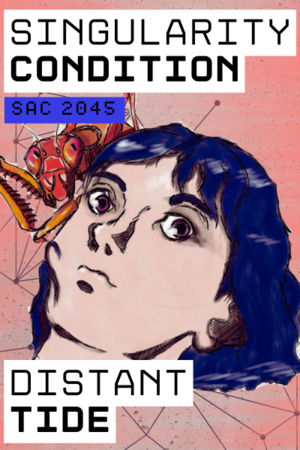
SAC 2045: Singularity Condition
"Living with My Ghost — NIGHTFALL"
Osaka, Nukekubi Japan, 2036
. . .
The city didn’t look like the result of nuclear fallout, but the darkness could not hide a new flatness added to the land. Remaining car and floodlights glowed in the distance, flickering in different directions and patterns through the silent night. As the search and rescue effort turned from hours into days, the chances of finding survivors would decline. Still the rescuers and desperate families continued their work through the night, scared and hopeful they would find loved ones alive among the rubble of Osaka Bay.
Some Section Nine members were still out here too, picking through the rubble but a little further east and upriver. Kusanagi didn’t follow the lights, instead she wandered toward the waterfront to the tune of her crunchy boots on fields of scattered debris.
Out in the bay below Osaka, Kusanagi could see the glow-over of emergency and military tugboats buzzing around the half-sunken, Niihama capital mega float. The man-made island was difficult to make out now, a series of half-submerged towers—some to the East, bending and dangling on their last concrete supports at inconsistent 30 degree angles.
The disaster intelligence reports the Prime Minister fed to Section Nine suggested Niihama Island’s hybrid concrete-landfill foundation snapped under the tidal forces of the tsunami. Years of saltwater weakened the reclaimed terrain and ate away at the island’s superstructure. Meanwhile, the megathrust earthquake drove fractures as far as several kilometers inland. No doubt Niihama was another victim to the fractured seabed. But with its collapse, gone were some recent physical memories of Kusanagi’s past.
Among the toppled skyscrapers, at least one was Section Nine’s old Niihama headquarters. Their unit used to operate from the fortieth floors, now empty with water damage and shattered glass. A curious thought wondered if evidence of Section Nine’s old operations, or battles, still hid in those halls. Togusa’s old townhouse was somewhere behind her in the Osaka suburban high rises, now phantom pyramids against the dark, steep foothills around the Greater Yodo river basin. The Camp Yao airport was a fountain of lights compared to the fallen city. Kusanagi’s aimless path lay in these shadows. The military base faded behind her against some slant, rusted warehouses of the older, Old Osaka Waterfront. Two decades before, the concrete roads and container stores were also part of the open waters.
In a strange twist, the deeper Kusanagi clambered through the darkness, the more she felt the call of the Net. Her heavy footfalls trudged through endless mud and all manner of organic and inorganic debris. She could multitask in her sleep. Breathing while walking and surfing the Internet was a cakewalk in comparison. And so she found herself back on the Net, doom scrolling through endless headlines and forum posts—most aggregated from the Niihama Television home page. Unfortunately, their site also wore the unavoidable banner at the top: EARTHQUAKE EVACUATION IN NIIHAMA. HUMAN SERVICES SUSPENDED. IN CASE OF EMERGENCY, CONTACT EMERGENCY SERVICES #119—@BOUSAI.GO.JP.
Of course, the top simulated stories therefore were about the Nankai.
TOP STORIES: EARTHQUAKE
(NHTV) Live Updates: Death toll climbs, Rolling blackouts as South Japan search and rescue effort continue
(SCTV) Video: Nankai tidal wave crashes over abandoned Tokyo One, Reconstructors evacuated
(MDSI) Hamaoka, Ikata, Tokai nuclear reactors see temporary shutdown for damage risk, Radiation micromachines dispersed
(OXTV) Video: Blame flies as Niihama Mega Float foundation falls to tsunami
READ MORE. . .
In the current day, big media outlets became auto-generative aggregates of social media content. A speculation loop complex. Amateur images, video, and commentary scanned by web-crawling programs as formatted data. Contextual information processed into human content by generative ghost-writing services built on data sets of once-greats for sprinkles of personality. And hordes of consumers increasingly less human day after day. Articles and videos spun and weaved together based on lies and truth with no distinction between the two. And yet reality still held on by a thread.
Niihama Television and other platforms operating to the march and tune of cold machines was not their fault however. Not entirely at least. The earthquake and tsunami were circumstances out of their control, and passive operation and income would keep the business lights on, even after the eventual reconstruction. The other causes—according to Japanese scholars of the day—culture, economy, and war.
A consequence of a spiraling, inescapable unreality created by real circumstance. In this strangeness, a collective reality survived, through average people—from journalists to business people to consumers. The reality of the media industrial complex was a game of diminishing reality, of entropy—less travelers, less news offices, less people. Automation took over because there wasn’t enough people left to tell the stories of civilization, lost both to war and to a global society scared to bring new life into an unfeeling, cold world. And even more were gone now, day after day in a numbing tragedy. From earthquake to tsunami, from depression to old age. So many were dead, but how was one to feel for just a number in a paragraph on a screen?
Kusanagi could mourn because she held the survivors and dead in her cold machine hands. But what about the people outside the disaster zone?
A scrolling, news bulletin zipped across Niihama Television’s secondary banner: “Immediate death toll estimates rises to four thousand, expected to balloon into tens of thousands.”
Kusanagi’s boots continued to find new treasure to stomp in the debris fields: broken glass, gravel, mud, loose wood, contorted plastic, seaweed, and warped metal. But not humans, no fresh bodies. The rescue crews were already through this place. Kusanagi went with them on her first afternoon. She tuned out her thoughts as new headlines filled her unfocused retinas.
[They] were talking about Kayabuki again. Of course they were, between journalists and social media users, but who could tell the living, dead, and machine apart?
TOPIC: PRIME MINISTER
(MDSI) Ousted Kayabuki cabinet protests national security law following biography legal pause
(CBB) Chief Cabinet Secretary disputes ‘selfish’ PM Kayabuki refusal to evacuate in tsunami
(NHTV) Video: Fleet air boss protests Kayabuki administration over favored anti-submarine jet retirement
READ MORE . . .
At least one headline brought a smirk to the Major’s face. The ousted Chief Cabinet Secretary Takakura was a familiar face. He helped bring about the Individual Eleven incident almost four years ago, and now serving prison time on corruption charges. He was not the mastermind, but he brought Japan to the brink of war between America and Asian refugees; now he cried foul from his cell block over national security laws he helped codify. The same laws of which now censored his stalled biography.
The secretary’s new replacement was having a difficult evening instead covering for Kayabuki’s attempt to stare down a tsunami. Probably not helped he was there too, staring down the disaster when Section Nine came to his and the staff’s rescue. And somewhere between all of the pointless news—a stray article bubbled to the top: some high ranking flight officer didn’t like the Prime Ministers snubbing the Americans again, this time over some foreign-licensed carrier strike fighter.
TOPIC: TECHNOLOGY SCANDAL
(CBB) East Sapporo traffic paralyzed for the third day as ransomware strikes rideshare company
(MDSI) LOCUS SOLUS Japan executive board resigns after NPA probe into gynoid programming scandal
READ MORE . . .
Kusanagi began to disassociate from the articles as her tired eyes spotted construction boats and the uncanny, remade Osaka beach close by.
The headlines carried on and on still. Even for a brain of mostly machinery, the titles were bleeding together. The Locus Solus job stuck out to her, but she remembered little of it. She did little work on that case, Section Nine did—while she was away. Batou mentioned it in passing now and again as a real life horror story...
After so many years as an investigator—inside and outside Section Nine—her own memory bled together too without assistance of external, cloud storage. It was two years now since she returned to Section Nine. In the same time, the work doubled and the bureaucracy tripled. The organization moved on without her in size and scale.
According to Batou, Section Nine’s expansion was Chief Aramaki’s doing in a sense after losing her talents as team leader. She wasn’t sure whether to feel praise or insult. Did Section Nine need a ballooned operating budget and provincial teams across Japan to do their job without one, somewhat talented hacker like herself?
Kusanagi did not want to downplay her abilities, or the team’s. However, believing herself to be top of the world fed an ego which forgot to believe in bigger, hungrier fish. She hoped the expansion of Section Nine made them less blind, not more blind to the dark corners of the world and the endless Net.
As their on-and-off-again field commander, who was Major Kusanagi Motoko to them? It was a weird reintroduction in 2034. Some android lady walking into a conference room introduced by Aramaki to dozens of cybersecurity officers and police detectives as their new boss right after the Department of Health scandal.
Workplace professionalism at Section Nine never dulled. Anyone deserving of being there was there. When Togusa and Batou took over vetting, they kept a tight ship. And yet, the massive team of “new” Section Nine took a while to adjust to her jumping back into leadership and all the new faces processing a commanding officer they knew little of. And two years on, some distance between herself and the new faces remained. Coming home didn’t fix all the holes she let behind...
Then set aside the ranks, awards, and titles. Kusanagi Motoko was just a girl born from tragedy who found a motivated and lucky path in life. No destiny, no fate. She was just sometimes in the right place at the right time. All the strange and mysterious things she witnessed over the many years since World War Three could not be her own unique reality. They were a sliver of the vast, changing world Kusanagi could not keep up with. She couldn't be present for every minor discovery or advancement. And the world was advancing much too fast.
The Major should be happy with her little life's taste of mystery, yet a dissatisfaction remained. It joined the other emotions: humor, despair, boredom, confusion, disgust, doubt, and anger.
She felt this way before—been in this emotional soup before. The feeling of being lost, and always preceded a sudden change in her life. What would the new change be this time?
A freezing, wetness flooded into Kusanagi’s combat boots as they faltered at the dark water’s edge. The hard clicking of underfoot debris faded into sloshing water and mud. The Major raised her eyes, closing out the endless-pointless list of headlines. The horizon and sky met in perfect, dark distance and brilliant with rare stars unseen by city nightlife.
Kusanagi found herself on the Osaka beach. Once of smooth concrete sea walls, now just sea pebbles. A silly thought—if she kept walking, maybe her legs would’ve marched her into the sea. Of course not, but for a moment the odd thought brought a ghost of a smile to her cheeks.
The smile slipped though because under the stars and boat lights, something—several somethings glittered in the dark amongst a dirty, rolling tide and the destroyed beach. Long, shiny and serpentine. Augmented by her night vision, Kusanagi could make out four blobs of silver fish skin along the shore and shifting about as the tide broke. But there was nothing living among the piled organic mounds. Large black-dead eyes gleamed, thought fogged over, amongst the silver against the boat lights nearby.
“The Giant Oarfish. Do you know the legend, Batou?”
Faded boots crunching on the new rocky shore halted twelve paces from the Major. Her purple bob cut spun gracefully in the humid evening air as similar eyes met the faded green glow of the Section Nine sub-commander’s unblinking “Sleepless Ranger” dish retina implants. The silver, saucer-like plates were a form of kill flash anti-reflection material which paired well with therm-optic camouflage but sometimes leaked the synthetic vision glow underneath when improperly maintained.
“You heard me coming over, or did you detect me following you?” He asked as a non-answer.
“I know you traced me by my cyber lobby. Didn’t see much point in telling you off.” Kusanagi shrugged back, her eyes returning to the giant fish corpses. If she was right, the bodies were fresh—brought in by the tsunami wake—and each measuring between three and seven meters in length. They were about average despite their reputation in fishermen folklore: messengers sent from the palace of Ryujin, the kami (god) of oceans.
Batou kept to the dry rocks as he closed his distance with Kusanagi. He stopped two steps from her shoulder. “If you can’t sleep, you should’ve invited me. The ground is still unstable out here.”
“Sleep is still important even for someone who can’t shutoff their eyes. But I’m fine, thank you.” Kusanagi retorted, she raised a hand towards the dead oarfish. “You didn’t answer my question though—have you heard the story of the earthquake messengers?”
“Kinda. See one, and they warn of a tsunami wave? They’re able to see through time and predict disaster.”
“There’s a lot of animals our ancestors used to predict disaster. Birds, deer, and fish. Fishermen called them shrine maidens of the sea god’s palace. But yes, oarfish predicted disaster too.”
Batou took a few more steps passed Kusanagi and knelt next to one of the dead sea creatures. “So, if we’re seeing them after the tsunami, does it mean they warned us too late? Or, is there another earthquake coming?”
The giant of a cyborg prodded the dead carcass, pulling back withered skin which gleamed against the multi-sources of light within the night. Frilled fins extended at the flexing of the decaying muscles, turning a light purple-indigo. As he pulled part of the body into a straight contortion, its surface rippled like a cloudy mirror—similar to the surface activation of therm-optic camouflage.
“I don’t think that is how the rules work,” the Major admit, uncertain of the full myth herself. “Either way, I’m not one to deal in superstition.”
Batou eyed her. “I seem to recall you telling me that my spider tank developed their own soul. And I know you spent two years looking for Kuze on the Internet. Don’t tell me you aren’t a little superstitious...”
Kusanagi offered an overly-human roll of her synthetic eyes. “We’re all a little crazy at some point or another.”
The former Army Ranger shook his head. “Faith isn’t crazy. It might be delusional but its a biological phenomenon, a way to compensate for the unknown. We’re not creatures of pure logic because there’s no such thing. Logic comes from the same brain which produces belief and imagination. Logic is an emotion, just for a different biological purpose than faith because its faces inward rather than outward.”
Kusanagi blew a wisp of humid air from her synthetic lungs. “You pull that off the Kyushu University website?”
“I dabble, but I got it from my internal memory.”
The Major huffed at Batou’s odd distinction. “And what about someone who never had a hormone system?”
Batou shrugged with a slight chuckle, “Maybe human nature is just convergent mimicry. Give a robot human form long enough, and it might start singing in Japanese.”
“Or maybe our human form limits us? I’ve spent all this time trying to be human, but maybe it holds me back?”
Batou stood up and shifted is way over to the Major, grabbing her shoulder with both strength and gentile care she could not expect from him on the regular. He squeezed down, pushing against her false skin—Kusanagi wasn’t sure if it was to ground her, or to ground himself against her words.
“You achieved a lot, or little. So what? What’s the matter with you? The last time you talked like this sorta nonsense, you disappeared for two years.”
Kusanagi gaped at her sub-commander in surprise, leaning back from his grasp but unable or unwilling to escape it. Maybe his grasp was to ground her.
“Could you stop with the angst and tell me what you’re thinking? At least tell me before you go doing something stupid you’ll regret a couple MORE years from now.”
The Major finally balked and shrugged off his wrist. The giant cyborg continued, “Because either you’ll come back, or I’ll come find you.”
“I’m not going to do anything. Not going anywhere or doing anything! Maybe that is it? An earthquake just hit the country, thousands are dead. I’m alive, but I can’t seem to feel like anything changed? The world didn’t end, just like it didn’t end after all the world wars and all the scholars in the world said it would.”
“Hmm. Sticks and stones...” Batou muttered. “Whatever. You feel stuck? Like a dead fish on a beach? Is that it?”
A flurry of confused emotions scrolled on Kusanagi’s face before settling on a deadpan stare. “How very funny of you... No, I woke up tonight and couldn’t sleep because I feel sad and I’m sad because I don’t know why I’m sad. Happy?”
“Congratulations. You’re human,” Batou offered a smirk in return. “And happy? Maybe a little.”
Kusanagi grimaced but couldn’t find it in herself to be angry at her friend. “I... You’re annoying, Batou. No, I’m not happy and it didn’t help.
Yet despite her refusal, Batou remained quiet as if waiting for something. The seconds passed and Kusanagi couldn’t help it anymore. Her lips twitched upward. She didn’t know where it came from but she blew a nasally, spit-less inflection which warbled into a chuckle. A chuckle she couldn’t figure out from where, but the ice of her mind seem to give a little. Shifting a little as something else loosened free—give an inch, take a mile—light snowfall, and a glacier moves.
She covered her lips and forced herself to calm down. A quick neural check confirmed Batou didn’t just inject her cyber lobby with a laughing virus or something. The chuckle came from inside her. Kusanagi sighed.
“Maybe you’re right. Try being human long enough, and the different might not matter...”
Kusanagi smirked at Batou.
“Okay. I’m happy a little... Not much, but you helped the mood. I still haven’t figured out what this emotion is.”
Batou offered his own half smirk, curling his left-side lip and tilting his head off center a little like a curious dog. “Better, better. You want to talk about it some more or you got something else in mind? These fish are pretty cool, you know? Even if their forecasting is pretty poor.”
The former Army Ranger took two steps back from the surf. He then sat down on the gravel beach with a shoveling of pebbles and the thud of his butt. Whoever he borrowed his own military clothes from would probably be complaining in the morning. Still, Batou patted the gravel ground to his right.
“Here, come sit with me.”
“Okay,” the Major nodded with a thin smile. She sauntered over and sat cross-legged in the rocks and dirt. “I got something for you then. A navy legend about oarfish. It’s a somewhat recent tale, I doubt you’ve heard it?”
Batou shrugged. “Never claimed to be a sailor, but do tell.”
“So... Back during the Third World War, know—how Tokyo sank from nuclear attack? Do you remember the weapon used?”
The former Army Ranger thought it over for a moment. “It was Russian right? Some kind of nuclear torpedo?”
Kusanagi nodded. “Mm-hmm. The Status-6 Poseidon nuclear torpedo. A standalone, first-and-second strike crew-optional nuclear drone with supercaviation. Tokyo was hit by one estimated at more than fifty megatons, though it is unclear if the Soviets used one or maybe two. We just know it was Russian.”
“So what’s this legend?”
“It’s how we know it was Russian anyway. After the attack, the United States Navy retreated from the West Pacific and China filled the naval security void. It effectively ended the Article Nine agreement in the Japanese Constitution because the Americans were suppose to guarantee our common defense so we had no world-class military.”
The cruel thing about all of it was we lost sixty percent of our population in a day. The United States lost its other forward bases to second strike nuclear bombardment so they had no fleet to offer. Our emergency government tried to prepare for an invasion of our Home Islands by the Sino-Soviet Alliance. And in some trick of fate, civil wars took up their time in the follow up nuclear attacks so we managed to dodge the invasion in the last days of the war.”
Batou glanced down at the Major. “Okay? I learned about all this in high school,”
“Well, I read about all this when I was still a toddler... Kinda.” Kusanagi shrugged.
“Kinda?”
“You know... I didn’t exactly have a childhood.”
“Right, full body cyborg and all that.”
“I did go to school though.” Kusanagi added.
“Oh, okay.”
The Major continued, “Well, the Russians actually had a fleet of Poseidon ready to hit multiple American allies. The Philippines, South Korea, Australia, Singapore. But something interesting happened. Three days after the attack, the Japanese submarine force nationalized the Nippon Geological Survey and Meteorological Agency and enlisted their seismic buoy arrays to scan for Sino-Soviet submarine activity because our satellites were useless during this time.”
“So, they found submarines?” Batou asked, his eyes darting between the open sea and Kusanagi’s eyes.
Kusanagi shook her head. “They found nothing, but suddenly there was a lot of surprise volcanic activity when Japanese subs started getting close to Izu Oshima Island, just south of Tokyo. In hindsight, it should’ve been obvious to the Russian submariners they picked a poor part of the seafloor to hide in. At the gap of the Izu-Bonin Trench—seventy miles east of Tokyo Bay. Like on our literal doorstep.”
“If I remember my geography, the depth there is like 9000 meters deep? And that’s the big island just south of Tokyo?”
The Major nodded. “Yep. And this strange seismic behavior seemed way too slow and too isolated for magma displacement.”
Batou raised a gray-haired eyebrow. “So this was a sub? The sub?”
“I’m getting there,” Kusanagi said, patting his shoulder. “The navy sent out three subs to chase the noise. But the start of the trench is very wide and not well mapped. If you go low, you’re bound to crash into something because few nations properly mapped this part of the seabed at the start of the submarine cable age. Then out of nowhere, flocks of these giant oarfish started to appear. There were so many of them, you could pick them out with sonar.”
“Do oarfish usually live that deep?”
Kusanagi shook her head, and she checked her external memory to be sure. “Their ideal environment is suppose to be closer to the coast and between 500 and 1000 meters depth. But there they were at 2000 meters, somehow flocks of them, gathered in clusters like balloons near this odd seismic activity. Some sub skipper thought, why not follow these schools of giant fish?”
“And then...?”
“They found her. The Volgograd. An Oscar II-class nuclear missile submarine with a Belgorod command extension module. If you’ve ever seen a diagram of them, they’re nine or fifteen meters elongated at the center to accommodate midget submarines as a sorta tender or mother ship. This one was super modified for every stealth function imaginable—early thermal distribution, ducted fan propulsion. And a free motion, six-legged, fiber-squid limbs for undersea maintenance and sea cable manipulation.”
“And it was carrying or commanding the Poseidon torpedoes?”
Kusanagi nodded, making another affirmative hum.
“So they sank her with every torpedo they had. We got our revenge because a bunch of fish pointed the way.”
Batou shook his head. “Wow... Damn...”
A silence fell over the two police commanders. Kusanagi watched Batou stare toward the dark sea, deep in thought. Batou was easy to flabbergast but he wasn’t easily stumped. Somehow she landed a rare blow. Kusanagi allowed herself a toothy grin, hidden away from Batou’s eyes as she looked towards Osaka Bay as well.
The bigger cyborg finally coughed but Kusanagi didn’t meet his eyes immediately.
“Major...”
She glanced up at Batou. “Yeah?”
“You got that off the Based32 forums... Didn’t you?”
It was Kusanagi’s turn to gawk. She glanced towards the sea, then Batou with sudden wide eyes.
“I would never...”
“Bullshit, I’m looking at the forum post from nine years ago right here!”
“No, its a slightly popular story among submarine—”
“User: PotatoChip!Yokai@23, (ID: 458963) Forum Title: How the JSDF sank a Gojira Sub... (Follow the Fishes), Postmark Date...”
Kusanagi scrambled, but unable to blush, raised her arms up at her sub-commander in protest. “No! No! Hold on, wait—! ”
The sudden shouting and chuckling erupting from Kusanagi and Batou managed to bring out an unseen audience. Flashlights cut through the darkness, drawing their attention to the concrete ruins at the top of the beach wall. A squad of green camo JSDF troops with reflector belts and vests paused at the top of the hill, shining their lights down on the two.
“Hey, you two. Are you alright out here? We heard a commotion. What unit are you with?”
Kusanagi tried to rise to attention but Batou unceremoniously used her shoulder as a leaning stool to lift himself off the pebble beach. She grumbled at him but also rose once he was standing without assistance.
“Sorry about that, I’m Major Kusanagi Motoko. Public Security. We were just checking the shoreline. Found some monster fish.”
The Major pointed to the dead piles of giant oarfish scrunched along the rocks. Apparently it was enough to make the Army soldiers forget about the odd display they found two, strange military-dressed cyborgs jostling one another on a ruined beach after a nation-breaking catastrophe. They too were jumping down the rocks in sudden curiosity at the giant oarfish.
“Wow! Get a picture!”
By camera light and boat light, Kusanagi felt the days and thoughts of darkness slip away back into her forgotten nightmares and nostalgic memories. If only for a time, Batou bumped her shoulder to draw her attention. As their odd-artificial eyes met, they traded soft smiles.
"You're quicker on the draw, Batou. But you take out all the mystery, and all the fun..."
Despite all the events, all the adventures and tragedy, the lifelong friends were still smiling. There was still life found in the aftermath of catastrophe. And once more, they began again—anew.






Please sign in to leave a comment.