Chapter 7:
Cold Touchdown
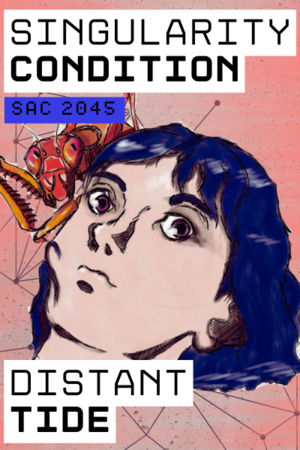
SAC 2045: Singularity Condition
“Network Anxiety – UNFINISHED GIG 1”
Hokkaido, Nukekubi Japan, 2039
. . .
Recollection Two. Six years from sea change…
“We’re close, Major. Time to wake up.”
Major Kusanagi Motoko shivered with annoyance. She re-positioned the itchy JSDF canvas blanket over her curled-up, tactical skinsuit and her ratty folding cushion of the past five hours. She rebuffed Batou’s voice despite being her ever dutiful deputy. Five more minutes, no, an extra hour! And yet…
“Come on, Major. You’re setting a bad example for the team.”
Offering a quiet huff, Kusanagi casually began to flick-on her synthetic bodily functions. Outside of her cyborg shell, Batou and thirty-two other Public Security operatives watched on curiously as their field commander let off a defiant breath of hot air from her synthetic lungs.
The Major began with the more tolerable of her internal systems: flexibility, synthetic muscles, smell, and taste functions. Batou smelled of something animal-like, but she couldn’t recall the last time he put serious thought to owning a dog. He always talked of ownership, for as long as she knew him anyway. Maybe he would finally get one, or maybe he got one recently? She flicked on her sense of touch and registered Batou’s general proximity like a friendly whisper. His warm breath tickled her neck and she couldn’t help a small, humorous smirk behind her closed lips and eyelids.
His voice had a quality of a distant and welcome trumpet, familiar and steady in her uneven storm of a life. She could hide a little longer, Kusanagi thought once more to herself. But at the slight distress and annoyance under Batou’s words, she knew the fun was over before it started. Back to work, once more. Her shy, innocent humor vanished. Once more, one last time.
Kusanagi’s smirk dropped into a frown as she flicked on her virtual gyroscope, reintroducing gravity to her mind and system. Selective touch became full awareness and she accepted the indisputable fact she was on Section Nine’s tiltrotor heavy transport aircraft with its wobbly handling in turbulence and lack of creature comforts for a contemporary aircraft. Her cushion and the aircraft floor gave a groan and mighty shake as if a universal confirmation. Maybe it was just an immutable law of the universe and with exception to their wondrous technology, defense contractors seem to make military aircraft at the lowest value possible of creature comforts.
Besides the shaking of the tiltrotor, she gritted her vibrating jaw with unfortunate acceptance that the high-speed fan blades would one day shatter her perfect, synthetic teeth. Kusanagi unlocked her jaw and licked her elastic lips experimentally. Being a cyborg was always a matter of compromises, living a contradictive full and half-full existence caught between the material and virtual worlds. Especially the virtual world, a place where netizens increasingly needed to remind themselves it was not separate from the real and material.
The brain might remember to breath on its own, but the ghost in the machine might forget the volitionary essentials: water, exercise, food, and sleep. Kusanagi’s own existence to an extent was a virtual experience imposed onto the physical world. Despite her full cyborg body, she still had need of the human essentials too. By her existence, it was easy to forget without software alerts about biological and mechanical upkeep. It was a trivial thought but the small details of her imperfection protected the thin, illusionary veil of her humanity. They created a clear, personal separation against the human-shaped machines and the humans seeking mechanical forms.
She spent her younger years practicing human mannerisms to convince others, but especially herself that she was irrefutably human. She knew this for certain. She had a human past, and yet she spent a long time carrying the insecurity. What if she wasn’t human after all? She addressed it, curtailed the fear. But the fear returned. Maybe that was the most human quality of all, to experience the world in fluctuations of emotion. Always changing, like the everchanging sea tides. Certainty and doubt were never far behind one another, changing in cycles.
“I’m awake Batou, can you let the ground team know of our arrival? I still need a moment.”
The Major spoke her vague orders but she still felt asleep, as if far away from her present reality. There was something else underneath the insecurity but she had difficulty formulating it into thoughts, then words. Every time Kusanagi felt close to grasping the crystallization of her troubles, it slipped through her fingers like sand granules on the wind. It wasn’t just one problem, but an ever evolving one, changing and adapting with the interfacing of new information. The closest she came to an answer was in the heights of the Health Ministry’s vertical warehouse in 2034 and the creature of the Net she encountered put something like a mirror to her face.
The creature, the rogue AI system called Puppeteer or maybe the late-bureaucratic system programmer Takaaki Koshiki, was unclear in its origin as human, machine, combination, or something else entirely. But it existed to solve problems, behaving in a manner reflective of the growing incomprehension among creators and engineers in next-generation AI training: the so-called “black box AI” condition. Black boxes hid their inner functions from the end user; it would not be such a problem if only the black box condition didn’t obscure AI functions from developers too. They had their access but the black box became a twisted mirror to cover that computer complexity got beyond their own aspirations. It was an excuse: an allowance to walk away as a government assemblyman claimed no knowledge of his project’s inner workings, as a fortunate death of the Health Ministry’s prodigal network designer by self-neglect, and consequences resolved only to the extent of police paperwork say-so and classified out of reach from auditors and government watchdogs.
Post-investigation and privately, Kusanagi and Chief Aramaki agreed the best summary of the Puppeteer incident was a popular unconscious guided by networked human users, or an integrated AI network generated a “cascading paperclip problem” out of the increasing socioeconomic pressures under investigation at the Ministry of Health, Labor, and Welfare. They exchanged few words of Kusanagi’s own role in the incident. The Puppeteer was another standalone complex; another strange, and spontaneous Internet manifestation. To say more would muddle an already confusing apparition.
The creature spoke, from far off in her daydream, echoing her own words and its own as a harmonized choir five years later. “You still haven’t pieced it together? Come now, Kusanagi Motoko. Surely there cannot be an overabundance of people dwelling in your memory burning with this overwhelming, egotistical rightfulness?”
The Puppeteer showed Kusanagi faces. Faces of her friends, her foes. And her. The mirror.
“We’ve synchronized with countless consciousnesses over the years, so it shouldn’t come as a big surprise that your deep collective subconscious came to life. And with it, the Solid State is complete. It’s time for us to go forth. Let’s become a vanishing mediator and go take an active hand in the next society.”
But what made the Solid State complete? Who or what made up the deep collective subconscious? Was it too early to assume it was gone for good? Where did it go to? And who or what did it take with it? It seemed to imply she went too…
So many questions. The problem with the agreed-on conclusion between Kusanagi and Aramaki was its conservativism in imagination. The Puppeteer’s exchange with the Major didn’t sound like a simple paperclip maximizer. It sounded convincingly human, or something trying to rationalize for a human. Did that make it human, or something else? Chief Aramaki was never one without imagination, but possibly with the dangers of dreaming big dreams, he and Kusanagi didn’t dare speculate how far the Solid State or other standalone complexes reached in scope.
It was a justification to escape something they simply could not comprehend yet, and hoped someone in the next generation might figure out instead. And it was an excuse, but such things invited fear and dread. Powerlessness and exposed weakness in the face of humanity’s achievements. Was their technology getting away from them? Kusanagi shivered again over the thought the Puppeteer was still out there somewhere on the Net watching her from afar. Could that mean Hideo Kuze was out there too, watching over her?
The Major hardened her mind. There was no room to allow unfocused speculation. Kuze was dead, and so was the Puppeteer. If either survived in some form at all, what else once dismissed out of hand could turnout true? To ask was to fall back into the mystifying maze of the virtual world once again. Kusanagi opened her eyes, blinking out of practice rather than biological necessity.
The tiltrotor aircraft wobbled once more as ever expected, but outside the windows a partly sunny horizon and an expanse of white ground glowed from below. Japan’s big island Hokkaido was radiant in winter: in a few minutes they would lower to the ground and Section Nine’s mission would begin. The Major mumbled an old quote she remembered from an American Empire science fiction drama she saw as a child. “That when convention and science offer us no answers… Might we finally turn to the fantastic as a plausibility?”
“Did you say something, Major?”
Batou stepped away for a moment to converse in the tiltrotor cockpit with an unseen party, likely the pilot or the ground investigation team expecting their arrival.
“Sorry Batou, I was just thinking to myself.”
The former Ranger kneeled before Kusanagi and grasped one of her chair handles to balance himself against the shaking floor.
“What’s on your mind? You seem a little out of it this morning…”
Kusanagi met Batou’s veiled cybernetic eyes, offering distant eyes and a soft shrug.
“You know why.”
Batou frowned. “Maybe, but there’s always something more with you. Something I can’t see.”
Kusanagi’s eyes widened, freeing herself from half-slumber. Despite wakefulness, a rare sense of bashfulness washed over her. She looked away from Batou, “You got whiskers.”
The white-haired giant of a cyborg wiped his sand-white chin with the back of his glove on reflex. “I suppose I have. Helps with the cold… But that’s a dodge if I’ve ever heard one from you. Is it the mission, or Section Nine?”
“Maybe. Could be both? Or all of it altogether?” Kusanagi phrased her remark as a surprised question, even to herself.
“You know I’m here if you want to talk about anything.”
Kusanagi shook her head. “Not right now,” she offered a soft chuckle. “You and I seem lousy at timing.”
Batou hummed, changing subjects. “Yeah, I suppose you’re right. We were lucky the winter storm cleared out as we flew in, the operation won’t be so bad now. The ground team secured a car park for us on the edge of Sapporo. We’ll land and drive out from there.”
“Snow movers clear the roadways?”
Batou glanced away to check their virtual itinerary. Despite the Major already checking it herself, the mission relevant items made for good conversation to pass time and forget her concerns, or at least other concerns of the day.
“Yeah, snow clearing in the area begins at midnight and continued until daylight. Average snowfall is twelve or less centimeters so that helps limit routes of escape. Prefecture police started several roadblocks at 0730 local time along Route 274 out of Sapporo’s northern district and intersections of the Ishikari River valley.”
The Major hummed back, glancing at a virtual Sapporo factsheet. “That’s fast coordination… 5,400 kilometers of snow cleared across Sapporo’s roadways every night. I suppose we can’t expect the same efficiency from all their police?”
Batou raised an eyebrow, “You trying to do this job without them, Major?”
Kusanagi’s eyes closed, tightening in strained thought. “No, I… Don’t like last minute operations. This is messy, and going off another agency’s intelligence has never done us any good. Togusa tell you anything new during your call this morning?”
“Nothing he didn’t already say two days prior from debriefing with the police liaison and our local team. The police aren’t happy we took over, but they agree with Police HQ about the ‘Den Spirit’ group. They’re ambitious enough, and even Sapporo wants them gone.”
“So much for the courts and due process. Or maybe the prefecture government already tried that… Scouring online discourse just contains gossip and conjecture. It feels like, we’ve been setup to fail here. Just one mission to the next, no time to plan or verify.” Kusanagi remarked of forlorn reason, glancing back to the tiltrotor cargo bay. Many of their field agents and officers were still in varied degrees of sleep or relative relaxation.
Batou shrugged, “We’ve been here before. Back when Gouda was yanking our chain.”
Kusanagi remained distant, “At least we fought him that time. We won. Does this look like winning?”
Many faces of Section Nine looked on with faraway stares probably nursing similar worries as Batou and the Major through the cargo bay. Most operatives clutched their canvas blankets knowing what was to come: a gunfight and then oblivion. They were a reduced force now; the assault team was down fourteen agents thanks to private sector headhunting and a hiring freeze.
The skies over Hokkaido were already cold, but the aircraft pressurization and air conditioning system worked to moderate the chill a little. When they touched down, the team would meet the afterbite of a blizzard. Had Kuze lived, Kusanagi wasn’t sure how the future might look but he might’ve offered useful insight into winter warfare from the Korean peninsula. Overhead lighting flickered from dimmed ambience to an even interior glow as the aircraft intercom crackled overhead from one of Section Nine’s few human pilots, “We’re beginning touchdown proceedings. Sapporo police are at the designated landing zone, and Commander Togusa with Team North is waiting for us. Shifting from forward to vertical thrust, standby. Ninety seconds to touchdown. One last check, make sure equipment and personnel are strapped in.”
Green acknowledgement lights winked on across the Section Nine cyber lobby, confirming the pilot’s request. Batou slipped into the empty chair next to Kusanagi and latched the aged four-way buckle strap to his torso. His acknowledgement light flashed from yellow to green as Kusanagi rolled her canvas blanket into a ball and flashed her own greenlight.
“About to be super cold,” Batou grumbled as the tiltrotor turbines groaned against the wind, turning into a glorified helicopter.
“Turn down your skin sensitivity?” Kusanagi suggested.
Batou shook his head, “It’s part of my intuition, I need to feel the wind direction. Like neck hair standing up before someone takes a shot at me.”
“Those Ranger instincts never go away, do they?”
“Nope. No matter my equipment, innate human instinct trumps it all. These sleepless eyes still give information when they fail. I know their contradictions and fail points.”
“Stubborn habits. They might kill you one day,” Kusanagi added, as more banter than warning.
“The Self Defense Army hasn’t marked them EOL (end of life) yet.”
“I know, otherwise I would’ve forced you to upgrade already.”
Batou hummed in agreement.
The pilot reported in again as Section Nine assault team members clutched their equipment bags close under their seats. “Preparing for touchdown.”
A harsh thunk rumbled through the cargo cabin of the tiltrotor aircraft, the Section Nine operatives mumbled to one another as the dim lighting changed to an emergency red. Batou addressed the agents, “Prepare to step off, leave nothing behind! I need six volunteers to assist with off boarding the Tachikomas, they need to be on the ground in four minutes.”
Kusanagi stood up and pulled her black duffel bag out from beneath her seat, sliding by Batou as he made his announcements. She added, “I leave the think tanks in your care. I’ll debrief with Togusa and the police and see if there’s any new details.”
Batou nodded in confirmation and grabbed a couple of the newer recruits by the shoulders, stragglers from the columns of exiting agents. He gave orders with a sickly grin, “You two, you’ve volunteered! Find two more each and let’s get the tanks off the tilt-copter.”
Kusanagi offered a sympathetic smirk to the two voluntold and marched to the back of the tiltrotor craft. Her Section Nine subordinates were quick to recognize her approach from lithe but intentional-sounding footfalls of her combat boots as they turned and cleared a path to the bay door for her. “The Major is coming through, make a hole!”
“Major. Major. Ma’am,” the Section Nine agents greeted Kusanagi without salutes the way she preferred.
The Major arrived at the front and pinged the pilot over her radio microphone. “We’re ready to offboard, Lieutenant Hoshino. Go ahead and lower the ramp.”
“Hai, Major. Lowering the ramp now.”
With a thunderous slow screech, the large, combined door-ramp unhooked from its locks and the hydraulic valves lowered the ramp down meter by meter giving Section Nine their first glimpse of early morning Sapporo by black ice and tarmac. A brilliant burst of cold wind crashed through the open gap, causing many to shiver against the sudden breeze.
A distant voice called out over the blizzard bite, a familiar in the land of ranch and snow. Togusa’s grin was a welcome gift all its own.
“Welcome to Sapporo, Major!”





Please sign in to leave a comment.