Chapter 1:
Welcome to Shimizu
Under the Seal of Repudiation
The town of Shimizu is one of the most important places in the Mino Province. As cities like Kyoto or Nagoya, it has experimented in the later years with what people call modernization. This is seen with the arrival of steam trains, printing presses, and Western medicine, which came from countries like America.
By the year of 1885, the city had become a place of factories and progress. But at the same time, families like the Apricots wanted to maintain the purity of Japan and its traditions. The Apricot family liked to keep their traditions unchanged for centuries, but, how could they fight against this modernity, which everyone seemed to enjoy?
That year, with the guide and help of this father-in-law Haruto Apricot began taking the reins of the family, which consisted of himself, his wife, and their two daughters, Sachie, 17 and Himawari, 15.
Haruto began to study modern medicine in that time leaving the tradition of herbology and traditional medicine that had been in the family for years.
But even so, some traditions continued. By 1886, Haruto began searching for suitors for Sachie. Although she cooperated and quietly agreed to meet to meet those suitors and their families, nothing ever materialised. Those families only have something to complain about Sachie: too talkative or asking too many questions.
"What's the problem, Sakurai san?" they asked him one day when they decided not to proceed with the engagement.
"My son found Miss Sachie getting dirty with dirt and mud."
This surprised Haruto, he didn't understand what he'd just been told. He was stunned and demanded an explanation.
“Let Miss Sachie explain." With that, Sakurai left, annoyed at the wasted time and pondering which other family might be a suitable candidate to marry his son off.
With that, Sakurai left the Apricot family house complaining about the wasted time while she pondered about which other family had a more suitable candidate for wife for his son. That evening when Sachie came home, his father demanded to her about what Mr Sakurai said. Haruto noticed the details he had ignored until that day: her kimono was muddy and so were her hands.
Sachie, unable to hide it, explained to her father that she wanted to continue the legacy of her grandfather. She believed that it wasn’t correct to abandon the tradition of ancient medicines only because the western medicine was fashionable. This enraged Haruto who couldn't approve of Sachie soining her Kimono. Akiko was also at fault.
She was useless raising her older daughter. Haruto began to complain about Sachie's kimono; in his eyes that kimono was as good as rags. To make matters worse, he noticed along with the dirt in her hand, the tanning of her skin. Haruto felt deeply ashamed of Sachie and her behaviour
“But Himawari is my success…” thought Akiko after hearing all the complaints of her husband. And this was true.
Himawari, Sachie’s 15 year old sister, was the complete opposite: she was obedient, submissive to her father and learned quickly the basic abilities expected from women; sewing, embroidery, tea ceremony, and Shōdo (Japanese Calligraphy) . All abilities Sachie didn’t have.
November, 1890
At the age of 19, Himawari got engaged to Lieutenant General Izumi Yanagi. This was a great event for the Apricot family: their younger daughter was joining a wealthy and prestigious family.
“Himawari is our pride,” Haruto commented ,during a dinner. This made Himawari uncomfortable.
“She has mastered her dancing and has learned some basic dishes. Akiko, is a great teacher and mother.” Haruto continued talking, Akiko, Haruto's wife, smiled. Taking credit for the results of her younger daughter made her feel less guilty about her failings with Sachie.
The sake toast was made, and the evening was a success. Fortunately, Sachie didn't appear and didn't interact. Haruto forbid her to her to participate and she obeyed. But her name was still whispered, accompanied by warnings.
That night, Himawari went to her sister’s room to talk. Sachie wasn’t in the mood, feeling that Himawari only wanted to lecture her about proper behavior—and she wasn’t entirely wrong.
“Onee sama (big sister), please, you should help mother more,” she said in a pleading tone. Himawari sat at Sachie’s door as she spoke. The door remained closed, but Himawari insisted knowing her sister was awake.
“Please, stop going to that garden,” Himawari continued, begging. “Your skin will be ruined and you’ll look like a peasant.
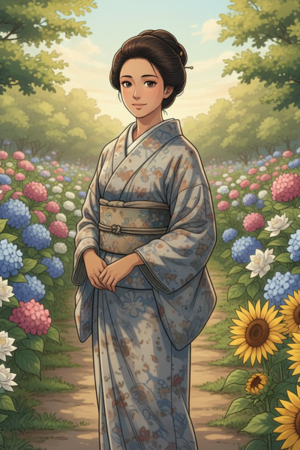
There were no words, no confrontation. A bit sad, Himawari stood up and went to sleep. The next day, Sachie went directly to work in the garden. She had been cultivating flowers all summer, including hydrangeas, gardenias, and in a special corner she kept sunflowers.
In the summer of 1891, Sachie smiled when she saw the first sunflower sprout; she remembered her childhood with her sister when everything was easier. No one worried about weddings, engagements, whether she danced poorly, or whether her sister was better at reading poetry.
“Did you grow all these plants and flowers?” a male voice startled Sachie, making her turn around. She didn’t recognise him.
“Yes… yes, I grew this garden,” Sachie replied with some hesitation. From his clothing and manner of speaking, she knew he was someone important.
“My apologies if I scared you,” the man said. He is at least twenty centimetres taller than Sachie, his black hair neatly styled in western fashion, complemented by that detestable American-style clothing.
“No… there’s nothing to apologize for,” Sachie said, unsure of what to do.
She decided to get up and return home to take a bath and read some books. Her father had reluctantly allowed her, in secret, to continue her studies in herbology after noticing a small niche of people who still sought traditional medicine.
“Could you help me?” the man said. “I’m looking for some flowers for my mother, and your hydrangeas are perfect.”
“You wish to gift my flowers?” Sachie asked, surprised. The man nodded in silence.
“Would you do me the favour of arranging the hydrangeas?” he insisted.
Sachie sighed and began arranging them without knowing why she was doing it. When she finished, she tried handing them to the gentleman.
“Could you accompany me? I got lost.” Sachie was getting tired of the man’s attitude but she agreed. She guided him through the city streets, both remain in silence for a long time.
“May I know your name?” Sachie asked after a while to break the uncomfortable silence. The man laughed nervously, realising his mistake.
“My apologies lady” he said, embarrassed. “I’m Takahara Takumi.” Sachie stopped all of a sudden. Without realising it, she had been speaking casually with the heir of that new factory. Why had she spoken so informally? Takumi chuckled a little when he saw her reaction.
“May I know your name?” Takumi asked.
“Apricot Sachie,” she replied curtly as they kept walking. Takumi looked at her with curiosity. He had already heard rumours about that unmarried girl who preferred working the land over planning her engagement. He had even already met Lieutenant Yanagi, Sachie's sister's fiancé.
Fifteen minutes later, they arrived at the Takahara residence, where Takumi’s mother received them. Confused upon seeing Sachie dirty and tanned, she asked:
“Have you come to help cleaning?”
“Mother, this is Apricot Sachie,” Takumi interrupted. Mrs. Takahara was surprised and looked at Sachie with pity: dirty and cheap clothing, tanned skin, rough hands. Trying to improve the mood, Takumi took the flowers from Sachie and handed them to his mother, claiming they could decorate her room. A cry was heard, and almost immediately Mrs. Takahara rushed over to ask what had happened. A woman—certainly a household servant—ran to the entrance, frightened, saying that little Souta had fallen and was hurt.
“What was he supposedly doing to injure himself?” Mrs. Takahara shouted as she entered her house dropping the flowers on the floor. Takumi picked them up and decided he could at least use them to decorate the dining room.
“Could you help us with my brother?”
“What?” Asked Sachie with surprise.
“Don’t play innocent, Apricot-san,” Takumi said to Sachie with a smile. “In town people say one of the Apricot daughters practices traditional medicine.”
“And what makes you believe I have exactly what your brother needs?”
“You can at least try.” Takumi guided Sachie into the house, and they quickly found some servants trying to calm Takumi’s brother, Souta, who was crying.
His hands were dirty, his face red from crying, and one knee was scraped. All while their mother scolded him for running barefoot in the garden.
“And why hasn’t anyone cleaned my son’s wound yet?” the mother shouted, stomping on the floor.
“Mother, Apricot-san can help us,” Takumi said, to which Mrs. Takahara replied that he should get that beggar out of the house.
She insisted that Sachie would not touch Souta with her filthy hands. Sachie was done with always being insulted, belittled, and hearing people talk of her grandfather’s teachings as if they hadn’t been useful in the past.
“Takahara-san, I need a clean cloth and water, please,” Sachie said to Takumi, who immediately ordered the servants to bring she requested.
“Takahara chan, if you allow me, I’ll help heal that wound,” Sachie said to Souta, who was frightened and unsure but allowed her to clean it. Mrs. Takahara tried to intervene, she wanted to do something, to stop her, but she was interrupted by her elder son, who whispered that she should let Sachie handle it. Souta remained calm the entire time, silently watching as she treated his injury. Once it was clean, Sachie took from her pouch an ointment that smelled of mint and applied it to the wound.
“This will relief some pain and aid healing," Sachie explained to Takumi and Souta’s mother. “You should bandage the wound for at least a day. Takahara-san,” she said, looking at Souta, “don’t touch the wound; that way it will heal faster.”
Without another word, and bowing politely, Sachie left the property with a sense of pride, knowing she’d shut the family’s mouths and proven her worth. Souta was satisfied with the treatment. He liked the scent of the ointment and told everyone that the servant girl had healed him. Mrs. Takahara felt embarrassed for addressing her as a mere peasant.
That afternoon, a doctor arrived to treat Souta. Unaware of who had been responsible for cauterising and cleaning the wound, he simply praised the work. Mrs. Takahara never mentioned Sachie. She wouldn’t say it out loud, but her skill treating wounds and children was noteworthy and she had earned her respect. It was a shame she wasn’t married.















Please sign in to leave a comment.