Chapter 11:
The Weight of Time
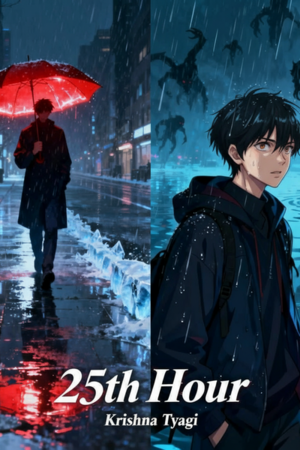
25th Hour
The droplet didn’t move.
Kazu stared at it like he was looking at something alive—small, perfect, balancing on the pavement as if the world had placed it there on purpose. His breath misted in front of him, curling around the droplet, but the surface didn’t quiver. Didn’t sink in. Didn’t slide away. It just… stayed.
Another one formed above it. Not falling—appearing. A soft plink into nothing. Kazu took one slow step back. Then another.
“…Not again,” he whispered, voice thin. But that was it. No lanterns. No ringing in his ears. No world collapsing into frozen blue. Just two impossible droplets sitting on the ground like someone left him a warning he wasn’t ready to read. He swallowed, brushed the alley wall with his shoulder, and forced himself toward the stairwell.
“Not tonight,” he muttered, barely audible. “Please… not tonight.”
The apartment door clicked behind him. The droplets stayed where they were. He reached the café early. Too early. Evening shifts usually had noise—steam hissing, cups clattering, Miki yelling something about lactose-intolerant customers ordering milkshakes. But today the café felt strangely… dense. Like the cold outside had slipped under the door and settled in everyone’s bones.
Kazu tied his apron, grabbed a tray, and stepped into the dining area—and stopped. Two university students sat in the corner, whispering in that sharp, breathless way people do when talking about something they don’t want to believe themselves.
“—seriously, the streetlight froze,” one said. “At exactly 3:59. The rain too. Just hanging there.” His friend frowned. “I swear I saw the same thing. Thought I was dreaming.” Kazu’s fingers tightened around the tray. His heartbeat tripped. Please don’t hear this, Miki. Please.
“Oh my god,” Miki groaned behind him, already annoyed. “Time freezing? Guys, buy another latte before starting a ghost podcast.” But the students didn’t smile. Didn’t even look embarrassed. They knew what they saw. Kazu exhaled slowly—too slowly—and stepped away before Miki could read the panic on his face.
It’s spreading.
The thought hooked onto his ribs and didn’t let go. During his ten-minute break, the world pushed again. He sat near the back, nursing lukewarm tea he was too tired to reheat. His coworker Riku—perpetually half-awake—slid into the seat across from him.
“Bro, look at this,” he said, turning his phone. A headline glowed:
TOKYO METEOROLOGISTS REPORT “STATIC DROPLETS,” PRESSURE SHIFTS ACROSS MULTIPLE DISTRICTS — Cause Unknown
The photo looked wrong even though it was blurry: droplets suspended under an umbrella at dawn. Not falling. Not moving. Kazu stared at it until the pixels melted together. Riku laughed lightly. “Urban legends levelling up, huh?”
“Yeah… probably.” Kazu managed a weak smile. But inside, his pulse stumbled. He glanced toward the front window. A little girl tugged her mother’s hand, pointing outside at a water fountain. The mother ignored her, but Kazu caught the girl mouthing something:
“It’s stuck.”
A shiver crept down his spine. At 6:50 PM, the door chime rang. Kazu turned from the counter. A man stepped in—black jacket, surgical mask, hood half up despite being indoors. Unremarkable enough. Normal enough. But something about his posture, or the rhythm of his steps, or maybe the silence around him… felt wrong. Wrong in a familiar way.
He ordered coffee without looking up. Kazu brought it to his table. The man in the mask stirred his coffee slowly, as if waiting for it to say something back. Kazu placed the bill on his table. “Thanks,” the man said without looking up.
Kazu nodded and turned to leave—
“Hey,” the man added casually, “you work evenings only?”
“Uh… mostly, yeah,” Kazu replied. “Classes during the day.”
“Makes sense. Nights stick in your head more, don’t they?” His tone was light, almost joking. “Feels like time behaves differently once the sun goes down.”
Kazu paused.
The man chuckled quietly. “Don’t mind me. I’ve just been losing track of my days lately.” He tapped his mug. “Sometimes I swear Monday feels like it sneaks behind Wednesday, you know?” kind of weird.
Kazu offered a polite smile. “Yeah… I guess that happens.”
“Mm.” The man lifted the cup, watching the steam. “Ever wake up and feel like you skipped something important… but you don’t know what?” Kazu felt a prickle at the back of his neck.
“I mean—like forgetting breakfast?” Kazu tried to joke.
The man finally looked at him. His eyes were sharp, tired, familiar in a way that made Kazu’s chest tighten without reason. “No,” he said softly. “Like forgetting an entire moment. Something small. Something you thought would stay.”
The room felt colder. Before Kazu could respond, the man continued with an easy, almost lazy tone: “Memories are weird. They don’t line up as cleanly as people think. Sometimes the middle moves. Sometimes the end comes early.” He smirked behind the mask. The spoon clinked against the mug. Normal sound. Wrong atmosphere.
Kazu forced a laugh. “You’re talking like a novelist.”
“Maybe I just have a bad brain,” the man said playfully. He leaned back. “Or maybe… time just has a bad habit.” He stood up, leaving the half-empty mug behind.
“Oh,” he added at the door, almost as an afterthought, “if something strange ever happens… try not to blink too quickly. It’ll make you miss things.”
Kazu frowned. “…Why would blinking matter?” The chime rang. He was gone. And Kazu’s heartbeat refused to settle. Kazu stood still, breath uneven.
By the time he tied his second apron that night, the unease hadn’t left him. Not physically—just something in the air. Like the cold was watching him. The restaurant kitchen was loud and humid, yet Kazu couldn’t shake the sense that everything was half a second behind. Even the clatter of pans felt delayed. He rinsed dishes, wiped down a counter.
“You good?” a coworker asked from behind. “Yeah,” Kazu muttered, staring at the cut. “Didn’t notice.” Only when he saw the blood did he realize he’d cut himself.
“Man, this cold. Gets into your head.”
Maybe. Or maybe his head hadn’t been working right since the very first droplet. The smell of fried oil clung to the air — different from the café. An elderly customer sat near the window, steam rising from a bowl of miso soup. White hair. Soft eyes. A faint smile that felt older than the room. The old man finished half his miso soup before speaking.
“Cold night, hm?” His voice was gentle, tired in a peaceful way. Kazu nodded. “Yeah. Winter came early this year.” The old man chuckled. “Winter never comes early. People just notice it late.” Kazu blinked. “Really?”
“Mm.” He lifted the spoon slowly. “Changes arrive quietly,” he said.
A pause.
“People only notice when they’re forced to.”
Kazu didn’t know what that meant. He didn’t ask. “You look tired, son,” the old man said. “Long day?”
“Yeah… something like that.”
The old man hummed knowingly. He didn’t pry. Instead, he wiped the edge of his bowl with practiced calm. “You know…” he began, tone casual as a drifting thought, “when people are tired, they start worrying about the future too much.” Kazu chuckled. “I think I worry about everything.”
“Ah.” The old man smiled softly. “Then let me tell you something my wife used to say.” He rested his spoon.
“Don’t let tomorrow borrow you before today is done.” Kazu tilted his head. “Borrow me?”
“Yes.” A nod. “Because the future is greedy. It takes pieces of us before we even reach it.” Kazu swallowed. “…That sounds scary.”
“Only to those who walk with their head turned the wrong way.” Another smile. Faint. Warm. “Keep walking straight. Don’t chase what hasn’t happened yet.” Kazu breathed out slowly. “…I don’t know if I can do that.”
“That’s why I’m telling you,” the old man said kindly. When Kazu turned to check an order slip—just one second—the old man’s seat was empty. No footsteps. No door sound. Just the quiet steam rising from the abandoned soup. He clocked out close to midnight. The walk home felt… wrong. Not dangerous—just too quiet.
As if the city was pretending to be asleep. A dog barked somewhere behind him—one sharp, sudden bark—then silence. Like the sound had been clipped. He passed the vending machines. The shuttered bookstore. The small alley where the droplets had appeared. He didn’t slow down. Didn’t look. When he turned to the last corner, the digital billboard ahead flickered twice. Normally it played ads—phones, cosmetics, whatever.
But tonight, the screen went black. And for a heartbeat—just one— displayed: 04:00
Kazu froze.
A faint static buzz pressed into his ears—thin, trembling, like a radio stuck between stations. bzz—59—hour— b-zz--… Then the billboard snapped back to its ad.
He checked his phone. 3:59 AM. Kazu’s heartbeat skidded inside his chest. The cold around him no longer felt like winter. It felt like a warning. The number burned into his eyes.
Whatever this was, it didn’t feel patient.














Please sign in to leave a comment.