Chapter 2:
All Happy Families
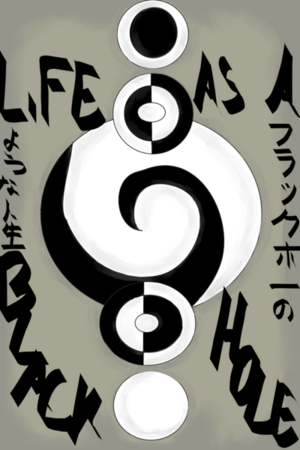
Life as a Black Hole
When Akihiro was a kid, his father wasn’t around. Then, for a brief moment of time, he was, until he simply up and left again. For those two years when he stayed, Akihiro always felt on edge and nervous; what if one day he disappeared as quietly and quickly as he had shown up?
Grandmother, the night the both of them realized he was never coming back, seemed nonplussed, as if she anticipated the whole thing.
“Coming home at all hours of the night just to eat all our food and bolt,” she said as she clicked her tongue against her teeth. “I’ll tell you something, Hirokun. Just because you can’t use magic doesn’t mean other people’s sympathies will extend that far.”
As if sympathy entered the equation, he wanted to tell her. As young as he was then, he knew what it meant to be agentless. To have classmates sort of bounce their eyeballs around the room after they found out, to stand just a little further than usual as if it were contagious. Nobody ever hit him over it, or told him to leave the school or the country, but they definitely didn’t talk to him as much anymore.
Not that was anything that could be done about it. Most people could use magic to some degree, even if meant in practice just being really good at fixing leaks or restarting the oven’s pilot light. Grandfather, for one, could stabilize the ground underneath him within a three meter radius; for Grandmother, someone whose entire body seemed to shut down during earthquakes, it was a godsend. If she believed in such in things, which she repeatedly asserted she didn’t. Akihiro wasn’t so sure. At least they never had to worry about the TV breaking.
Since his magic didn’t exactly strike anybody as impressive, him marrying a Hoshino didn’t raise that many eyebrows. Hoshinos, or at least their branch of the family, could never use magic. Grandmother liked to claim herself as the sole exception, but the only evidence she could present was that she could tell when the toilet backed up.
Their children, as a result, were either agentless or bordering on it. Akihiro’s uncles had a bit of magic to their names, and so both of them wound up marrying women with the same level of ability. No harm, no foul. Expected, really. His father, on the other hand, committed a most heinous act and eloped with a girl from his class, also agentless. Oh, the shame. The terror of knowing she had given birth to such a reprobate made Grandmother’s hair turn prematurely gray and deepened her wrinkles.
At least, those are the two things she always brought up when she recounted the story to Akihiro, who at that point could pretty much recite it by heart. As for how the rest of it played out, he knew it just as well.
The already muddied name of Hoshino sunk even lower when one summer evening, Grandmother answered the door to find a police officer on her front steps holding a four-year-old’s child’s hand; a child that looked remarkably similar to the son she had very recently just disowned.
“He says his name is Akihiro,” the officer said, “and that his father Naoki lives here.”
Grandmother had blinked, looked at the both of them as if they were yokai come to haunt her, and then sighed so deeply as if trying to take in all of the world’s oxygen at once. “Yes, that’s my grandson.”
Her public acceptance of him, he figured, drove her not only to resent him in place of his father, but to use it as a whip to crack him into shape.
“You are your father’s son, never forget that,” she said as he drank the tea Grandfather prepared. “And if you ever act like him, you’ll destroy this family.”
Though they would never admit it, as he grew up, he could tell that the only way they looked at him was with a sort of resigned disappointment. He could’ve made up for his father’s mistakes, his lack of potential, his utter lack of respect for his family, but whatever redemption Akihiro could’ve offered disappeared with the realization that he too was agentless.
There being only so much a failure of a son could do, Akihiro spent as little time as he could in their salvage shop and as much time in his room reading and drawing manga. It seemed to him the perfect outlet for the useless. A mangaka didn’t have to use magic, except with the kind made with a pen and paper. All the interviews at the back of Shonen Leap and Monthly Square told him as much.
“I realized I couldn’t use magic when I was ten, but I could still hold a pen!” one had claimed. “Nobody expects much from a guy who draws manga anyway. We’re all disappointments, in a way.”
It wasn’t lost on Akihiro that the interviewer made mention of how jovial the artist was when he said it.
Maybe this how you get to be good, he thought as he set the magazine on the shelf. Maybe I can be happy as him one day!
So for most of his childhood, as much as he was able, he spent hunched over his desk, manga magazine to the left and drawing pad to the right, sketching and writing and inking and compiling. He devoured everything, shonen, shojo, sci-fi, slice-of-life, anything he could get his hands on, and every time at school he got that dreaded “career plans” worksheet, he would jot down “mangaka” and then get called to the staff office without fail.
“You sure this is what you want to do? You didn’t even put down a single college, or another kind of job,” his grade seven teacher said. “It’s not an easy living.”
I don’t want easy, he wanted to say. I want purpose.
Life played out in a similar fashion for years, until one day, Dad showed up out of the blue a few weeks after Akihiro turned fourteen.
“Hey,” he said, with what would become his trademark: a sheepish smile that did an incredibly bad job of hiding the wound in his pride.
Though initially Akihiro found only consternation and wariness in himself regarding this man, soon enough he did the same thing all boys do; he separated his father from the rest of the human race. His opinions of Naoki were organized according to a different system than even his grandparents. Whenever his father did something buffoonish or stupid, or made a mistake that even Akihiro realized was avoidable, he would chalk it up to him having some good, uncontestably valid reason for doing so.
Though ostensibly he worked for Grandmother and Grandfather at the salvage shop, he would leave, often weeks a time, and only give another “researching” job as the excuse. To Akihiro, it was all perfectly on the level. Dad’s gotta go to work, Dad’s gotta help put food on the table and pay the bills on time.
Their usual interactions never went beyond shallow pleasantries for the most part, with the extent of Naoki’s interest in his son’s life being whether or not he did his homework, if he was doing well in school, if he had any friends. Nothing about how the both of them were agentless, if Akihiro chafed under the yoke of a draconian matriarch or if his struggles with existing as himself continually carved wounds into his psyche.
After a while, the conclusion Akihiro reached was that his father simply wasn’t capable of asking those sorts of questions. After all, neither of his grandparents did. Maybe nobody else’s parents did either. Surely nobody had anybody who cared enough to ask.
Then, a month or so after he turned sixteen, just as he feared, his father was gone. The reason would be unknowable.
“I hope you didn’t think it would last,” Grandmother had said. “That man is as unreliable as they come.”
“He’ll be home tomorrow,” Akihiro squeaked. “I know he will.”
That night, however, for the first time in his life, as he lay in bed staring up at the ceiling, he knew his grandmother was absolutely, positively right.
He hated her for that.



Please sign in to leave a comment.