Chapter 15:
To See Is To Defy
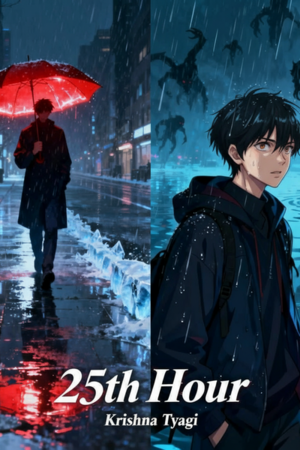
25th Hour
Darkness didn’t fall after the last minute ended. It thinned. Not like fog lifting all at once, not like night retreating before dawn—but like breath returning to lungs that had forgotten what air felt like. Slowly. Unevenly. The kind of return that made you aware of every rib, every ache, every place oxygen scraped on the way back in. The city emerged in fragments.
The underside of a frozen bus, its rusted frame caught mid-sway. A bent streetlight humming weakly, electricity trapped in a loop it could never complete. Raindrops suspended inches from the ground, each one a perfect, glassy needle reflecting a broken version of the world. Kazu lay on one knee between two stalled cars, one hand braced against the asphalt. Cold bled through his skin.
Not the sharp kind that shocked the nerves awake but the deep, numbing cold that crept slowly upward, sinking into muscle, settling into bone like it intended to stay there. His palm stuck slightly to the road when he shifted his weight. The surface felt wrong. Too smooth. Too still.
His breathing sounded too loud.
Each inhale echoed in the hollow space between buildings, bouncing back at him distorted, as if the city itself were listening closely measuring, remembering. Something had changed. The static was still there, humming beneath everything like a distant power line, but it no longer filled the air evenly. It pulsed now. In pockets. In intervals. Selective. Intentional.
Lanterns drifted back into existence one by one. Not all of them. Some never relit. Glass shells hung uselessly from poles and wires, their interiors hollow, flames extinguished so completely that even the memory of light seemed scraped out. No glow. No warmth. Just empty housings swaying slightly, moved by a wind that didn’t exist. Kazu noticed them immediately.
His chest tightened, not fear, not grief—but a quiet, sinking awareness that something irreversible had happened while he wasn’t looking. Like arriving late to a conversation and realizing the most important decision had already been made. The lanterns that did glow were different. Their light didn’t flicker or strain. It didn’t pulse erratically like before. It simply existed warm, steady, almost comforting.
The kind of light meant to calm people down. The kind that softened shadows instead of cutting through them. The kind meant to lower guards. That scared him more than the screaming ever had. Footsteps echoed somewhere far off. Not running. Not chasing. Just movement, careful, measured, deliberate. The sound of something that didn’t need to hurry.
Wraiths lingered at the edges of the streets, half-formed silhouettes clinging to walls, pooling beneath fire escapes, stretching thin across alley mouths. They didn’t crawl. They didn’t shriek. They watched. Their shapes shifted subtly, like ink spreading through water, never fully settling into a single form. Faces surfaced and sank again. Hands formed, dissolved, reformed somewhere else. They were waiting. A lantern detached itself from above and descended until it hovered at eye level.
This one was different.
Smaller. Narrower. Its glass was clear and unblemished, as if it had never known impact or neglect. The flame inside burned with a controlled steadiness that felt almost… deliberate. Observant. It didn’t flicker when it spoke.
“Kazu,” it said, voice gentle enough to pass for concern.
The sound of his name landed heavier than it should have. “Do you wish to fight?”
He didn’t answer.
The lantern waited. Its silence wasn’t impatient. It didn’t press or repeat itself. It simply stayed, like it knew time would bend before Kazu did.
“Or do you wish to survive?”
Kazu pushed himself upright. His knees shook once, a sharp tremor that threatened to fold him back to the ground—then locked. He steadied himself with a slow breath, eyes lifting, not toward the lantern, but past it. Across the frozen city. Toward the wraiths that refused to come closer.
“They’re keeping their distance,” he said quietly.
“Yes,” the lantern replied. “They are uncertain.”
“About what?” Kazu. The lantern tilted slightly, mimicking thought. Mimicking hesitation. “About you.”
Pressure bloomed behind Kazu’s eyes. Not pain. Not memory. Just weight—like years of swallowed words pressing outward, demanding space. Things unsaid not because they were forgotten, but because saying them had never felt useful. His jaw tightened. He exhaled slowly through his nose.
“You’re lying.” Kazu. The lantern’s flame didn’t waver. “No,” it said softly. “I am guiding.” The lie was perfect. That was the problem.
Kazu reached out. Not fast. Not aggressive. No sudden movement that could be mistaken for fear or defiance. He simply extended his hand and placed it into the lantern’s light. It didn’t burn. The warmth folded inward instead, collapsing on itself as if obeying gravity that hadn’t existed a second ago.
The flame compressed, layers of light sharpening, condensing tighter and tighter until the glass casing fractured without a sound. It peeled away in thin, translucent shards that evaporated before they could hit the ground. Metal took shape beneath his fingers. A hilt—slim, unadorned, balanced so naturally in his grip that it didn’t feel like holding something new. It felt like remembering something old. Something he had always known how to hold, even if he had never named it.
The light stretched outward from his hand, thinning into a blade that seemed to drink illumination rather than reflect it. Matte steel ran the length, dark and unassuming, with a single line of pale glow tracing the edge—not decorative, not emotional. Functional. Absolute. It didn’t pulse. It didn’t demand. Kazu closed his hand fully around the grip. The remaining lantern shell drifted backward, empty now, hovering nearby like an observer rather than a source. Its voice lowered, almost reverent.
“Everyone carries a lantern,” it said quietly. “Some to see the path. Some to burn it.”
Kazu didn’t respond. He stepped forward. The wraiths reacted instantly. Not as a swarm but as vectors. Shadows detached from corners, stretching into limbs that scraped against concrete as they lunged. One came high, claws arcing toward his throat. Another slid low, sweeping for his legs. A third spiraled in from behind, its form unraveling and reknitting mid-motion. Kazu didn’t swing wildly. He moved. A half step to the side. A turn of the wrist.
The blade dropped in a controlled arc not into flesh, not into a face—but into the darkness anchoring the first wraith to the street. The edge traced a clean line of pale light. The wraith collapsed inward, folding like paper soaked too long in rain, its form imploding without sound. The second struck. Kazu raised the sword just enough to catch the impact. The collision rang sharp and hollow, the vibration traveling up his arm, into his shoulder. He twisted his wrist, guiding the blade along the creature’s limb, slicing through the shadow where it fused with its torso.
The arm disintegrated mid-motion, unraveling into smoke. He stepped forward again. The third wraith lunged low. Kazu stepped over it. The movement felt almost disrespectful, calm, economical. He drove the sword straight down, pinning its core shadow to the pavement. The creature convulsed, faces surfacing all at once, mouths opening in silent screams. Then it imploded. Darkness smeared the ground before evaporating. Silence spread outward.
One lantern nearby flickered violently. “That wasn’t supposed to work,” it whispered. Kazu didn’t look at it.
He was already moving again.
The plaza Reina stood in no longer resembled a place meant for people. Concrete was split and cratered, scorched with lingering arcs of red light. Walls bore claw marks deep enough to expose steel rebar beneath. Lanterns hovered overhead like judges, their flames harsh and unblinking. Wraiths came in waves now. Not chaotic. Coordinated.
Three from the front, advancing in staggered timing. Two from the sides, low and fast. One held back—waiting for her to commit. Reina felt it even before she saw it. Her blade cut a wide arc, crimson light tearing through the first wraith’s torso in a burst that sprayed fragments of shadow across the ground. The second slipped past the edge of her strike, claws raking across her ribs. Pain flared white-hot.
She didn’t scream. She turned with the momentum, shoulder slamming into the creature’s chest, elbow driving into its warped face. She followed with a brutal, close-range slash that tore its lantern free. The flame sputtered as it hit the ground, cracked once, then dissolved into dust. One kill. Her breathing grew ragged.
Blood soaked into her sleeve, warm and sticky. Her legs trembled, not from fear, but from the sheer effort of staying upright. Every breath scraped. Every movement pulled at something torn.
The lantern above her burned brighter.
“You are cutting too deep,” it warned. “You will not like what remains.”
Reina wiped blood from her mouth with the back of her wrist and laughed—sharp, broken, almost hysterical. “I don’t fight monsters,” she said hoarsely. “I fight what I failed.” She planted her foot, blade low, shoulders squared, and whispered the name.
“Crimson Solace: Afterimage Severance.” She moved. Not fast—layered.
The first strike missed intentionally, carving empty space. The second followed the memory of the first, arriving a fraction later. The third landed where the wraith would be not where it was. The delay snapped shut like a trap. Two wraiths froze mid-motion as crimson lines traced through them. A heartbeat later, they split apart, lanterns shattering as the remains fell.
Reina staggered as the technique ended. Her knees buckled. She caught herself on the blade, breath tearing at her lungs, vision blurring at the edges.
“I thought the blade was heavy,” she muttered. “Then I realized it was the hand holding it.”
More shadows gathered. They didn’t rush. They waited.
Kazu heard the voices before he saw them.
A human—breathing hard, stumbling, panicked. A lantern drifting beside him, its tone soothing, urgent, almost kind. “This way,” it said. “You’re almost safe.”
Kazu slowed. He crouched behind a frozen bus, peering through shattered glass.
The human nodded frantically and ran. Halfway across the street, the wraiths emerged. No chase. No warning. They tore into him like something rehearsed. Flesh split. Blood sprayed across frozen concrete. The sound, wet, tearing— echoed too long, too clearly. The man screamed until his throat collapsed.
Kazu couldn’t move.
His sword lowered a fraction. The lantern beside him whispered softly: “A second too late is tragedy.” Something snapped. Not loudly. Cleanly.
They don’t guide, Kazu realized. They curate outcomes. “The 25th Hour isn’t punishment,” he thought. “It’s evidence.” He turned and ran.
Wraiths surged to intercept him. Kazu didn’t stop. He cut while moving—short, precise arcs that severed shadows at their anchors. One slash took a wraith’s head as he passed. Another carved through a torso without slowing his stride.
Run. Cut. Pass through. No hesitation.
The plaza came into view.
Reina stood alone, bleeding, surrounded—still standing. Wraiths recoiled as Kazu entered the space. Lanterns above flickered violently.
One voice slipped through the chaos, distorted and afraid:
“Synchronization complete.”
Kazu raised his blade. Reina turned — sensing him before seeing him. The wraiths hesitated.
The moment held. Then—Cut.











Please sign in to leave a comment.