Chapter 2:
Unfolding (part II)
Civilization
***
Habitat general maintenance hardly qualified as anyone's dream job -- not exciting, not glamorous, and dangerous enough that nobody pictured themselves doing it forever. Because of the high risk, the compensation was quite good: not only money, but long vacations and additional paid leaves, passes to the luxury areas, or even free tickets to other habitats, and other cushy perks. Needless to say the work was highly ranked in society; those who kept the megastructures alive and running rubbed shoulders with the creators and lead engineers.
However, most of the habitat's upkeep was automatic -- fleets of drones and bots, swarms of varied sensors, and thousands of kilometers of wiring and hydraulic pipes hummed throught the guts of the whole habitat. The maintenance crew usually spent most of its time waiting on alerts that rarely came. Despite this high level of automation -- the set of safety maintenance protocols demanded periodic human inspections: wiring checkups, space debris damage assesment, and visual inspections of external structures such as communications array.
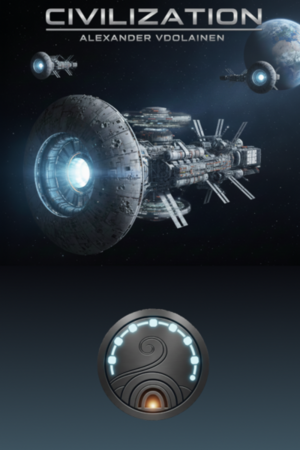
Habitat itself looked like a collosal, gigantic drum rotates like a wheel around the spindle inserted into the centre. The spindle was longer than the habitat's drum and basically consisted of two parts: an internal one located inside the cylindrical drum's inner space, and two mostly identical external parts on each side of the rotating drum. The spindle was a static structure. The internal part hosted many supporting struts and elements that connected the spindle's static core to the outer shell of the rotating drum. The two external parts of the spindle hosted a variety of equipment: engines for position corrections, ship docking stations, communication arrays, sentry weapons to deal with debris, and massive heat dissipation arrays.
It was a Phoebe-class habitat -- the most latest, modular, and advanced megastructure. Using the latest advances in material science technology the rotating part was truly immense: forty kilometres long and ten kilometres in diameter. Rotating at a rate of one revolution about every 2.3 minutes, Phoebe provided about 0.989 g for her inhabitants. The outer surface moved at roughly 98.7 metres per second due to this rotation, allowing the rim to launch small satellites or drones.
The core of the moving section was an enormous drum skeleton; its structure created a cellular pattern across the drum's surface. It was made intentionally: each cell was designed to fit a standard habitat building block.
However, this elegant solution wasn't visible: the space between building blocks and the outer light-gray plates was filled with minerals, soil, and water to shell against radiation. Inside the habitat's gravity zone, layers of equipment, soil, and minerals covered the cell blocks, though the design allowed a block to be removed and replaced.
Most Phoebe‑class habitats were located at the Earth–Moon Lagrange point (L2); the latest were installed at the Sun–Earth Lagrange point (L1) to better serve the inner Solar System. But Mair was luckier: his maintenance duty was on an L2‑placed habitat. Besides the dangers of servicing the static hub, the denser population there made life easier for him. Each Phoebe‑class hosts at least 600,000 inhabitants, which meant there was always plenty to do.
It was just a regular shift for Mair -- except something had been found near the communications section of the external static structure. Orbital junk was nothing new, but from his experience debris didn't just sit there; it damaged things. That made this different.
Going from the rotating habitat into the static hub always left him a little dizzy, so he downed two beer cans to dull the inner-ear transition before the exit. It was forbidden, but he'd done it for years. Reluctantly leaving his housing block, he rode the elevator from the lower tier up to the docking‑station level on the static spine. With a cranky magnetic boots he moved towards the transparent air lock.
The view through the transparent airlock stopped him cold. A device of impossible geometry clung to the hull of the communications module: a mirror‑smooth material folded and curved in ways that resisted easy measurement. It wasn't the shape that stunned him so much as the economy of it -- every curve and void seemed designed to use as little raw materials as possible and to vanish from casual sight easily. The sight was mind blowing: object's highly reflective surface and weird shape, heat dissipator's redish barely noticable glow, the habitat's gray hull, and blinking navigation lights all mixed together, making it feel utterly otherworldly.
Those low‑mass, low‑signature designs had begun to show up only in the outer system, where non‑gaseous raw materials were scarce. But the material itself -- its surface, its sheen -- was unlike anything he’d seen.
"I need assistance here -- an investigation crew, and... undock a shuttle to place near the communications module," Mair requested via the secure link embedded in his space suit.
Torn by curiosity but apprehensively, he silently moved out of air lock, and continued toward the unknown structure in the silence of space. What stopped him next made his gut tighten: at the base of the strange object was a standard data socket — one end plugged into the object's hull, the other end plugged into the communications array's maintenance panel. Red and white wires ran from the plug straight into the module and disappeared inside. Neither the weird device nor a civilian data cable should have been there. Instinct took over; Mair reached out maintenance panel and opened to indestigate further.
Right after that the investigation team spilled out of the airlock, and events accelerated. The strange object detached from the hull, drifted away from the static spine, then detonated into a spray of shards. The largest fragments slammed into the antenna arrays; shards of outer shell nicked Mair's suit and sent him tumbling, weightless, for a breathless moment. The impact shock was enough to knock him out: the comms chatter dissolved into static, and Mair slipped into unconsciousness.
The shuttle arrived too late. All that remained for the arriving crew was to collect debris and assess damage to the hull and antenna arrays.
***
Snowing continued to create the landscape miracles layer by layer covering everything was below the water melting temperature just like years and centuries ago during the winter. Adrian's car had long away from the high-speed road and now was fully relied on his driving skills. Local road wasn't cleared in the way high-speed one does instead the surface was covered with heavily compressed snow, boot and rear window were layered with thick snow.
Snow continued to fall, laying miracle‑like layers of white over everything below the water‑melting temperature, just as winters did years and centuries ago. Adrian's car had long since left the high‑speed road and now relied entirely on his driving skill. The local road wasn't cleared like the highway; its surface was packed hard with compressed snow, and the rear window and trunk were layered with thick snow.
"I have never been here, so far from the highway." , - Mikko interrupted a buzzing silence in the car.
“Huh. That's the point of being in places like this — fewer people and almost no light pollution,” Adrian replied, his eyes locked on the edge of the road where the white snow met the brownish granite of the exposed roadside cliffs.
After a few seconds he added, “It's already dark. Let’s grab a couple of good beers and steaks at my favourite spot nearby. After that I'll set up my home office and we will try to figure out what the hell happened to the dawn car.”
The road curved and dropped toward the suburbs of Landenpohja. Adrian parked quickly by one of the older buildings. It was a typical two‑storey place with large windows: the ground floor housed a pub and kitchen, the second floor a small hotel. Nothing special about the building itself -- old‑fashioned LEDs and dimmed lights in the pub gave it a cosy winter mood. The place was about half full that evening, so there was plenty of room to sit.
"This place is mostly occupied by newborns, isn't it?" Mikko asked, his voice dropping as they approached the entrance.
"Yep, mostly. You afraid of them?" Adrian let out a short, dry laugh. "I'm telling you, they're just like us. They just live without the gene therapy. Aside from their aging at the 'natural' rate, there’s no real difference. You'll see."
They stepped into the pub, leaving the biting cold behind. The interior was a sanctuary of a bygone era: heavy oak tables scarred by decades of use, and walls clad in dark wood panels that met a ceiling painted a deep, hunter green. The ceramic floor tiles were worn into smooth paths by generations of boots, speaking to an age that modern world of megascale engineering had long forgotten. Dimmed, amber lights softened the edges of the room, casting a warm glow that made the low hum of conversation feel like a protective cocoon of privacy.
They settled into the farthest, dimmest corner.
"Keep an eye on the news," Adrian said, his voice low. "I'll bet our accident is already saturating the streams. Did you ever reach Virta? Never mind -- I’m going to go order. It might take a bit; they don't do automated service here."
Mikko looked around, feeling like an astronaut on a foreign planet. He was used to the clean, sterile lines of modern glass and composites; these heavy, dark proportions felt oppressive. Even the air was different -- thick and heavy with a scent of human sweat, rich malt, and the sharp, peppery kick of seasoned meat. It was a smell so dense he felt he could taste it on his tongue. To his surprise, nobody was interested in their presence.
Signs on the wall sparked with old-fashioned LEDs: “Buy Five, Get the Sixth Free,” “Never Miss a Fresh Pour,” “Ice Cold.” The atmosphere was so thick it made him forget about a call for a moment. Remembering, he pulled his sleek terminal from his pocket. He tried a voice link three times, but the connection refused to handshake. With a frustrated sigh, he dropped a text message to Virta instead.
Adrian returned, thumping two heavy glass mugs onto the wood. "Here we go -- best brew you'll find in this hemisphere. Forget the data for a second; we've got time. So, tell me -- how are you finding the 'natural' life?"
"It's... quiet," Mikko admitted, glancing at the amber liquid. "Immersive, I guess. But definitely not my usual scene."
Adrian slid into the opposite bench and took a long, appreciative sip. "Thank God for the evening. Did you get through to her?"
"No," Mikko said, a shadow of disappointment crossing his face. "Just a message. Strange, I couldn't get a voice link. Maybe she's just out with friends."
"Whatever she's doing, you can relax. Trust me," Adrian said, his eyes twinkling over the rim of his glass.
Mikko paused, his brow furrowing. "Wait... do you know something I don't?"
"Nothing serious," Adrian replied, his face a mask of practiced calm. "She called me yesterday about your celebration next week. Long story short, she's off with her presentations for the ongoing summit. Top secret stuff."
The tension drained out of Mikko's shoulders, replaced by a visible wave of relief. "Ah. And here I thought you didn't care for social events. You live out here in the middle of nowhere, avoiding crowds like the plague."
"I don't," Adrian chuckled. "But even a hermit knows when a gathering is mandatory."
He leaned back, his eyes wandering to the dark wood of the table. "Besides, my choice of home has nothing to do with avoiding people. I guess you've already noticed the lack of light pollution here, and the... well, the 'ancient' feel of things. I love it because it allows me to do a deep dive into memories that are centuries old. This place feels like those memories."
He paused, a nostalgic smile playing on his lips. "And that's not all. When the skies are clear, you get a view that's impossible in the cities. Imagine looking up and seeing ancient forests and orbital habitats in a single frame. On a good night, you can see the habitats with the naked eye -- tiny, blinking points of light. They look like diamonds, Mikko. Little diamonds used as a home for many hundreds thousand people."
Adrian finished the thought with another long sip of his beer, the amber light of the pub reflecting in his eyes.
"It goes without saying that I own a few of the local businesses," Adrian added. "I made this place to my own taste and kept it that way for a long time. But in recent years, I've stepped back -- letting the locals run things their own way. So that's why I shifted my focus toward orbital industries and deep-space trade thing."
Mikko set his glass down. "I've always been fascinated by your work. Why do you still do it? With your resources, you could have retired decades ago."
"A few reasons," Adrian said, leaning in. "You know the legal requirements since you follow the same protocols. But really? It's too boring to do nothing. I'm still quite curious. There are too many questions lying right on the surface, lurking around, and waiting for answers."
"Indeed, so the today's mystery is part of the equation?" Mikko took a long, thoughtful sip of his beer.
"Oh no, today is just a local task -- intriguing, but small, at least that's my first impression. I'm talking more about the global picture." Adrian's voice dropped to a conspiratorial hum. "Have you noticed that our technology hasn't truly advanced in a century? We just scale things up. Bigger habitats, faster engines, advanced sensors, faster communications, better fusion, but no fundamental breakthroughs. Just refining the same old laws of physics. And our population is stagnating. A long lifespan is only one part of the equation; we can still die in an accident without a hope for a replacement. By keeping a low profile here, I can work on those kinds of questions in peace."
They sat in silence for a moment as the weight of that reality settled between them, until Mikko's terminal chirped with a sharp notification.
"Seems like a reply from Virta. Let me check." Mikko reached for his pocket.
But it wasn't a private message. An urgent news bulletin overrode the standby screen, the message header flashing with high-priority metadata.
"Hey, Adrian -- that's not a message. News ...," Mikko exclaimed, his eyes fixed on the glowing text. "You'd better grab another round. The news is breaking, and I think it's about the death case we were investigating on the highway!"
Adrian stood up silently. As he wove through the heavy oak tables toward the bar, his mind raced through the possible telemetry failures that could have caused the crash. He dreaded the inevitable mountain of formal reports, but a small, darker part of him felt a spark of interest.
"Maybe a few days of fun, after all," he thought.
"Hey, Tom -- two more, please," Adrian said, leaning against the worn bar top. He'd known every bartender in this place for a lifetime. "And could you flip the screen to the news feed? We need to see the report on that fatality from the highway."
Adrian took the glasses and turned back toward the table. His dark-green eyes immediately caught the change in Mikko's expression; the man looked utterly blindsided, his face a mask of deep, pale shock. Adrian felt a spark of adrenaline hit his gut. What? What the hell happened?
He closed the distance to the table quickly. "Hey, what is it? What happened?"
Mikko looked up, his voice tight. "It's not our case. Or... not just our case. An hour ago, there was a major incident on a Phoebe-class habitat. And get this for a coincidence: it’s the German cluster’s habitat..."
Adrian set the beers down, his mind already calculating. "The German cluster? That’s the same jurisdiction as the today's victim came."
"Exactly," Mikko replied, swiping his screen to share the feed. "The reports say it was some kind of unknown surveillance device -- a spy-bot or something like that -- clinging to the hull. It detonated during a maintenance sweep. No fatalities, fortunately. The engineer was caught in the blast, but he's in the hospital now. They say he'll make a full recovery, which means the primary witness survived."
***
Freezing rain pattered against the reinforced glass, driven by wind gusts that created a relentless, monotonic rhythm. It was a typical office monolith in the heart of Frankfurt's business district -- all concrete and steel -- but despite its outward dullness, this building served as the nerve center for the entire German Cluster.
Michael, one of the committee's highest-ranking managers, stared out at the grey city. At this moment, he felt as though his role was a punishment for some disastrous sin in his past. Two catastrophic events in a single day. He knew the weight of his responsibility and the fallout that would follow if this situation goes wild. He tapped his fingers nervously on the polished table, awaiting the rest of the executive personnel. They had been summoned on short notice; for some of them living in the orbital habitats, the gravity transit down to Earth had been a grueling, hurried trip.
"The first problem is Lizzie's death," Michael thought, his mind racing. "That might be manageable. But the second... that will require a far greater effort to bury."
The committee's primary directive was clear: keep all dark secrets under the shiny cover, at any costs.
The heavy doors hissed open, and the top managers stepped in. Their faces were masks of professional indifference, perhaps tinged with a slight dissatisfaction at being summoned so abruptly. Michael, the man responsible for securing their interests, felt a bead of sweat form on his forehead. He knew the risks; if this situation spiraled out of control, it would be devastating for everyone in the room.
"We've already secured the internal investigation, Michael. That's the part you seem to have missed," one of the members said as he took a seat, his voice cold. "We have a few days to figure things out on the habitat."
"And what about the habitat engineer?" Michael countered, his voice tight. "He was right there when it happened."
"Do nothing," another member replied flatly. "We'll keep him medically sedated and unconscious for a few days. In the meantime, you will prepare a plausible cover story. The risk of this incident exposing what lies beneath is already too high."





Please sign in to leave a comment.