Chapter 3:
An aftermath (part I)
Civilization
***
A tiny, glinting speck appeared against the void of deep space -- the distinct sign of an approaching orbital crawler, another creation of humanity's massive engineering marvels. A handful of these crawlers drifted between the inner and outer Sol system; their varying orbits and precise timing maintained the constant pulse of trade, supply chains, scientific research, and general travel.
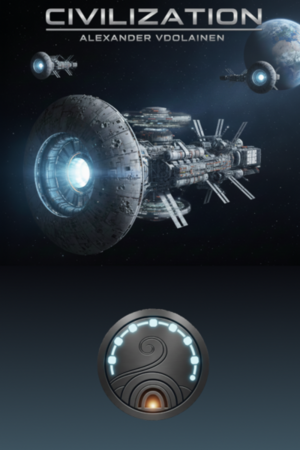
The appearance of orbital crawler was led by a massive plate shield, 2,500 meters in diameter. Its gray and white surface was covered by a mosaic of scars from space debris, a testament to the constant maintenance it required. The crawler never truly stops; it moves perpetually along its defined path, piercing different orbits like a comet captured in a permanent loop. Using planetary gravity to support course, it offered a slower but significantly cheaper way to transport different freight. Only a small fraction of its cycle is dedicated to loading and unloading cargo near destination points -- a brief window also used for intensive repairs.
The central iris of the forward shield slid open, allowing the engines to fire against the direction of travel to decelerate the massive structure. The exhaust glowed a brilliant light blue as the crawler began its braking phase. After a two-year journey from the outer Sol system, its arrival was a monumental event for both the crew and the commodity markets -- especially for those trading in fusion fuel and various volatiles. While the cargo volume had been known for years, its physical arrival finally hit the local markets; prices began their jump dance, and insurance companies finally started to breathe easier as their liability periods for the arriving cargo closed.
Positioned directly behind the shield was the rotating habitat. This secondary circular structure emulated 0.99g by rotating once per minute at a tangential velocity of 99 meters per second, sufficient to provide Earth-standard gravity for the personnel and sensitive cargo. During the braking phase, the ship hummed with activity. Temporary crew members prepared for their return home, while commanding officers catalogued the ship's wear and tear.
One of their primary nightmares was the maintenance of the defensive equipment: the railguns and rocket sections. Space is never as empty as it looks, and any object moving at these velocities requires active protection. Automated drones were already swarming the forward section of the main spine, replenishing projectiles and missiles for the next leg of the journey.
The main supporting spine stretched seven kilometres behind the shield. Along this central structure, the cargo was carried in an orderly array of plugged-in standard containers. Each container was a small ship in its own right, equipped with manoeuvring thrusters and enough fuel to detach from the crawler and rendezvous with local orbital freighters. These containers were whitish, though like the shield, they were peppered with small, dark scars from years in the void. While the crew and drones were frantic with activity, the cargo section remained the most silent part of the maneuver -- thousands of scarred modules bound to the crawler’s fastenings, waiting for the signal to float free and begin their final descent to the local markets.
The actual docking and undocking procedure was a spectacle witnessed by few, a beautiful, high-stakes parade of automation. Every incoming container and landing module was already in motion, trailing slightly slower than the crawler, waiting for the precise millisecond to fire their thrusters and lock into place. They looked like an armada of metallic insects hovering in wait, preparing to descend upon a massive bird. Nearby, another group of vessels waited in high-readiness to intercept the cargo the crawler was about to shed.
At the mathematically perfect moment, the dance began. Groups of docked containers detached in synchronised waves, drifting accurately toward the waiting near orbit freighters. Immediately following this exodus, the waiting armada "attacked", as new containers, fuel pods, and landing ships organically latched onto the crawler’s spine, making her fat with cargo once more.
The entire operation spanned a week, though the actual exchange took only a few hours. The remaining time was dedicated to the crawler’s deceleration and the fine-tuning of its trajectory for an Earth gravitational slingshot -- a maneuver designed to whip the vessel around the planet and back toward deep space with enough added velocity to save months of travel time. As the final docking clamps engaged, the iris of the forward debris shield slid shut, and the engines went dark. While swarms of maintenance drones busied themselves along the hull, the fresh shift of personnel began settling into their quarters.
Usually, this gargantuan event passes unnoticed by human eyes. Trajectory data and collision reports typically go straight to insurance company servers, ignored by a world that takes supply chains for granted. But not this time.
Optical and radio sensors from a monitoring satellite at a Lagrange point were capturing every second of the procedure. Every object in the sector was being tracked; every deviation, no matter how small, was logged. To prevent conflicts or commercial wars fueled by insurance monopolies, independent monitoring firms were on duty to archive these movements. By pure chance, one of these firms had chosen this specific arrival to stress-test their newly installed equipment with a full-sector sweep.
The anomaly began when an automated container tug broke formation minutes early. Like a hunting eagle, it dove toward a cluster of packed containers. This tug was brighter than anything else in the swarm -- not just from the flare of its liquid-fuel and ion targeting thrusters, but because it glowed like a Christmas tree in the radio spectrum. Executing a series of violent, rapid route corrections, the tug moved at a dangerously high velocity toward its prey.
At the moment of final approach, a blinding flash of radio-wave emissions erupted from the tug. Under the influence of this electronic surge, the targeted containers began to move erratically, drifting toward the docking belly of the rogue ship. The entire hunting lasted only minutes. Then, the radio flares vanished as suddenly as they had appeared. The tug, now heavy with its stolen cargo, burned its engines to their thermal limits and vanished from the scanned sector.
Four containers had been snatched by a mad automated ghost ship.
***
The day after the accident began later than usual for Adrian. He woke up at the most frustrating moment of a dream: a strange, disjointed flow of unconnected events, puzzling and disordered. The last thing he remembered was a blurred light at the end of a strangely shaped dark tunnel, somewhere deep within a space habitat.
“Bloody hell, I'm dreaming again. I really should stop mixing beer with gene therapy,” the thought sparked in his mind.
Mikko was already at the workbench. His face, as usual, was a mask of nothingness, yet Adrian detected a tiny, uncharacteristic flicker of curiosity in his partner's eyes.
“Hey, how are you holding up?” Adrian asked, his voice tinged with irony.
“Better than you, I suspect,” Mikko replied, not looking up. “I've spent the last two hours trying to parse the full data log from the vehicle's automated pilot. There's something wrong with it. Something I've never seen before.”
He gestured to the scrolling data. “Usually, you can trace every logical block, even the access to the learning database -- every read, every write. But this is a complete mess. It looks as though the pilot's code was constantly rewriting itself during the final minute before the crash.”
Technically, such a thing was nearly impossible. The core implementation of a self-driving module is housed in a device's ROM (Read Only Memory) hardware section. This was a deliberate safety feature designed to prevent undefined behaviour or malicious evolutionary tricks. In reality, the entire module had the cognitive capacity of a hamster, with no ability to alter its core behaviour or evolve beyond its factory parameters.
“That's impossible... technically,” Adrian said, his skepticism turning to indignation. “So, there are two possibilities: either you're going mad, or you've found something completely new and frightening.” He paused, his expression darkening. “At least, frightening for the manufacturer.”
An anomaly like this could ground an entire fleet of vehicles using that specific module. However, doing so required a grueling, strictly defined safety investigation -- the very responsibility assigned to Adrian and Mikko. Over the centuries, as automated solutions became infinitely more complex, accidents had become vanishingly rare. When they did occur, the cause was almost always trivial.
This case, however, was refusing to follow the pattern.
***
One of the cargo stations at the lagrange point glinted in the sunlight. Its numerous static docking ports looked like precisely mounted spikes on a white metallic club, while a torus-shaped gravitational habitat rotated at the far end of the monumental structure. From a distance, this colossal construction appeared as a static, dead sculpture of unknown origin. In the visible spectrum, only a few navigation lights blinked in rhythmic patterns; however, in the infrared and radio ranges, the station was a roar of electromagnetic activity. Its sharp edges and geometric precision looked utterly unnatural against the black emptiness -- a jagged outlier in the void.
This was one of the cargo sites for the German Cluster. Due to the vast distances of space, its sister stations were invisible to the naked eye, hidden beyond the horizon of the visible spectrum. These outposts served as the system's sorting hubs: packing, unpacking, and enforcing strict safety and quarantine protocols.
System-wide regulations dictated that no cargo could be delivered directly to a habitat. Every container destined for or arriving from an orbital crawler had to pass through these outposts first. It was a rule written in blood, established only after the total loss of two habitat populations and a devastating terrestrial epidemic on Earth.
Another massive construction drifted through the silence: a seven-hundred metres long tug. Its debris shield, though only fifty meters in radius, caught the sun with a brilliant sheen despite the microscopic pits of space-weathering. A distinctive, cold blue light from the fusion engines flared ahead of the shield, colouring the monochromatic void as the tug began its braking maneuvers.
The ship's skeletal spine was nearly invisible in the glare; only the mounted components stood out: the shield, backup fuel pods, fusion reactors, and the delicate, glowing heat dissipation arrays. In the vacuum of space, shedding waste heat is a constant struggle, achievable only through radiation; as a result, the radiator fins glowed with a dim, ominous red. To a distant observer, the ship looked like two disconnected circular structures moving in tandem rather than a single vessel. The tug was mostly empty -- only four containers were clamped to its hull.
The tug approached one of the station's docking spikes like a needle. It performed a high-precision dance to fight its own inertia, firing thrusters to align its seven-hundred meters long frame with the narrow port. In a final display of navigational mastery, the vessel executed a slow rotation and docked firmly to the spike.
Immediately, the four containers detached and began their transit toward the station's core. Simultaneously, dozens of other containers detached from neighboring spikes, swarming toward the tug's spine to be loaded for the next leg of the journey. For a brief moment, the static station seemed to come alive -- a giant, mechanical tree rustling at the touch of a visiting bird.
***
Mair's consciousness finally clawed its way back. When he opened his eyes, a massive headache pulsed in time with his heartbeat. His chest felt as if it were on fire, and his arms and legs itched with a persistent, maddening crawl.
He tried to piece together what had happened, but his memory was a void. Only two questions sparked in his exhausted mind: "Where? When?". With a trembling hand, he found the emergency button to call for a nurse.
While he waited, he fought to concentrate, desperately reaching for a single anchor -- a flash of memory, a name, a task, a sight -- but there was nothing.
The nurse arrived within minutes. “Are you in pain?” she asked.
“Yeah... headache,” Mair managed to croak, his voice barely audible. “And my eyes... the light dims with every heartbeat.”
“I'll give you a painkiller and some medication to stabilise that,” she said, her voice professional but detached. “But there are people who want to speak with you first.” She turned and opened the cabin door to allow two visitors inside.
Mair couldn't make out their faces; his vision remained a blurred, watery mess.
“Do you remember the accident during your servicing turn up there?” one of the visitors asked, their voice low and expectant.
“No.” Mair replied, the confusion mounting. “I was hoping you could tell me... up there? Where? Servicing what? What's the date? I have... a lot of questions.”
“You need rest.” the visitor replied, cutting him off with a tone that was more of a command than a suggestion. “Rest now. We will speak again later.”
The visitors nodded to the nurse and vanished as quickly as they had appeared. The nurse made a few final entries into the bed's automation console and followed them out. Mair felt his consciousness begin to slip away again. Before he could grasp at another thought, he fell into a deep, medicated sleep.
***
Michael was exhausted. The last few days had been a relentless grind of high-stakes decisions and mounting consequences. As a one of the top tier member of the German Cluster’s management board, he was used to pressure, but this was different.
Outside, the gray sky and sudden gusts of wind mirrored his own internal turbulence. He was acutely aware that his recent directives were not aligned with the rest of the board; by moving unilaterally, he had placed the full weight of the responsibility on his own shoulders. It was a lonely, dangerous position. He decided to light a cigarette. The bluish smoke coiled upward in slow, shifting patterns, adding a thin layer of texture to the oppressive gray of the room.
Only a few hours ago, he had issued the order to prematurely wake the engineer who had survived the explosion. Michael needed to confront the reality of the situation immediately, before somebody's else narratives could be given to the management board. He had bypassed standard protocols, sending his own private agents to interrogate the man while he was still disoriented.
As the nicotine hit his system, his mind raced, firing off potential solutions and contingencies. Yet, through the noise of his thoughts, one singular imperative remained constant, anchored in his mind like a command: "keep everything silent".
***
Several hours of silent labor passed in Adrian's home office. While Mikko sifted through the logged garbage of the autonomous driving software, Adrian waded through the murky depths of privacy protocols. Finding information in this digital landscape was like walking through dark, shallow waters, searching for a hidden drop-off. Eventually, the victim's identity surfaced.
"Hey Mikko, I was right about her age," Adrian said, breaking the silence. "She was old, and wealthy -- a high-ranking member of the German Cluster. There's still no data on her intended route or final destination."
Mikko didn't look up; he was consumed by the logs. His education had covered over three hundred landmark cases, each with its own bizarre set of circumstances, but nothing compared to this. The code preserved at the moment of impact simply didn't match the logs. He had a theory forming, but it was too radical, too impossible to voice.
"My findings are more significant," Mikko said aloud, his voice strained. "The code has been modified in a way that defies logic. It isn't just the driving software; it looks like the microcode on several CPUs was rewritten multiple times mid-flight to avoid detection. The car's hardware shouldn't have the computational resources to do that." He sighed, leaning back. "I can see patterns, but beyond that, it's unreadable."
Adrian wasn't surprised. He was already looking past the technical glitches toward a larger, darker tapestry. He could feel the threads of the last few days pulling together.
The victim held a key role in the German Cluster's directorate, controlling fifteen percent of the vote. She had died the same day an accident occurred on a German Cluster orbital station -- all of this happening just days before the annual directorate meeting. Yet, the directorate had remained suspiciously silent.
"Do you remember the 'cleanup' clowns crew at the crash site?" Adrian asked.
"Why?" Mikko replied.
"They weren't just unfriendly; they looked like they were panicking. My gut tells me germans already know what you found. They might have even been the ones to scrub the data... or perhaps..." he paused, "perhaps they triggered it."
"Are you going mad?" Mikko asked, his disappointment evident. "Who has the tech to intrude on a closed car system like that? And why would they assassinate one of their own high-society members?"
"Just because something is unplausible doesn't mean it's impossible," Adrian said softly. "We lack the background intel. For now, take a break. Go home. Don't discuss this with anyone." He lowered his tone further. "I’m going to dig deeper. My curiosity won't let me do anything else. And... we’re still on for the celebration at your place next week?"
"Yeah," Mikko muttered, still distracted. "Though this case is going to keep my brain on high alert. What about the celebration then?"
"I'll share my findings there. Prepare a technical report to close the case officially," Adrian said. "It's time we challenged the Germans; they've become too comfortable flouting our authority. This is finally getting fascinating."
As Mikko waited for his transport, he tried to fit the pieces together. He had known Adrian for years, yet the man remained a mystery -- a shadow of a cold genius who saw connections where others saw noise. Adrian was one of the first longlivings, a mentor to those like Mikko who followed the path of extended lifespans.
Centuries ago, when national governments still struggled to enforce disappearing laws and hoard taxes, Adrian had been among the first to deny the social and natural order. His motive was never money or power; it was a pure, relentless curiosity -- a force so strong it had sustained him for hundreds of years. To work with Adrian was to live for centuries on the shore of a vast lake, always sensing the depths but only ever standing in the shallow water. He was possessed by a singular, relentless obsession: to hunt down the weirdest, most unnatural phenomena in the universe and strip away their mystery until they became common, everyday facts. And he did this only so he could stand upon that new ground and look even further into the dark, searching for the next unnatural thing to explore.
Now, that curiosity was pulling them both into the deep.





Please sign in to leave a comment.