Chapter 10:
Chapter 10: The Threshold
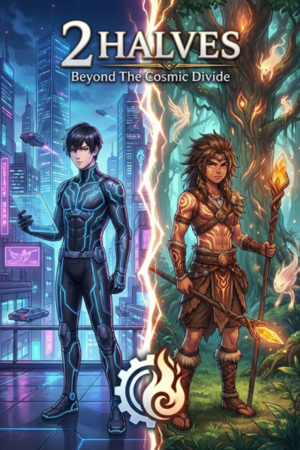
2 Halves: Beyond The Cosmic Divide
The Command Nexus at the edge of the Ravine was a cathedral of cold light and calculated risk. Carved directly into the basalt cliffs, it was protected by three meters of lead-reinforced concrete and a dedicated shielding array that hummed with a low, bone-deep thrum. The air inside tasted of recycled oxygen and the particular metallic tang that accompanied high-stakes gambling with other people's lives.
Xiang Wang stood at the center of the tactical theater, his posture rigid as the durasteel pillars surrounding him. Above, the primary holographic display—a massive, shimmering map of the known world—showed three pulsing blue icons: the DSS Horizon, the DSS Vanguard, and the DSS Pioneer. Three tiny specks of human ambition moving toward a void that had swallowed every drone they'd sent.
"The trajectory is stable," Ibrahim Aziz observed, his voice smooth and clinical. He sat in a plush leather chair to Wang's left, idly tapping a stylus against a tablet that cost more than most families earned in a year. "My fuel-efficiency models suggest atmospheric resistance will be manageable. However, every minute we spend in that interference zone burns through our quarterly resource allocation. If the land beyond isn't as resource-rich as preliminary surveys suggest, this mission represents a significant net loss."
"Resource allocation is a secondary variable, Ibrahim," Satō Dai interrupted from across the console. The Utopian representative looked older in the harsh blue light, the wrinkles on his face deep as canyons. "We are sending four hundred people into an environment that has demonstrated active rejection of our technology. The ecological data from the coastal sensors shows the Wall wasn't merely a barrier—it was a stabilizer. We're flying into conditions we fundamentally don't understand."
"The Utopians and their 'human variables,'" Ivan Patrov scoffed, leaning against a bulkhead. His heavy industrial-grade suit looked out of place in the sleek room, but as CEO of Patrov Products, he'd manufactured the very plates that made up the ships' hulls. "The Horizon is built with Patrov-V reinforced plating. It's rated for vacuum exposure and deep-sea pressure. It doesn't matter if the physics are 'different'—a hull is a hull. Either the metal holds or it doesn't."
"And if the metal forgets it's metal?" a new voice asked.
All heads turned.
Darius Rose sat slightly removed from the group, a shadow in the corner of the room. He was the only one not looking at the holograms. Instead, his attention was fixed on a small, archaic ticker-tape machine on his desk—a device so old it belonged in a museum. A thin strip of paper was slowly spooling out, recording simple binary pulses transmitted via hardened copper line from the Horizon.
"Explain yourself, Darius," Wang said, his voice carrying an edge.
"The drone failures weren't mechanical," Darius replied, still not looking up. "The hulls didn't breach. The circuits didn't short. The materials simply stopped agreeing to be what they were. Molecular bonds require consistent physical laws. If those laws are... fluid... then your Patrov-V plating isn't indestructible, Ivan. It's conditional."
Patrov's face reddened. "My engineers assured me—"
"Your engineers," Darius interrupted, finally looking up, "have never worked in an environment where their assumptions don't apply. None of us have."
"Then why," Wang said slowly, his eyes narrowing, "did you allow your son to board the Horizon?"
The room went silent. The question hung in the air like a blade.
"Because," Darius said, his gray eyes reflecting the cold blue of the displays, "Zone understands that data cannot be obtained from safety. Either he returns with information that changes everything, or he doesn't return. Either way, the Rose family benefits from knowing."
"That's your son," Satō Dai said quietly, something like horror in his voice.
"That's my investment," Darius corrected. "I have another son. I don't have another opportunity to understand what killed our drones."
A technician's voice crackled through the room's speakers: "General Wang, the Horizon is requesting communication. General Draeven for you, sir."
Wang pressed a control. A second holographic display materialized, showing the bridge of the Horizon. General Alaric Draeven stood at its center, his white Utopian uniform crisp despite the visible tension in his shoulders.
"General Wang," Draeven said, his voice steady but tight. "We're approaching the threshold. All personnel are secured. However, I want to note for the record that Mr. Zone Rose has filed a formal objection to our current crystal configuration."
"Of course he has," Wang muttered. Then, louder: "Put the boy on screen."
The camera angle shifted. Zone Rose came into view, standing near a viewport with a canvas pack at his feet. He looked impossibly young—seventeen, lean, with gray eyes that seemed to calculate probabilities while looking at you.
"Mr. Rose," Wang said, his tone barely concealing irritation. "You've had seventy-two hours to voice concerns. We launch in ten minutes. What is your objection?"
"The medical bay's stasis pods contain seventeen anamatic crystal matrices," Zone stated, his voice flat and clinical. "The galley's heating elements contain another twelve. The soldiers in the cargo hold are wearing powered exo-frames—each with three to five crystals for servo-assistance and targeting systems. You've optimized the ship's primary systems, but secondary systems still put you 22% above your own safety threshold."
Wang's jaw tightened. "We need those medical systems. We need those exo-frames. If we strip every piece of equipment, the crew will be defenseless."
"You'll be defenseless anyway," Zone replied. "The question is whether you'll be defenseless while mobile or defenseless while falling."
"The Rose family's paranoia," Wang said, his voice sharp, "is noted and dismissed. The Wang family engineers have modeled every scenario. Your concerns are theoretical."
"So was the Wall's existence," Zone said, "until seven days ago."
Ibrahim Aziz leaned forward. "General Wang, perhaps we should consider—"
"We are on a timeline!" Wang snapped. "The Rose Operatives sent a distress beacon from this sector three days ago. Every hour we delay reduces their survival probability. We don't have time for another retrofit based on a teenager's anxiety."
Zone's expression didn't change. "Then you're accepting a calculated risk of catastrophic failure. I wanted that noted for the record."
"Noted," Wang said coldly. "General Draeven, you have clearance to proceed. May your launch be smooth and your landing smoother."
The display cut off.
Darius Rose made a small sound—not quite a laugh, not quite a sigh.
"Something amusing?" Wang asked sharply.
"No," Darius said, watching the ticker-tape continue its steady pulse. "I was just calculating how long it would take for you to realize Zone wasn't expressing anxiety. He was establishing documentation."
"Documentation for what?"
Darius didn't answer. He simply pulled out a mechanical pocket watch—identical to the one he'd given Zone—and wound it carefully.
Tick. Tick. Tick.
"For the lawsuit," Darius said finally. "When this fails, and you try to blame the pilots, I'll have a recording of my son warning you. The Rose family doesn't lose investments, Xiang. We simply... reallocate blame."
Wang's face went pale, then red.
But before he could respond, the technician's voice returned: "General, the Horizon is crossing the threshold in thirty seconds."
Everyone turned back to the primary display. The three blue icons approached the line marking where the Wall had stood.
"All stations," Wang said into the communications array. "Mark this moment. Humanity expands today."
In the corner, Darius Rose watched his ticker-tape machine and said nothing.
Part II: The Tuning ForkTwo hundred miles away, inside the bridge of the DSS Horizon, the world felt very different.
Zone Rose sat in his jump seat, the coarse canvas of his analog kit resting between his boots. He wasn't looking at the consoles. He was listening.
He'd trained himself to hear the specific harmonics of the ship—the sixty-hertz thrum of the anamatic core, the soft rhythmic hiss of oxygen scrubbers, the high-pitched chirp of the AI guidance system. It was a symphony of order, each instrument perfectly tuned.
But for the last ten minutes, the symphony had been going out of tune.
The core's hum had acquired an overtone—a dissonant harmony that shouldn't exist. The oxygen scrubbers were cycling irregularly. And underneath it all, there was something new: a resonance coming from outside the hull, like the ship was becoming a tuning fork struck by an invisible hammer.
"General," Zone said, his voice cutting through the bridge's tension. "The hull resonance has increased by 14% in the last three minutes. It's no longer coming from the engines. It's coming from the air."
General Alaric Draeven stood at the command console, his white uniform looking like a shroud in the dim light. His hands rested on a manual flight yoke—steel cables and hydraulic pressure, backup systems that hadn't been used in actual operations for fifty years.
"We're aware of the interference, Mr. Rose," Draeven said without turning. "Dr. Tanaka?"
"Shielding holding at 92%," Dr. Yuki Tanaka reported from the sensor station. Her fingers moved across a physical keyboard—the holographic interfaces had been disabled as a precaution, replaced with phosphor-tube monitors that flickered with green text. "But the exotic energy density is spiking. General, the anamatic crystals in the forward array are beginning to glow. They're absorbing ambient charge faster than we can vent it."
Zone unbuckled his harness and moved to the viewport. Through the reinforced glass, he could see the DSS Vanguard maintaining formation to their port side—a jagged block of gunmetal gray bristling with weapon systems.
The metal was changing.
It wasn't melting. It wasn't corroding. The outer layer of armor was peeling away in long, silvery ribbons that dissolved into glittering dust the moment they touched the atmosphere.
"It's losing structural cohesion," Zone said quietly. "The anamatic crystals bonding the molecular lattice are reaching hyper-resonance with the environment. The ship isn't failing. It's unraveling."
Draeven's head snapped toward the viewport. His face went white.
"Vanguard, report!" he barked into the communications array.
Static. Then a sound that made everyone on the bridge freeze.
It was a high-pitched, melodic shriek—not mechanical, but almost musical. It seemed to come from everywhere at once: the walls, the floor plates, the very air in their lungs. Some of the crew pressed hands to their ears, but it didn't help. The sound bypassed ears entirely, resonating directly in bone and tooth.
"What is that?" someone whispered.
"The crystals," Zone said, his voice steady despite the wrongness of it all. "They're singing. Harmonic resonance at frequencies incompatible with our shielding."
"Threshold in twenty seconds!" Yuki called out, her voice high and strained.
Zone moved back to his seat and pulled out his mechanical watch. He noted the exact time: 14:47:32.
The bridge lights flickered.
Just once. But that single flicker sent a wave of tension through the crew. If the lights were failing, everything else was close behind.
"General Draeven," Zone said calmly. "I recommend we abort the crossing and return to—"
"Recommendation denied," Draeven said, his jaw set. "We have four hundred people on these ships and orders from the Continental Congress. We proceed."
"Then I recommend immediate core ejection the moment we cross the threshold," Zone continued. "The energy absorption rate will—"
"You don't give recommendations on my bridge, Mr. Rose!" Draeven snapped. "You observe and document. That's your role."
Zone fell silent. He'd made the attempt. What happened next was data.
"Ten seconds," Yuki whispered.
Zone felt it then—the vibration in his teeth that he'd predicted. The biological resonance. The environment itself was producing a frequency incompatible with human neural patterns.
"Five seconds."
He pulled out his voice recorder—mechanical, spring-driven, analog. Pressed record.
"Mark timestamp 14:48:02," he murmured into it. "Biological resonance detected. Environment actively hostile to Tech Side physiology."
"Three seconds."
Around him, the crew was gripping their stations, their faces set with determination or fear or both.
"One."
The DSS Horizon crossed the threshold.
Part III: The DegradationThe transformation wasn't violent. It was intimate.
For exactly 3.7 seconds, nothing happened. The Horizon crossed the invisible line where the Wall had stood, and everything seemed fine. The lights stayed on. The engines maintained their steady hum. The crew began to exhale in relief.
Then the air inside the bridge began to sing.
It started as a barely perceptible hum—the biological resonance Zone had predicted. But as they pushed deeper into what had been beyond the Wall, the hum grew, evolved, became a vibration that seemed to bypass ears entirely and resonate directly in bone marrow.
"Interference spiking!" Yuki screamed, her hands flying across the console. Numbers on the phosphor screens were climbing exponentially, the green digits blurring with speed. "It's not 4-to-1... it's 20-to-1! No—50-to-1! General, this doesn't match any of our models!"
The ship lurched.
On the Tech Side, gravity was a constant—maintained by gyroscopic stabilizers and carefully calibrated field generators. Here, gravity became a suggestion. The floor tilted thirty degrees left, paused, then swung forty degrees right, then seemed to forget which way was down entirely.
Zone's stomach dropped as the bridge inverted. His harness dug into his shoulders as he hung upside down for three seconds, watching loose equipment—tablets, styluses, a forgotten coffee mug—drift through the air like they were underwater.
Then gravity remembered itself with vicious certainty. Everything crashed down.
"Thrusters non-responsive!" the navigation officer shouted, his voice cracking.
"Crystal matrices are glowing!" Yuki's voice had gone high and sharp with panic. Her fingers hammered at the mechanical keyboard. "They're not supposed to do that! They're absorbing the ambient energy! The crystals are heating—internal temperature rising past safety limits!"
Zone watched the mechanical gauges mounted as backups along the bulkhead. The needles were spinning so fast they snapped off their pins, tiny fragments of metal skittering across the tilting console.
Through the viewport, he could see the Vanguard in their formation. The military vessel—built with twice the crystal density of the Horizon for maximum power output—was dying.
Its hull plating wasn't melting. It wasn't breaking. It was peeling. Like the metal had forgotten it was supposed to be solid and was reverting to its component atoms, drifting away in silvery clouds that sparkled in the purple-tinted atmosphere.
"Vanguard is losing hull integrity!" Draeven roared, fighting the manual controls. His knuckles were white on the flight yoke. "All ships, emergency protocol—"
The radio exploded.
Not metaphorically. The ancient high-frequency transmitter—the simplest piece of technology on the bridge, a design that predated the Separation itself—detonated. Sparks and molten components showered the communications station. The officer manning it fell backward, clutching his face, his hands already blistering.
Zone unbuckled, stumbled across the tilting deck to the emergency locker. He yanked out a manual fire extinguisher—chemical foam, no electronics—and sprayed down the burning console.
"Horizon, this is Command!" Wang's voice crackled through the backup speaker system, distorted but audible. "Report your status! What's happening?"
"The environment is rejecting us!" Draeven shouted toward the communications pickup. "Anamatic systems are failing across the board! We need—"
The speaker burst into flames.
The backup system—the last connection to the Command Nexus—died in a spray of sparks and melted circuitry.
They were alone.
"The core!" Zone shouted over the chaos, still holding the fire extinguisher. "Draeven, you have to eject the anamatic core now or the ship will shake itself apart!"
"If we eject the core, we have no power!" Draeven's face was red with strain as he hauled on the flight yoke. Hydraulic fluid was starting to leak from the manual control system—even the purely mechanical backups were being stressed beyond their design limits. "We'll be a glider at best, a brick at worst!"
"A glider can land!" Zone shot back. "A coffin just falls!"
The Horizon bucked violently. Somewhere below, Zone heard the shriek of tearing metal—a sound that shouldn't be possible on a ship this well-constructed. Through the viewport, a piece of the port-side hull tore free, tumbling into the purple atmosphere like a discarded toy.
The singing intensified. It was no longer just uncomfortable—it was painful. Zone felt his teeth vibrating in his skull, felt something warm trickling from his nose. Blood. The frequency was damaging tissue.
Around him, crew members were gasping, crying, some collapsing entirely. The human body wasn't designed for this environment. They were biological machines optimized for specific conditions, and those conditions had just been revoked.
Yuki Tanaka made the decision.
She lunged across the bridge, smashed the safety glass over the emergency core jettison with her elbow, and yanked the heavy manual lever with both hands.
THUNK.
The sound reverberated through the ship's skeleton—a deep, final sound like a god's heartbeat stopping. Zone felt it through his feet, through his bones, through the hand he'd braced against the bulkhead.
Outside the viewport, the anamatic core—the violet, crystalline heart that had powered the Horizon since its construction—fell away into the void.
It tumbled through the purple sky, pulsing erratically, then shattered in a brilliant cascade of light that looked like a dying star finally giving up its fire.
The singing stopped.
The lights died.
The hum of environmental systems—so omnipresent Zone had stopped consciously hearing it—ceased.
The artificial gravity vanished.
The Horizon became a tomb of metal, falling through an alien sky in perfect, terrifying silence.
For three seconds, there was only the sound of human breathing and the creak of stressed metal.
Then someone whimpered.
"Emergency lighting," Draeven rasped, his voice hoarse.
Zone cracked chemical light sticks—the ones he'd packed in the survival kits. Green and red glows spread across the bridge, casting everyone in sickly colors that made them look like corpses.
"We're in a dead fall," Yuki whispered. She was floating near her console, blood dripping from where the safety glass had cut her palm. The droplets formed perfect spheres in the zero gravity, drifting like tiny red planets. "No power. No thrust. No guidance. We're just... falling."
"Not dead," Zone corrected, his voice unnaturally calm in the chaos. His mind was already calculating angles, wind resistance, glide ratios. "We have a 3-to-1 glide ratio without power. The hull is aerodynamic. General, the manual steering controls are still hydraulically operated—they'll work without the core. Get to the yoke. Yuki, survival equipment is in the starboard emergency locker. Everyone else, aft section. Redistribute weight toward the tail."
Draeven stared at him for a moment, his face slack with shock.
Then his military training reasserted itself.
"You heard him!" Draeven barked. "Move!"
The bridge crew scrambled, pulling themselves hand-over-hand along safety rails. Zone moved to the viewport, watching their descent.
Below them, the landscape was wrong.
They'd crossed into an area that appeared to be a land of flames, but calling it "land" felt inadequate. The ground was a nightmare of obsidian spires and rivers of actual, flowing lava that glowed orange-red in the dim light. The "forests" were crystalline structures that pulsed with deep red bioluminescence—not reflected light, but light generated from within. And the atmosphere itself seemed to shimmer with heat distortion, creating layers of mirage that made distance impossible to judge.
"Altitude?" Zone asked.
Yuki had pulled herself to a mechanical altimeter—spring-loaded, purely analog. "Ten thousand feet," she read, her voice shaking. "General, we're coming in too steep! The angle is—"
"I see it!" Draeven's muscles bulged as he fought the yoke. The hydraulic lines were designed for power-assisted flight—using them purely manually was like trying to steer an ocean liner with a rowboat's oars. Sweat poured down his face. "I can't pull up fast enough! We're going to hit the ridge!"
Zone watched the approaching mountainside, his mind running calculations automatically.
Impact angle: 47 degrees.
Speed: approximately 210 meters per second.
Hull composition: Patrov-V composite, rated for 180 m/s maximum impact.
Survival probability in current trajectory: 3%.
"The escape pods won't launch," Zone said flatly. "The explosive bolts are electronically triggered. They're all dead weight now."
He pushed off toward the emergency locker, started pulling out the manual parachutes he'd stashed seventy-two hours ago. "We have to jump."
"Jump?!" A young navigation officer—couldn't be older than twenty-two—stared at him with wild eyes. "We're at five thousand feet!"
"Four thousand eight hundred," Zone corrected, checking the altimeter again. "And decreasing rapidly." He shoved a parachute pack into Yuki's arms. "Put this on. Pull the red cord at one thousand feet. Not before—the wind shear will destroy the canopy. Not after—you won't have time for deployment."
"How many parachutes?" Draeven asked, still fighting the controls.
Zone glanced at the locker. "Six."
The bridge went silent except for the groan of stressed metal and the whistle of wind through the hull breach.
There were fourteen people on the bridge.
"Six," someone repeated, their voice hollow.
"I packed what I could carry," Zone said, his tone clinical. "I recommended installing more. The Wang family engineers said it was a waste of mass allocation. Take it up with them if we survive."
"I can save the ship!" Draeven shouted, sweat and desperation in his voice. "If I can just level out the glide angle—"
The Horizon clipped an obsidian spire.
The sound was reality breaking. The entire starboard side of the bridge tore away like tissue paper, exposing the interior to the atmosphere. The heat hit like a physical blow—120 degrees Fahrenheit, thick with sulfur, hot enough to sear lungs with each breath.
The ship began to spin.
People were screaming, clutching at consoles, at each other, at anything fixed as centrifugal force threw them toward the jagged opening. One crew member—the young navigation officer—lost his grip and tumbled out into the void, his scream dopplering away into nothing.
Zone didn't scream. He grabbed Yuki with one hand, Draeven's collar with the other, and dragged them both toward what was left of the aft corridor.
"Move!" he shouted over the wind.
Three other crew members grabbed parachute packs and followed, their faces masks of terror.
The rest remained frozen, clutching their stations, unable to accept that the ship—the massive, sophisticated triumph of engineering they'd trusted with their lives—was simply going to stop being.
Zone pulled Draeven and Yuki through the corridor access. Behind them, the bridge crumpled inward as the Horizon struck another spire, the reinforced bulkheads folding like origami.
He didn't look back.
There wasn't time.
Part IV: The Moral VariableThe corridor to the aft airlock was a journey through a dying machine that refused to stay still.
Without the anamatic core to stabilize the hull's molecular cohesion, the DSS Horizon was no longer a masterwork of engineering. It was a three-hundred-meter collection of debris held together by momentum and failing structural welds. The ship tumbled end-over-end as it fell, creating a chaotic, shifting gravitational field. One moment Zone was weightless, his boots drifting inches from the floor; the next, he was slammed against a bulkhead with three times normal gravity.
His fractured rib—acquired when gravity had first failed—sent white-hot spikes of pain through his chest with each impact.
"Move!" Draeven's voice was a jagged rasp. The General hauled himself along the manual safety rails, his silver hair matted with blood from a scalp wound. Behind him, Yuki was hyperventilating, her eyes fixed on Zone's green glow-stick as if it were the only solid thing in a dissolving universe.
Three other crew members followed—a young officer whose name Zone had never learned, a medical technician clutching his parachute pack like a religious icon, and the ship's communications specialist, her face blank with shock.
They passed the crew galley.
The hatch was open. Inside, the "smart" appliances had short-circuited, filling the air with the suffocating smell of scorched plastic and ozone. The room was a chaotic mess of floating food packets and broken glass, spinning slowly in the zero gravity like a snow globe made of debris.
In the center of the room, a man was pinned beneath a massive industrial refrigeration unit that had torn loose from its magnetic moorings.
His legs were a ruin—crushed bone visible through torn fabric, white shards protruding from flesh that was already turning the gray-purple of dying tissue. A globule of dark red blood drifted beside his head, catching the green light from Zone's glow-stick and refracting it into a sphere of ruby darkness.
"General..." the man wheezed. His fingers clawed at the smooth floor plates, trying to pull himself free even though his spine had clearly been severed. "Help... please... I can't feel my legs... please..."
General Draeven skidded to a halt, his boots screeching against metal. For a moment, the ship's tumbling stabilized, creating a brief pocket of normal gravity.
"Soldier!" Draeven started forward. "Yuki, grab his arms! We need to—"
"General," Zone said.
His voice was a cold scalpel, cutting through the panicked humidity of the corridor with surgical precision.
Draeven turned, his eyes wild. "He's alive, Rose! Help us lift this—"
"He has a crushed pelvis and probable severed spinal cord," Zone stated, his gaze moving from the cook to the mechanical altimeter mounted on the bulkhead. The needle was vibrating violently: 8,000 feet. "Bilateral femur fractures. Internal hemorrhaging based on the pooling pattern of subcutaneous blood. Even if we extract him, he requires immediate surgery and blood transfusion to survive the next ten minutes."
Zone took a step closer. The green light of his glow-stick cast long, skeletal shadows across the cook's face—a man maybe forty years old, with laugh lines around his eyes that were now filled with tears of pain and terror.
"To extract him requires two people and approximately ninety seconds," Zone continued, his tone as clinical as if he were reading a weather report. "To stabilize him for transport requires medical equipment we don't have and four additional minutes we don't have. The ship's hull will reach structural compression limits in—" He glanced at his mechanical watch. "—two minutes and seventeen seconds."
The ship lurched. Somewhere above them, metal shrieked as another section gave way.
"He is a variable that reduces our survival probability to zero percent," Zone said, meeting Draeven's horrified stare. "I am an analyst, General. Not a savior. I don't trade my 42% survival probability for his 0%."
"He's a human being!" Yuki screamed, her voice cracking. Tears were streaming down her face. "We can't just—"
"He was a human being," Zone corrected. He looked at the cook, whose eyes were pleading, begging, full of the desperate hope that someone would prove Zone wrong. "Now he is mass. Weight. A calculation that doesn't favor survival."
The cook's hand reached out. "Please... I have a daughter... please..."
Zone turned away.
"Move," he commanded. "Or stay here and become part of the wreckage with him."
Draeven looked at the cook. Then at Zone. Then at the corridor ahead where the aft airlock waited—their only escape.
For a moment, the General looked like he was going to hit the boy. His hands clenched into fists. His jaw worked as if he were trying to find words that would make this choice something other than what it was.
Then the ship groaned—a deep, bass shriek of twisting durasteel that vibrated in their very marrow. A section of ceiling thirty feet down the corridor buckled inward, venting a violent hiss of pressurized air.
Draeven's shoulders slumped.
He didn't look at the cook again. He grabbed Yuki by the harness and began pulling her toward the aft section.
"Forgive me," Draeven whispered to the air. To God. To himself.
Behind them, the cook's pleas grew fainter as they moved away.
Zone didn't whisper. He didn't ask for forgiveness.
He simply calculated the next turn in the corridor, the optimal grip points on the safety rails, the precise moment when the ship's tumbling would create a window of stable gravity they could use to move faster.
I was right, he thought, feeling something cold and crystalline settle in his chest. Not satisfaction. Not guilt. Just the profound completion of a proof being validated by reality.
My data predicted this exact scenario. Forty-two percent survival probability if I move now. Zero percent if I stop. The mathematics don't care about his daughter. They don't care about Draeven's morality. They don't care about Yuki's tears.
They simply are.
They reached the aft airlock—a heavy, circular iron wheel that looked like it belonged on an ancient submarine. Patrov's "obsolete" backup, installed because regulations required manual overrides even though everyone had assumed they'd never be needed.
Everyone except Zone.
"Rotate!" Draeven commanded, grabbing one side of the wheel.
Zone grabbed the other. They strained against cold iron. On the Tech Side, physical exertion was something performed in optimized gyms for calculated health benefits. Here, it was the only currency that could purchase their lives.
Grind. Screech. Clunk.
The seal broke.
The atmosphere of the Unknown Territory didn't just enter—it invaded.
A violent, sulfurous gale roared into the corridor, smelling of burnt stone and scorched metal and something else, something organic that Zone's database had no reference for. The temperature jumped from 72 degrees to 115 in the span of a heartbeat.
But it was the air itself that made Zone's analytical mind stutter.
It wasn't just hot. It was heavy. The atmosphere had a physical presence, a thickness that made each breath feel like inhaling warm syrup. The air had texture, a quality that shouldn't exist in a gas. Zone felt it sliding into his lungs, coating his alveoli with something that made his cells scream in biochemical confusion.
Atmospheric density: +18%, his mind cataloged automatically. Pressure differential creating inner-ear stress. Oxygen partial pressure adequate but something else present. Unknown particulate. Unknown energy signature. Cellular-level rejection response initiating.
He stumbled to the edge of the airlock and looked out.
The sky was wrong.
It was a bruised, angry purple—not the purple of sunset on the Tech Side, but a deep, living purple that seemed to pulse with its own internal rhythm. Streaks of crimson light shot through the clouds like veins carrying blood through cosmic tissue.
And below...
Below was a hellish scene.
From this altitude, it looked like the surface of a dying star. The landscape was a sea of fire—not metaphorical fire, but actual, visible flame that moved in waves across the terrain. Obsidian spires jutted up through the inferno like the bones of a titan. Rivers of molten lava carved glowing orange channels through the darkness, their light reflecting off crystalline structures that Zone's eyes couldn't quite focus on.
And in the distance, impossibly vast, was a complex.
It sprawled across twenty square miles of volcanic plateau—walls of black stone that seemed to drink in light, massive geometric structures that defied his understanding of architecture. Thousands of heat signatures moved through it in patterns too organized to be random. It was a city. Or a fortress. Or both.
Military installation, Zone's mind provided. Scale suggests garrison of 50,000-100,000. Strategic position overlooking multiple approach vectors. This is their equivalent of a major defensive position.
We're falling into the heart of their military power.
"Zone..." Yuki's voice was small, childlike. She'd pulled herself to the edge and was staring down at the sea of fire. "What is that?"
"That," Zone said, his voice steady despite the wrongness of everything, "is where we're going to land."
Through the opening, Zone could see the other parachutes deploying. Five white specks against the purple sky—tiny, pathetic, absurd in the face of the landscape below.
One was falling wrong. Not deploying. The young officer who'd grabbed a pack—he was tumbling, his parachute streaming behind him in a useless tangle.
Zone watched him fall. Calculated the impact velocity. The probability of survival.
Zero percent.
The officer hit the obsidian spires five seconds later. Zone was too far away to hear the impact, but he saw the burst of red that marked where a human body had been converted into constituent elements by kinetic force.
Data point, Zone thought coldly. Parachute deployment failure rate: 16.6%. Note for future missions.
If there were future missions.
"Jump," Zone commanded.
"I can't!" Yuki backed away from the ledge, the wind tearing at her hair. "The heat... Zone, we'll burn before we even—"
Zone didn't argue. He grabbed the manual deployment handle on her shoulder harness and shoved her out into the abyss.
Her scream was swallowed by the roar of superheated wind.
The medical technician jumped next, his face set in grim acceptance. Then the communications specialist, moving like a sleepwalker.
Draeven stood at the threshold, looking back toward the bridge—toward the two hundred and thirty-seven people still trapped in a falling tomb.
"They deserved better than this, Rose," Draeven said, his voice hollow.
"They deserved commanders who understood the environment they were entering," Zone replied, checking his mechanical watch one final time. 14:50:43. "Go. Pull the cord when you see the crystalline trees. Not before."
Draeven closed his eyes. Let go. Stepped into the void.
Zone was alone.
He walked to the edge of the metal lip. The ship was breaking apart now—he could hear the secondary hull plates shearing away behind him, could feel the vibrations as the Horizon began its final disintegration.
He looked down at his boots. At the canvas pack strapped to his chest. At the sea of fire waiting below.
He felt a flicker of something in his chest. Not fear. Not regret.
Vindication.
I was right. Every calculation. Every warning. Every probability model.
They dismissed me. Called me paranoid. A coward. Theoretical.
And now 387 people are dead because they trusted their assumptions more than my data.
He pulled out his voice recorder one final time.
"Final entry," he said into it, his voice steady. "The mission has failed exactly as predicted. Survival rate: approximately 1.5%. Cause of failure: fundamental incompatibility between anamatic technology and the environmental conditions beyond the former Wall. Recommendation for future missions: complete technological reset to pre-anamatic baseline, or—"
The Horizon struck the ridge behind him at a forty-degree angle. The sound was apocalyptic—metal shrieking as it tore, the deep percussion of mass meeting immovable stone.
Zone pocketed the recorder and jumped.
The fall was a descent through wrongness.
As Zone cleared the structural shadow of the dying Horizon, the air ceased to be a gas and became something else entirely. It had weight. It had presence. Every meter of descent felt like pushing through increasingly thick layers of invisible resistance.
His lungs revolted. Each breath tasted of scorched copper, sun-baked earth, and something sweet-sick that made his neurons fire erratically. The air was alive with energy he couldn't see but could feel—a vibration at the cellular level, like his very molecules were being asked a question they didn't know how to answer.
Atmospheric composition analysis impossible, his mind noted. Unknown particulate creating interference with standard biological processes. Oxygen present but... contaminated? Enriched? Something else present. Unidentifiable.
He reached for the red ripcord.
It resisted. Not stuck—just sluggish, as if the mechanism was moving through syrup instead of air. He yanked hard.
The parachute deployed with a violent, bone-jarring crack that jerked his entire skeleton upward. On the Tech Side, parachute deployment was a gentle deceleration. Here, it felt like hitting a wall. The air was so dense that the silk canopy encountered resistance, actual physical pushback from atmosphere that shouldn't behave this way.
Zone's fractured rib became a broken rib. The pain was white-hot, absolute. He gasped, tasted copper—blood from a bitten tongue.
But he was slowing. Falling at a survivable rate instead of a terminal one.
He looked down.
The land of flame resolved from abstract horror into a specific nightmare.
The "sea of fire" he'd seen from altitude wasn't an ocean. It was a forest. The trees were massive crystalline structures, fifty meters tall, that pulsed with deep red bioluminescence. They didn't sway in wind—they flexed, like lungs breathing, expanding and contracting in a rhythm that matched... something. A heartbeat? The planet's rotation? Something else entirely?
Between the crystal trees, actual rivers of lava flowed in channels that seemed too geometric to be natural. The military complex he'd spotted dominated the horizon—black stone walls that rose a hundred meters high, covered in what looked like writing but shifted and changed as he watched, the symbols refusing to stay still.
And everywhere, everywhere, there was heat shimmer. Reality itself seemed to ripple and distort, making distance impossible to judge. What looked like solid ground from one angle became transparent from another. The entire landscape felt provisional, as if it hadn't quite decided what it wanted to be.
Zone could see the other survivors below him. Four white canopies drifting toward different landing zones in the crystalline forest. Draeven was a mile to the east. Yuki was further south, heading toward a cluster of the pulsing trees.
Then Zone saw the shapes moving through the forest.
They weren't animals.
They moved with too much coordination, too much purpose. Heat signatures weaving through the crystal trees in formations that looked almost... military.
Patrol patterns, Zone realized. We're landing in an active military zone. They know we're here. They're converging on landing sites.
The ground rushed up.
Zone pulled on the control cords, trying to steer toward a clear area between two obsidian outcroppings. The parachute responded sluggishly—the dense air made everything harder, slower, wrong.
He hit the ground at thirty miles per hour.
The impact drove every molecule of air from his lungs. His broken rib became shattered rib. His vision went white with pain.
He lay gasping on something that wasn't quite ground.
It was moss. But alive in a way that shouldn't be possible. Thick, spongy, warm—like lying on living tissue. The moss pulsed beneath him with that same rhythm as the trees, as the light, as everything in this nightmare landscape.
Then the moss moved.
It retreated from his body, flowing away like water, leaving him on bare scorched basalt. Within seconds, Zone was lying on naked stone while the moss formed a perfect body-shaped hole around him.
The environment is rejecting me, Zone thought through the pain. Biological incompatibility at the ecosystem level. I'm not just foreign. I'm toxic.
He forced himself to sit up, biting back a scream as his shattered ribs ground against each other. His left arm hung uselessly—shoulder dislocated. Blood ran from his nose, his ears. The dense air had ruptured capillaries throughout his body.
Survival probability decreasing, his mind provided helpfully. Multiple traumatic injuries. Hostile environment. Unknown hostiles approaching.
Current probability: 23%.
He fumbled for his pack with his functioning hand, drew out the kinetic pistol. The weight of the metal was a comfort—something that followed the same physical laws he understood.
Then he heard it.
A whistle. Three sharp notes, one long slide. Musical. Coordinated. Intelligent.
Zone turned, raising the pistol with shaking hands.
The crystalline trees parted.
And the hunters stepped into the clearing.
[End Part IV]




Please sign in to leave a comment.