Chapter 11:
Side Story. Takumi Takahara in the City of Nagoya Part 2
Under the Seal of Repudiation
"I am the second of three children from a family in Nagasaki. My older brother, Keigo, died two years ago from cholera. My father didn't really know what to do at the time. But he was determined to keep the business in the family, so I, having just turned eighteen, had to pretend.
"By the way, my family is dedicated to medicine. My father runs a small apothecary near the sea in Nagasaki. I love looking at the ocean; I can still remember how the air smells there. My little sister probably already has plans to walk on the beach once it gets warmer. The advantage of being seven years old is that you still have the freedom to go and play.
"It was my father’s idea. Instead of adopting a son-in-law, he decided it would be more convenient for me to start studying. I came to Nagoya because no one knows us here; I could pretend to be someone else. I enrolled as Tanaka Ren. It wasn't easy to forge the necessary documents, but I managed to gain access to an education.
"I’ve been studying like this for almost a year and I don’t regret it. I can study, read, meet people, and do things I couldn't do as a woman. For example, I have been present in the university’s reading circles.
"I love Aesop's Fables! I cried after hearing the tragedy of the gypsy Esmeralda; the adventures of Phileas Fogg visiting Bombay, and how he rescues Aouda makes me want to travel the world myself.
"Anyway… every two weeks I send my father a letter about my progress. He truly trusts me and knows I can achieve it. I am eternally grateful to him for giving me this opportunity, and I cannot let myself be discovered. I truly ask you not to say anything. It would ruin my plans… I mean, it would ruin my father’s plans, and I cannot let him down."
Takumi listened in silence. He was amazed that she could go a whole year without being discovered. She was seizing an opportunity that not just anyone in her situation could have. Therefore, he would keep his promise.
"I will keep the secret," Takumi remarked, which made Ren smile with excitement. “But I have a condition."
"What is it?" Ren asked with some hesitation.
"If you help me study, of course, I can help you."
Ren accepted the deal, and during that year, they formed a friendship while they continued their studies and maintained the appearance of Ren’s identity.
Throughout that year of 1888, both of their studies continued. From time to time, they met in their free time to talk, eat, or drink. In those moments, Ren mostly spoke of his family. He spoke of how his father was his role model, his guide.
"He likes to study," Ren told Takumi. His happiness was evident when he spoke of him. "He says he is certain that a woman is also capable of doing it. The only problem is that I must remain hidden."
"But you have managed to stay in this condition for a year," Takumi said with admiration. "It seems to me that not just anyone could do it. Besides, your father is a revolutionary for letting you study, even if it is in secret."
"I would say it’s dangerous," Ren admitted with a bit of a bitter laugh.
"Sometimes I think it would be easier if we just adopted someone and I became that fiancée who only knows how to bear children and keep a home. But of course, that is the easy path."
The easy path… Takumi thought. Was the path of marriage truly easy? He really doubted whether it was truly the easy way or if it was simply easier to follow custom. Surely, when this entire educational adventure was over, he would become part of that world of engagements and wedding plans.
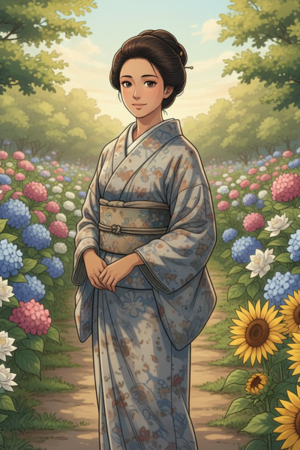
By the year 1890, Ren finally managed to graduate and prepare for the return to Nagasaki. One week before the trip and two days after graduation, Takumi encountered the true personification of Ren for the first time: he saw Renko in a beautiful, simple pink kimono, with her hair in a modest updo.
"Would you invite me for a walk?" Renko said. She had appeared at Takumi’s residence one March morning, catching Takumi so off guard that he was left speechless.
Her feminine beauty stood out now that she didn't have to hide, and she looked truly well appearing as she really was. Takumi accepted the invitation and they both went out for a walk. It was still somewhat cold, but they didn't mind.
In that situation, they looked like an engaged couple, a couple that would soon celebrate their wedding, or perhaps a newlywed couple. People turned to look at them and greeted them. Upon arriving at a nearby park, Renko grew a bit excited. Hydrangeas had been planted and, despite the weather, they had bloomed and were growing.
"It’s as if they are welcoming the spring!" Renko commented as she approached the flowers to see them better.
Takumi, meanwhile, felt uncomfortable. For the first time, he felt as if they were being pointed at and judged. Renko was loud, expressive, and open about saying what she thought, and he understood that for a woman, her behavior was not considered normal. He realized people already saw them as a married couple.
Both continued walking and, once again, silence settled between them. In those moments she looked worried, as if a secret were crushing her.
"What secret are you keeping now, Renko?" Takumi remarked as he forced his friend to sit down. "You’re making it hard for me this time."
"Have you ever thought about your future?" Renko asked him. Her gaze was distant as she observed the park gardens. Takumi looked at her, confused. What was she thinking now?
"My future is in Shimizu; I will be the owner of the textile factory that—"
"Of course. I already knew," Renko commented with anger and frustration. "It has always been this way. Parents deciding the future of their children. We must only obey without complaining."
"What’s wrong, Renko?" Takumi looked truly confused.
In the three years he had known her, Renko had never behaved this way. At least not in front of him. He always saw her as a person who liked and even enjoyed going to university, having that opportunity that no other woman could. Where was this behavior coming from?
"By my father’s order, I came here to study; for my father, I hid all these years. Now I must return to continue hiding. It would be easier if father just adopted a son-in-law."
"I don’t understand you, Renko," Takumi told her with some anger. "You always liked coming to university; you were happy to be able to study, to read, to have that opportunity. Why is it different now?"
"You don’t understand," Renko told him with some resentment. "I wanted to believe it was what I desired; I wanted to have father’s approval. I like studying, I liked having had this opportunity, but why must I hide? Why can’t I be myself? I would have liked to have come as Renko. Now he will take that opportunity away from me again, just to follow his plans."
"Then, what do you want?"
Renko fell silent. She thought she had already told him. That she had already told him her dreams, her desires, her ambitions. A light, cold breeze began to blow, causing them both to start heading home in silence.
"I wish I could run away," Renko spoke in a low voice, making Takumi strain to hear. "I want to run away, I want to travel the world like Mr. Fogg did. Sometimes I think that if I were a man—a real one—everything would be easier."
"It’s not as easy as you think," Takumi told her honestly. "In my case, I must meet my father’s expectations. I can't just give up that easily for whims like yours."
"Mine will never be a whim," Renko responded angrily. She stopped and looked Takumi in the eye.
This made him nervous. Renko was speaking loudly, and this made people turn to look, which made him feel uncomfortable. He didn't like it; it felt as if they were judging him, as if he were losing the control.
"What you call a whim, to me, are desires, dreams," Renko continued her speech. "I am burning with the desire to run away, to be myself to fulfill what I want over what others desire. But in my condition, I can’t. I never will be able to."
Renko began to cry. It was the first time she had shown that kind of weakness and, not knowing exactly what to do, Takumi only watched her, looking at her while she showed her vulnerability before him.
When Takumi and Renko reached her small room, the situation had become awkward. They had been walking in silence. Before saying goodbye, Renko’s eyes widened; as if there were a bug or dust on Takumi’s shoulders, she simply observed in silence.
"What if you run away with me?" Renko said to Takumi. Now he was the one looking at his friend with wide eyes.
"What?" was the only thing he managed to say. The idea was the strangest thing she had ever told him.
"Of course. We can run away. I have some savings; we can go to the nearest port and go to some nearby city and start from scratch. I could remain as a woman and we could—"
Renko was speaking very fast. She seemed excited by the idea. Takumi interrupted her, placing his hands on her shoulders. This made her stop.
"You’re crazy!" was the first thing Takumi said to his friend. "You can’t do that. You would be leaving your family, your stable future, for something you don't know."
Renko broke free from Takumi’s grip, and he lowered his hands. Renko was no longer crying, but she felt disappointed, fed up with the situation.
"Thank you for walking me home," Renko said, looking at the ground. "I hope all goes well in your stable future, planned by your parents."
Immediately after, she closed the door. Takumi ran his right hand through his hair, messing up his perfect hairstyle. He sighed and went home. The mere idea of running away, of giving up everything, seemed improper to him. Why would someone want to make that decision in the first place? The plans his father had for him weren't so bad.
Those plans gave him security; they gave him a purpose in life and, most importantly, they gave him stability. He wouldn't know how to direct his life on his own. He saw Renko’s life as similar to his own. Yes, it was strange that he forced her to be a man, but she never complained—he never saw her do it.
That week passed quickly between plans for the next school semester and invitations from classmates and friends. Over those years, Takumi had managed to establish relationships with several people, and his life was at its best since he arrived.
On Monday morning, he went to the post office to check if his father had sent a letter. He was surprised to see a letter with his name and a drawing of a lotus flower. He knew who it belonged to. The letter read:
“To the heir of the factory:
Good day, Takahara Takumi-kun. When you find yourself reading this letter, I will already be far away. You must assume I am on my way to Nagasaki, but you are mistaken. My destination is uncertain. I do not know where fate will take me now that I have finally put my thoughts in order.
What I can tell you, and hoping you keep my secret, is that I went to Yokohama. It is the city that Mr. Fogg visited on his journey. From there, you will know where I will go. Once I leave Japan, I do not know what I will do. I would have truly liked for you to accompany me.
I hope your idea of life is the correct one. Your father’s plans will include ideas that surely won't be aligned with what you desire: a forced engagement, securing an heir, continuing in that boring factory until your heir reaches the necessary age to take over sounds fun (I want to believe it is exciting for you). To me, it sounds more fun to take the reins of my own life, the freedom to make my own decisions without others intervening. It sounds even better than father’s plans for me. I wish you the best, and I hope that just as Fogg found Aouda, you are able to identify your own princess and fight for her. I was not that princess.
—Ren”
That afternoon, during dinner with some friends, he meditated. He couldn't speak of the letter. He had also heard Ren’s favorite story and, although he knew how it ended, he didn't understand how an adult could decide for themselves whom to marry.
"No one told him what to do. No one told him how to behave or what to do. Was that just what he desired to do?" Takumi asked with doubt, even with fear.
His friend was annoyed. They were supposed to have gone out to have fun, to relax. Classes were starting soon and they were trying to relax before the start of those lessons.
"I don't understand your doubts," his companion said, already fed up. "You have everything: a family, a stable future. Surely when you get to Shimizu, your family surely will plan your engagement."
"And what if I don't desire that?" Takumi asked, being sincere for the first time before strangers, and before himself.
“What do you want instead?" his companion asked him.
Takumi didn't respond. He didn't know well what he desired, so he decided not to continue the subject. It was much easier to avoid it, to ignore it.
That year was the last he spent in Nagoya, and by March 1891, he had graduated. Soon he would leave for Shimizu. Upon going to the post office, he discovered they had sent him enough money for a first-class train ticket to the town.
The last letter he received was short, with few words. His father told him that by next July the factory would be ready, but that he needed him as soon as possible to settle important family matters.
In this manner, two days later he boarded the train and departed for Shimizu, a port city about which he knew nothing. During that year, he had the opportunity to think about what he wanted for his future.
He never heard from Renko again, so her decision surely caused her problems; he imagined many possibilities regarding her fate. He even had nightmares during the first days of his departure. Dreams where her ship was wrecked, where her family caught her and took her home, and even—the worst of all—he dreamed that they discovered she was a woman.
His schoolmates mocked her; the school, humiliated, stripped her of all her achievements; and her parents even disowned her. The dream always ended with him seeing Ren in the red-light district.
“My father knows how to make decisions,” Takumi thought while he watched the landscape outside as the train advanced toward an unknown future. “I can trust him, and in this way, I can ensure a good future for myself—one that I can visualize.”
When the train braked, he woke up abruptly. Upon leaving the platform, it didn't take him long to find one of his family's servants, thanks to the family emblem. The person waiting for him told him the carriage was ready.
As the carriage moved through Shimizu, Takumi observed the city. Although he was tired, he relaxed upon seeing the town. It was a city that combined novelty, like electric lights, but at the same time, he liked seeing how in a certain sector one could still see the traditional houses of Japan.
The carriage stopped for a few moments to let some pedestrians pass. It caught his attention that they didn't look back at him. One of those people seemed strange to him. Her way of walking was that of a different kind of woman. Her back was straight, her hands still in front of her. She walked slowly, was alone, and her tanned skin was noticeable.
“What an odd peasant girl,” Takumi thought. His carriage moved forward, and a few minutes later he reached the area of the city where the famous factory was located—the one he had only read about in letters from his father. It was impressive from up close and much larger than he had imagined.
It was already fully built. Not far from there, a couple of blocks after the factory, was his residence. Imposing, with a large garden and a small terrace. The construction was clearly in that London style he sometimes saw in newspapers, and the garden was in the japanese style. There were no flowers, only some fir trees, small shrubs, and nothing more.
There was his father, at the entrance, waiting for him. After the greetings, both men went to the father’s office to talk. They spoke about the plans for the factory that year.
"We are still waiting for the machinery to arrive," the father remarked, "as well as some necessary furniture. The factory may look imposing from the outside, but there is still much to fix inside."
Keiichi, Takumi’s father, showed his son some blueprints of how the interior would look. His son watched intently, but his exhaustion was evident, and his father noticed.
"Go and rest, son," he said with a sigh as he began to put away the blueprints. "Dinner will be served promptly at six.”










Please sign in to leave a comment.