Chapter 7:
Smallins vs. Droctrus (3)
The Final Awakening
Virkin Rondiyord woke up one day and prepared himself quickly, for his father had summoned him for something important—something he wished the day of its revelation would never come.
He was troubled because his father had called him to the "Hall of Ancestors," a summons that only occurs when the family's Awakening holder decides that the end has come and the power must be passed to the next successor. Thus, Virkin felt deeply distressed and fearful.
Upon entering the room, where portraits of his ancestors hung along the walls of the corridor-like hall, he stepped forward slowly. He walked between the hanging images, staring at the candles always placed there to light the way instead of lamps.
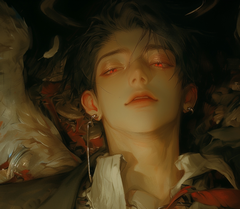
He was terrified, walking as if he were making no effort, as though he never wanted to reach his father. Deep inside, he felt what his father was about to tell him, and he never wanted to hear it. Virkin was a young man with dark hair and blue eyes, appearing ordinary but dressed elegantly in a white shirt and black trousers, making him look wonderful and fitting for the son of a wealthy family.
Finally, he reached his father, who stood before a giant portrait covering a large portion of the wall at the end of the hall. The person in the portrait appeared to be a middle-aged man with a slight scar at the edge of his mouth; that was Crifterl Rondiyord, the family founder and the original Spy who currently represented the card. Beside it were small portraits of those who had served the family and died while holding the card, including Drockters, Smalins, and many others.
Virkin looked toward the ground, avoiding his father’s eyes. He gradually raised his head to say, "I am not. I am weak, a fool who cannot do anything on his own. How can you place all these burdens on me at once? I am a mere nobody who spent his life in pursuit of fun; I do not deserve to be the leader after you. I believe both of my brothers are more worthy."
"This was not a request, Virkin, but an order—my final order as the head of this family." He placed his hand on Virkin’s right shoulder before passing him, continuing, "I shall see you tonight for the ceremony."
Before him was a small table holding a black pistol. Behind him, on the wall, were portraits of the old man, and above them, a designated space for his new portrait. A group of men in black suits—the family servants—stood by.
The old man showed some tension and fear, which was natural, but his greatest fear was that Virkin would not come or would disobey his words. Virkin finally arrived, appearing even more terrified than the old man himself, to the point where one could not tell which of them was prepared for his demise.
"Virkin, there is no other way to transfer the card but this. If I die naturally, you would have to fight me face-to-face in a spiritual duel to reclaim the card through summoning.
Therefore, there is no escape from killing me... Do it, Virkin. I am confident you will be a great man who leads the family toward transcendence." His father’s expression at that moment was firmer than ever before.
"It is the most successful way.
Moreover, this pistol is a treasure; it is also what I used to end my own father’s life," the old man spoke with a voice full of nostalgia. "My father was also a great man. At that moment, I was confused and psychologically devastated. As a human, the thought of someone dying before you is terrifying, and now you are in the position of the killer and the victim—and not just anyone, but your father.
It is very difficult. Then, my father told me something that completely changed my thinking: 'Do not treat this as a matter of killer and victim, but as an end and a beginning... from the hardest endings, the greatest beginnings are born.'"
They were simple words, yet they had a profound effect on me; you cannot have the best unless you pass through the worst.
Parts of the old man's body trembled involuntarily. Virkin’s observation of this made him hesitate further; he looked at the servants, who also avoided his gaze, wishing someone would save him from the situation. Finally, his father shouted loudly:
"Virkin!"
He pulled the trigger hard, closing his eyes. He fired.
He opened his eyes to see his father’s body slumping from the chair. He rushed to catch him, embracing him tightly. In that moment, Virkin realized he had never done so while his father was alive.





Please sign in to leave a comment.