Chapter 8:
The Choice in the Rain
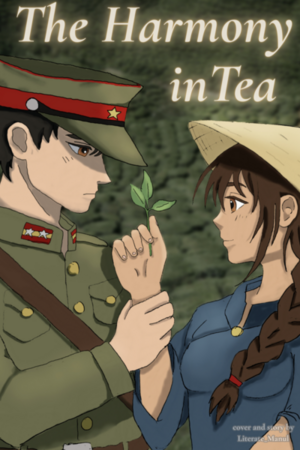
The Harmony in Tea
Since that day, I was no longer allowed to leave Pinglin.
I continued my work as I always had, checking the drying mats, giving instructions, moving through the storage rooms and processing halls.
My hands did what they had known since childhood.
But inwardly, I felt absent.
Time passed differently then.
Slower. Heavier.
I found myself listening for sounds that never came.
For footsteps.
For voices.
For the distant crunch of tires on gravel.
No one spoke of it, yet I felt it in the glances of the workers, in the way conversations fell quiet when I approached.
I had come to understand that my father had given clear instructions to them:
that no one was to help me or pass on any messages, and that anyone who did so might lose their work because of me.
The plantation was full of people, and yet I was alone.
In the evenings, I often sat for hours in the tea room, unable to sleep, thinking of Onodera.
Of our conversations, quiet and almost incidental, and yet meaningful to me beyond measure.
And of the moment when he had taken my hands in his and nodded once, as though a decision had been made without the need for words.
I wondered whether he knew what had happened.
He could have demanded my presence from my father.
Declared it militarily necessary.
So why did he not come?
The days passed without an answer.
Until one morning, I heard voices.
I was standing near the processing rooms when two workers passed by, speaking softly, not meant for me.
“…has been standing at the entrance for a while now,” one of them said.
“Who is it?” the other asked.
“A Japanese man. Army again…”
My heart missed a beat, and I heard nothing else.
I left everything where it was and ran, without thinking.
Gravel slipped into my shoes, my breath came hard, but I did not slow.
With every step, a certainty grew inside me, clear and insistent, allowing no doubt.
He was here because of me.
He had learned what had happened, and now he would set it right.
I could already see the main house, hear voices, picture his face in my mind, serious, attentive, as it always was.
I did not know what I would say, only that I had to say something.
When I turned the corner, I stopped short.
A military vehicle stood in front of the house, two soldiers leaning against the hood with crossed arms, and a little farther ahead an officer speaking with my father.
His uniform was immaculate, the cut sharp, every movement controlled.
I recognized him at once.
The same officer who had stood beside Onodera in the harbor office in Taihoku, his voice cool with authority.
But he was not the man I had hoped to see.
My gaze searched on, hastily, almost desperately, toward the entrance, the windows.
He was not there.
My father and the officer turned when they noticed me.
“Daughter…” my father said quietly, a trace of pity in his voice.
The officer’s gaze passed over me briefly, assessing, without interest.
I forced myself to step closer.
“Miss Lin,” the man said at last, his voice smooth and composed. “I have already had the opportunity to speak with your father.”
He smiled coolly.
“I am Chūsa Asano,” he continued, “here on behalf of the Governor-General’s Office. There will be… a few changes.”
Something inside me tightened.
“Changes?” I asked, without pressing further.
One eyebrow lifted almost imperceptibly.
“The former officer in charge, Taii Onodera, has been reassigned,” he said evenly. “His presence is needed elsewhere now. Responsibility for the army supply now lies with me.”
The words struck with quiet finality.
He paused, then smiled again.
“But rest assured, I have no intention of awarding the contracts elsewhere. Everything will remain as it is.”
I swallowed, heat rising to my face.
“That will be all,” Asano said, already turning away.
He left without looking back.
And something shattered in my heart.
᯽᯽᯽
A light breeze stirred the leaves of the old trees around the house.
Shu-fen sat with her knitting in her lap, the needles clicking softly, steadily, as though following a familiar rhythm.
Yi-yun crouched on the veranda floor, knees drawn up, sorting small, colorful stones she had found in the yard.
She laid them out side by side, arranging them by color and size, unhurried.
For a while, neither of them spoke, until Yi-yun looked up.
“And then?” she asked. “What did you do next?”
The corners of Shu-Fen’s mouth lifted slightly.
“Well,” she said calmly, “what do you think I did?”
Yi-yun frowned, thinking.
“You definitely didn’t listen to your father or the others,” she concluded.
“No,” Shu-fen said. “I did not.”
Yi-yun’s eyes widened, and she grinned.
“I wouldn’t have either!”
Shu-fen paused, set the knitting aside and looked at her.
“I know,” she said. “You are my granddaughter, after all.”
Yi-yun’s eyes sparkled.
“So you went to look for Grandpa?” she asked.
Shu-fen nodded.
“At night,” she said. “And very quietly.”
᯽᯽᯽
The house lay still.
Only a few windows glowed faintly in the rear rooms.
I waited until even those lights went dark, then slipped across the yard, my gaze fixed on the main building.
The keys lay heavy in my hand.
I had taken them from my father’s study while he was at supper.
The delivery truck stood where it always did, beneath the overhang, ready for the next morning.
For a moment, I simply sat there, my hands resting on the wheel, the interior unfamiliar.
The engine did not respond at first, only on the third attempt did it finally catch.
My hands were unsteady as I slowly drove off, letting the gate stand open behind me without looking back.
I did not know exactly where I was going.
Taihoku was large.
And I did not know where your grandfather had been posted, or whether he was still there at all.
But that did not stop me.
I had to try.
The rain began before I reached the mountain road, sudden and heavy.
Moments later, the windows fogged and the narrow road grew slick beneath the tires.
I tightened my grip on the steering wheel as the road twisted through the darkness, the headlights carving a narrow, unsteady corridor through the rain.
I was driving up the steep mountain road when I saw it.
Headlights, sudden and far too close.
I slammed on the brakes.
The truck skidded, tires shrieking, and for a terrible moment I felt it sliding onward, out toward the edge of the drop.
I stopped only a few steps before it.
The rain kept hammering on the truck, as I sat motionless for a moment, my hands clenched around the wheel, breathing hard.
Then the other door opened, and someone stepped out.
His uniform was soaked, his coat hanging askew, his hair plastered to his forehead.
He looked tired, not only in body.
When he recognized me, he stopped.
“Lin-san…”
Not Miss Lin.
Not formal. Not distant.
I stepped out as well, not trusting my own eyes.
“You came…” I whispered.
The rain fell between us, dense and unrelenting, and for a moment neither of us knew what to say.
“What are you doing here?” he asked at last.
There was no reproach in his voice.
I looked at him.
“You hadn’t come,” I said. “So I just set out.”
He closed his eyes briefly, as though gathering himself.
“I... have been reassigned,” he said.
Lightning split the sky, and in that brief light I saw how exhausted he truly was.
“I know“, I answered.
Rain ran down our faces, into our collars, over our hands.
Neither of us moved closer.
“I need to ask you something“, he began.
A short pause.
“Are you certain? About choosing this?” he finally asked, his face drawn. “You may lose everything if you do.”
I shook my head.
“No,” I said. “I will only lose what truly matters to me if I won’t.”
He exhaled slowly.
Then he smiled.
“I don’t believe I need to ask you the same,” I said lightly, tilting my head toward his car, and the place where we stood. “Do I?”
He laughed then.
Openly. Freely. Without a mask.
I could not hold myself back any longer.
I ran to him and pressed my face against his chest, against his rain-soaked uniform.
Momentarily taken aback, he wrapped his arms around me and whispered,
“I want you to call me Shuichi from now on.”
I looked at him, the man standing before me, not the title, not the reputation.
“Shuichi-san,” I said, tasting the name.
The rain continued to fall.
But in that moment, it didn't matter.









Please sign in to leave a comment.