Chapter 6:
The Quiet Between Us
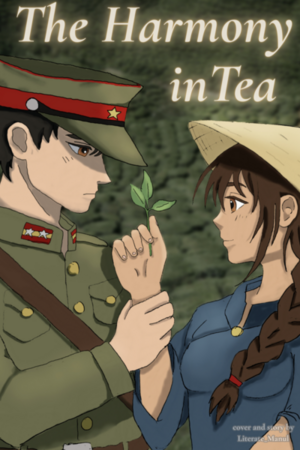
The Harmony in Tea
The closer we came to the harbor, the heavier the air grew.
Salt and seaweed hung over the streets, and the calls of dockworkers echoed loudly between the buildings.
Warehouses rose before us in long rows, their walls darkened by the damp climate.
Wide gates stood open, revealing interiors stacked high with crates and sacks.
Onodera slowed his pace.
“This is where the problems begin,” he said.
He went ahead.
As soon as I stepped inside the hall, the smell struck me at once.
Stale air, damp wood, and beneath it, a faint but unmistakable trace of mold.
Onodera stopped in the middle of the hall and turned toward me.
“Losses due to spoilage are low but increasing steadily,” he explained. “Tea, rice, dried goods. Even technical components.” His gaze flicked briefly toward the crates. “Too much to ignore.”
I did not answer immediately.
Instead, I let my eyes roam across the space.
The crates were stacked high, some reinforced with metal bands, others held together only by rope.
Dark stains marked the walls where moisture had crept in over the years.
“How long are the goods stored here?” I asked at last.
“From a few days to several weeks,” he replied. “Depending on transport conditions.”
I nodded slowly.
“And the crates,” I continued, gesturing lightly. “Are they lined?”
“That depends on the supplier. Not all of them use the same methods you do with your tea, and we lack both the time and the means to repackage everything here.”
I stepped closer to one of the stacks without touching it.
“The air is very humid,” I said quietly. “Is there any ventilation beyond the upper windows?”
“Hardly,” he admitted. “The building dates back to an earlier period, and no alternative storage space is available right now.”
For a moment, we stood in silence.
I did not want to rush anything.
“I would like to get a complete picture first,” I said at last. “May I review the inventory and material records? Delivery intervals, quantities, losses.”
He studied me briefly, then nodded.
“There is an office on the upper floor,” he said.
We climbed a narrow staircase to a small administrative room overlooking the hall.
Before long, several folders were stacked on the desk, and once I had taken a seat, I began leafing through them at once.
Below us, the noise of the harbor continued unabated.
Onodera remained by the window for a while, his hands clasped behind his back, watching the activity in the hall.
For a moment, I wondered whether he intended to stay.
No, more than that, I hoped he would.
But shortly afterward, footsteps echoed on the stairs, and another officer entered the room.
His gaze swept over me, sharp and assessing, before he turned to Onodera.
“Taii,” he said curtly.
Onodera’s posture shifted almost imperceptibly.
“Chūsa,” he replied with a salute.
“I’ll be back shortly,” he said to me at last, quietly but firmly. “Please continue. Take all the time you need.”
For a brief moment, his expression softened as our eyes met.
Then he turned away and followed the other officer out.
The door closed.
I remained seated, the open folder before me, and forced myself to continue reading.
But my heart began to race the moment I thought of the door through which he had left.
I paused, rested my hand briefly on the desk, and took a deliberate breath.
Lowering my gaze to the papers, I wondered when it had become so difficult to think straight.
After some time, voices drifted in from the adjoining room.
At first they were muted, little more than an indistinct murmur, but then they grew louder.
Sharper.
The words were impossible to make out, but the tone left no doubt.
An argument.
I set the folders aside and straightened instinctively.
The voices overlapped now, one unmistakably Onodera’s, controlled yet tense.
The other harsher, more insistent.
Then the door flew open.
The other officer strode out with long, determined steps.
When his gaze fell on me, cold and appraising, he paused.
“You would do well to ensure that certain… circumstances are no longer visible,” he said loudly enough for me to hear.
The corner of his mouth twisted into a thin smile. “Or some problems might disappear faster than one would expect.”
Then he turned and marched away, his footsteps echoing on the stairs long after.
I was already on my feet when Onodera entered.
His face was tense, his expression hard, as though he were holding himself firmly in check.
When he saw me, he paused.
“Is everything all right?” I asked at once. “If my presence is causing difficulties, then...”
“No.”
His reply was sharper than I had expected, almost a rebuke.
He stepped closer, his voice softer now.
“It’s all right,” he said. “You don’t need to concern yourself with that.”
I hesitated.
“I don’t want me being here cause any problems,” I said quietly.
He drew a deep breath.
“I’ll see to it,” he said without thinking, “that we can stay together.”
I froze.
My eyes widened involuntarily.
Stay… together?
For a heartbeat, it seemed as though he realized what he had just said.
A faint flush rose to his face.
He turned his gaze aside, pulled his cap lower, and cleared his throat.
“I mean…” he began, unusually hesitant.
“For the necessary arrangements,” he added, reverting to a more formal tone, almost hurried. “So that we can resolve the storage issues. That is… important.”
He looked at me again, but this time his eyes avoided mine.
I said nothing.
My heart was pounding so loudly that I feared he might hear it.
᯽᯽᯽
Yi-yun could no longer contain herself.
She giggled softly and covered her mouth with one hand.
“Grandpa really let that slip, didn’t he?”
Shu-fen blinked in surprise, then laughed with her, a rare, open laugh that loosened her shoulders.
“Indeed,” she said. “He did.”
She shook her head lightly. “And it was very important to me. Because in that moment, I knew that he cared for me just as much as I cared for him.”
Yi-yun raised her eyebrows.
“But why couldn’t he just say it directly?” she asked. “That would have been much easier.”
Shu-fen set down her teacup and regarded her granddaughter calmly for a moment.
“When you grow older,” she said at last, “you’ll realize that such things are not always as easy as they seem.”
Yi-yun made a face. “Talking about feelings?”
Her grandmother nodded.
“That’s right. Especially men often believe they must hide their feelings for as long as possible. Out of duty. Out of pride. Or out of fear of doing something wrong.”
Yi-yun thought about this briefly.
“But that doesn’t mean they don’t have any, right?”
Shu-fen shook her head.
“No,” she said softly. “Not at all.”
She lifted her teacup again and watched the warm steam rise for a moment.
“He made that very clear to me some time later, without any room for doubt…”
᯽᯽᯽
Some time passed during which we worked together almost unobtrusively.
There were no further incidents, and it seemed that Onodera had prevailed.
We spoke about figures, supply routes, possible improvements to air circulation, about what could be done and what could not.
At times we disagreed, always calmly, without sharpness.
And yet it worked.
Perhaps too well.
One evening, we closed the files a little earlier than usual, since there was nothing left to say.
At least nothing that could be said easily.
I had just returned from the washroom at the end of the corridor when I saw Onodera standing at the wall-mounted telephone.
I stopped.
His voice was subdued, calm, and carried an unfamiliar warmth.
I hesitated, unsure whether to announce myself.
“Yes,” he said quietly.
A pause.
“No… don’t worry.”
My heart began to race.
I caught only fragments, but something in his tone unsettled me.
“I’ll call again as soon as I can.”
He hung up.
When he turned back toward me, he noticed my look.
“Excuse me,” he said briefly. “The call was scheduled.”
I shook my head. “No… it’s fine.”
For a moment, we stood facing one another in silence.
Then something burst out of me.
“Was that… your wife?”
The silence that followed was heavy, and I lowered my gaze.
When I looked up again, he seemed surprised.
Almost hurt.
“No,” he said. “Why would you think that?”
“You sounded very familiar,” I replied quietly. “And I thought…”
He exhaled audibly.
“That was my mother,” he said. “She worries… more than necessary.”
I nodded, though the tension inside me did not fully ease. I realized I might have crossed a boundary with my question.
“I didn’t mean to...” I began.
“Yes, you did,” he interrupted, not harshly, but firmly. “It mattered to you.”
I looked at him.
“Yes,” I admitted. “It did.”
For a moment, it seemed as though he wanted to say more.
Then he closed his hand around the brim of his cap, adjusted it, and stepped back.
“It’s late,” he said. “Your driver is probably waiting.”
He had already turned away when I acted without thinking.
I reached for his sleeve.
Not tightly.
Not insistently.
Just enough to stop him.
My gaze was lowered, and I said nothing.
I felt him pause, then slowly turn toward me.
His expression was openly startled, and for a moment he, too, said nothing.
Then, suddenly, he took my hand.
His fingers closed around mine, steady and warm.
I looked up at him.
And he smiled.
Warm. Honest.
I returned the smile.
Then, without a word, he nodded to me.
A single nod, calm and resolute, as though it conveyed something that required no explanation.
He released my hand.
And at last, we parted without a word.
And yet, we were no longer alone.










Please sign in to leave a comment.