Chapter 2:
Promise at the Edge of Ruin
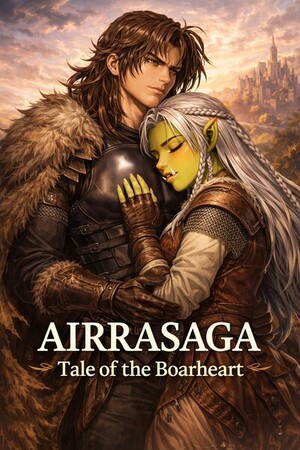
AIRRASAGA - Tale of the Boarheart
Three Days Later, within the keep of Leoham
Lothar sat by his father’s bedside, watching the strongest man he had ever known lie helpless and dying. On the other side sat his mother, Karga, gently stroking her husband’s brow. The room was quiet, the only sound Baldomar’s labored breathing.
He had remained unresponsive, fed only thin soup to maintain some semblance of nourishment. The prognosis was grim; it was believed he would not last beyond a few weeks. Neither the magic of the shamans nor the medicines of the healers had any effect. All that remained was to await the inevitable.
And so they kept their silent vigil, Lothar fighting back the storm raging within him.
“There must be something we can do,” he whispered. “Something I can do.”
Karga looked at her son—who would always be her little boy, no matter how much he grew. She smiled as warmly as she could, though the wetness in her eyes betrayed the flood threatening to break.
“Be strong,” she said. “For him. For us. The folk will need you.”
“I am not so sure the folk need me as much as you believe.” He looked down at his hands, at the fair, lightly bronzed flesh—a constant reminder of who he was, and who he always would be.
“Leadership means accepting that you will not be loved by all, Lothar,” she said in her soothing, matronly voice. “There will always be those who speak against you. No matter your deeds. No matter your charm. No matter your blood. Think of the gods—there are those who speak against even them. Or the Monad who made us all, mortal and immortal alike—and still there are those who spite him.”
She brushed her thumb along his cheek.
“Beings beyond our comprehension cannot escape detractors. Neither will you.”
She rested her palm against his face.
“I have watched you become the man you are now—a warrior, a leader, a man who has endured much and asked for little. I thank the gods and the ancestors every time I look upon your face that they brought you into my life and filled it with such joy and pride.”
Then she took his face in both hands.
“Your father dreamed of uniting our kind under one banner—so that we might stand strong against those who would subjugate or destroy us. And there are many now who would do just that, Lothar. Promise me, son—over the breath of your father who still lives—that you will see that dream fulfilled. Let me hear it. Let him hear it.”
Lothar clasped her hands.
“I promise.”
***
Meanwhile, elsewhere in Leoham
The alehouse was alive with rumbling voices and the scent of spilled mead, its timbered walls bearing silent witness to generations of orcs carousing and feasting. Light from flickering sconces danced across faces caught between laughter and contemplation.
Despite the failing health of the headman and the tensions stirring within the Witan, jubilation filled the hall. A trade wagon had returned to Leoham, bringing rare spices, fine cloth, good food, exotic trinkets—and merchants eager to drink among kin with full purses and lighter hearts.
Cragath, Osric, and Brithun sat at a scarred table, drinking quietly, when Cragath overheard a merchant speaking of something that caught his attention.
“Kinsman,” Cragath called, “come drink with us and tell us of these loners you saw.”
“Of course, kinsman!” the merchant laughed, stumbling over and dropping into a chair. “They were queer things.”
“Where did you see them?” Cragath asked.
The merchant gulped his drink. “Three—no! Four days’ ride from here, I’d say. Queer things.”
Osric and Brithun exchanged glances, unsure why Cragath entertained drunken rambling. Cragath winked them to patience.
“So you said,” he chuckled. “What was so queer about them?”
Without warning, the merchant stood and lifted his tunic, revealing a hideous scar across his torso.
“See that?” he hiccupped. “Fucking Otso—ripped the guts out of me.”
Brithun scoffed. “You’re telling fibs, kinsman.”
“I am not!” the merchant snapped, thrusting forward. “Does that look like drit-tales?”
Osric interceded as Brithun nudged the drunk back.
“You’d be dead. Otso carry poison in claw and fang—no cure for it.”
“Right,” the merchant nodded, burping. “I was ready to meet my ancestors when out of nowhere two goblins showed—a crone and a maid. Threw some drit that scared the beast off.”
He leaned over to fart, then continued.
“They muttered nonsense over me. Warm light. Suddenly my guts were back in. Poison gone. Like nothing fucking happened.”
“They healed you?” Brithun asked, now alert.
“Right as rain.”
“What did they look like?” Cragath pressed.
“The crone was horrid,” the merchant gestured. “Gray hair, yellow-black eyes, wrinkled like a raisin. But the maid…”
He traced a curvaceous figure in the air.
“…gods, she was built for bedchambers.”
Osric cut in sharply. “What did they do after? Did you get their names?”
“They took supplies in compensation and left,” the merchant said. “Crone’s name was… Allala? Tallala?”
“Atalla,” another merchant nearby supplied.
“That’s it,” the drunk snapped his fingers. “And the other was Rascha. Gods, that ass…”
Cragath thanked him and sent him off with a drink.
When he was gone, the three leaned in.
“We should tell Lothar,” Cragath said. “If there’s a chance these goblins can heal Baldomar, we must take it.”
“You think that drunk spoke truth?” Brithun muttered.
“That scar was real,” Osric replied. “And the other merchant knew the name.”
“Then let’s go,” Cragath said, rising. “If there’s any hope, we take it.”
***
Later in the evening, at Eumer’s estate
Pain throbbed through Eumer’s skull as he lay upon the long chair in his hearth room, clutching a cold cloth to his brow. His son, Rodolf, stood nearby, along with his supporters—Allowin, Vaelor, and Caerth. All were thegns save Rodolf, who had not yet risen beyond huscarl.
“Gods,” Eumer cursed. “Forgive me for not seeing you until now. What news following the Witan past?”
“That could have gone better,” Allowin said dryly. “If you meant to turn sentiment against yourself, congratulations.”
“I spoke nothing but truth,” Eumer groaned.
“Slighting Lothar is one thing,” Allowin replied, “but speaking ill of Karga was another. She is beloved.”
“Beloved or not, a wise headman would have set her aside.”
Caerth rose with predatory grace, his dark ponytail catching the firelight.
“The folk know this,” he said. “With Baldomar fading, we must secure the Witan’s consent.”
Allowin exhaled sharply.
“For now, we show only loyalty,” he warned. “We must not look like vultures circling a dying man. When Baldomar passes, only then do we move. And we tread carefully—press too hard against Lothar and we risk war. We must rein in talk of killing him. Leave room for retreat—for him and for us.”
Eumer listened, his mind sharpening despite the ache. No—Lothar must be denied martyrdom, denied sympathy, denied glory. Only once leadership was secure would he deal with him properly.
“Why all the cloak and dagger?” Rodolf scoffed. “Challenge him. I could fell him in one blow.”
Behind him, Vaelor chuckled, ruffling the youth’s hair.
“You have fire, boy—but youth makes you foolish,” he laughed. “Lothar would be the one killing you.”
“Yet he has a point,” Caerth murmured. “It would be clean.”
“It would also risk everything,” Allowin snapped. “Lothar is among our greatest warriors. What certainty do we have?”
“Vaelor is capable,” Eumer muttered. “As is Caerth. Lothar is not invincible, Allowin.”
“Capable is not certainty,” Allowin replied. “Invincible he is not—but formidable he is. You would flip a coin to decide the fate of this clan?”
Caerth leaned forward, eyes glinting.
“If risk is the concern… we remove it. Make the fight about something else.”
Vaelor frowned. “And what would that be?”
Caerth lowered his voice.
“His mother. Karga.”
Silence smothered the room.
“Defile her,” Caerth said calmly. “She names her attacker. No proof. Law demands a wager of battle. Lothar must challenge the accused—to the death.”
The fire crackled too loudly in the suffocating quiet.
“If he wins,” Caerth continued, “he gains little more than personal vindication. If he loses—he dies. And our greatest obstacle is gone.”
“You would volunteer for this?” Eumer asked.
Allowin, Rodolf, and Vaelor stared in disbelief.
Caerth smiled.
“Oh yes, my headman,” he said softly.
“It would be my pleasure.”




Please sign in to leave a comment.