Chapter 10:
Solnus 10. Ginkgo and the University, Refraction of Light, Rene Descartes' Groping in the Shadows, Answering the Last-Minute Question, How Many Japanese Have Firearms?, A Trio
The Bladderites, The Jarhands, and The Sound of Light
5741 days, or 15 years, 8 months, and 2-3 weeks before The Circumadversum Omatsuri, one night.
In Buriki kan no Barakku, John Anatole Holland was currently helping Professor Kimura move tin cans to the location Professor Kimura indicated, toward the right side of a stopped silver SUV.
Holland and Professor Kimura did so, wearing gloves and masks covering their noses. They moved the cans on a tray with only one tier of cans, taking their time moving large quantities at a time.
Holland followed Professor Kimura's instructions to proceed carefully, even though Professor Kimura said the cans were empty. However, their caution did not prevent them from taking other actions.
While engaging in these activities, the two men engaged in dialogue. Their dialogue, of course, did not discuss social theories such as the "theory about three distinct classes of citizens which directly correspond to the tripartite soul or three parts of the human soul" in Plato's work, "The Republic."
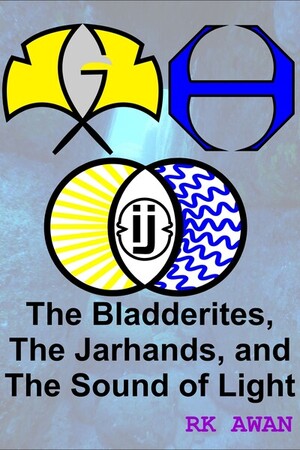
Holland and Professor Kimura discussed what is seen as "hic et nunc," what is seen as "here and now." The topic of their conversation was none other than the symbol "G and two ginkgo leaves." Professor Kimura confirmed that the two ginkgo leaves in the G symbol were inspired by the institution where he and Holland first met.
The institution in question is the University of Tokyo, one of Japan's most renowned universities. The university's symbol is two ginkgo leaves arranged in a circle. One ginkgo leaf is blue, and the other is golden autumn.
The golden autumn color represents the past and present, while blue is the university's color, which also represents innovation and the future. Ginkgo leaves can symbolize a Japanese cultural symbol representing beauty, longevity, and resilience. Ginkgo trees, which survived the atomic bombing of Hiroshima, are a fitting symbol for endurance.
The ginkgo leaf symbol symbolizes Tokyo University's historical presence in Japan and its roots in Japanese culture, combined with the university's practice of continuous scientific development and forward-looking vision. In Japanese culture, ginkgoes are often venerated in shrines.
Tokyo University's two-leaf ginkgo symbol was selected from seventy-nine proposed symbols in 1948. The iconic symbol was created by Professor Shoichi Hoshino of the Second Faculty of Engineering. Besides its profound meaning, the University of Tokyo also had an avenue of ginkgo trees planted since 1906 on one of its campuses, the Hongo campus.
It was at the Hongo campus that Holland first met Professor Kimura, specifically at the Graduate School of Engineering. At this point, Holland still speculates that the letter “G” between the two ginkgo leaves in Professor Kimura’s symbol could mean “graduate” or something related to “graduate.”
After the inspiration of the ginkgo leaf in the symbol was confirmed, Holland pursued answers regarding the meaning of the letter G. He posed a conjecture and asked, “Professor Starwood, what about the letter G in the symbol? Perhaps it stands for “groundwork,” as you mentioned when you entered this building?”
Professor Kimura replied, “It could mean that word.”
Holland asked, “Pardon?”
Professor Kimura explained, “The G in the symbol could indeed mean groundwork, but it could also mean something else. Or in other words, the G in the symbol has an equivocal meaning.”
Holland speculated and asked, “What other meaning could the G have besides groundwork? The Great Architect of the Universe? Or maybe geometry?”
Professor Kimura didn’t deny it. “Yes. Geometry could be. Because if you’re willing to join us, we’ll be working on something related to geometry.”
Holland commented, “Interesting, this is interesting.”
Professor Kimura continued his explanation, "Joho-san, to answer your question about the meaning of the symbol G, which I already explained is equivocal, there's another meaning that I think fits this Buriki kan no Barakku. Regarding that meaning, I must mention a story I think you still remember."
Holland asked, "What story is that, Professor Starwood?"
Professor Kimura said, "There's a story about two French scientists and mathematicians, Pierre de Fermat and René Descartes. Descartes was the one who said, 'I think, therefore I am.' You know, their talents and their environment made them rivals. You could say it's like Cristiano Ronaldo and Lionel Messi."
Several thoughts crossed Holland's mind after hearing Professor Kimura's words, but the Dutchman didn't reveal his thoughts and simply replied briefly, "Yes, I still remember that."
Professor Kimura continued, “Descartes discussed many topics. You know, besides mathematics and philosophy, he also discussed physics. One of the topics René Descartes discussed was the optical topic of the refraction of light.”
Holland commented, “Ah, yes. That famous scientific feud, one of the great feuds among many scientific disputes.”
Professor Kimura continued, “You know, at that time, Descartes published a work discussing the law of refraction of light, or what we now know as Snell's Law.”
Holland continued the dialogue, “But Pierre de Fermat considered Descartes's "La Dioptrique" to present incorrect reasoning, a circular reasoning.”
Professor Kimura continued, “That's right, Joho-san. Fermat called Descartes' reasoning "groping about in the shadows."
Neither Holland nor Professor Kimura continued their dialogue. As he walked, Professor Kimura looked at his cell phone and appeared to be checking something. This made Holland wonder, "Will that cell phone pick up a signal? Last time I checked, my cell phone couldn't get a signal here. Is this phone different? I have a bad hunch."
As they approached the silver SUV, Professor Kimura instructed, "Wait a minute, Joho-san. Let's take a break."
Professor Kimura opened the driver's seat door. He then opened the door to the second row on the same side as the driver's seat. Professor Kimura said, "Please take a break; sit in this seat."
Holland expressed his appreciation, "Thank you, Professor Starwood."
Once Holland and Professor Kimura were seated facing outward on the right side of the car, Professor Kimura immediately asked, "I haven't shown you much about Buriki kan no Barakku. But at this point, do you think you'd like to work here?"
Holland expressed uncertainty, "As for that..."
Professor Kimura commented, "You're still hesitant. That's natural. I haven't even told you what project we're working on."
Holland remained silent.
Professor Kimura said, "You remember, before this car entered Buriki, right? This is Barakku. I told you that I was sure you'd be satisfied with your salary."
Holland remained silent.
Professor Kimura said, "You'll get what I would call more than enough money for your retirement."
Holland remained silent.
Professor Kimura said, "You'll get a guaranteed vacation."
Holland remained silent.
Professor Kimura said, "Well, let me explain again: if we join, we might encounter the involvement of another country or some other group."
This time, Holland responded, "What other country or some other group?"
Professor Kimura gave a lengthy explanation: "As we discussed earlier about the story of Pierre de Fermat and Rene Descartes. Groping in the shadows. I think that's a good definition for the work we'll be doing here. G, this work could be groundwork, but we could also be groping in the shadows."
Holland remained silent again, unresponsive.
Professor Kimura asked, this time seemingly off-track, "Joho-san, do you know how many Japanese own firearms?"
Holland was taken aback, and he asked himself, "What? Professor Starwood, why are you suddenly asking that?"
Professor Kimura answered his own question, "I think you already know the answer to that: 'very few.' Maybe only 16 out of 1,000 people own firearms."
Holland, unresponsive, saw Professor Kimura stand up and walk toward Holland. This time, Professor Kimura showed him a pistol he had been holding in his right hand and said, "Because of this work, I'm allowed to own this."
Holland grew increasingly confused, while Professor Kimura said, “Maybe. Maybe, there will be deaths as a result of this work.”
Holland, observing Professor Kimura’s expression, suspected the pressure on Professor Kimura’s face. It was an expression Holland had never seen before. Holland immediately reacted, “Wait a minute, Professor Starwood. What do you mean? Were you actually forced to do this?!”
Professor Kimura shook his head and said, “I can assure you I did this without any coercion. But if I were under pressure, yes, that’s true. I was under much greater pressure.”
While Holland seemed to be struggling to decide what to do, Professor Kimura said, “Perhaps you once, when you were a student or college student, deliberately double-checked your answers until the time to stop working came. And here, the time will come when you have to submit your answers to the proctor.”
Holland seemed about to say something, but Professor Kimura interrupted, “But here, I’m not the proctor. The proctor will be here in a few seconds, and you have to submit your answers.”
Just then, the gate to the Buriki Kan no Barakku floor made a sound and opened again. Holland immediately turned his head to see a black car entering the floor. The car stopped directly behind Professor Kimura's silver car, and the three doors immediately opened.
Three people got out of the car. Holland didn't know who two of them were, but he could clearly identify the other. Holland couldn't help but exclaim, "Aren't you...?!"




Please sign in to leave a comment.