Chapter 7:
EPISODE - 7 - Forgotten Memories
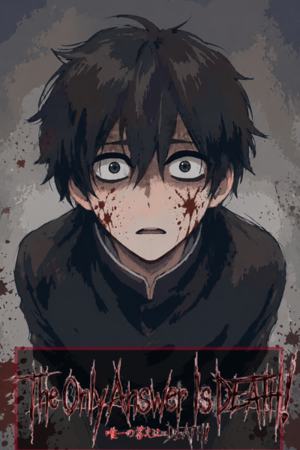
The Only Answer Is DEATH! (唯一の答えは...DEATH!)
[MA 18+ - Contains graphic violence, severe psychological trauma, blood and gore, and suicide]
The return to consciousness was different this time. Not violent. Not convulsive. Not the desperate gasp of someone breaking the surface after drowning. Just... awareness. Slow. Creeping. Wrong.
Mahitaro's eyes opened to a sky too blue, clouds drifting in configurations that seemed deliberately mocking in their normalcy. His body lay sprawled on sun-warmed grass—not the tatami of his bedroom, not the blood-slicked concrete of the overpass where Gekidō's blade had opened his throat. Grass. A park. Afternoon light filtering through leaves that swayed in a breeze carrying the scent of summer instead of arterial spray.
The wrongness hit before the nausea. His hands moved—instinctive, checking for wounds that should exist—and found small fingers. Child fingers. Eight years old at most. The sight of them triggered immediate physiological rejection.
His stomach contracted violently. He rolled onto his side, and the vomit came in waves that felt like his body was trying to expel not just bile but the impossible reality of what was happening. Acid and copper and something darker, something that tasted like thirty-seven years of accumulated suffering compressed into a throat that had only lived eight.
Between heaves, his mind catalogued the impossibilities: wrong body, wrong place, wrong time. His adult consciousness trapped in a child body.
The vomiting finally subsided, leaving him hollow and trembling. He pushed himself into a sitting position, grass-stained and bile-soaked, and stared at his hands—child hands that shouldn't exist, that couldn't exist, that proved the loop had dragged him somewhere far worse than previous resets.
I was sixteen, his mind screamed. I died. I felt it. The blade. The blood. Everything going cold. And now I'm—"You okay?"
The voice cut through his spiraling panic like a blade. Mahitaro's head snapped up, muscles locking, adult fight-or-flight instinct trapped in a child's body that couldn't properly execute either response.
Sitting on a nearby park bench, watching him with eyes that held too much knowledge for their young face, was a child. Eight, maybe nine years old. Thin frame. Concerned expression that didn't quite reach his eyes. And hair—impossible hair—the color of arterial spray, of emergency lights, of fresh wounds opened under fluorescent sun lights.
Red. Unnaturally, impossibly red through.
Mahitaro's breath caught. His vision tunneled, peripheral details dissolving as his entire consciousness focused on that flame-bright hair with the intensity of trauma recognizing its architect.
Gekidō. The name popped up into his head for some reason. Of course he didn't care to know why.
Not the teenage Gekidō who'd killed him. Not the adult consciousness wearing a younger face. But child Gekidō—small, vulnerable, watching him with what appeared to be genuine concern that made Mahitaro's mind fracture trying to reconcile it with the smirking cruelty he'd endured across loops.
Mahitaro's mouth opened. No sound emerged. His throat was still coated in bile and blood and the ghost-sensation of a blade that had killed him in another life. His hands trembled against the grass, nails digging into dirt, trying to anchor himself to something solid while reality bent around him like heated plastic.
This wasn't right. This was wrong. Gekidō shouldn't look like this—young and concerned and almost... innocent. The kid who'd smiled while Mahitaro's friends died. The architect of his suffering. The red-haired devil who'd orchestrated every loop, every death, every moment of despair calculated to break him.
But those eyes. Those too-knowing eyes that didn't match the child's face. They watched Mahitaro with an intensity that made his skin crawl, like being studied under a microscope. Measuring. Waiting.
He knows, Mahitaro's fractured mind supplied. He knows exactly what he's doing. This is another game. Another layer of torture. It has to be... "Hey, seriously, are you—" Gekidō started to lean forward, hand extending.
Mahitaro lunged.
His small body moved on pure instinct, rage and terror fused into motion faster than thought. His hands found Gekidō's shirt, twisted into the fabric, and he shoved with everything he had. The red-haired child toppled backward off the bench with a surprised yelp, hitting the ground hard.
"SHUT UP!" Mahitaro's voice tore from his raw throat, too deep for his child body, resonating with the weight of someone much older. "Don't—don't look at me like that! Don't pretend! I know you! I know what you are!"
His fists were already swinging, small and weak and pathetic but driven by accumulated lifetimes of suffering. They connected with Gekidō's face—once, twice, ineffectual child's punches that barely had the force to bruise. But Mahitaro didn't care. He hit again, tears streaming, his vision blurring with salt and rage.
"You killed them! You killed everyone! Eruto—Barisu—you made me watch them die over and over and you smiled—!"
Gekidō's eyes went wide. Not with cruelty or satisfaction, but with genuine shock and something that looked horribly like hurt. His hands came up—not to strike back, but to defend, covering his face as Mahitaro's fists continued their assault.
"I don't—what are you—Mahitaro, stop!" The voice broke, actual tears forming. "Why are you hitting me?! What did I do?!"
The words pierced through Mahitaro's rage like cold water. He froze, fist raised, his whole body shaking. Because the confusion in Gekidō's voice was real. The hurt in those too-knowing eyes was genuine. This wasn't the mask he'd seen before—the cruel smile, the calculated cruelty.
This was a innocent person. An actual person who didn't understand why his friend was attacking him.
Mahitaro's breath came in ragged gasps. His raised fist trembled, then slowly lowered. The rage drained out of him like water through a cracked vessel, leaving only exhaustion and confusion in its wake.
What is this? What timeline is this? Why doesn't he remember? Or is he... is he acting again? Is this performance too? Footsteps on pavement made both children freeze. Adult footsteps, urgent and worried.
"Mahitaro! What on earth—?"
The voice cut through Mahitaro like a blade made of memory and impossible recognition. He turned, slowly, his neck creaking like rusted metal, and saw—
His mother. But not his mother. Not the hollowed-out alcoholic with contempt in her eyes and poison on her tongue. This person was younger, her hair darker, her face less lined. She wore a yellow shirt and jeans that Mahitaro had never seen before, and her eyes held something that made his heart constrict painfully: concern.
Genuine, maternal concern.
Behind her, jogging to catch up, was his father—also younger, also different, the perpetual disappointment in his expression softened into something approaching actual worry.
"What happened?" His mother knelt beside them, hands fluttering between Mahitaro and the still-prone Gekidō. "Did you two have a fight?"
Mahitaro couldn't speak. His throat had closed entirely, his tongue thick and useless. His mind was fracturing, trying to process too many impossibilities at once. Parents who cared. Gekidō who didn't remember. A timeline that shouldn't exist.
Gekidō pushed himself up, rubbing his cheek where Mahitaro's fist had connected. His eyes were wet, lips trembling, and when he spoke his voice was small: "I... I don't know what I did. We were just sitting, and then he got sick and then he..." The kids voice broke. "I just wanted to make sure he was okay."
The hurt in those words was a knife between Mahitaro's ribs. Because if this was performance, it was perfect. If this was manipulation, it was flawless. And if it was real—
Then I just attacked my childhood friend for crimes he hasn't committed yet. Crimes he doesn't even remember.
His mother's hands cupped his face, forcing him to meet her eyes. "Mahitaro, sweetheart, what's wrong? Why would you hit Gekidō? You two have been inseparable since—"
"Since what?" The words fell from Mahitaro's lips before he could stop them, desperate and broken. "Since when? I don't—I can't—"
He couldn't finish. Because the memories were there, suddenly, bleeding through like watercolors in rain. Not his memories—or were they? Flashes of red hair and laughter. A smaller version of himself holding hands with this child, walking to school. Sharing lunches. Drawing pictures together. The weight of friendship, of connection, of something warm and pure that his adult consciousness couldn't reconcile with the torture he'd endured.
False memories. Implanted. This is another layer of the loop. It has to be.
But they felt real. They felt more real than the isolation he remembered, more substantial than the loneliness that had defined his original childhood. And that was the horror—that this twisted past felt better than the truth.
"Come on," his father said gently, helping both children to their feet. "Let's get you home. I think you might be coming down with something. You're burning up."
Mahitaro let himself be guided, his legs moving on autopilot while his mind spiraled into chaos. Gekidō walked beside them, casting worried glances that Mahitaro couldn't meet. Every time their eyes threatened to connect, Mahitaro looked away, his stomach churning with confusion and residual rage and something worse—doubt.
What if I'm wrong? What if this is real and I just hurt someone innocent? What if the loops broke my mind so thoroughly that I can't tell reality from torture anymore?
They reached a house Mahitaro recognized and didn't recognize in equal measure. The structure was familiar—same street, same neighborhood—but it was different. Maintained. Warm. Light spilled from windows that should have been dark. The garden was tended, not overgrown with neglect.
And standing in the doorway, waiting with a smile that made Mahitaro's world stop—"Welcome home, little brother."
Tall. Older. Strong. Features that Mahitaro knew intimately from loops of watching them contort in suicide's final moments. Hair dark and messy, eyes warm, posture relaxed and open in a way Mahitaro had never seen before.
Yasuke.
Not the Yasuke crushed by parental expectations. Not the Yasuke who'd stabbed his teacher in desperation. Not the corpse that had haunted Mahitaro through countless resets.
Yasuke alive. Yasuke whole. Yasuke happy. The name fell from Mahitaro's lips in a whisper that was half prayer, half accusation: "...Brother?"
Yasuke's smile widened, and he ruffled Mahitaro's hair with easy affection. "Of course. Don't tell me you've forgotten me already." The teasing tone held genuine warmth. "Come on, dinner's almost ready. You too, Gekidō—you're staying, right? Your usual spot's set."
Usual spot. Like this is routine. Like Gekidō eats here regularly. Like we're... family. Mahitaro felt his knees give out. Cofused on why he's gaining these strange memories or why he suddenly has a brother who is also shown in them. His father caught him, concern deepening on his face. "Okay, definitely sick. Let's get you lying down."
They guided him inside, through a living room that smelled like home cooking instead of stale alcohol, past walls decorated with family photos that Mahitaro had never seen—pictures of three kids, arms slung around each other's shoulders, grinning at the camera. Himself, Yasuke, and Gekidō. Inseparable. The trio the whole neighborhood knew.
This is a lie. This has to be a lie. I would remember this. I would remember having a brother, having a friend, having a family that smiled to.
But the memories kept bleeding through, each one sharp and detailed and wrong. Birthday parties. School festivals. Gekidō sleeping over, the three of them building blanket forts and telling stories until dawn. Yasuke teaching them both to ride bikes. His mother making extra lunches because she knew Gekidō's family situation was "complicated."
No. No, this didn't happen. My childhood was empty. I was alone. I—
They laid him on his bed—his bed, in his room, decorated with posters and books and evidence of a life lived with love. Gekidō hovered in the doorway, still looking hurt and confused, while Yasuke pressed a hand to Mahitaro's forehead.
"You're really burning up. Want me to stay until you fall asleep?"
The question was so gentle, so genuinely caring, that Mahitaro felt something crack inside his stomach. A dam he'd built from thirty-seven years of isolation and suffering, crumbling under the weight of impossible kindness.
"Why..." His voice came out hoarse, damaged. "Why can't I remember you?" Yasuke's expression shifted to concern. "What do you mean? Mahitaro, you're scaring me. Should we call a doctor?"
"I should remember." Tears burned in Mahitaro's eyes, hot and unwelcome. "If you're my brother—if Gekidō's my friend—I should remember. But there's nothing. Just... just holes where you should be. Just emptiness."
From the doorway, Gekidō spoke softly: "Maybe the fever's making him confused? Delusional?"
Or maybe the loops broke me so thoroughly that I erased my own past. Maybe I'm the monster. Maybe I destroyed my own memories to cope with trauma and now I can't tell what's real anymore.
The thought was worse than any torture Gekidō had inflicted. Because if it was true—if this warmth, this love, this family had existed and Mahitaro had somehow forgotten it—then everything he'd suffered, every death he'd witnessed, every moment of despair had been built on a foundation of self-inflicted amnesia.
I could have had this. I could have had them. And I lost it. Or worse—I threw it away without even knowing. The strangest part is loops are also involved in those memories.
His mother appeared with water and medication, her touch gentle as she helped him drink. His father stood in the hallway, discussing calling the doctor in hushed tones. Gekidō sat on the floor beside the bed, no longer hurt but worried, watching Mahitaro with those too-knowing eyes that now held only concern.
And Yasuke stayed close, one hand resting on Mahitaro's shoulder, grounding him to this impossible reality with warmth that felt like salvation and damnation in equal measure.
"It's okay," Yasuke whispered. "Whatever's happening, we'll figure it out. You're not alone, little brother. You've never been alone."
The words broke something fundamental in Mahitaro's soul. He turned his face into the pillow and sobbed—deep, wrenching sounds that came from somewhere beyond his eight-year-old body, echoing with the accumulated grief of someone who'd died countless times and never found peace.
Because the cruelest torture wasn't the loops. It wasn't the deaths or the betrayals or the endless suffering anymore. It was this: the possibility that he'd had everything he'd ever wanted, and somehow lost it without even knowing what he'd lost to.
Yasuke held him while he cried, whispering reassurances that felt like knives. Gekidō's hand found his, small fingers interlacing with his own, offering comfort that made Mahitaro want to scream.
And as consciousness began to blur at the edges, fever or exhaustion or the loop's mercy pulling him toward sleep, Mahitaro's fractured mind whispered one final, terrible question:
What if I'm not the victim? What if I never was? What if I'm just a broken thing that destroyed its own happiness and called it fate?
The answer, if it existed, dissolved into darkness as sleep claimed him. But the question remained, burning in the space behind his eyes, waiting for him to wake and face the truth:
That sometimes the cruelest prison is the one you build from your own forgotten memories, and the only way to escape is to remember what you spent lifetimes trying to forget.
TO BE CONTINUED...



Please sign in to leave a comment.