Chapter 9:
Note: Salt, Buddhist Sutras, and Ofuda – Traditional Japanese Exorcism Items
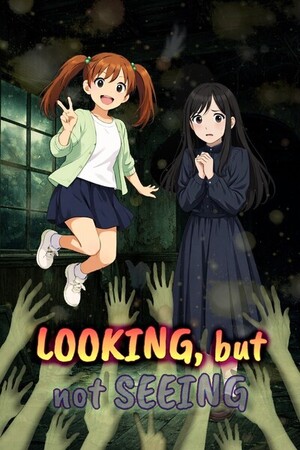
LOOKING, but not SEEING
A character who handles exorcism items appears in the story.
In reality, you can easily find plenty of people and products like that, can’t you?
Setting aside the question of authenticity, if such things can bring even a little peace of mind, then owning an affordable charm isn’t such a bad idea.
Now, to the main topic. In ancient Japan, exorcisms were most often performed using three main items: salt, Buddhist sutras, and ofuda (paper talismans).
Let’s take a look at how each of these is treated in modern Japan.
Let’s start with the most familiar one: salt.
Salt is used to cleanse away kegare—impurity or spiritual defilement.
In Japan, where death has long been regarded as a form of kegare, there is a custom of sprinkling salt on oneself after attending a funeral before entering the home.
Modern Japanese rarely think consciously about the concept of kegare, yet many still use salt as a kind of habitual ritual.
You may have also seen small mounds of salt placed at the entrances of homes or shops.
These are meant to keep bad energy out and invite good fortune in—a lingering trace of old beliefs about purifying spaces.
And then there’s sumo.
Before stepping into the ring, wrestlers dramatically toss handfuls of salt into the air.
This custom comes from the time when sumo was a sacred ritual dedicated to the gods, serving as a way to purify the dohyō (ring).
Even the yokozuna’s shiko—the act of raising and stamping the legs—is said to drive away evil spirits.
By the way, I’m a fan of the sumo manga Aah Harimanada.
It’s a fantastic series, though sadly it has never been translated into English.
Next comes the sutra.
A sutra is a Buddhist prayer text, and its meaning and purpose vary slightly among sects.
Chanting a sutra isn’t a way to defeat spirits; it’s more about restoring a sense of calm and helping them find peace—a kind of spiritual dialogue or gentle persuasion to move on.
You don’t see this much in modern horror works, but when I was a child, stories often depicted desperate protagonists reciting sutras in a last-ditch effort to protect themselves.
Nowadays, few people in Japan can recite a sutra from memory.
If someone in a modern horror movie suddenly started chanting, it might actually break the tension.
One of my favorite stories goes like this: A man cornered by an evil spirit trembles as he desperately chants a sutra.
Then, from just beside his ear, a whisper comes—“It doesn’t work on me.”
It’s frightening, of course, but what fascinates me more is the idea that even spirits might have their own individual differences.
Finally, we come to the ofuda.
In fiction, they often appear as tools for casting barriers or as powerful seals that command shikigami familiars in battle.
And in Chinese folklore, a similar paper talisman is used to stop hopping vampires—jiangshi—by sticking it onto their foreheads.
In Japan, people have long believed that written words themselves hold spiritual power.
Writing down a prayer is, in a sense, a prayer made visible.
Even today, ofuda continue to live on as physical forms of prayer.
At New Year’s, many people receive them from shrines and place them in household altars, on walls, or above doorways.
They come in many types—fire prevention, traffic safety, academic success—and are usually replaced once a year.
Old ofuda are not thrown away.
Instead, they are respectfully returned to a shrine’s kosatsu nōsho (offering place for old talismans) to be ritually burned in a shōnō ceremony.
Speaking of written power, one of my favorite classical ghost tales is Mimi-nashi Hōichi—Hoichi the Earless.
To protect Hoichi from vengeful spirits, a monk covers his body with written sutras, making him invisible to them.
But the monk forgets to write on his ears, and the spirits find only those—tearing them off and taking them away.
Looking at all this, Japanese exorcism seems less about banishment and more about harmony.
We purify with salt, soothe with words, and protect with writing.
Rather than denying the dead, we’ve developed ways to coexist peacefully with them.
Perhaps Japan, after all, is a surprisingly kind country—to those who’ve already passed on.




Please sign in to leave a comment.