Chapter 9:
Note: Jintsūriki — The Power that Connects with the Divine
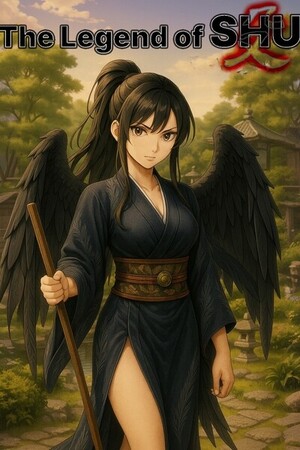
The Legend of SHU
The story briefly mentions the word Jintsūriki.
Although the power itself never actually appears, in Japan the phrase “In Japan, when people think of tengu, they think of Jintsūriki” is almost taken for granted.
The representative abilities most often attributed to tengu are as follows:
Jinsokutsū — instant movement, flight
Tengentsū — clairvoyance, farsight, precognition
Tennitsū — perception of sound and vibration
Tashintsū — telepathy, illusion, mind reading
Shukumyōtsū — insight into fate and past lives
Rojintsū — self-transcendence, enlightenment, awakening
In addition to these, tengu are also said to command powers such as manipulating fire or wind, perceiving the dead, and sealing spirits or souls.
Of course, in modern fiction a single character would probably never master them all—if someone could do everything, it would make plotting almost impossible.
The word Jintsūriki (神通力) is composed of three characters:
神 (jin / “god”), 通 (tsū / “to pass through, to connect”), and 力 (riki / “power”)—
literally meaning “the power that connects with the divine.”
The origin of Jintsūriki can be traced back to around the 5th century BCE in Indian Buddhism.
The “Six Divine Powers” (ṣaḍ-abhijñā) referred not to miracles, but to six forms of transcendent wisdom achieved through ascetic practice—proofs of enlightenment rather than feats of magic.
Between the 4th and 8th centuries, as Buddhism spread into China, it merged with Taoist and immortal traditions.
During this period, Jintsūriki expanded to include the mystical abilities of sages and immortals—flight, clairvoyance, longevity—becoming ever more concrete and supernatural.
When Buddhism reached Japan in the 9th to 12th centuries (the Heian period), these ideas entered through esoteric Buddhism and shugendō, the mountain-ascetic tradition.
Here, Jintsūriki took root as “spiritual power that communes with the gods and buddhas,” or the ability to alter phenomena through prayer and ritual.
By the 14th to 16th centuries (the Muromachi period), tengu and monks who commanded wind, flame, or spirits embodied this concept.
Jintsūriki had by then come to signify any kind of miraculous power.
From the 17th to 19th centuries (the Edo period), the phrase entered common speech. People would say, “That monk has Jintsūriki,” meaning he possessed divine efficacy or extraordinary power.
It appeared in storytelling, woodblock prints, and popular folklore, firmly established among ordinary people as “mysterious, supernatural ability.”
In the late 19th century and into the modern era, as Western ideas such as supernatural power and psychic ability were imported, Jintsūriki was reused as their Japanese equivalent.
Its religious meaning faded, and it came to stand for superpowers, paranormal abilities, or psychic energy—a redefinition that continues today.
Seen in this light, Jintsūriki began in India as a form of Buddhist “wisdom,” absorbed “Taoist arts” in China, and in Japan became a “spiritual power” of the shugendō tradition.
By the Muromachi period it already meant “every kind of miraculous force,” and by Edo times it had become a household word.
In today’s fiction, the equation Jintsūriki = supernatural power is the natural outcome of that long cultural evolution.
Looking back, it does feel like our ancestors might have gone a little overboard.
I can’t help wondering what a Buddhist monk from ancient India would think if he saw all this today.
He’d probably praise us—with a polite smile.
While writing this, I realized something completely unrelated but amusing.
In SNK’s fighting-game series Real Bout Fatal Fury, the Qin brothers have special moves named after five of the six divine powers.
Back then, I just thought those move names were odd—but now their inspiration finally makes sense.
Thank you for reading, and I hope you’ll join me again next time.




Please sign in to leave a comment.