Chapter 3:
Chapter 3: Pretense
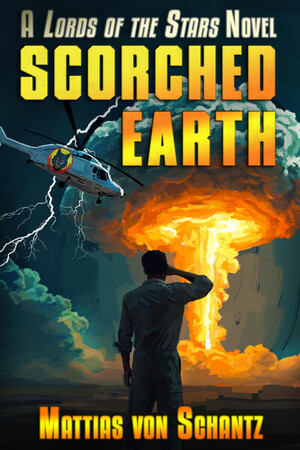
Scorched Earth
March 2, 2029 AD, Organización de Intereses del Yucatán Headquarters, Mérida, Mexico, Earth
The polished marble floor of the spacious office, the enormous potted palms and spiky cacti decorating it, and the wide panoramic windows through which the tropical sun shone suggested that the man sitting behind the opulent desk had an opinion of himself that was, perhaps, a tad elevated.
Internally, the United States Special Envoy to the Organización de Intereses del Yucatán sighed. Externally, he showed no reaction to the room, neither awe nor disdain.
“Welcome, Mr. Carter. Welcome!”
The man behind the desk beamed at him. “Sit down, my friend. Can I offer you a cigar? The finest Cuban you’ve ever tasted.”
“Thank you, Señor Castillo, but I will have to decline,” Elijah Carter said, though he did sit down in the soft velvet chair with its embroidered purple backrest that the Chairman of the OIY had had his secretary bring out for him. “I am here to listen to your proposal, to ask clarifying questions about it, and to bring that information back to the President of the United States. That is all.”
“Of course. Of course,” José Manuel Castillo replied absentmindedly, as he rummaged through the small humidor on his desk. Eventually, he abandoned his search for tobacco, apparently deciding it would not benefit his position to smoke in the presence of an American diplomat who did not.
This was not the first time Carter had met with leaders of the Global South, nor, he imagined, would it be the last. Every country would always try to gain the upper hand in the game of international politics. His job was to ensure that in all such transactions, the United States of America would come out on top, preferably with her enemies in a worse position than they had been in when negotiations started.
Not that the Yucatán Interest Organization was an enemy of the United States. Of course not. They were just another group of loosely aligned countries—third world countries, to be precise—that had banded together because of shared grievances with the Western world. It was not the first time such a thing had happened, and it would not be the last. Neither their economies nor their armed forces were strong enough to warrant them more than the briefest attention.
Still, Carter thought, the OIY was unique in that it had managed to gather among its members more or less all the Central American, South American, and Caribbean states, from Mexico in the north to Brazil in the south, from Ecuador in the west to Cuba in the east. While they were too weak to put any real weight behind their demands, they were still strong enough that the President had decided to listen to them, if only to placate them.
“I am aware of the broad strokes of your grievances, Chairman Castillo,” Carter said, trying to steer the meeting back on track. “But I would be happy to listen to the details. Please explain what it is you want from the United States.”
The Chairman sat in silence for a good ten seconds before replying. When he finally looked up at Carter from behind his desk, the opulent, almost whimsical persona he had displayed when the U.S. diplomat had first entered the room was gone.
This was a man who knew where he stood.
Silently, Carter cursed himself for having underestimated the Chairman.
“Mr. Carter. For a very long time—centuries, in fact—the United States of America has, together with the other Western countries, exploited the nations of the south. To put it bluntly, you are rich today because we are poor. The Organización de Intereses del Yucatán, representing the interests of the American Global South, demands reparations for the damages these wrongdoings have caused our member states.”
It was not a new argument, and it was, in truth, one he was a little tired of hearing. Fortunately, this also meant the United States already had an official response to such demands.
“I understand your position,” Carter explained, careful not to offend the Chairman. “The United States is always willing to listen to its friends and neighbors. However, it is the position of my government that these grievances you bring up are purely historical and have nothing to do with the hardworking American citizens of today. Punishing a poor coal miner’s family in Kentucky for perceived trade imbalances in Panama in the nineteenth century is not the policy of the United States.
“Furthermore, the President strongly rejects the notion that the United States should be singled out for such demands. Other countries, particularly in Europe, have a far longer history of exploiting their former colonies. The United States has given back more than it has taken from its neighbors. We believe the only fair option is that you press your claims against the European Union, not against us.”
Chairman Castillo seemed to contemplate Carter’s declaration for a few moments.
“Thank you for your candor, Mr. Carter,” he said, eventually. “It is not an unexpected response from you. But let me tell you why you are sitting here today, in that chair, and not your counterpart from the European Union.”
Carter leaned back, steeling himself for what was to come. Taking criticism was part of his profession, and he was very good at his job.
“The reason you are here and they are not is, beyond the fact that you are our neighbors and they are located on the other side of the Atlantic Ocean, that we are already having a dialogue with the European Union. I mean no offense, but with the United States, we do not.”
It was a good thing he had prepared for this exact argument, Carter thought. He discreetly glanced at his papers to make sure he got the numbers right.
“The recently created European Union Monetary Fund for International Aid contains, as of today, 514 billion euros, out of which 143 billion is allocated to Central and South America. That might sound like a lot of money, Chairman Castillo, but you and I both know it is not. What are your demands of the United States?”
“Twenty trillion dollars, to be paid out to our member states over the next decade.”
That was quite a bit more than Carter had expected. He had a hard time seeing the President even taking a demand for such a ridiculously large sum seriously. Not that the man in the Oval Office would have agreed to paying what practically amounted to extortion even if the amount had been smaller, of course. But the incredulous sum did prove the United States’ point that the Europeans weren’t paying their due, and he told the Chairman of the OIY as much.
Chairman Castillo sighed. “I think you are missing the point, Mr. Carter. I wholeheartedly agree the Europeans could do more. What they contribute is just a drop in the ocean. But the point is, they are helping. You are not.”
This time, Carter thought, it was the Yucatán Interest Organization that had underestimated the United States. While the number the Chairman had presented had been higher than expected, the argument itself had not been unanticipated. The United States diligently did its homework, and the President had already provided him with a counterproposal he was authorized to make, should the issue of European negligence be brought up.
“On behalf of the President of the United States, and in line with our government’s position that the Europeans are taking advantage of us both, we propose that the Yucatán Interest Organization drop its claims for compensation against the United States and instead redirect them toward Europe. Should the OIY agree to this proposal, the United States would put its full weight behind supporting the organization’s claims against the European Union in the Appellate Body of the World Trade Organization.
“In exchange, the United States would commit to investing five hundred billion dollars in Central and South American natural resource extraction industries during the coming decade, primarily in the oil industry. It is a deal that would benefit both our blocs, Señor Castillo. Your economies would get a substantial monetary infusion, significantly more than the Europeans are providing, and the United States would get access to cheap oil, which in turn would benefit our own economy. It is a win-win proposal.”
“Except for the Europeans, eh?” the Chairman said, winking at the U.S. diplomat.
The conspiratorial gesture was perfectly in line with the persona José Manuel Castillo had displayed when Carter had first entered the room, the character of a man collecting riches and power for himself by pretending to represent the interests of his people—a stereotype of the Latin American despots of the twentieth century.
But Elijah Carter saw through Chairman Castillo now.
It was all for show. Something was coming. Something bad.
Something the President of the United States had not foreseen.
“Let me show you something,” Chairman Castillo continued, as he rose from behind his desk and walked over to the large windows overlooking the magnificent city below. Carter followed, stopping at the Chairman’s side.
“What do you see?” the Mexican asked, indicating the sprawling streets and the lush vegetation beyond with his hand.
“It is a beautiful country, Chairman,” Carter said, meaning every word. “A place to be proud of.”
Chairman Castillo nodded.
“Indeed,” he replied. “But that is not what I see. When I look out of my window, I see death. I see the mushroom cloud resulting from a hundred teratons of kinetic energy smashing into the Gulf of Mexico. I see the air burning and a billion dinosaurs being roasted alive.”
He turned to Carter before continuing.
“We are standing inside the impact crater of the asteroid that killed the dinosaurs sixty-six million years ago. The Organización de Intereses del Yucatán didn’t choose Mérida for its founding location by accident.
“You—and your President—have assumed you are here to talk only of our historical grievances against the United States. You are not.
“For the past century, the industries in your country, the very machines that have made you rich, have emitted four hundred billion tons of carbon dioxide into the atmosphere. The United States—one country—has done that, alone. That is a full one quarter of the total amount of carbon dioxide ever emitted in the entire world, and more than all the countries of the European Union taken together.
“You asked why we are singling out the United States for our demands for reparations. Now you have our real answer. All that carbon dioxide you have expelled is impacting us in the South right here and right now. With rising temperatures, crops are failing and diseases are spreading. It affects everyone in the world, but none more so than we who live close to the equator, already poor from centuries of unfair treatment by the West. It is time you pay us back for that, so we can afford to adapt to the changing climate. For us, it is not a matter of convenience. It is a matter of life and death.”
So this was what it was all really about, Carter thought. Fortunately, whatever his own opinions on the matter were, the position of the United States on the topic was clear.
“The President of the United States does not recognize the concept of global warming as a man-made phenomenon,” he declared. “It is the opinion of the U.S. administration that climate change is a green-left conspiracy, designed to damage our country and enrich the climate scientists who perpetuate that myth.”
Chairman Castillo sighed again, but this time the sound of exasperation was laced with an undertone of contempt.
“Do you see any climate scientists driving around in their Ferraris and dreaming of gold, Mr. Carter? I have never met one who does. I do see how Mr. Trump and those close to him enriched themselves by means of the policies they championed, though. We were hoping that his successor in the White House would be more amicable to our pleas, but all I hear from you is a repetition of the same talking points we have heard from Washington for the past four years. You worked for the previous administration, too. You know how it was.”
He did, but he preferred not to comment on it. For a man in his position, it would not be appropriate to do so.
“Our current President is dedicated to continuing former President Trump’s very successful work to make America great again,” Carter declared instead. “Both the former and the current administrations have worked diligently to ensure that only scientific predictions that benefit the American taxpayers get published, and that doom-sayers prophesying a climate apocalypse that never seems to materialize do not. It is the official position of the United States that global warming is a scam.”
The Chairman of the Yucatán Interest Organization looked at him intently, as if trying to gauge the reality behind the words Carter spoke. The U.S. diplomat most fervently hoped the sharp Mexican would not succeed in doing so. Because if he did, Elijah Carter would most certainly lose his prestigious and quite well-paid job. The current President, like his predecessor, was quite keen on keeping himself surrounded only by yes-men.
Then Chairman Castillo laughed, though there was no joy in his face when he did so.
“You cannot even bring yourself to call it the greenhouse effect, can you? Where the rest of the world calls it what it is, you insist on saying ‘global warming’ instead, as if the ambiguity of that phrase could stave it off.”
“Rising temperatures—if they are indeed rising—could be due to a hundred different things,” Carter retorted, trying to project confidence on behalf of his country. “Changes in the sun. Dust clouds in space. The tilt of the Earth’s axis. Humans are simply too small and too powerless to affect the climate of the planet. Raising the taxes for those Kentucky miners to pay you reparations for changes to the sun that have nothing to do with them would not only be unfair, it would be objectively wrong.”
Chairman Castillo nodded. “Of course, Mr. Carter. Except all those things you mentioned have been measured, and they either don’t exist or they don’t line up with the Earth’s increasing temperature curve. The amount of carbon dioxide in the atmosphere does.”
It stung Carter to have to contradict the Chairman, but explaining the position of his country was his job, whether he believed in his own words or not.
“Measured by scientists,” he corrected Castillo, trying his best to make the word sound ugly. He failed, mostly, but it still seemed as if he got his President’s point through anyway. The intention behind his response clearly riled up the Chairman of the Yucatán Interest Organization.
“You must be the only country in the world that has managed to reduce science to opinion!” he exclaimed, slightly too loud for what was expected in a diplomatic exchange. “Trust me, it will come back to bite you.”
“Is that a threat, Señor Chairman? You should know that the United States takes threats to its sovereignty very seriously indeed.”
José Manuel Castillo paused for a moment. “It is not a threat, Mr. Carter, at least not in the sense you mean it. But science is science whether you believe in it or not. Claiming the greenhouse effect is just an opinion is not going to stop it from getting worse, not in the slightest. On the contrary, it will probably only going to make it happen even faster.
“And when it does, we will all suffer from it.”
In the end, it was clear that the two men—or at least the blocs they represented—would never see eye to eye on the matter. Elijah Carter would take the Yucatán Interest Organization’s proposal to the President, but he already knew what his administration’s response would be.
The South would not get a single dollar out of the treasury of the United States of America.
Author's Note
The story you're reading is one of many set in the Lords of the Stars universe I've been creating over the past 30 years, where familiar characters and places reappear, and new favorites await discovery. Check out my profile to explore more stories from this universe.
While Scorched Earth is entirely standalone and can be read without any prior knowledge, I think you'll also enjoy Wonders From Beyond the Sky, Time for Memories and Choices of Steel, all of which are standalone sequels to this story.
Visit the official Lords of the Stars blog for more information about this hard sci-fi universe: https://lordsofthestars.wordpress.com
If you enjoyed this chapter, please consider giving it a like.





Please sign in to leave a comment.