Chapter 4:
Chapter 4: Precipice
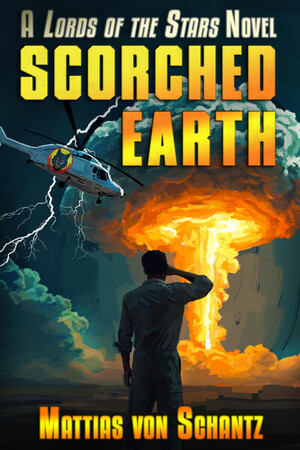
Scorched Earth
March 28, 2029 AD, Hohenheim University, Stuttgart, Germany, Earth
Death came in the shape of a thin, squiggly line on a small piece of pink graph paper.
At every given moment in time, a thousand and more scientists across seven continents were studying the data points collected by a multitude of satellites, balloons, and weather stations sprinkled around the globe. The majority of the petabytes of data they collected each day was freely available for any scientist to sink their teeth into, should they wish to do so—and many did.
It was, after all, the whole point of science. Across the world, scientists worked independently and diligently, day by day and hour after hour, in dusty basements, small cubicles lit by harsh LED lights, and rickety sheds heated by old and noisy radiators, comparing and studying and modeling their data until they were ready to draw their conclusions. Those results were then published openly for everyone to read. They were criticized and vetted by other scientists until one could know, with near certainty, that the conclusions they had reached were not skewed by instrument failure, noise, or human bias.
It was the scientific method, and for centuries it had faithfully served humankind.
At every given moment in time, a thousand and more scientists were studying the exact same data points she had been looking at. Any of them could have uncovered what she eventually discovered.
There was nothing special about her. In fact, if she hadn’t found it, one of the others would have. But by pure chance, she—and not one of them—was the one who managed to publish her results on the subject matter first.
It was pure chance that ensured history would never forget the name of Dr. Freya Angermeyer.
Was she shocked by what she had found? No. Not in the slightest.
Could she have predicted it? Yes. Yes, she could have. In fact, a thousand and more of her colleagues had done exactly that during the course of the past century, ever since Svante Arrhenius, working in Stockholm, in cold, remote Sweden, in 1896, had first discovered the greenhouse effect.
What Dr. Angermeyer found was neither surprising nor unexpected. It was, perhaps, the most inevitable discovery in the entire history of human science.
And yet, someone had to be the woman or man who first connected the dots in such a way that the result would hold up to peer scrutiny.
History would record that that woman was Dr. Freya Angermeyer.
* * *
Outside the window, the sun shone from a clear blue sky. Birds, blue and great tits, were singing from the trees lining the walkways through the university campus as nature prepared for the summer to come. It was a beautiful spring day, and Dr. Angermeyer almost regretted having to spend it inside the gloom of her lab. But the computer she was working with wasn’t exactly built to be portable.
Here, at the supercomputer center of the Department of Climatology at Hohenheim University, line after line of racks filled with GPUs stretched across the back room, slowly hissing from the cooling liquid circulating through them. Every morning, she loaded them with the latest data sets collected from the global network of satellites and weather monitoring stations, tweaked some parameters, and set the system to run her custom-written simulation of global weather patterns. Hour by hour, the algorithms ticked forward in tiny increments, until simulated years turned into decades and weather turned into climate.
There was nothing nefarious about her tweaking the simulations, despite what certain politicians were in the habit of suggesting. On the contrary, doing so was the whole point of running them. You wanted to know what would happen if a proposed European Union policy were implemented? Dr. Angermeyer would turn policy into code, and a few hours later she’d tell you the climate consequences of the new law.
Today’s simulation was less exciting than that, though. This was one of the routine parameter sets she ran at regular intervals to continuously keep track of the changing climate. In a sense, it was a calibration run, a what-if scenario looking into how the climate would develop should humanity—or to be more precise, humanity’s emissions of greenhouse gases—suddenly disappear entirely.
At least that was how she used to explain her work to her friends. In reality, things were a little more complicated than that. Her climate model wasn’t perfect. No model was. To compensate for that, climatologists like Dr. Angermeyer didn’t limit themselves to running just a single one. Instead, they had a whole set that they ran in parallel, filtered, averaged, and compared. If all the models gave the same, or at least very similar, results, you could be fairly certain you were on the right track. On the other hand, if one of them turned out to be an outlier, that model either warranted extra scrutiny, or it had to be discarded.
In either case, it was a lot of work. And Dr. Angermeyer loved her work.
By now, she had been running models with this particular set of parameters for years. Now and then, one of them would lock itself into a runaway cycle, where one climate system or another would enter a feedback loop and the rise in global temperature would take on a life of its own. Sometimes it was the oceans that got so warm that they started to release stored carbon dioxide, which resulted in an even stronger greenhouse effect and, consequentially, even warmer oceans. Which, of course, meant they expelled even more carbon dioxide, and so on and so forth, until temperatures on the planet skyrocketed. Other times, it was the ice and snow cover that ended up in a vicious cycle where every winter saw higher temperatures and less snow than the one before, meaning there was more dark ground and open sea around to absorb sunlight, heating up the oceans and the land and making the cold season even shorter, until, in the end, autumn turned to spring with no winter in between.
This was when those other models in her portfolio came into play. This was when she would run a model from the UK Met Office or from the Max Planck Institute for Meteorology, with exactly the same input parameters, and compare the results to her own.
Most of the time, none of those models would show the same feedback loops.
At least, that was how things used to be in the past. Dr. Angermeyer was thirty-nine years old, and by now she had been doing this job for more than a decade and a half. And with each year, it had become increasingly common for her to find that more than one of her models ended up in the same feedback loop.
It had been years since she first saw the writing on the wall. Climatology wasn’t, as people jokingly liked to put it, rocket science. Well, writing climate simulations kind of was—not literal rocket science, of course, but it did require some pretty advanced math and programming skills. But the actual science behind the models wasn’t that difficult to grasp. It didn’t require a university degree to understand the basics of how carbon dioxide trapped heat from the sun within the atmosphere. Kids learned all about that in middle school.
Nor was there any confusion among climatologists about what the effects of that trapped heat were, about the correlation between that heat and the carbon dioxide content in the atmosphere, or about where those greenhouse gases came from in the first place. In fact, among the physical sciences, climatology was perhaps one of those where confidence was at its highest.
If you were to look to other disciplines of physics, you’d find uncertainties and discrepancies everywhere, and far greater than those related to the greenhouse effect. Dr. Angermeyer used to joke with her friends in the astronomy department that if Trump ever got wind of the Hubble tension, he’d cease to believe the universe existed. Of course, now that the man was no longer in office, there was always hope she’d never have to tell that joke again—assuming, of course, that his successor in the White House would display a more enlightened attitude toward science than his predecessor had done.
No, Dr. Angermeyer had known for years that as time went on, more and more of the models she was running would end up in feedback loops. Then, one day, the moment came when the first of her simulations locked itself into two simultaneous runaway effects, both the warming oceans and the melting snow at the same time. In recent years, that had happened more and more often, and not just with those two feedback loops, but also with others—three or four in total. The process was accelerating, and time was running out to halt it.
She knew, with the same certainty she knew the sun would set in the evening, that the day would eventually come when all seven of her climate models would lock themselves into the same multiple feedback loops.
And on that day, Dr. Angermeyer knew she would bear witness to the end of the world.
Because on that day, no matter what mankind did, it would be too late.
The printer next to her desk squealed as its heads traversed the slip of pink graph paper she had fed it. Slowly, methodically, the ink blobs they deployed on its surface began to form seven multicolored graphs.
All rising exponentially away from origo.
Author's Note
The story you're reading is one of many set in the Lords of the Stars universe I've been creating over the past 30 years, where familiar characters and places reappear, and new favorites await discovery. Check out my profile to explore more stories from this universe.
While Scorched Earth is entirely standalone and can be read without any prior knowledge, I think you'll also enjoy Wonders From Beyond the Sky, Time for Memories and Choices of Steel, all of which are standalone sequels to this story.
Visit the official Lords of the Stars blog for more information about this hard sci-fi universe: https://lordsofthestars.wordpress.com
If you enjoyed this chapter, please consider giving it a like.






Please sign in to leave a comment.