Chapter 7:
Scholar’s Mate
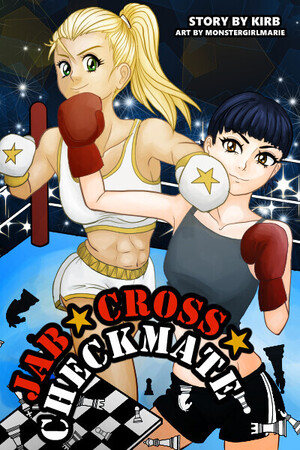
JAB★CROSS★CHECKMATE
“How much chess do you know?” I asked, as we sat opposite each other, setting the pieces up on the board.
“Hmm… I know how the pieces move… I played a couple games against my mum years ago… but that’s really about it.”
“That’s fine. Means I won’t have to un-teach you any bad habits.” I wasn’t sure my patience would extend far enough to forcibly making someone unlearn the stupid wayward Queen attack. A blank slate is one I can carve however I see fit. “Here’s what we’re gonna do. We’ll play out one quick match straight, then go back and look at what went wrong. After that we’ll play another game where I’ll have you talk through each move, alright?”
“You’re the boss!” she said, flashing a peace sign. She was far more excited to learn chess than I was to learn boxing. Almost made me feel bad for what k was about to do.
Almost.
Sorry love, it’s tradition.
I as white played e4, and she responded with e5. I pulled my bishop out to c4, and she placed a knight on. I planted my queen on f3 and, as I expected, she failed to see the trap. She played bishop to c5, and I checkmated her with queen to f7.
“That’s called the scholar’s mate,” I said, moving my pieces back to their starting squares. “It’s sort of a tradition that every new player loses to it once, and it teaches an important lesson. Can you guess what it is?”
“Hmm… that the Queen is really strong?”
“True, but that’s not what I meant.”
“Uhhh… that bishops and queens are really strong together?”
“You’re on the right track, but you’re thinking too specifically. It’s more broad than that.” I waited for a moment for her to respond, but when she tilted her head quizzically, I decided to give her some more hints. “When you made your moves, what were you thinking about?”
“Well… I wanted to get the strong pieces out quickly so I’d be prepared to attack or defend.”
“And what were you not thinking about?”
She looked down at the board silently for a moment, but this time I could tell she was thinking things through, not just buffering due to conclusion.
“…oh!” she exclaimed after a short silence. “I was so focused on my own moves I wasn’t even thinking about yours!”
“Congrats. You got it,” I said, before tracing a couple of lines with my fingers. “Both the bishop and the queen were attacking the same undefended pawn. If you had slowed down to think about why, you might have countered it by moving your own knight or queen to block the attack. This is the mistake new players always make. Treating chess like its singleplayer. You should be taking just as much time to consider what your opponent might do as you do for your own moves.”
“I see…” she said, putting her hand on her chin. Then, after a moment, she lit up with a smile, like she’d been hit with a eureka moment. “It really is like boxing! To win the game, you have to understand the person you’re playing.”
“Well yeah. But it’s far more complicated when the options you’re predicting aren’t limited to ‘punch’ and ‘don’t punch.’ You’ve got hundreds of moves to think about, with long term strategies and short term tactics appearing and stacking up move after move. Nothing in your primal fist-fighting compares to that.” I said it with more contempt than I had intended, but the comparison had left a bad taste in my mouth. Boxing is about physically overpowering someone. Chess is about intellectually outmanoeuvring them. To compare them was an insult.
“I’ll have to show you just how much you’re underestimating boxing,” replied Touka, with a smile far too warm for someone whose discipline I had just dissed. “But that can wait until next week. We’ve got more chess to play, right?”
“Of course.” As if I’d let her off that easy after she put me through the suffering of Prometheus. “I want you to try and explain the rationale behind every move we both play. I’ll help you out when you’re stuck, but I want you to try for yourself first.”
“It sounds difficult, but I’ll give it a try.”
I decided to go with something very standard and pretty easy. The Italian Game. A very classic opening, and a staple for beginners. It was also an old favourite of mine, before I picked up my beloved Vienna Gambit.
I pushed my pawn to e4, and waited for her to say something.
“…moving that pawn out of the way means you can get both the bishop and queen out diagonally, right?” She spoke tentatively, seemingly having little confidence in her answer, but not at all worried about making a fool of herself. She had nothing on her mind but a willingness to learn.
For some mysterious reason that I refuse to confront, I felt slightly ashamed.
“You’re not wrong, but you’re thinking too much about the one specific move instead of the grand strategy,” I replied. “Where do you think most of the action happens on the board?”
“Uhh… in the middle?”
“That’s right. So control of the centre is one of the most important aspects of the game. If you completely control the centre, you control the very field you’re playing on.”
“I… see…” she thought for a few more seconds before continuing, “so… pushing the pawn to the middle, you’re making some of the squares unsafe or off limits to the opponent… so you control more of the centre?”
“You’re spot on. Good job.”
I almost felt condescending for praising something that felt so obvious to me, but if I was being fair, it was an impressive thing to pick up as a beginner without it being spelled out to her. There was clearly a head on her shoulders that hadn’t been destroyed by CTE.
“Hmm… so I should play…” she muttered, before replying with e5. “So I do the same as you, attacking some squares in the centre, and I don’t lose my pawn to yours.”
“Perfect. You’re starting to understand.” I picked up the knight on g1 and advanced it to f3. “So, what about this move? Think about the short term goal and the long term effects here.”
She silently drew out the lines the knight could go, seemingly satisfied when she identified e5 and d4 as the dangerous squares. Smart, but also exactly the long term mistake I was banking on.
“It attacks the pawn… and the square the pawn is guarding… so it’s controlling the centre and threatening my control at the same time.”
“Nice, I’m impressed you noticed.” She was really picking up the concepts fast. Most newbies would notice the attack on the pawn, but wouldn’t understand the consequences that way. “So, how do you protect your pawn and centre control?”
She hovered her hand over her pieces and drew out lines again. For a moment she considered both the d7 pawn and the f8 bishop, but eventually she settled on the best move, knight to c6.
“Why that move? Why not the pawn or bishop?” I’ve had to test if it was fluke, or if she really understood the benefits of her own move.
“I think…” she trailed off, tracing her own moves with her finger, “…the pawn or bishop could both protect the other pawn, but neither of them help me hold the middle of the board. Pushing the pawn means I have one less pawn I can put in the centre, and moving the bishop blocks the pawn entirely, right?”
I have to say, I was impressed. It was very basic, very simple chess, but she had gotten there most alone in less time than it takes most people to even learn what ‘control the centre’ even really means. She was already starting to grasp the most important precepts, and we had barely started our first proper game.
I moved my bishop out c4, and wondered if she could keep the momentum up. The bishop was arguably the stronger piece, covering more distant squares than the knight, but this makes it difficult for new players to really understand its value.
“Any ideas behind that one?” I probed. Once again I could see her track the line out, but now she was doing it subconsciously with her hand bit ever really in her own sight.
“You… attack the pawn near the king again? And also defend the square next to my pawn so I can’t push my other pawn there?” She sounded like she had just a little bit more confidence in her answer than she had before, but was still uncertain and nervous. She was starting to understand the game more, but each layer of complexity reminded her that she was a beginner.
“So, if that’s your worry, what will you do?” I rested my hands on my chin, hoping she’d choose the move that would make choosing this opening worth it.
She looked over the book several times, seemingly playing out move after move in her head. A couple of times she glanced at me, but my expression was patient and unchanging, and she seemed to get the message to take her time. In fact, the longer she took, the happier I was. Playing someone who doesn’t think their moves through properly was no fun.
Finally, after over a minute of waiting, she played it. Knight to f6.
“What made you choose that?” I asked, trying not to give away in my voice how glad I was.
“You haven’t put a defender on your pawn yet. The pawn and the square it’s attacking are both in the middle, so controlling them makes my position better. And it stops you from doing that checkmate on me again if you get the queen out.”
I stifled a smile. Her reasoning was good, and by an experienced player it would be a good move. This would be where I test her ability to consider her opponents moves and what counters she has.
I went on the offensive. Knight to g5. An aggressive, dangerous move so early in the game. This was an opening called the Fried Liver Attack, a devastating trap to those unfamiliar with it. If you don’t respond properly, you can expect to be down by six points of material in just six moves. This would be where I figure out if she really knows how to read and respond to threats.
“Can you see what I’m going for here? Look carefully. Consider every possibility.”
“Uhh…” she murmured, looking far more confused than she had before. It was to be expected, of course. I had thrown quite the curveball at her. There was the obvious red herring of the knight now defending the attacked pawn, but after tracing the line with her finger, she seemed to discard the idea that it was my goal. That alone was better than most new players did.
She started tracing everywhere else the knight could move, realising that every attacking square would just get the knight taken.
Then, after what must have been more than a full minute of thinking, her expression lit up.
“It’s the same as with the queen! The pawn in near the king is weak because nothing is defending it, so you have the knight and bishop both attack it together!”
I have to say, I was impressed. I really didn’t expect her to notice a trap like that the very first time she played.
“So, what’s my next move likely to be?”
“Umm… if you took the pawn with the bishop, you attack the king…” she said, though she seemed to already realise this wasn’t the goal. “...but the king just moves away, right?” She thought about it some more, then traced the knight’s line instead. “...ooh! Oh! I got it! The knight aims at the queen and rook at the same time, and since you can’t take the knight, you can only save one of them!”
I couldn’t help but crack a smile. She figured it out with barely any prompting. Not many new players could do that. This girl might have potential after all.
“So, what do you think you do from here?” I asked, though this part I truly expected her not to get.
“Umm… I have to stop you attacking the pawn, right? So…” she looked at her available move options, but each one she traced seemed to make her less and less confident. After quite a bit of thinking, she gave a very hesitant answer. “Do I… move the queen out of the way? Then you can’t attack both at once, and I’m defending the pawn?”
“That’s not an awful move, but it’s not great,” I said, trying my best to be gentle. It was a mistake very natural for newcomers to make. The actual best line was a little unintuitive. “You do remove the threat of being forked—that is, attacked in two places at once—but you don’t actually defend the pawn. Because if you take back with your queen, you lose a queen for a bishop and a knight, which is a bad trade for you.” I moved the queen to e7 as she suggested, then took on f7 with the bishop. “Now I’ve checked your king, you need to move it to where the queen was. That means once I’ve moved the bishop away I can just check with the knight, and you’ve lost your rook all over again.”
“Ohhhh…” she replied, mouth agape. It was hardly a surprise she hadn’t thought that far ahead, it takes a level of intuition built up over dozens to hundreds of games, not one. “So… what do I do then?”
“The best thing to do is block the bishop by pushing your pawn to d5 so the knight isn’t protected anymore. Black loses the pawn, but ends up better in the centre, and white’s attack is totally stunted.” I played out the line, then reset back to the fried liver position to show her something a little more exciting. “My favourite response, though, is the traxler.” I moved her bishop out to c5 and started playing through the moves. “You totally ignore white’s attack and mount your own counter. You check the king with a brutal bishop sacrifice, then check him again with the knight. After that it’s just a matter of harassing the king with your queen and knight, and then you’ve go-” I cut myself off. “...what? Why are you looking at me like that?”
“You really do love chess, don’t you?” she said, a warm smile on her beautiful face. “I feel like I’ve just seen a totally different side of you. You said that you hate how easy you find winning, but beneath it all, you still love it. I can see it in your eyes when you talk.”
I was a little taken aback at the sudden topic shift. I couldn’t imagine anything in my expression was so profound as to change her entire perception of me like that.
Then again, the first thing this girl ever said to me was complimenting my earrings from a whole room away. Maybe she just had incredible perception like that?
“Well… yeah, I’d never deny that,” I said. “I do love chess. Every single move adds an uncountable amount of variations and choices, and the only way to win is to choose just one of them every single turn, and to choose well enough to outsmart your opponent. It’s beautifully simple, and beautifully complex all at the same time. It’s the greatest test of human intellect we’ve ever created. And those moments where something new clicks in your brain, and you feel like you understand it just a little more than you did yesterday, are the moments I live for. So yeah. I love chess. More than I love almost anything else in the world.”
Almost.
For a moment, I almost felt embarrassed. I sounded like such a fucking nerd, ranting about my love for a board game of all things. But Touka never dropped her smile. If anything, she only smiled wider.
“One day, I hope I can make you feel the same way about boxing.”
“Huh…?”
Me? Loving boxing the same way I love chess? I couldn’t see a future where that happened. There was no artistry or intellect to battering each other like thugs. It was a barbaric sport, only testing your ability to overpower each other.
Could I really love something so violent and primitive as much as I love chess?
I looked for something else to say, but a ringing from Touka’s phone beat me to it.
“Hmm? Oh! That’s the end of our time! It went so much faster than I expected!” she said, pushing her chair back and getting to her feet. “I have a bus to catch so I can’t stick around and chat, but I’ll see you next week!”
“Huh-? Oh, yeah. See you next week…”
Boxing, huh? The same as chess? How ridiculous…







Please sign in to leave a comment.