Chapter 3:
Chapter 2:The weight of zeroes
All in
Kenji Tanaka did not sleep.
At 4:47 a.m., he was still on his laptop, reading academic papers on micro-expression analysis with the desperate focus of a student who'd discovered the exam was tomorrow. At 5:30, he switched to YouTube videos of poker tells, watching at double speed while making notes on a pad that hadn't been used since his last tournament. At 6:15, his mother's alarm went off the NHK morning news, a kettle whistling, the soft shuffle of her slippers and Kenji realized he'd been awake for twenty-six hours straight.
His brain felt like it had been replaced with static and regret.
"Kenji?" Her voice through the door. "You're still here?"
"I live here, Kaasan."
"You know what I mean. You didn't sleep."
He heard the accusation in her voice the particular disappointment of Japanese mothers who believed that sleeplessness was a moral failing, like not returning shopping carts or talking on trains.
"I slept," he lied.
The door slid open. His mother stood there in her house dress, grey hair now properly braided, holding a cup of green tea like a weapon. She looked at his face. She looked at his laptop. She looked at the twelve empty energy drink cans arranged in a crescent moon around his futon.
"You slept," she repeated flatly.
"Strategically."
"Kenji."
"Kaasan."
They stared at each other. It was a familiar standoff the unstoppable force of maternal concern versus the immovable object of filial avoidance. She'd raised him. She knew all his tricks. But he'd learned a few of his own.
"I need to go out," he said, standing too quickly. The room tilted. He grabbed the desk.
"You need to eat."
"I'll eat on the way."
"You need to sleep."
"I'll sleep when I'm dead, which feels increasingly likely." He kissed her forehead a preemptive strike against further argument and grabbed his jacket. "Don't open the door for anyone. Don't answer unknown calls. Don't—"
"Kenji." Her voice stopped him at the door. Softer now. "What's happening?"
He turned. She looked small in the morning light, smaller than she used to be, like the years were slowly erasing her. The thought made something twist in his chest.
"Nothing," he said. "I'm handling it."
"You've been handling it for four years."
"Practice makes perfect."
He left before she could respond.
The pharmacy opened at 8 a.m. Kenji was there at 7:55, leaning against the shutter like a man waiting for a lover instead of blood pressure medication. The clerk a university student with a nose ring and zero interest in customer service arrived exactly at 8, unlocked the door, and processed his purchase without making eye contact.
Forty-seven thousand yen. Gone.
He watched the money leave his wallet and thought about Yamamoto's words. Interest is the gift that keeps on giving. Two points two billion yen. Two point two billion.2.2 billion . He said it in different ways, hoping one would sound smaller. None did.
Two point two billion was an abstract number until you saw what it could buy. A used car. A year at a cheap university. His mother's life, apparently.
His phone buzzed.
"9 p.m. Park Hyatt, 52nd floor. Come alone. Come alive."
He stared at the message. Come alive. Not or else. Just... a suggestion. A reminder that the alternative existed.
He walked.
Tokyo in the morning was a city that had forgotten its nightmares. Office workers in perfect suits. Schoolgirls in perfect uniforms. Trains running exactly on time, as if chaos had been banished by collective will. Kenji moved through it like a ghost, invisible among the visible, unremarkable among the remarkable.
He found himself in Shibuya without meaning to. The crossing was already busy tourists taking photos, teenagers ignoring each other, businessmen pretending they weren't looking at the giant video screens. He stood at the edge and watched the flow of humanity.
His father had brought him here once, when Kenji was seven. They'd stood on the Hachiko statue and watched the crossing, and his father had said, "Look at them, Kenji. All those faces. Each one hiding something. Each one lying about something. Your mother thinks I'm at work. I'm not at work."
Kenji hadn't understood then. He understood now.
His father had left two weeks later. Not dead just gone. A postcard from Osaka every year on Kenji's birthday, always the same message: "Study hard. Be better than me." Kenji had stopped opening them five years ago.
He pulled out his phone and called the only number that mattered.
"Tanaka-san?" A woman's voice. Professional. Flat.
"This is Kenji Tanaka. I received an invitation."
"We know."
"How do you know?"
A pause. Then: "We know everything, Tanaka-san. That's why we invited you."
He wanted to hang up. He wanted to run. He wanted to go back to the pharmacy and ask for a refund on reality.
"Who are you?"
"Tonight. Nine o'clock. All questions answered." Another pause. "Your mother takes her medication at 8 p.m. Tonight, make sure she takes it early."
The line went dead.
Kenji stood in Shibuya, surrounded by 2,500 people crossing in perfect chaos, and felt completely alone.
He spent the day doing pointless things.
He bought new shoes black, plain, expensive enough to not embarrass him but not so expensive that he'd feel guilty when he died in them. He got a haircut at a barber in Ginza who didn't ask questions and used scissors that cost more than Kenji's laptop. He ate a bowl of ramen at a counter restaurant and watched the chef's hands, reading the micro-tensions in his knuckles, the slight hesitation before he added the pork, the way he breathed differently when a pretty woman walked past.
Everyone has tales, Kenji thought. Everyone is lying about something.
Including him. Especially him.
At 6 p.m., he went home.
His mother was in the kitchen, making dinner. The smell of miso and simmering vegetables filled the tiny apartment, made it feel like a home instead of a trap.
"You're early," she said.
"I have a game tonight. A good one. Big money."
She didn't turn around. "You already said that."
"I wanted to see you before I left."
Now she turned. Her eyes searched his face the way they had when he was five and had hidden a bad report card. "Kenji."
"Kaasan."
"You're scared."
He wanted to deny it. The word was on his tongue, ready to be deployed like a poker chip. But she'd raised him. She'd changed his diapers and kissed his scraped knees and sat through every parent-teacher conference where they'd said "your son is very bright but doesn't apply himself" as if that wasn't the story of every gifted child who'd ever lived.
"I'm handling it," he said.
"That's not what I asked."
He sat down at the kitchen table. It was small two chairs, one window, a view of the building across the street where someone had been watching them yesterday.
"Someone wants me to play in a game tonight," he said. "High stakes. Private. The buy-in is 2.2 billion"
"Yen?"
"Yen."
Her face didn't change, but he saw her hands tighten on the ladle. "We don't have 2.2 billion yen."
"Someone paid it for me."
"Who?"
"I don't know."
A long silence. The vegetables simmered. A train passed somewhere in the distance, the sound muffled by walls that were too thin and dreams that were too small.
"Why?" she asked.
"I don't know that either."
"And if you don't go?"
He thought about Yamamoto. About the white van in the parking lot. About the photo on his phone. "Then we have a different problem."
She turned back to the stove. For a terrible moment, he thought she was crying. But when she spoke, her voice was steady.
"Your father called himself a professional player too. Did you know that?"
Kenji blinked. "What?"
"He played. Small games. Underground. He told me he was in real estate." She laughed a dry, hollow sound. "I believed him for three years. That's how stupid love makes you."
"Kaasan..."
"He owed money when he left. Not as much as you, but enough. Enough that they came to the apartment. Enough that I had to explain to the neighbors why strange men were knocking on our door." She served the food rice, miso soup, vegetables and sat across from him. "I never told you because I wanted you to remember him as your father, not as a gambler who ran away."
Kenji looked at the food. He wasn't hungry. "Why are you telling me now?"
"Because you're him." Her eyes met his. "You have his smile. His charm. His ability to make people believe things that aren't true. And you have his problem." She reached across the table and took his hand. Her fingers were thin, fragile, warm. "I don't want you to have his ending."
"I'm not running anywhere."
"Then don't go tonight."
"I have to."
"Why?"
He couldn't explain it. Not the debt, not the threat, not the photo that was still on his phone. Those were reasons, but they weren't the reason. The reason was simpler and more terrible: for the first time in four years, someone wanted him. Not the washed-up version, not the has-been, not the cautionary tale. They'd paid two and a half million yen for him. They'd watched his apartment. They'd called his mother.
He was a player again.
And players played.
"I'll be back by morning," he said. "I promise."
She held his hand for a long moment. Then she let go.
"Take your medication at eight," he said. "Early tonight. Don't ask why."
She didn't ask. She just nodded, the way she'd been nodding at his lies for thirty-two years.
He ate his dinner. He kissed her forehead. He walked out the door.
The train to Shinjuku was crowded. Kenji stood near the doors, holding the strap, watching the faces around him. A woman reading a manga. A businessman checking emails. A teenager with headphones so loud he could hear the tinny beat from three feet away.
All of them had no idea that a man on their train was going to a penthouse to play poker for stakes he didn't understand.
All of them had no idea that the man didn't understand them either.
The train pulled into Shinjuku Station. The doors opened. The crowd pushed forward, carrying him with it, and Kenji Tanaka let himself be carried.
Above ground, the city was neon and noise. The Park Hyatt rose in the distance, a tower of glass and money, visible from everywhere and approachable from nowhere. Kenji walked toward it, new shoes squeaking on the pavement, old fears squeaking in his chest.
He stopped at the entrance. A doorman in a suit that cost more than Kenji's entire wardrobe looked at him with the particular disdain of those who judged by appearance.
"May I help you, sir?"
"I'm here for the game."
The doorman's expression didn't change, but Kenji caught it the slight widening of the eyes, the fractional lean backward. Recognition. And something else. Fear?
"Your name, sir?"
"Tanaka. Kenji Tanaka."
The doorman spoke into a discreet earpiece. Listened. Nodded.
"Fifty-second floor, sir. The elevator requires this." He held out a keycard plain white, no markings. "You'll need it to go up. And to come down."
Kenji took the card. It was heavier than it should have been. "And to come down?"
"The game doesn't end until it ends, sir. The elevator won't operate without the card. And the card won't work until the game is complete."
Come alive, the message had said.
Kenji looked at the keycard. He looked at the doorman. He looked up at the fifty-second floor, invisible from the street, waiting for him.
"Any advice?" he asked.
The doorman hesitated. Then, quietly: "Don't trust anyone who offers you tea."
Before Kenji could ask what that meant, the doorman was gone, opening a taxi door for a couple in evening wear, the perfect professional once more
Kenji walked into the lobby.
The elevator was mirrored. He watched himself rise through the floors—10, 20, 30, 40—and saw a man he barely recognized. The same face he'd had at twenty, at twenty-five, at thirty. But the eyes were different. Older. More careful. More afraid.
You're either the bravest man I've ever met or the stupidest.
Yamamoto's words. He still didn't know which one was true.
The elevator chimed. The doors opened.
Fifty-second floor. Penthouse.
A woman stood waiting. She was striking in the way that expensive things were striking polished, perfect, slightly unreal. Late forties, maybe early fifties, in a silk dress that probably cost more than Kenji's debt. Her hair was pulled back. Her smile was pulled tighter.
"Tanaka-san," she said. "We've been expecting you."
Kenji stepped out of the elevator.
"I'm Yuria," she said. "Welcome to the game."
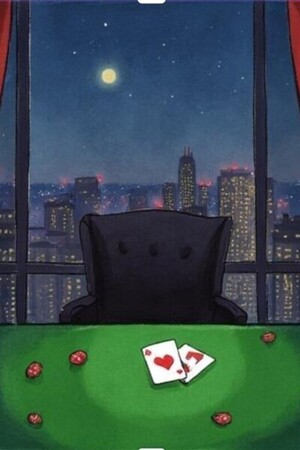
Behind her, through an archway, he could see the room floor-to-ceiling windows, the Tokyo skyline glittering like a promise, a green felt table with four players already seated.
One of them turned to look at him.
A Russian. Dead eyes. A scar on his neck.
He smiled. It was not a nice smile.
Kenji Tanaka walked forward, because there was nowhere else to go.




Please sign in to leave a comment.