Chapter 7:
Chapter 7: Reaction
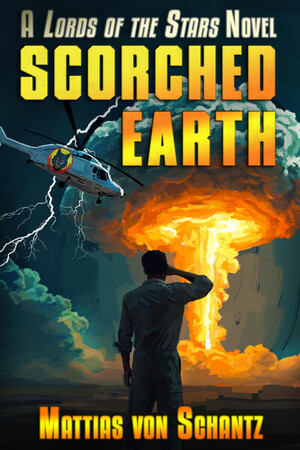
Scorched Earth
July 27, 2031 AD, National Aerospace University, Kharkiv, Ukraine, Earth
“Did anyone remember to bring the marshmallows?”
It was a ridiculous idea, and Dr. Kravchenko couldn’t stop herself from laughing out loud at the utter absurdity of his question. But then again, Valentyn always knew how to crack her up.
Not that it would be even remotely possible to roast marshmallows on the reactor heat. The uranium rods inside were held firmly in place by a ceramic framework, protected by a thick lead shield, and sealed within a steel casing, and even if you could—by some magical means—reach them, she couldn’t imagine anyone willingly eating a small piece of roasted sugar burned to a crisp by the nuclear fires within the drive.
Which, of course, was the whole point of Valentyn’s joke.
They had a good rapport, she and her team. No one was afraid to speak their mind, which was exactly how things should be in academia in a Western, democratic country like Ukraine.
With roasting candy out of the question, Dr. Kravchenko turned to her infrared thermometer to monitor the increasing heat of the reactor, as the temperature inside began to climb toward 2,000 Kelvin.
“Let’s show the world nuclear power in Ukraine is about more than Chornobyl,” she said, hoping to convey her vision for the future to her teammates.
“I’m not letting Ukraine take responsibility for that,” Valentyn replied with a chuckle. “I’d say Chornobyl was the most Russian disaster there ever was. Take a nuclear reactor built with multiple known design flaws, staff it with untrained people who are so afraid of the state they’d rather sweep their mistakes under the rug than ask for help when things go wrong, and then attempt to solve the resulting disaster by shipping busloads of expendable people to fight the fires. Does that remind anyone else of the Russia we all know and love?”
Well, he wasn’t wrong about that, Dr. Kravchenko thought. Once you removed Russia from the nuclear equation, fission power was both reliable and efficient. And this wasn’t the 1986 communist dictatorship of the Soviet Union. This was the democratic republic of Ukraine, and here, safety was paramount. As long as everyone in this room was honest about their mistakes and reported them upfront, so they could be fixed before becoming a problem, no one would lose their job today, even if the National Aerospace University’s nuclear thermal project failed.
And most importantly, no one would die.
Then again, the prototype NTP drive they were working on today wouldn’t fail. She was sure of that.
This was the culmination of more than eighty years of work. The project could trace its roots back to the early efforts of pioneers like Ulam and Cleaver in the 1940s, though Dr. Kravchenko’s design would probably have been unrecognizable to the scientists who had first come up with the idea of accelerating a spacecraft by letting a nuclear reactor directly heat a propulsion mass, rather than warming it by means of chemical combustion.
In a nuclear thermal drive, the propellant itself didn’t burn. It simply expanded as it was superheated to temperatures far higher than those a chemical rocket could produce. That meant the reaction mass itself didn’t have to be fancy. The best option was, of course, the lightest of the elements—hydrogen—but other substances, like ammonia or even water, could be used if that was what was available, though obviously the efficiency of the drive would be lower when it had to operate with heavier molecules.
And, as if by a happy accident, if there was one thing space was full of, it was water.
Dr. Kravchenko snorted as she was reminded of the multitude of movies she’d seen in which aliens came to conquer Earth because they wanted its water. To her, that made no sense at all. No, the real treasure on this planet was, in her opinion, intelligence. Nowhere else in the known universe had complex molecules bonded in such a way that they could understand their own uniqueness. That was what set humans apart from every other species on the planet, and what made human life, and by extension the planet they inhabited, worth protecting, rather than the simple presence of water in a universe where that substance was nearly everywhere. After all, water was just hydrogen with a little bit of oxygen tacked on. And hydrogen just so happened to be the most common element in the universe.
Inside the sheltered concrete room of the test chamber on the other side of the wall, the prototype nuclear thermal propulsion engine roared to life like a metal dragon waking from its deep slumber. Despite the thick wall separating her team from the nuclear furnace beyond it, she could still feel the vibrations in the floor as superheated reaction mass burst from the drive’s nozzle.
“Here we go!” Valentyn shouted above the cacophony of the glowing gases. “Watch out, little green men—Ukraine is coming for the stars!”
Despite knowing that Valentyn hadn’t meant his outburst literally, Dr. Kravchenko felt the need to take the joker down a peg or two. She had already done the back-of-the-envelope calculations needed to understand what it would mean to take their NTP drive to the stars. She imagined most of the other scientists and engineers on her team had done the same.
“I think our partners in the ESA will be disappointed in us if you do that, Valentyn,” she shouted back. “It’ll take a full century of constant acceleration just to get to Alpha Centauri, if you want to slow down halfway so you can actually stop and enjoy the view.”
The engineer laughed back as he winked at her. “Then let’s just blast through instead. At least a Ukrainian would be the first man to the stars.”
“You’d be the first corpse to the stars, silly. Even at a tenth of the speed of light, that velocity would turn the interstellar medium into a particle cannon aimed directly at your body. I think we’d better stay in the solar system, Valentyn. Zipping to Mars in two months to ski on Olympus Mons sounds much more pleasant than dying from acute radiation sickness halfway to Alpha Centauri.”
“But at least we’d take the Darwin Award for the most idiotic use of nuclear power back from Russia, wouldn’t we?” Katya, the particle physicist from Odesa, interjected. “Can’t have them bask in the glory of Chornobyl forever, right?”
“I think you mean bask in the glow of Chornobyl!” Valentyn quipped, before turning his attention back to the readings on his screen.
“So where would everyone go, if they could pick a destination?” Kacper, the Polish grad student working with the team, asked. “Any place of your choice. We already know Valentyn is dreaming of dying a slow and painful death in interstellar space, so he doesn’t have to answer. But what places in the solar system would the rest of you want to visit? Me, I’d like to see Neptune.”
“Mars,” Dr. Kravchenko replied, without even having to think about her answer. “I want to walk on the red sands of Mars.”
“I’d love to go to Titan,” Katya added, a dreamy undertone to her voice. “Imagine standing on the beach of Kraken Mare one rare smog-free day and seeing the clouds part to reveal Saturn in the sky. What a sight!”
“2,700 Kelvin,” Valentyn suddenly announced, pretending not to hear the gentle mocking of his travel preferences. “Still holding steady. No oscillations.”
“Let’s not get ahead of ourselves,” Dr. Kravchenko cautioned him. “We won’t be able to tell if there is any cracking inside the reactor until it’s cooled down enough for us to investigate it.”
She briefly glanced at her instruments before continuing. “But you’re right. From what I can tell from the outside, everything does look good. It seems like our latest redesign is holding up to our expectations, after all.”
Of course, the engine they were working on here was only a scaled-down test unit. It would never taste vacuum. For safety reasons, it had been built with a closed-loop system in which a primary coolant circulated through the reactor, transferring its heat to the hydrogen before that hydrogen was expelled through the drive nozzle, untouched by the fissionable materials within the core. The design was far less efficient than heating the reaction mass directly, but when you had to work in such close proximity to the device, you didn’t want it spewing radioactive gas. Its future descendants, up there in space, where contaminated reaction mass could dissipate harmlessly into the vacuum, would be very different beasts.
And that was really the crux of the problem. Down here, in a bunker ten meters below the National Aerospace University in Kharkiv, it was easy to work on the system. A pair of shoes and a lab coat was all that was needed to approach the drive. But at the same time, the nuclear propulsion engine could never safely be launched from Earth. The reactor itself wasn’t really the problem. Dr. Kravchenko trusted her design implicitly. But to launch it into space, you had to put it onto a rocket, and rockets were notorious for occasionally blowing up, which would mean all that radioactive material from the reactor core would be vaporized and spread through the atmosphere.
One more way they could beat Russia at the Darwin Awards, she thought with a wicked smile.
No, the full-scale version of the nuclear thermal rocket they were designing would eventually have to be built in low Earth orbit, assembled from parts so small and protected so well that they were safe to launch even if the rocket carrying them failed. But not only was sending heavy things like a nuclear reactor into space expensive, working with it once it had arrived in orbit would be exceedingly difficult compared to sitting in a terrestrial laboratory. Dr. Kravchenko was a rocket scientist, after all, and not an astronaut. Despite her daydreams, she was well aware she would never get to go into space.
The nuclear thermal drive had been an almost unimaginably difficult project to bring to fruition, and it was no wonder it had taken humanity eighty years to perfect the technology behind it. But here, in this room, they were so close to the finish line she could almost taste it. She was determined that hers would be the team that would have their names written into the history books as the group of scientists and engineers who first opened up the solar system for mankind.
It would be a game changer to have a rocket engine that no longer relied on the explosive, short burn of hydrogen, kerosene, or methane, and instead could keep the drive online for weeks and months at a time, slowly building up acceleration until the spacecraft it was attached to traveled an order of magnitude faster than any chemical rocket ever could. The NTP drive wouldn’t just make the trip faster, it would allow for significantly larger payloads as well. A ship powered by Dr. Kravchenko’s engine could take a hundred or a thousand people, together with the supplies they needed for their survival, to the planets.
Still, all of those dreams belonged to the future. The nuclear thermal propulsion project was funded in part by the European Union and in part by a consortium of private European launch providers. Getting the final version of her drive into orbit, and onto a spacecraft, would be a far more expensive proposition than just building a prototype on the ground. The investors wouldn’t sign the checks unless they believed they would receive something of greater value in return. Chances were that, like so many other revolutionary ideas born over the past century of spaceflight, her design would never fly.
But then again, the unexpected had a way of intervening, and things could still turn out for the better.
Or for the worse.
Author's Note
The story you're reading is one of many set in the Lords of the Stars universe I've been creating over the past 30 years, where familiar characters and places reappear, and new favorites await discovery. Check out my profile to explore more stories from this universe.
While Scorched Earth is entirely standalone and can be read without any prior knowledge, I think you'll also enjoy Wonders From Beyond the Sky, Time for Memories and Choices of Steel, all of which are standalone sequels to this story.
Visit the official Lords of the Stars blog for more information about this hard sci-fi universe: https://lordsofthestars.wordpress.com
If you enjoyed this chapter, please consider giving it a like.





Please sign in to leave a comment.