Chapter 6:
Chapter 6: Repercussions
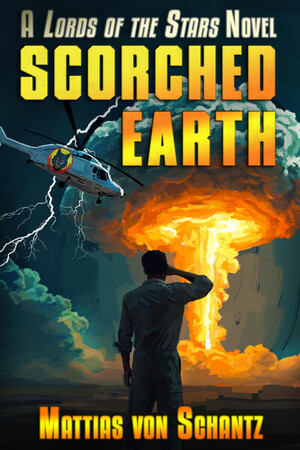
Scorched Earth
July 18, 2031 AD, Organización de Intereses del Yucatán Headquarters, Mérida, Mexico, Earth
The first time he had entered this room, Elijah Carter had been struck only by its overwhelming opulence. But that had been a long time ago. In the years since, he had come to know it intimately. He now saw the dust collecting in the corners of the marble floor, the bird droppings on the panoramic windows, and the crumbling, dead leaves of the potted palms. When he sat down in the ornate velvet chair that always waited for him here, it squeaked under the pressure of his weight, and a single thread escaping from the armrest kept getting longer and longer each time he visited the Yucatán Interest Organization. The opulence was gone, replaced by familiarity.
Like the rest of the world, this room was disintegrating. And the money to fix it was now needed elsewhere.
Chairman Castillo looked up from his desk. Like the room he occupied, the man had become familiar to Carter over the years. During their negotiations, they were not on friendly terms. In fact, each time they met, it seemed that their attempts at diplomacy only caused their respective countries to drift even further apart. But by now, Carter both understood and respected the man behind the organization.
Ironically, their now more cordial personal relationship meant their diplomatic interactions were far more intense. With understanding and respect came honesty, and Chairman Castillo did not mince words when he presented the position of the Yucatán Interest Organization. In return, Special Envoy Carter, while often more subdued in his responses, had become more than just a passive listener there to carry the Chairman’s words back to the U.S. President. These days, the two men actually talked—or shouted, depending on their mood.
“How is Evelyn settling in at her new school?” the Chairman asked, genuine interest evident in his voice. “Has she found any new friends? Moving is always hard on children.”
Carter plucked absentmindedly at the thread protruding from the armrest. “She likes it. She had a classmate over for dinner last week when I was back in Chattanooga. She seemed like a good kid. I think it’ll be fine.”
“Good,” Chairman Castillo said, nodding. “I’m glad to hear that. It’s been a long time since my children moved out, but you never stop worrying about them, do you?”
Carter chuckled lightly. “Yeah, it’s part of the job as a parent, isn’t it?”
“Indeed. Well, sadly, I suspect we have a much more depressing conversation ahead of us today. You’re here to tell me your President rejected our latest offer, aren’t you?”
“I’m sorry, Manuel, but there was just no way he could accept it,” Carter said after a quiet sigh. “You must have known that.”
“You can’t know unless you ask,” Chairman Castillo replied with a wink.
But Carter wasn’t done.
“We rejected your initial demands for twenty trillion dollars. That was an astronomically high number. There was just no way the President could even consider paying out that much for something we don’t even believe we’re responsible for. But when we said no, you raised your demands to thirty, and obviously we rejected—”
Chairman Castillo cut him off.
“Two things, Elijah. First, the reparations we’ve been demanding are meant, in part at least, to offset the growing cost of survival for our nations and our people as the climate deteriorates. Each year, the damage increases, and so does the projected cost of mitigation. It should come as no surprise that our demands increase alongside it.
“And second, every time we have raised this matter, you Americans have dismissed the figure we are asking for as unreasonable. I do not believe it is, if you’re just willing to consider the facts. Please allow me to lay them out for you.
“Last year, the gross domestic product of the United States was twenty-eight trillion dollars. That represents the total value of all goods and services produced by your country in a single year. We never asked for twenty trillion dollars all at once. Our proposal was for that sum to be paid out over a decade, which amounts to two trillion dollars per year, or just seven percent of your GDP, to be divided among all the nations of the OIY. I do not consider that unreasonable.”
“There’s nothing ‘just’ about seven percent of GDP, Manuel.”
“All right. Fine. But let me put it this way—in a good year, your economy grows by three percent. Seven percent, then, amounts to little more than two years of growth for the United States. That is all it would have taken to save six hundred million people, at the cost of a four percent recession in your country spread over the next decade. You have survived worse in the past, Elijah. We haven’t.”
Carter sat silent for a good half minute. He knew the math. He understood the stakes. He had from the very beginning. But what did that matter? It was the President’s decision, not his, and the President of the United States had rejected the demands of the Yucatán Interest Organization. There had been nothing Carter could do other than present that decision to Chairman Castillo.
“Are you saying you’re going to ask for forty trillion dollars this time?”
Carter had expected the Chairman to either say yes or respond with an even higher number. Instead, the leader of the Yucatán Interest Organization said nothing. He only sat there behind his large desk, wringing his hands as if trying to delay the inevitable.
“What is it, Manuel?” Carter asked as he leaned forward. “A hundred?”
When the Chairman finally replied, the words that came out were completely different from what Carter had been bracing for.
“There’s a recently published paper by a German climatologist, a Dr. Freya Angermeyer. Self-Reinforcing Systems in Long-Term Numerical Climate Simulations. Have you read it?”
He had. Its subject matter had been quite a bit more exciting than its title suggested. The content also ran very much against the President’s policy, which meant it was Carter’s job to poke holes in it.
“I have. The President found it very interesting. It supports many of the arguments he and his predecessor have been making for years.”
“Really? I find that very hard to believe.”
“Well, for example,” Carter said, trying to compose himself, “Dr. Angermeyer’s paper argues that global warming is happening on its own, without any human input. The planet is warming itself. That’s exactly the position the President has held on the matter for years. Also, Dr. Angermeyer agrees with the President’s opinion that humans can’t affect the climate. Her paper is very clear that there’s nothing we can do to stop the warming trend.”
Chairman Castillo just stared at him, his open mouth making him look like a goldfish.
“You can’t believe that,” the Mexican finally said, and there was now an edge to his voice. It was a statement, not a question. “I know you, Elijah. You don’t believe that. What you just said were talking points for your President. Don’t use them with me.”
Carter wished he didn’t have to. But wishes couldn’t change his job description.
“I’m here to represent the President of the United States, Manuel. You know that.”
“But that’s the most idiotic misrepresentation of Dr. Angermeyer’s conclusions I’ve ever heard! You know very well why she said those things. The greenhouse effect is self-reinforcing now because we created the conditions necessary for it in the past. For a century, we had the power to change things. We just didn’t, and now we’re out of time. Your reinterpretation is complete and total madness.”
Arguing about it was meaningless, and Carter made an attempt to disarm the tension. “Let’s agree to disagree on the specifics of the paper. Let’s just call them alternate facts. What was it about her paper that made you bring it up when we were on the subject of reparations?”
“We’re not asking for compensation this time,” Chairman Castillo finally revealed. “Like you said, Dr. Angermeyer’s paper is very clear that the warming trend will continue no matter what we do. The equatorial region of the Americas will eventually become uninhabitable, and no amount of reparations will be able to compensate for that.”
“Are you saying the OIY is officially withdrawing its demands, then?”
“We’re withdrawing our monetary demands, yes,” the Chairman explained. “Instead, we’re now asking that you accept our people as climate refugees. If they stay in their home countries, they’ll eventually die. It’s that simple. The Organización de Intereses del Yucatán hereby officially presents its request that the United States of America open its borders to receive the displaced populations of our member countries, both on humanitarian grounds and as compensation for your role in creating the current crisis.”
Carter looked at Chairman Castillo, trying to gauge the practical implications of this new demand. “How many people are we talking about here, per year? You know the President’s Republican base has a long history of opposing immigration into the United States. Building the wall was something of a prestige project for his predecessor. We can’t just open the borders now.”
“I’m sorry, Elijah. I don’t think you understand. I’m not talking in terms of people per year. When I said that Dr. Angermeyer’s paper predicts the equatorial region of the Americas will eventually become uninhabitable, I meant that literally. Every citizen of the affected countries will have to move, or they will die.”
Carter stared at him, dumbfounded. If the twenty trillion dollars the OIY had asked for in reparations two years ago had already been ridiculous, then this was completely insane. “Everyone? You’re saying you’re asking us to accept six hundred million refugees? Do you know how that sounds?”
“Six hundred million is probably going too far,” the Mexican conceded. “I believe our southernmost member states, like Paraguay and Bolivia, will make it through the crisis mostly unscathed. Their citizens won’t need to go north. In fact, those countries may be able to take in some of our own refugees. But the region from Ecuador, Colombia, and Venezuela all the way up to Mexico, including the Caribbean, will be severely affected by the crisis. Their citizens will have to migrate north, or die.”
“That’s still three hundred million people, Manuel. That’s almost one refugee for every American citizen. I can’t ask the President for that.”
José Manuel Castillo leaned back in his chair, placed his arms behind his head, and closed his eyes. To Carter, he looked almost relaxed, but when he opened them again, there was pain in them.
“I know you can’t,” the leader of the Yucatán Interest Organization told him, finally dropping all pretense. “And yet you have to. You need to understand that they will die if they stay. I can’t ask my people for that. Eventually, they will go north whether you or I come to an agreement or not. But things will be much less messy if we can do this amicably and organize the migration together. In the end, it will be cheaper for both of us, and we’ll save more lives. A chaotic, uncontrolled wave of refugees will be far more costly.”
“Is that a threat?”
“Two years ago, you asked me the same question when we presented our first demands. I told you then that the only threat to the United States was your willful ignorance of science. I warned you it would eventually come back to bite you.
“Well, now it has, and we will both have to live with the consequences. Yes, this time it’s a threat.”
Carter sat in silence for a moment before finally relenting. “I’ll talk to the President.”
“This isn’t optional, Elijah. It will happen. The question is only how it will happen.”
Author's Note
The story you're reading is one of many set in the Lords of the Stars universe I've been creating over the past 30 years, where familiar characters and places reappear, and new favorites await discovery. Check out my profile to explore more stories from this universe.
While Scorched Earth is entirely standalone and can be read without any prior knowledge, I think you'll also enjoy Wonders From Beyond the Sky, Time for Memories and Choices of Steel, all of which are standalone sequels to this story.
Visit the official Lords of the Stars blog for more information about this hard sci-fi universe: https://lordsofthestars.wordpress.com
If you enjoyed this chapter, please consider giving it a like.





Please sign in to leave a comment.