Chapter 13:
Chapter 13: Diplomacy
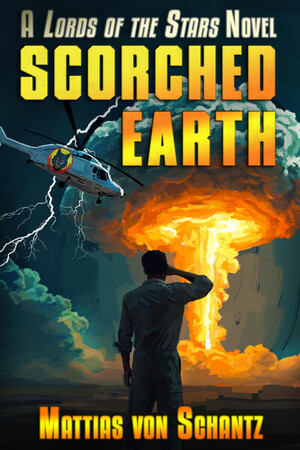
Scorched Earth
February 28, 2033 AD, Laredo, Texas, United States of America, Earth
“Excuse me, sir,” the blonde woman seated in the back of the car said to him, “would you mind clarifying our objectives here, please?”
It was a valid question. Only hours earlier, Elijah Carter had met with the President in the Oval Office for a final briefing before meeting up with the rest of his diplomatic team. They had left Ronald Reagan Washington National Airport on a small jet that had all the characteristics of a civilian plane, and now they were sitting here in Laredo in eight unmarked—but very much armored—vehicles, waiting for their Yucatán liaisons to arrive. To Carter, the whole thing felt very much clandestine. It was no wonder the junior diplomats on his team were wondering what they were doing.
Not that they would ever express such thoughts in public, of course. While they were still early in their careers, they certainly weren’t inexperienced. They were professionals working for the Department of State, and he was confident they would perform their duties according to his expectations.
That didn’t mean they wouldn’t privately wonder about their objectives. He often did so himself.
“Of course, Ms. Morris. What part of the mission is it you feel is unclear?”
“The country is in uproar. Everyone’s out for blood, Republicans and Democrats alike. A foreign army has invaded the United States of America, and no matter their political affiliation, everyone demands a military response now, and none more so than the President’s core voters. And yet he’s delayed military action to send us here to talk with the enemy? I feel like I don’t fully understand the endgame.”
A look of embarrassment came over her. “I’m sorry, Mr. Carter. I know it’s not our job to understand. It is only to convey the President’s wishes.”
He looked at her. She could not be more than thirty, he thought. A career woman who must have risen quickly through the diplomatic ranks, she was clearly both intelligent and competent. Then again, in the current administration, there were other qualities that were valued more than those.
“No, it’s all right,” he said. “It’s important that you understand. It’s true that we’re not politicians. We’re not here to debate or to have opinions on these matters. But to do our jobs well, we still need to understand the underlying reasons.
“Yes, the country demands action. Politically, that’s a no-brainer. We’ve been attacked, and we need to show strength by striking back. That’s the American way. But the Europeans don’t see it like that. Their focus is solely on the evacuation project, and everything else—and I mean everything—is secondary to that. As a Solar Charter member, we can’t risk alienating them, and so we’re here to show them we at least tried to talk with the Yucatáns.”
She seemed disappointed. “It feels wrong. We’re the United States of America.”
Carter smiled, but it was an expression devoid of joy.
“These aren’t the Obama years anymore, Ms. Morris. Beyond our borders America no longer enjoys the respect it once held. The focus of our country is on itself. The past two administrations have made it very clear to the world that America must come first. Consequently, we’ve taken a step back from global affairs. For years, we’ve told the Europeans—in no uncertain terms—that they have to take care of themselves. America is no longer willing to spend its resources holding their backs. For the past decade, we’ve demanded that they take the reins themselves.
“Well, they have, and now they lead and we follow.”
The young woman looked out the tinted window. The cars were sitting at the American end of the long bridge over the Rio Grande, waiting for confirmation that the Yucatán Alliance’s guarantee of safe passage had been enacted before crossing it.
“What’s going to happen?” she asked suddenly.
Perhaps he had misjudged her. There was a measure of fear hidden beneath the professional look on her face. While he didn’t enjoy seeing his young subordinate afraid, it did tell him that she understood the stakes better than he had first assumed. And to him, that was a feather in her cap.
“They are going to back down, Mr. Carter, aren’t they?”
Privately, he wished she hadn’t asked that. He knew Secretary General Castillo, and he knew the answer. But putting it into words made it so much more real. Of course, he was under no obligation to discuss this with her. But as he had told her at the start of their conversation, to do a good job here, she had to know what was going on.
Even if that meant he privately had to contradict the talking points of the President of the United States.
“I’m sorry, Ms. Morris, but I think that’s very unlikely. You must understand that they have no choice in the matter. If they stay in the south, they will die. If they cross the border into the United States, they might live. At least there’s a chance they’ll survive. Unless we somehow manage to physically stop them from crossing, I don’t see how we can convince them to just turn around and leave.”
“You almost sound like you admire them.”
He didn’t. They were a coalition of enemy nations that had declared war on his homeland. That alone made them his adversaries. But more than that, the Yucatán Alliance had, by force or coercion, turned the majority of the civilian population of their countries into a paramilitary army that they had marched north.
Not that they didn’t need to leave their home countries. Carter knew they would have to, eventually. Despite the President’s rhetoric, he fully understood both the science and the reality of the greenhouse effect. One day in the near future, the equatorial region would become uninhabitable. But that day wasn’t today. The conditions there were harsh now, for sure, with famine and disease spreading, but the area was not yet uninhabitable. To Carter, that meant the Great March North had been driven more by political and strategic reasons than by humanitarian ones.
And that was something he had a hard time forgiving Secretary General Castillo for.
No, he didn’t have to admire the enemy to see them as human. All he had to do was look at the face of a young Colombian girl who had lost her parents to starvation, or a Guatemalan husband who had lost his wife to mob violence.
They weren’t the threat here. The real threat was in Mérida.
Well, technically, it was in Monterrey now, he reminded himself. While the Yucatán Alliance’s civilian headquarters were still located on the Yucatán Peninsula, their military leadership had moved north with the march of their great army.
In a moment of weakness, Carter almost made a mental addition to his list of dangers. It was true that the threat was in Mérida and Monterrey. But perhaps, just perhaps, it was also in Washington, D.C.
He couldn’t quite bring himself to carry that thought to its conclusion, and his musings were interrupted by the signal that the Alliance liaisons had finally arrived. As the column of cars began to cross the concrete bridge over the slow-flowing river below, Carter couldn’t help but feel as if a new chapter of his life was about to begin.
The eight inconspicuous cars stopped on the Mexican side just after the bridge had ended. There, they were met by armed Yucatán Alliance guards, who escorted them from their cars to the waiting Alliance convoy. As they switched vehicles, he was separated from Ms. Morris and placed in the back of a covered, camouflage-painted four seat jeep.
For a moment, he thought he would be riding to Monterrey alone, but just before the convoy began to move south, the door to the vehicle opened and a massive Yucatán guard climbed inside. The man said nothing as he laid his assault rifle on the seat next to the American diplomat, never removing his hand from it.
“Hello, Mr. Moreno,” Carter said calmly. “It’s good to see you again.”
Seeing the rank insignia on the Ecuadorian’s uniform, the American diplomat quickly corrected himself. “Lieutenant Moreno. My apologies.”
The Yucatán soldier’s only response came in the form of a grunt. Whatever had happened to him since their last meeting in Mérida had clearly changed the man, Carter realized. Quietly, he wondered whether the former security guard would still be willing to protect him, should the need arise.
But the two-hour journey to Monterrey went without a hitch. Along the way, they passed more than a few military checkpoints, but the soldiers there simply waved them through. Clearly, the Yucatán Army was expecting them.
When they were finally allowed to leave their cars again, the American delegation was quickly and unceremoniously ushered into the courthouse of the state of Nuevo León, which now performed double duty as the local headquarters of the Yucatán Alliance. As he walked up the stairs past the statue of the ever-vigilant Lady of Justice, he couldn’t help but notice the pristine condition of the white building. Up here along the American border, the chaos that reigned in Central America was still a distant terror for the Mexicans. Yet, for the American President, the very presence of the Latin Americans now amassing on the southern border was nothing short of an existential threat.
Silently, he wondered how long the courthouse in Monterrey would remain pristine. If NATO responded on behalf of the United States, this city might soon be reduced to nothing more than dust.
“Welcome to Monterrey, Mr. Carter,” the Supreme Commander of the Yucatán Allied Forces greeted the diplomat as he entered the conference room their Mexican hosts had prepared for them. “I trust you and your people have been treated well? Would you like some refreshments?”
Carter declined politely. It wasn’t that he thought the enemy would go out of their way to poison the American delegation, but they wouldn’t be staying long in Mexico, so why take the chance? Still, he understood the offer was part of the diplomatic dance they were performing.
“The Yucatán Alliance eagerly awaits the response from the United States,” Supreme Commander Velázquez continued, gesturing with his hand to indicate that the floor now belonged to Elijah Carter. “Is your President willing to negotiate safe passage for our citizens into your southern states? If you agree, the Yucatán Alliance pledges to respect the territorial integrity of your borders. There will be no further military incursions.”
The heat inside the room and the magnitude of the message he was about to deliver made Carter feel dizzy. What he was about to say would seal the fate of half a billion souls, Americans and Latin Americans alike. But what choice did he have? The Yucatán Alliance had, without provocation—at least military provocation—attacked his homeland. On February 26, forces from the Yucatán Army and Air Force had penetrated the United States of America at multiple points along the Texas, New Mexico, and Arizona borders, reaching as far as Hebbronville and Cotton City before being turned back by the inevitable U.S. response.
There could be no peace on the American continent.
“On behalf of the President of the United States of America, we hereby reject the Yucatán Alliance’s request for further negotiations. Furthermore, the United States demands that the staging grounds of the Yucatán Army—the so‑called refugee camps—be dismantled, and that the enemy combatants residing within them be relocated to a distance of no less than one hundred miles from the border of the United States. This relocation process must begin immediately, and concrete evidence that the withdrawal has commenced must be provided to representatives of the United States before noon tomorrow, Eastern Standard Time.
“Failure to comply with the President’s demands will be considered an act of aggression by the Yucatán Alliance, and the United States of America will respond with force and determination to any and all threats along its border. It is the President’s position that a state of war now exists between the United States of America and the countries of the Yucatán Alliance.”
Author's Note
The story you're reading is one of many set in the Lords of the Stars universe I've been creating over the past 30 years, where familiar characters and places reappear, and new favorites await discovery. Check out my profile to explore more stories from this universe.
While Scorched Earth is entirely standalone and can be read without any prior knowledge, I think you'll also enjoy Wonders From Beyond the Sky, Time for Memories and Choices of Steel, all of which are standalone sequels to this story.
Visit the official Lords of the Stars blog for more information about this hard sci-fi universe: https://lordsofthestars.wordpress.com
If you enjoyed this chapter, please consider giving it a like.





Please sign in to leave a comment.