Chapter 6:
Chapter 1: The Whispering Descent
World Before the New
The world didn’t end with a bang. It didn’t burn in sudden fire or fall to a swift plague. It exhaled a long, suffocating sigh. Color and sound leeched away as the sky’s hue shifted and an oily haze thickened into rain.
It was called the Rain.
At first, it was a curiosity: a greasy sheen that clung to glass and metal, leaving iridescent stains that refused to fade. It smelled not of petrichor, but of acid and metal, a stench that lodged in the throat. Curiosity soured to dread when the drizzle grew viscous, pressing down on the world like a sentient weight. It slicked every surface, muted birdsong and traffic, and turned cities into muffled, grey shadows. Breathing became labor. Each inhale felt like a coin toss with poison.
The fever followed. It crept in, quiet and relentless: a cough that never cleared, aches that sank into bone, clammy chills that no blanket could repel. The rain didn’t just coat skin, it seeped in—into pores, lungs, blood. Doctors fell alongside their patients, their science useless against an enemy that was everywhere and nowhere. News anchors coughed through static-choked broadcasts that grew shorter each day. Hospitals became overflow morgues.
Civilization, built on fragile interdependence, unraveled. Supply chains snapped. Power grids failed as workers collapsed at their stations. Engines, factories, sirens—one by one, the noises of humanity died, replaced by a heavy, watchful quiet. Governments and corporations could find no enemy to bomb, no virus to isolate. Death was in the air, the water, the very rain that fell.
Memories of the "before" turned into charms people clutched in the dark. A grandmother’s picnic under a blue sky. A photograph of crowded streets ablaze with neon. A child’s drawing of a sun that no longer existed. Those fragments, salvaged from fading minds and flickering drives, made the past feel like a myth—too bright to be real.
The Rain became a character in their stories: a constant, smothering presence. Its metallic stench haunted every breath. Its sheen lacquered shelters, belongings, skin. The sky itself seemed bruised, forever purple and grey, and even when the clouds withheld their oily tears, residue clung to everything. The world felt like a sealed terrarium slowly choking on its own atmosphere.
From the early days came whispers of something worse than fever. Of things that formed in stagnant puddles left too long to fester under the twilight sky. The ‘children’ of the oily tears.
No one agreed on what they truly were, only that they were wrong.
They were spoken of in images: spider-like bodies with insect joints bent at impossible angles; drowned, distended torsos of something once human; heads that were gaping, toothed ruptures or smooth, humming domes. Limbs multiplied or vanished. Some scuttled on spindly legs, others lurched on columnar stumps. Their slick, iridescent skins wept corrosive slime that burned whatever it touched.
They didn’t move like animals. They unfolded, flowed, stretched. A thing six feet tall one moment could reach a ten-foot ledge the next, joints bending in directions that mocked bones. Bullets tore through them with little effect; wounds closed with wet, obscene sounds. The residue they shed killed small creatures in minutes, melting them into greasy sludge.
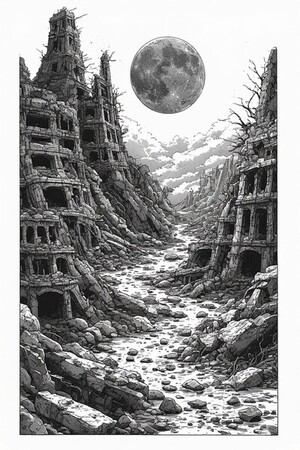
Cities became their hunting grounds. Lampposts turned into perches; skyscraper windows into darkened, oily eyes. Soldiers and tanks bogged down in the mire. Roads swallowed convoys whole. Humanity discovered that its most advanced weapons merely annoyed these things.
They hunted without smell or sight as humans understood it, drawn instead to vibrations and the faint electric hum of living flesh. Some lay flat as puddles until they burst upward in a whip-fast "unfurling" that dragged victims into gnashing maws or cocooning slime. Consumption was absorption: bodies broken down slowly, agonizingly, in living sacs of poison.
Forests fared no better. Trees gleamed with oil, their trunks seeming to writhe. Creatures masqueraded as fallen logs or clumps of underbrush, waiting for footsteps. The land itself became a trap.
Mara’s understanding of all this came in fragments. She remembered being very small, clinging to her mother’s back as they ran through a debris-choked street. The stink of metal in the air. The wet click of something very close by. A flash of iridescence, a blur of impossible motion, and then the slam of a bakery door barricaded in panic. The silence afterward pressed against her eardrums harder than any scream.
Her mother had tried to impose order on the chaos with notebooks: food inventories beside notes on the sky’s deepening bruise, the growing absence of birds and beasts, the dead hush settling over nearby towns. One trembling line burned itself into Mara’s memory:
"The rain has changed them. The quiet has changed them. I fear what it has awakened."
Who they were was never explained.
Mara grew up through this slow collapse—through the flicker and fade of the news, the death of the internet into a ghostly, sputtering network, the rise of rumor over fact. Knowledge frayed into superstition. Fear flooded the gaps.
What remained of humanity retreated into enclaves.
Underground, in the broken veins of a subway system, the ‘Rattlers’ nested. The tunnels were a maze of rusted steel and cracked concrete, lit by oil-fed lamps that turned every dust mote into a drifting spark. The air was heavy with stagnant water and rot. Sounds twisted in the passages: a droplet became a footstep, a shifting beam became a predator’s advance. The Rattlers moved in tense, tight groups over precarious catwalks welded from scavenged metal. Each crossing was a gamble against gravity and decay.
On the ruined shores, the ‘Harbors’ rose from rusted ships stranded in an oily sea. The Saltwater Scavengers lived in damp cabins and cavernous holds, navigating by rope bridges and memory. Phosphorescent fungi painted the deepest decks in sickly green light, both warning and torch. Metal groaned, bulkheads wept foul water, and sometimes something vast in the black depths thrummed against the hull, making bones vibrate.
Inland, abandoned factories became ‘Forge Towns.’ The Gearsmiths coaxed failing machines back to life, eking power from corroded generators and presses. Their world was one of echoing halls, artificial light, and the thick taste of dust and fumes. Hammers and welding torches made a familiar music, but beyond that rhythm lurked other sounds—scrapes, thuds, and the steady testing of concrete and steel by the creatures outside.
All three enclaves shared the same sickness: the sheen of oil on every surface, the reek of decay, and above all, a bone-deep fear of the surface.
The world above was the realm of the ‘children’ now, a place defined by its sounds: the wind’s lament, the chittering chorus of unseen mandibles, the dragging of immense bodies over broken stone, and, worst of all, the deep hum. When that low, resonant vibration rolled through the ground, every settlement went dark and silent, prayers whispered behind clenched teeth. The deep hum meant something ancient was near.
In the tunnels where Mara lived, survival had hardened into ritual. Their unspoken constitution was simple and absolute:
Never venture above ground after dark.
Darkness, here, wasn’t a matter of sunlight—they hadn’t seen true sun in years—but of danger. The shallow twilight when the sky lightened to a bruised gray was their only permitted window for surface scavenging. After that, the world belonged entirely to the creatures.
Children flinched at the mere mention of the surface at night, their bodies responding to inherited terror. Elders, faces mapped with insomnia and grief, whispered of the ‘Nightfall Creep’—the time when the world shifted from ruin to hunting ground.
Every evening, as the dim sky above faded further, the enclave performed its most sacred ritual: securing the entrances. Doors torn from subway cars became barricades, dragged into place with grunts and curses. Chains and ropes lashed metal to concrete. Blankets clogged every draft. Voices dropped to murmurs. Any stray shaft of light seeking the ceiling was quickly smothered by frantic hands and hissing shushes.
The law kept them alive, but it also trapped them.
Mara felt the trap more keenly than most. At twenty, she moved with the quiet precision expected of a tunnel-born survivor, yet her thoughts were elsewhere—fixed on horizons she had never seen. She performed the rituals alongside everyone else, but as her hands secured plates and knots, her eyes traced the imperfections: gaps between metal and stone, hairline fractures in sealed shafts, the suggestion of paths that led up instead of deeper.
Her world was cramped passages, recycled air, organized piles of tools, and scavenged goods. The obsessive cleaning, the meticulous sorting, the constant fussing over small details—Mara understood them as an attempt to impose order on a universe that had become alien and hostile. Fear had turned inward, breeding hyper-vigilance and claustrophobia.
She carried a different weight: the memory of her grandmother.
The old woman’s eyes had still held a glimmer of the Before. On quiet nights, she’d speak of open skies and green fields, of cities glittering under honest starlight. Once, she’d shown Mara a brittle photograph: towers of glass and steel piercing a limitless blue. It looked like a fantasy. As the years wore on, nostalgia and fear eroded her. She faded slowly, wasted by a sickness the tunnel-dwellers blamed on the tainted air above and called the Wasting.
For Mara, that loss became a spark.
She began to linger during scavenging runs, fingers brushing sealed vents and half-blocked shafts. She memorized the layout of collapsed tunnels, learning where rubble might hide a narrow passage. Her curiosity was no reckless, thoughtless thing; it warred constantly with the same ancestral terror that stiffened every other spine in the tunnels. But it never quite lost.
The paramount law was a cage, and her need to know what lay beyond it was the bird beating its wings against the bars.
She watched the Rattlers’ fear twist their lives into smaller and smaller spaces. She heard the tremor in their hushed conversations, saw the way even a dropped tool could ripple panic through a chamber. She understood, deeply, that this fear had saved them. But she also understood something no one else would say aloud:
Fear had become their warden.
Mara Kade’s rebellion began as a quiet, gnawing ache—a hunger not just for food or safety, but for sky. She yearned to know if the stars her grandmother spoke of still burned behind the poisoned clouds, if any warmth from the sun could still touch the ruined earth.
In a world that worshiped survival and obedience, that yearning was dangerous. It marked her as an anomaly, a fault line running through the bedrock of their rules. She sensed it every time she looked up at the cracked ceiling and felt, beneath the press of stone and earth and fear, the faintest pull of something beyond.
Mara didn’t yet know when she would break the law.
Only that someday, she would.
And when she did, the careful, fearful world of the tunnels would never be the same.




Please sign in to leave a comment.