Chapter 7:
Chapter 2: The Surface Beckons
World Before the New
The decision, when it finally solidified, wasn’t a thunderclap but a quiet, inexorable tide. It began as a shift inside Mara: the low hum of discontent sharpened into a persistent ache, like a trapped bird beating against its cage. She studied the faces of her kin and saw not just exhaustion, but a deep resignation, a spiritual numbness settling over them like the dust that coated their salvaged homes. Their fear—of the ‘Nightfall Creep,’ the ‘Wasting,’ the surface itself—had become their entire world. It was less about specific horrors and more about the unknown, the terror of anything that broke the predictable rhythm of their underground lives.
Mara’s restlessness was different. It wasn’t a simple rebellion; it was a burning need to know. She wanted to test the legends, to see if the surface was truly the monstrous realm painted by the elders. The tales of the ‘children,’ those mutated predators that ruled the night, fascinated rather than deterred her. Their stories clashed with her grandmother’s whispered memories of starlight and a gentle moon, of a sky that had once held beauty instead of dread. Between these contradictions, her determination hardened. She had to see for herself.
The paramount law—Never venture above ground after dark—was etched into her bones. The fear it carried was visceral; even thinking of the surface at night made her skin prickle. Yet equal to that fear was a relentless curiosity. She dissected the legends, trying to separate truth from exaggeration. The ‘Wasting’ was said to be a slow decay brought on by the poisoned air after the ‘Great Fall,’ but Mara suspected that fear had swollen the stories into shackles. Her grandmother had also spoken of herbs and cleaner places, of terrain where the air itself was less lethal. Those half-remembered hints became fuel for Mara’s resolve.
She knew the cost of her idea. Resources were scarce, scavenging runs were tightly controlled, and any unauthorized venture wasn’t just a personal risk—it endangered everyone. She watched the scavenging parties, memorizing their careful routes, their signals, the way they moved with quiet purpose through the ruins. She studied the maps no one cared about anymore, traced the reinforced seals of their haven, and learned each locking mechanism until she could open them in her sleep. What others saw as barriers, she saw as puzzles. Her plan took shape in stolen moments: move at the deepest hour of the night, slip through the seals unseen, carry only what she could not live without, and head toward the vague eastern landmarks her grandmother had once described—a rumored sanctuary, a place of cleaner air and fragile hope.
By the time she began her ascent, everything was prepared—at least as much as anything could be in a world like theirs. The climb up the rusted ladder was a slow, breathless struggle. The familiar, damp scent of the tunnels thinned, replaced by something sharp and alien. Her pack cut into her shoulders, each rung a reminder that she was stepping beyond every law that had kept her people alive. The final hatch, with its layered locks and groaning hinges, yielded under her careful hands. Instead of screaming winds and immediate death, a still, suffocating darkness greeted her.
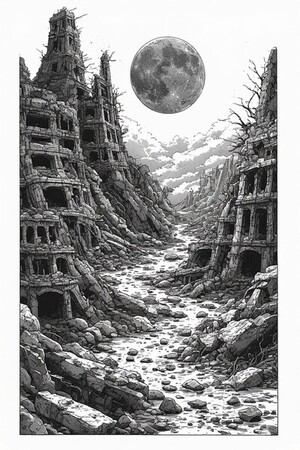
The surface night was deeper than any tunnel blackness. The air was colder, drier, carrying a cloying sweetness overlaid with a metallic tang of decay. Each breath felt like inhaling the last exhalation of a dead world. She pulled herself up onto a surface that crumbled under her weight—granular, powdery, scattered with shards of fused plastic and ceramic. As her eyes adjusted, she saw the skeleton of a city around her: jagged silhouettes of shattered towers clawing at a starless sky. Her grandmother’s promised tapestry of stars was gone; above her stretched only a blank, oppressive void that felt less like sky and more like a lid closing over a tomb.
The silence was alive with threat. No hum of generators, no muffled voices—only the faint whisper of a half-hearted wind and the pounding of her own heart. The smell of decay pressed in from all sides, a vast, unseen tide of rot and chemical corruption. The ruins were both magnificent and horrifying: twisted rebar like exposed ribs, tilted walls like broken teeth, streets buried under rubble and dust. She moved carefully, her boots crunching on shattered remnants of the old world, feeling impossibly small.
When the disorientation grew too strong, she pulled the salvaged glow-lamp from her pack. Its weak, bluish light carved a trembling circle in the dark, casting long, warped shadows that made the ruins seem to writhe. The lamp made her visible, but the thought of walking blind in that absolute void was worse. She dimmed it as low as she dared and pressed on.
Subtle signs of new life appeared as she ventured deeper: a thin, oily film on lower walls, pulsing pale fungi clinging to cracks, faint internal glows that mirrored her own lamp. The air vibrated with a strange energy, as if the ground itself held a slow, malignant pulse. Then came the sounds—first a distant skittering overhead, like countless claws across dry bone, then a distinct crack nearby that could not be dismissed as settling debris.
Mara froze, knife in hand, every instinct shrieking. She forced herself to breathe, to move forward. That was when she found the slime trail: a thick, iridescent ribbon snaking across the fractured ground, reeking of sweetness and ammonia. Her grandmother’s tales of the ‘Creepers’ rose unbidden—things of damp and darkness, feeding on decay, more force than a single creature. The scale of the trail spoke of something massive, or many acting as one. Gooseflesh crawled across her skin, but still she followed, deeper into the city’s broken heart.
Eyes appeared in the debris—at first as flickers, then as dozens, then as hundreds. Tiny, ember-like points of light watched her from cracks, doorways, and shattered windows. The concept of haunting shifted: not ghosts of the dead, but a living, crawling presence inheriting the corpse of civilization. The silence became a stage on which unseen horrors waited just beyond the glow of her lamp.
The trail led to a ruined public building, its entrance a jagged wound in the facade. Inside, shadows moved with a fluid grace that wasn’t human. The air grew thicker, sweeter, almost unbreathable. The fungi glowed brighter, the floor vibrated with a faint tremor, and the chittering rose into a constant, oppressive chorus.
Then came the hiss.
It cut through the darkness like a blade—wet, grating, and full of territorial promise. The scattered eyes multiplied, surrounding her in a ring of multifaceted attention. She stood trapped between the dead street and the building’s hungry maw, finally understanding that the surface did not simply contain danger; it was danger, condensed and sentient.
When the creature finally moved, it was almost too fast to see. A blur shot from the depths of the ruin—a serpentine mass of limbs and claws and iridescent flesh. There was no clear head, only a writhing body studded with rows of small, gleaming eyes and a vertical maw that pulsed with hunger. The legends had never captured this: the speed, the horrifying grace.
Her instincts saved her. Mara hurled herself back as it lunged, the hiss swelling into a roar. Claws raked her thigh, tearing cloth and flesh. Pain flared hot and bright, but also gave her focus. She ran. The careful, measured steps from before vanished, replaced by a desperate sprint through a treacherous maze of rubble. Debris snagged at her boots, twisted underfoot, tried to drag her down. The chittering swelled into a storm all around her, a chorus of unseen watchers reveling in the hunt.
She darted into a narrow alley, hoping the tight space might slow the creature. The air grew stagnant, heavy with rot and a harsh, metallic tang. The slime trail continued there, glistening faintly—a clear sign she was deep inside their territory. At the alley’s mouth, a pair of multifaceted eyes appeared, gleaming like dark jewels. The creature waited, patient and coiled, savoring her fear.
When it finally lunged, the alley filled with its undulating bulk. Mara moved on instinct alone, dodging a claw swipe that shredded the wall beside her. Dust rained down as she stumbled forward, chasing small shafts of dim light that broke through the suffocating dark. She knew she couldn’t outrun it forever; its speed and endurance dwarfed hers. The world above wasn’t just hostile—it was engineered, through catastrophe and time, to favor things like this.
Bursting back onto a wider street, she understood just how badly the odds were stacked. Eyes glowed from every recess, tiny witnesses to her flight. The chittering had become a constant hum, filling the ruin like an invisible fog. The creature behind her moved with obscene fluidity, its many limbs finding perfect purchase on the broken terrain. Its skin shimmered with its own faint light, turning it into a moving wound against the dark.
Far above, the sky remained a blank, smothering void. No stars. No moon. No comfort.
At the boundary between ruin and tunnel-mouth, another figure watched.
Elias Rourke lay prone on the skeletal remains of a collapsed skyscraper, eyes narrowed against the biting air. He knew this territory: the hidden paths, the tremors that meant movement below, the ways sound twisted between broken walls. He had survived by watching, not by intervening. The surface had taught him that stepping into anyone else’s struggle usually meant death—for them, for him, or for both.
From his perch, he tracked Mara’s frantic flight, the wavering arc of her glow-lamp, the dark stain spreading down her injured leg. He felt the vibrations of the pursuing creature through the ruined concrete, heard the rising frenzy of the chittering around them. She was broadcasting her presence to every horror in range, defying every unspoken rule of survival he had carved into himself over the years.
Irritation flickered, then faded into something more complicated. He had seen this before: the reckless dash, the desperate gamble, the belief that sheer will might bend a dead world. He had watched others try and fail. He had chosen, again and again, to remain a ghost in the ruins, unmarked, uninvolved. It had kept him alive—but it had also left him with memories that gnawed at him in the quiet hours. Anya’s laugh was cut short. A child’s plea unanswered. Faces he had never managed to forget.
Mara’s stubborn refusal to stop, to simply lie down and die, scraped against that old scarred place inside him. Her tiny, flickering lamp looked like an act of defiance against a universe that had no interest in hope. He envied it. He hadn’t dared carry light in years.
When the creature closed in and Mara stumbled, dropping her lamp, Elias saw the outcome before it happened. The beast’s iridescent bulk slid into view, its multifaceted eyes drinking in her terror. One more second, and she would be nothing more than another smear of blood on broken stone.
His body moved before his doubts could catch up.
Elias descended from his perch with practiced efficiency, scaling broken steel and concrete like a man who had long ago made peace with heights. He chose a landing point ahead of the creature’s path, spear in hand—a crude weapon of scavenged metal and worn wood. When he hit the ground, the impact jarred his bones, but he stayed upright. His sudden arrival split the hunt’s rhythm in two.
The creature halted, reassessing. Its countless eyes turned toward this new shape that dared stand between predator and prey. Mara, gasping and half-blind in the dark, clawed her way to her fallen lamp and brought its pale light up just enough to see him—broad-shouldered, worn, and impossibly calm in the face of the nightmare looming over them.
“Stay behind me,” he said, voice rough as stone. It wasn’t a promise of safety, just a practical order.
Mara obeyed, too shocked not to.
The standoff lasted only heartbeats. The creature tested the air, its chittering rising in pitch. Elias adjusted his grip, feeling the familiar weight of the spear, the slow drum of his heart. He knew what this was: not a battle to win, but a chance to buy a few precious seconds.
“It’s fast,” Mara whispered. “Faster than anything I’ve ever seen.”
“They all are,” he replied. “Adaptability’s what’s left of nature’s mercy.”
The lunge came like a snapped cable—sudden, explosive. Elias met it with a desperate parry, angling the spear so the blow slid rather than shattered him. The impact still rattled his bones. Using the creature’s own momentum, he twisted and shoved, knocking it just off-balance. Its shriek tore through the street.
“Run!” he roared. “Now. Don’t stop.”
He bolted sideways, away from Mara, into a narrower gap between two collapsed buildings, dragging the creature’s focus with him. It followed, relentless, its limbs gouging the ground, its hiss thick with fury. Elias’s lungs burned; an old wound in his leg ignited with each step. Still, he forced himself onward, deeper into the tight alley where at least the beast’s movements might be constrained.
It wasn’t enough. He stumbled on loose rubble, the spear skittering out of reach. The alley funneled the creature straight toward him. Cornered, empty-handed, he shut his eyes for a beat, bracing for the end he had always expected would come in some forgotten hole like this.
The light hit first.
A white-hot beam slammed into the creature’s side, far brighter and more focused than Mara’s earlier glow-lamp. It shrieked, convulsing, its skin smoking where the light struck. Elias blinked against the glare, then forced his eyes open.
Mara stood at the mouth of the alley, breath ragged, glow-lamp abandoned at her feet. In its place, she held a larger, salvaged lamp—one she must have grabbed from some hidden cache when he wasn’t looking. In her other hand was a length of metal pipe wrapped at one end in tattered cloth, gripped like a club.
“Get up, old man,” she called, voice shaking but resolute. “You’re not dying here today. Not on my watch.”
For a moment, all Elias could do was stare. The girl whose recklessness had nearly killed them both was now the one holding the line. The watcher had become the one being saved.
He dragged himself to his feet, the distant chittering of unseen creatures rising again around them, and realized with a grim, reluctant clarity that his life was now tangled with hers. In a world that had forgotten humanity, two stubborn sparks had just refused, together, to go out.





Please sign in to leave a comment.