Chapter 15:
Chapter 10: The Last Signal
World Before the New
The first dawn after the siege was colorless.
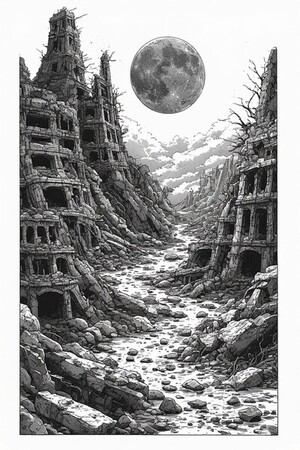
There was no sunrise—only darkness thinning into a bruised glow that seeped through the dust-choked sky and down into the broken bones of the enclave. Twisted girders, slumped walls, and a ruined plaza made the place look less like a refuge and more like a cauterized scar.
Mara Kade stood in the center of that scar and listened.
No aberrant screams. No bone-deep drone to turn thoughts to static. The silence was so complete it made every cough, every ragged breath, every scrape of boot on rubble feel too loud and fragile.
They had survived the night.
She wasn’t sure any of them knew what to do with the morning.
Behind her, the last of the pyres guttered. There had been no safe ground to bury their dead, only a shielded chamber beyond the secondary airlock where they burned what they could and let the filtered smoke slip into the poisoned sky. Faces she knew and faces she didn’t have went up in that thin, bitter plume.
Elias. Others.
She turned away before she started counting them again.
Footsteps approached over fractured tiles.
“You should sit down,” Jun rumbled. “Before you fall.”
Grease streaked his face; one eye was swollen half-shut. His bulk filled the archway, lantern swinging from his shoulder strap.
“If I sit,” Mara said, “I may not get up again.”
“Then we’ll roll you where you need to be. Make you a mobile command unit.”
A laugh rose and snagged on something sharp.
“How bad?” she asked.
“Structural?” Jun grimaced. “We’ve sealed the worst breaches. The East corridor’s tight. South access will hold if nobody sneezes hard. We lost three levels. They’re just…cavities now.”
“And people?”
“Seventy-two confirmed dead. Twenty-two people are missing under the collapse. Wounded…too many. Some won’t see another day without the med support we don’t have.”
Numbers were cleaner than names, but they still weighed.
“And the aberrations?”
“Nothing on the inner perimeter. No movement, no sonic interference. Whatever drove them, it’s quiet.”
Quiet felt wrong, a lie told in a sacred place.
“They retreated,” Mara said.
“Or regrouped. Or died. Or found something else to eat,” Jun answered. “I don’t pretend to know how they think—if they think.”
Mara remembered the way they had swarmed the conduit, adapted under fire, screamed when the overloaded array pulsed.
“I’m not sure I want to know,” she said.
Jun hesitated. “Sera’s awake. Asking for you.”
Mara’s insides clenched. “Is she—”
“Alive,” he cut in. “Tired. Angry. Rude to anyone who says ‘rest.’ So, herself. Medbay. Mother Harrow’s with her.”
“That’s an unusual pairing.”
“Apparently, faith and science can share a square meter without spontaneous combustion,” he said. “Might want to see it before the universe corrects the error.”
Mara took in the plaza—patched barricades, makeshift shelters, hunched shapes sleeping in the lee of shattered walls.
“I’ll be back,” she told him.
Jun’s mouth quirked. “We’re not going anywhere.”
The medbay had shrunk to a bent L of cots, heaters, and lanterns. Half the original space lay behind warped blast doors. Antiseptic smell waged a losing war against blood and melted plastic.
Sera sat propped on blankets, leg splinted, one arm in a sling. A tangle of wires and scavenged sensors sprawled beside her. Mother Harrow perched on a crate with a cracked cup between her hands.
“Commander,” Sera rasped. “I was just telling Mother Harrow she can’t use the last bio-scanner to bless her incense.”
“I did not say ‘can’t,’” Harrow said mildly. “I asked about efficiency.”
“That’s scientist for ‘no,’” Sera muttered.
“If we’re debating incense, we might be in better shape than I thought,” Mara said.
“We’re debating faith allocation,” Sera corrected. “Different stakes, same arguments.”
“The child is angry with me,” Harrow observed.
“I’m angry with everything. You’re just in range.”
Mara’s gaze flicked over Sera’s injuries. “Jun said you were awake. He didn’t mention obstinate.”
“He assumed you’d fill that in,” Sera said. “How bad is it?”
“Bad,” Mara said. “But not terminal. Yet. We’re still here.”
Sera’s fingers tightened on a wire. “The array?”
“Dead. Emitters slagged. Conduits burnt out. We’d need a full fab suite and a month to start rebuilding. We have neither.”
“Good,” Sera exhaled.
“Good?”
“That weapon almost killed us faster than the aberrations. We turned the sky into a drum and stood under it. Rebuilding with scraps would be suicide. Some tools you have to let go.”
“Mother Harrow would call that wisdom,” Harrow murmured. “The Weaver does not hand us knives for every problem.”
“Sometimes it hands us shovels,” Sera said. “To dig out of the holes we made.”
“The beacon?” she asked Mara.
“We sent it. You saw that.”
“I saw it leave,” Sera said. “That doesn’t mean it reached orbit. Or that anything was listening.”
“No response. We can’t scan far. For all we know, the storms ate it.”
“Then it’s Schrödinger’s signal,” Sera said. “Alive and dead until proven otherwise. It both matters and doesn’t. What we can control is what we do now.”
“Which is what?” Mara asked.
“Live as if no one is coming. Plan for us. If help arrives, we adapt. If it doesn’t, we’re not caught waiting empty-handed.”
“And with hearts turned outward instead of inward,” Harrow added. “We have cried out. That is enough. Any answer is beyond us.”
Mara weighed it, then nodded. “Then that’s what we do.”
“You have embraced command,” Harrow said.
“Feels more like falling into a hole,” Mara muttered.
“From the outside, it looks like someone standing when others cannot.”
“Poetry aside, she’s right,” Sera said. “They’re looking at you, Mara. Not at me. Not at Harrow.”
“That’s a mistake,” Mara said.
“Maybe,” Sera replied. “But it’s the one we have.”
They ran the numbers. Three weeks of rations if they were strict, more if agri-vats revived, less if wanderers came. Power triage, medbay lit, commons dimly alive. Harrow claimed despair and fanaticism as her enemies. Sera began rebuilding low-power monitors, analog and stubborn.
“If the beacon reached anyone,” Sera warned as Mara left, “we may never hear back. Not in time. Not at all.”
“We sent it anyway,” Mara said.
“Then we did what we could. The rest is noise.”
The enclave reshaped itself around its wounds.
Wide halls narrowed to braced channels with luminous arrows. Storerooms became bunkrooms. The shattered council chamber became a vault; decisions were made in the plaza where anyone could hear.
Jun’s teams coaxed ancient solar arrays back to life, cannibalizing every luxury system. Power now served lights, heat, and a handful of vital monitors. Everything else went dark.
Sera’s manual sensors sprouted along the inner perimeter: coils, gauges, seismic readers scratching faint lines on paper—a stubborn heartbeat of data independent of the dead mainframe.
Mother Harrow moved among them all, a thin, tireless ghost. She sat with the grieving, stared down would-be demagogues, and refused to let any single story of blame take root.
Mara worked everywhere: hammering braces with Jun, hauling crates, holding hands outside the medbay, arguing rations with Sera, listening when Harrow named corners thick with resentment.
Each night she stood on the cracked steps.
“This is what we repaired today,” she would say. “This is what we lost. This is what we still have.”
No promises. Just a tally.
On the seventh day, a small group from the lower levels approached.
“We want to send a scavenger team past the old south conduit,” their spokesman said. “See if any farms have stock left. We can’t live on ration bricks and hope.”
He wasn’t wrong.
Mara imagined the skeletal city beyond, irrigation grids, forgotten caches.
“How many volunteers?”
“Eight. We’re not asking for guards, just gear and a spot on the rotation chart.”
“You don’t go unarmed,” she said. “Two veteran perimeter crew go with you. Leave at false dawn. Sera briefs you on what not to touch. Jun sets a recall flare. You don’t pass the third ring. If anything looks like it wants to sing to your bones, you run.”
They returned limping two days later with half-full carts and hollow eyes, but alive.
They brought nutrient packs, medical supplies, water filters, and seed pods from a rooftop bed. They also brought stories—streets scoured clean by aberration swarms, buildings grown through with humming glass, an overturned orbital lifeboat cracked open and empty.
For one night, they ate a little better.
That was the night the sky changed.
Mara woke to a pressure in her ears and a prickling along her skin. For a heart-stopping moment, she thought the aberrations were back. Then she realized this was different. Lower. Steadier.
A hum.
She was on her feet before thought caught up, pulling on boots, grabbing her pistol, mostly for comfort. In the corridor, others spilled out: Jun, hair wild; Sera, barefoot and half-dressed; Anya, blinking.
They met in the plaza.
Outside, the bruised twilight was subtly brighter. The haze glowed with faint, shifting veins of light.
“Not natural scattering,” Sera murmured, hand finding Mara’s elbow. “Too coherent.”
“Please don’t let that be the aberrations learning to paint,” Jun said.
Slow, deliberate streaks of light arced across the sky. Trails.
“Something’s moving up there,” Sera whispered.
“Ships?” someone breathed.
Mara’s heart stuttered. The old orbital platforms should have been hulks by now, but automated systems could linger. Protocols could loop.
A third streak intersected the others almost overhead.
“Jun,” Mara said.
“Already on it.” He lumbered toward the nearest sensor station.
Sera dragged her gaze down. “Come on. If any receivers still breathe, we might catch a shadow.”
The comms alcove still smelled of burnt insulation. Jun wrestled with the jury-rigged board as static-laced data sputtered over a flickering screen.
“Talk to me,” Mara said.
“Elevated EM across multiple bands,” Jun grunted. “Could be aurora. Could be my grandmother. Hard to say.”
Sera elbowed in. “Move.”
She coaxed the dying sensors. The chaos resolved into a faint pattern.
“There.”
“Signal?” Mara asked.
“Burst transmission,” Sera said. “Short, narrowband, repeating. Old-world encoding, corrupted. It’s a handshake. Querying.”
“Us?”
“Or anything still listening on that band,” she said. “Which is basically us and a graveyard of relays.”
A faint echo blipped back from their own systems.
“Our infrastructure just knocked back,” Sera muttered. “Some ancient protocol heard a ping and responded on reflex.”
“Can we stop it?” Jun asked.
Mara’s instincts screamed yes, but Sera shook her head slowly.
“The beacon already lit us up brighter than this. If anything, notice that this won’t change much. Kill it, we go dark. Let it run, we join a conversation that might be very short.”
“We listen,” Mara decided. “No new signals. No power surges. Just listen.”
They watched the handshake—ping, echo, ping, echo—growing weaker as the enclave’s systems strained.
Then the pattern shifted.
The receiver spat out jittery fragments of text.
…—CR…L ST…ION 3…
“Control Station Three,” Jun guessed.
“Or Central,” Sera said. “Keep going.”
SURV…NG…NCL…VE SIG…L DET…CTED
“Surviving enclave signal detected,” Sera whispered.
…REMAI…NG ORBITA…ASS…TS …NIT…NG EMERG…NCY EXTRA…TION PRO…COLS
Jun laughed once, unbelieving.
“Say it,” Mara told Sera.
“Remaining orbital assets initiating emergency extraction protocols.”
The words felt like a story from another life.
More fragments: resources are limited. Prioritized evacuation window. Designated coordinates. An estimate: less than two hours.
“Extraction how?” Jun demanded.
“The message doesn’t say,” Sera replied. “But whatever’s up there thinks it can take some people off-world. Some.”
The implication settled heavily.
“They can’t take everyone,” Mara said.
Silence thickened.
Two hours to decide whether to trust a broken voice in the sky. Two hours to choose who went and who stayed.
Mara straightened. “Get me the plaza PA,” she told Jun. “We do this in the open.”
The shattered plaza filled faster than she thought possible. Fewer faces now, more bandages, but the same charged air.
“We sent a distress beacon,” Mara said into the squealing PA. “We emptied our reserves into the sky and hoped. Something heard. We’ve received a damaged signal from orbit. From what’s left of the old platforms. They’ve detected us. They’re initiating emergency extraction.”
Hope and fear rippled through the crowd.
“Extraction?” someone shouted. “Off-world?”
“Maybe,” Mara said. “Maybe not. Resources are limited. Whatever’s up there can’t take everyone. It might not even survive entry. This is not salvation. It’s a chance. A dangerous one.”
“Who decides who goes?”
“I do,” she said. Before outrage could build, she added, “With you. In the open. Not behind closed doors.”
Mother Harrow’s voice cut through next. “The Weaver’s loom has thrown us a thread. We may grasp it or let it pass. But we will not cut each other for the right to grab it first.”
They argued: time, numbers, fairness. A ragged man demanded a free-for-all scramble. Harrow shut him down with talk of bloodshed before the shuttle even arrived.
Mara raised her voice.
“This enclave exists because we chose to stand together when everything else fell. We bled for each other. Burned our dead together when we couldn’t bury them. Whatever we do now, we don’t betray that.”
She swept the crowd with her gaze.
“There are people here who will not survive another winter down here: the very old, the very young, the badly injured. If there’s any chance for them to see more than a slow dimming in the dark, I won’t deny it.”
Murmurs softened.
“But this place also dies if everyone with critical skills leaves. If there is a future here—and there is—someone has to stay to tend it.”
She took a breath.
“I propose we send an envoy: those least likely to live if they stay, and one who can speak for us if there’s any structure up there. Someone who understands the old systems.”
Eyes turned to Sera.
“No,” Sera said at once.
“Yes,” Harrow countered quietly. “You are the bridge between codes and bricks.”
Sera glared at Mara. “You can’t ask me to abandon—”
“I’m not asking,” Mara said. “I’m begging. If there’s anything up there—supplies, data, a relay, a promise—we need someone who sees what’s real, not what we want. You’re the only one I trust to do that and remember us.”
“What if it’s nothing?” Sera whispered.
“Then you come back if you can. Or you don’t. We go on either way. But if it’s something, you make sure they don’t forget we exist.”
Sera laughed once, cracked. “There’s a non-zero chance I end up arguing with a deranged AI over soil data.”
“Then pick the fight,” Mara said. “For us.”
Sera wiped her face. “All right. Children. Elders. Me.”
“And one more,” Jun said.
“No,” Mara snapped.
“Yes,” he insisted. “You need a builder. If that shuttle’s held together with duct tape and prayer, someone has to keep it flying. Someone who can fix things with the wrong tools.”
He met Mara’s eyes. “I taught half the maintenance crew. Let them run this place. Besides, if the sky tries to eat Sera, someone has to pull her back out.”
Harrow watched them all and nodded once. “The young, the old, the bridge, and the builder. A good pattern.”
They would not save everyone. They never could. But they could choose who carried their story upward.
“Gather those who must go,” Mara said. “No pushing. No trampling. If this is our last act together, let it be one we’re not ashamed of.”
They assembled beneath the ragged mouth of the main breach.
A dozen children, four frail elders, two badly injured. Sera, leaning on a metal rod. Jun, pack slung over his shoulder.
Mara moved among them, straightening straps, meeting small eyes.
“Will you be here when we come back?” a little girl asked, clutching a ragged toy.
“I’ll be here,” Mara said. “You bring me good stories.”
Nearby, Sera pressed a data slate into Noor’s hands.
“Manual routines,” she said. “Water testing. You know this. You don’t need me.”
“What if something goes wrong?” Noor whispered.
“Then you improvise. Like I did. Just…try not to blow anything up.”
Jun clapped Noor and Tavi on the shoulders. “I didn’t teach you to patch leaks and swear for nothing. This is your stage. Don’t make me regret the free education.”
Harrow joined Mara.
“You could still go,” the old woman said. “Let another hold the walls.”
“This is my place,” Mara answered.
“So it is,” Harrow said, resting a light hand on her shoulder. “The Weaver asks much of you.”
“It asked much of all of us,” Mara replied. “I’m just one thread.”
The hum in the air deepened. A stormless thunder rolled overhead.
“Positions,” Sera called.
They stepped out onto the scarred ground. Wind tugged at their clothes, carrying the taste of old ash. The enclave loomed behind them, a jagged tooth.
Something moved in the haze above—a darker blot resolving into angles and straight lines. A shuttle descended: old-world, scarred, patched, visibly limping.
“It’s flying,” Jun breathed. “Barely.”
“Barely is enough,” Mara said.
Panels irised open on its belly. A reinforced harness unfurled on thick cables, swaying as the craft fought the poisoned air.
“Automated cargo-extraction rig,” Sera said. “Repurposed. Crude, but it might work.”
“Will it hold?”
“If nobody dances,” Jun said.
Flickering lights along the harness steadied, beckoning.
A warped synthetic voice crackled down: “—priority—remaining—capacity limited—stand clear—begin boarding procedure—”
“This is it,” Mara told them. “Children. Elders. Then Jun and Sera. If the rig fails, we cut it ourselves before it drags the shuttle down. Understood?”
They moved.
Children first, lifted gently, strapped in. Anya’s voice smoothed panic into breath. Harrow’s touch blessed each bowed head.
The harness rose slowly and creaked. The shuttle swayed, thrusters flaring, then swallowed the first group.
“Cycle complete,” the voice rasped. “Remaining capacity—limited. Commencing—second—”
The elders went next.
One old man refused until Mara met his eyes and said, “Please.” Then he climbed in, back straight.
Jun argued until Mara punched his chest.
“Keep that thing in the air,” she said. “If it falls apart, I’m blaming you.”
He laughed once, then pulled her into a bruising hug and turned away.
Finally, Sera.
“If there’s a functioning terminal up there—” she began.
“—You’ll hack it,” Mara said. “If there’s anything that can come back—”
“—I’ll send it.” Sera gripped her forearm. “If this is just a ride into a dead hull…”
“Then you’ll see something other than these walls before the end. That matters.”
“You stubborn, infuriating woman,” Sera said.
“Go.”
As the cradle rose, Sera called down, “Don’t you dare be dead when I get back!”
Mara’s smile hurt. “Come back and find out!”
The harness vanished into the shuttle. Engines screamed against gravity and corrupted winds. Warnings crawled red across its underside.
For one breathless moment, Mara thought it would tear apart.
Then the shuttle clawed its way upward—slow, then faster—cables retracting, hatch sealing, angling toward the faint orbital glow.
She watched until it was a spark, then nothing.
Harrow’s hand found hers.
“You let them go,” she said.
“I had to.”
“Yes,” Harrow agreed. “You did.”
The hum faded. The enclave behind them felt emptier and strangely lighter.
“How many?” Anya asked.
“Not enough,” Mara said. “But more than none.”
They waited for a streak of fire, for a roar of failure. None came.
For now, that was the closest thing to an answer.
Days passed.
Life didn’t wait for certainty. There were leaks to patch, mouths to feed, fevers to break. The absence of those who’d gone up was everywhere—empty bunks, quiet jokes that never landed, silences where arguments used to be.
Sometimes, at night, Mara went to the breach and stared up at the unchanged, bruised sky.
“Do you think they made it?” Anya asked once, joining her.
Mara thought of Sera’s fierce eyes, Jun’s rumbling laugh, the children’s thin arms and stubborn grips.
“Yes,” she said.
“You don’t know that.”
“I don’t,” Mara agreed. “But I chose it.”
“That’s not how truth works,” Anya said.
“No,” Mara replied. “But it’s how we work.”
Behind them, the enclave hummed a little louder. Jun’s apprentices woke another solar array. Noor and Tavi built a jury-rigged grow room from reflective panels and salvaged lines. Harrow’s stories began to weave threads that reached skyward as well as side by side.
Life, small and stubborn, persisted.
On the fortieth day after the shuttle rose, one of Sera’s manual monitors twitched.
Noor found Mara patching a seam.
“You need to see this,” she gasped.
In the sensor alcove, the paper roll that had mostly recorded dull tremors and atmospheric noise now bore a repeating pattern.
Short—short—short—long.
Short—short—short—long.
Not wind. Not ground.
“A signal,” Noor whispered.
“From where?” Mara asked.
“Up,” Tavi said simply.
They had little capacity to decode, but enough memory.
“Dots and dashes,” Tavi said. “Short and long. Sera told us about an old emergency code. Inefficient but elegant.”
“Three shorts and a long,” Noor murmured. “That’s the letter V.”
“V for what?” Anya had once asked.
“Victory,” Sera had said. “Or ‘still alive.’ Take your pick.”
Mara stared at the repeating pulses, something in her chest loosening and knitting at the same time.
“Keep recording,” she said. “Every line. We’ll learn the rest later.”
She stepped back into the corridor, leaned against cool metal, and let herself breathe.
Above them, beyond sight, something was still singing. Not a weapon. Not a scream. A pulse. A letter. A promise.
Sera was alive.
Or someone who remembered her was.
Either way, the meaning was the same: We heard you. We are here. We are trying.
Mara pushed off the wall and headed for the plaza.
There was work to do. There would always be.
But as she walked, the faint hum of lanterns and heaters seemed to blend with another imagined sound: a low, steady tone in time with the scratch of a needle on paper.
Three short. One long.
A message stitched across the void, echoing their own.
Their dawn had not come in a single blaze of light or perfect rescue. It had come in half-measures and broken signals, in limping shuttles and stubborn gardens, in grief and grit and letters etched on fragile paper.
It had come in their choice to stand—whether the sky answered or not.
Now, at last, the sky had whispered back.
Mara lifted her head, squared her shoulders, and went to tell her people that the world was, in some quiet, impossible way, larger again.
The long night was not over.
But its song had changed.
And in that changed song—in three short pulses and one long—they found enough light to go on.




Please sign in to leave a comment.