Chapter 16:
Chapter 11: The Ending.
World Before the New
On the forty-first dawn, the sky almost looked like it remembered how to be a sky.
Not blue. Not clear. The haze still bruised the horizon, and the light was thin and warped—but the murk had thinned, streaked with paler gray.
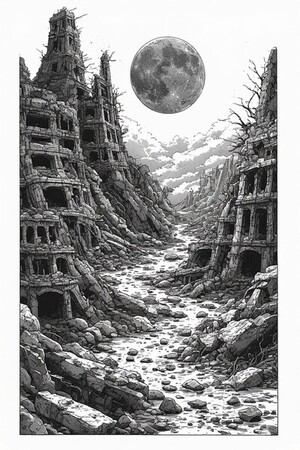
Mara Kade stood at the edge of the breach, watching the not-sunrise crawl over the ruined city. The wind tugged at her coat, tasting of rust and ash. Behind her, the enclave murmured into morning: coughs, clanks, the wheeze of a pump that refused to die.
She listened for another sound.
Three short. One long.
Nothing audible. The message lived as scratches on paper and faint needle-wavers Tavi guarded like a relic. In Mara’s mind, it had become a rhythm as real as her heartbeat.
Still alive.
“Talking to the sky again?”
Anya’s voice broke her reverie.
“Just making sure it remembers us,” Mara said.
“No new pulses last night,” Anya reported. “Noor thinks the window only opens when something in orbit passes overhead.”
“So we get whispers,” Mara said. “Not conversations.”
“For now. She also thinks they’re trying to send more than a ‘V.’ The pattern shifted once. We just don’t have the resolution yet.”
Mara imagined Sera somewhere above—on a limping platform or in a patched shuttle—swearing at ancient software until it bent. The thought twisted warm and sharp in her chest.
“She’ll keep at it,” Mara said. “She liked arguing with things that refused to make sense.”
“Wonder where she got that from,” Anya said.
Mara huffed a breath that was almost a laugh. The wind took it.
The day’s work began, as always, with the tally.
They gathered in the plaza, fewer than before the siege and fewer than on the day the shuttle rose, but dense enough to feel heavier than any crowd Mara had addressed.
She stepped onto the cracked plinth. The makeshift PA coughed, then steadied.
“This is what we repaired yesterday,” she said. “West corridor leak patched. Secondary heater line in sector four rerouted. Three grow trays added to the south rig.” She checked her slate. “This is what we lost. Two filters burned out. One support beam in the north shaft failed; that section’s sealed. We lost Avel last night.”
Avel had survived aberrations, failing systems, and hunger. His body had finally decided it was enough.
Mara let the murmur pass.
“This is what we still have,” she said. "The solar output is a little higher than last week. Water stores are holding. New seedlings took in seven of ten trays. We have breath this morning. We have walls. We have one another. And we have a signal that says at least some of ours made it off the ground.”
Heads lifted.
“We don’t know what’s up there,” she went on. “We don’t know what they can send back, or if they can come back at all. Until we do, nothing changes. We plan as if no one is coming. We build as if we are the only ones we can count on. If the sky gives us more than that, we adapt. Like we always do.”
Mother Harrow watched from the front, leaning on her cane, eyes gleaming with approval—or at least acknowledgment.
Anya took the PA for work assignments. There were no idle hands: children carried, elders mended and taught, the sick advised from bed.
Mara stepped down. A boy nearly tripped past, muttering an apology. His little sister had gone up in the first harness cycle, clutching a broken plastic charm he’d pressed into her hand.
Mara wondered if she still had it.
Midday found her in the grow room—once an equipment bay, now lined with reflective panels and racks of nutrient trays. The air smelled of damp and green things.
Noor stood ankle-deep in tubing, patch kit at her belt, hands stained with mineral residue.
“How’s our private jungle?” Mara asked.
“Alive,” Noor said. “Stubborn. Like the rest of us.” Tiny leaves unfurled from dark substrate. “They like the new spectrum mix. The old presets were for a world that doesn’t exist anymore.”
“Get used to that sentence,” Mara said.
Noor hesitated. “Tavi wants to divert a bit more power here during rest cycles. Just a sliver. We think we could boost yield.”
Mara ran the numbers the way Sera had taught her.
“If we dim the south corridor by ten percent after curfew, we might give you that without breaking the grid.”
“People won’t like darker halls,” Noor said.
“People won’t like starving,” Mara replied. “Explain it. If they complain, send them to me.”
“They’ll say you’re turning us into mushrooms.”
“Tell them mushrooms survive. And they taste better than ration bricks.”
Noor laughed. “Yes, Commander.”
The enclave was a web of such trades now. Dim this to brighten that. Lose one comfort to gain a day of heat. Risk a scavenger run for a part that might buy another month of air.
No grand strategy. Just a thousand small bets placed against the future.
The new signal came on the fifty-third day.
Mara was waist-deep in a failed pump when Tavi burst in, breathless.
“It’s changing,” he gasped. “You need to see.”
The sensor alcove was crammed: Anya, Noor, teens, even Harrow.
On the jury-rigged table, the paper roll crawled under the scratching needle. The line was no longer a simple repetition.
Short—short—short—long. Short—long. Long—short—short.
Not tidy. Amplitude wavered. Pulses blurred. But there was intention.
“We think it’s Sera’s code,” Noor said, copying pulses into dots and dashes. “Just…more of it.”
“.–.” she murmured. “R. Then I. Then R again…” She frowned. “R I R A… then noise.”
Tavi pointed at another section. “Here: V, E, N, E. V-E-N-E. Maybe the start or end of a word.”
“The letters mean something to someone,” Mara said. “Fragments across a gulf.”
“She’d know how to clean this up,” she added softly.
“She’s trying,” Noor said. “From the wrong side of the sky.”
Harrow said, “Whatever the letters, the meaning is persistence. Someone who won’t stop knocking.”
“That sounds like Sera,” Anya said.
“And Jun,” Tavi added.
“And us,” Noor whispered.
“We keep recording,” Mara said. “We don’t stop patching pumps and feeding seedlings. Signals won’t keep the air clean.”
“You don’t want to send anything back?” a teen blurted.
“We don’t have the power for a sustained transmission,” Noor said. “We’d burn weeks of reserves for a message that might die in the storms.”
“The Weaver has heard your first cry,” Harrow said. “The rest may be better woven in steel and seed than static.”
“For now, we answer with survival,” Mara said. “If we can say more than ‘we’re here’ without tearing something vital apart, we will.”
Word spread. Hope outran sound. Soon, theories bloomed.
“It’s coordinates.”
“It’s a warning.”
“It’s a hymn.”
Mara watched speculation harden toward factions and climbed the plinth again.
“Listen,” she said, and the plaza stilled.
“We have a signal. Letters, not words. We won’t pretend otherwise. Some of you want it to be a rescue. Some fear it’s a curse. Some want a sign from the Weaver. It might be any of those. It might be none. Until we know, we won’t tear each other apart over guesses.
“Every sequence we catch will be posted. Noor and Tavi will teach the code to anyone. If you’re going to guess, guess together. Not in corners.”
“You’re just going to let everyone read it?” someone asked.
“Yes. Secrets nearly killed us. We’re not building new hierarchies around who gets to hear a broken song first.”
“Our strength is not in being chosen,” she finished. “It’s in choosing each other.”
The first clear word arrived on the seventieth day.
By then, children tapped dots and dashes on each other’s arms for fun.
In the quiet hours after lights-out, Noor burst in on Mara.
“We got a clean run,” Tavi said, hands ink-smudged.
On the paper, a sequence stood out.
V. E. R. E.
Then: N. E.
“V E R E N E,” Noor whispered. “Verene.”
“Not nothing,” Harrow said. “An old name. A station. The Broken Ring. A project half-finished when the world burned.”
“If that’s right, they’re telling us where they are,” Noor said. “Or what’s left of it,” Tavi added.
“If they’re sending a station name,” Anya said, “maybe they can push more—a map, instructions.”
“Or a warning,” Tavi said.
“They’re not just saying ‘we’re alive’ anymore,” Mara said. “They’re saying ‘we are somewhere specific.’ That’s new—and dangerous.”
“If we built a transmitter strong enough to reach them?” she asked Noor.
“Everything nonessential,” Noor said. “Maybe some things we call essential. Half the lights, most of the heat. For a short burst. And if it failed…”
“The Weaver does not demand you burn your house for smoke,” Harrow murmured.
“Then we don’t,” Mara said. “Not yet. Verene is a fact, not a destination. If they want us there, they’ll keep trying. It’s what they do.”
Winter crept closer, not with snow but with thin, harsh air and shrinking solar output. Metal bones sighed at night. They sealed more corridors, doubled bedding, and taught children to recognize frostbite and ration breath.
“This is a bend in the road,” Mara told Anya. “Not a wall.”
“Feels like a wall.”
“Walls are invitations to find doors.”
“You sound like Harrow.”
“Don’t tell her.”
At night, Mara dreamed of the shuttle—falling in fire, or docking at a ring of light. She woke with the same hollow ache either way. Dreams blurred faces. The paper did not.
On the eighty-second day, another near-word:
V E R E N E R.
“Verene R,” Noor said. “If it’s two words, we’re missing the seam. If it’s one, it’s nonsense.”
“R for ‘ring’? ‘Relay’?” Tavi said.
“Maybe we’re asking the wrong question,” Mara said. “We’re reading this like spoken language. Sera and Jun label things. ‘Verene R’ could be ‘Ring sector R.’ A compartment. ‘Here.’”
“So much effort to send ‘here,’” Harrow said. “Humans are determined to be known.”
“Then we know it,” Mara said. “They’re there. Breathing. Thinking. Sending what they can. Our story didn’t end at the clouds.”
“And ours?” Anya asked. “How does it end?”
“There’s a mistake in the question,” Mara said. “Stories don’t end. They leave you where you’re allowed to put the book down, if you want.”
The last leak before deep winter was a small one in the east vent.
“Almost not worth it,” Jun would have said.
Mara insisted.
“Why?” Anya asked, shivering.
“Because it’s there. Leave one small leak today, we leave a bigger one tomorrow. And it gives us an excuse to use curses Jun would be proud of.”
When the patch held and the needle steadied, Mara felt a quiet satisfaction.
“This is it,” she said.
“This is what?”
“The work. The ending. Not a shuttle, not a blast of light. This. Choosing, every day, to hold the line between what breaks and what we can fix.”
“That’s not very cinematic,” Anya said.
“No,” Mara said. “It’s better.”
On the hundredth day after the shuttle rose, the pulses stopped.
Three days. Four. Seven. Nothing.
Noor tore down and rebuilt the monitor. The array worked. The sky was what had gone quiet.
No new letters. No more Verene.
Hope, once a background hum, stuttered.
“They’re dead,” someone sobbed. “We should have gone—”
“A stopped thread does not mean the Weaver has cut it,” Harrow said. “Sometimes the loom moves beyond our sight.”
Mara wanted to believe.
She went to the breach alone.
The sky was its usual sullen gray. Somewhere behind it, maybe, a broken ring tumbled, its last air bled out. Or not. The not-knowing hurt most.
“I told you,” she said to the horizon, “I’d be here when you came back.”
The wind answered with nothing.
She let grief sit with her until it became something she could carry, then stood.
“We sent a beacon,” she said. “You answered. We built a bridge of broken signals between earth and sky. Even if it snapped—even if you’re gone—I won’t let that be the only thing your names did.”
Behind her, the enclave pulsed with life: a cough, a baby’s wail, a clang, and a curse.
Work sounds.
Mara turned her back on the dead sky and walked toward them.
The ending did not arrive as a single event.
No final siege. No last great storm. No revelation from orbit.
Instead, there were more days.
The enclave rode out the winter. Two died. Five were born. A grow tray failed and flooded a bunkroom with nutrient slurry, making a mess and, later, a story.
In early thaw, scavengers found a collapsed library with shielded data cores. Tavi and Noor coaxed three back.
One held agricultural archives—soil, seeds, pest control. Sera would have crowed.
“We don’t need a message from Verene to learn,” Noor said. “Ghosts wrote everything down.”
“Maybe that was their message,” Harrow said. “‘We were here. We tried. Take what you can and make it yours.’”
Mara approved two new grow rooms.
They named them Sera and Jun.
Years blurred. The enclave never became a utopia. There were shortages, arguments, and losses. Births, deaths, betrayals, reconciliations. Small cruelties. Small kindnesses.
The aberrations returned once in a chittering tide. Sera’s old monitors gave an early warning. Mara—older, slower—ordered every breach shuttered. The city shook. The walls held.
“That’s all an ending is,” she told limping Anya afterward. “The worst you feared happens—or doesn’t—and you find you’re still here.”
“You practicing speeches?” Anya asked.
“I used to make them every night.”
“Now you don’t need to,” Anya said. “We all know them by heart.”
One night, Noor knocked on Mara’s bunkroom door.
“We were going through old rolls,” she said. “Early pulse logs. We ran them through new filters. We…saw better.”
She handed Mara a yellowed strip.
V E R E N E R A.
“No gaps this time,” Noor said. “Verenera.”
“Another station?”
“No records,” Noor said. “But in a myth file, it appears once. ‘Verenera, the path between broken rings.’ Not a place. A way. Moving between ruins. Making use of broken things.”
“Seems familiar,” Mara said, throat tight.
“Does it change anything?” Noor asked.
“Yes and no,” Mara said. She set the strip on a shelf beside a worn toy charm a boy had once refused to throw away. “It changes how I tell the story. Not what I do tomorrow.”
On the last day, Mara would stand at the breach—which she did not know was the last—the sky looked much the same.
Bruised. Stubborn. Secretive.
Her bones ached. Her breath was short. But when she closed her eyes at night, she saw patched walls, glowing grow rooms, children racing narrow halls, and elders telling half-lived stories to those who would live the rest.
Anya joined her.
“Taking inventory again?”
“Old habits,” Mara said.
They were quiet awhile.
“Do you ever regret not going?” Anya asked. “On the shuttle.”
Mara let the question settle.
“No,” she said at last. “I regret not knowing what happened up there. Not hearing Sera complain about station gravity, or Jun swear at Verene’s plumbing. Not seeing the kids see a sky without ash. But I don’t regret staying. This was my thread. Someone had to hold this end. They held theirs. Between us, we wove something that reached farther than either place alone.”
“Feels small, sometimes,” Anya said. “Just this pocket.”
“Small isn’t unimportant,” Mara said. “Ask any seed.”
They watched the not-sunrise.
Somewhere above, maybe, a ring of broken metal still circled, long dark. Or maybe a handful had moved on to another orbit, another rock, another chance.
Either way, the path between broken rings had been real.
It existed here, too—in patched halls, stubborn gardens, and the choice, made and remade, to reach across fear instead of sinking into it.
The long night hadn’t ended in one blaze of light.
It had ended in choices. Again and again, in the face of not knowing, Mara and her people lived as if their actions mattered.
That was the ending.
Not a closed door.
A hand held out in the dark, and another hand taking it.
Between earth and sky, between past and whatever came next, the thread held.
And that was enough.




Please sign in to leave a comment.