Chapter 17:
Epilogue!
World Before the New
Ten years after the last pulse from the sky, the children started building towers.
They did it without permission and mostly without supervision, which was how most important things began in the enclave.
From Mara’s old vantage at the edge of the breach, the structures looked like a scattered line of teeth jutting up from the ruined city. They were ugly, at first—stacked scrap and welded lattice, scavenged antennae and bent girders lashed together with cable and stubbornness. Each one rose a little higher than the last.
“Signal towers,” the children called them.
Anya called them hazards.
“You know what wind shear does to half-rusted metal,” she muttered, watching a gang of teens haul another beam into place. Her limp was worse in damp weather these days, but she still climbed more ladders than people half her age. “One bad gust and we’ll be pulling kids out of the rubble for a month.”
Noor, now head of both the grow rooms and anything even vaguely related to old tech, stood beside her with arms folded.
“They’re overbuilding the bases,” she said. “I checked their support. They learned from the east vent collapse. Mostly.” Her mouth twitched. “Besides, you wanted a higher relay for the weather monitors. This is them taking you literally.”
Anya snorted. “I wanted a mast, not a forest.”
Below, a girl named Lysa—barely sixteen, already in charge of the south scavenger team—cupped her hands around her mouth.
“Stop glaring and start helping, Aunt Anya!” she shouted. “If this falls, I’m blaming you for jinxing it!”
Anya tried to look offended and failed.
“You hear that?” she said to Noor. “Disrespect. Entirely your fault. You taught them to question their elders.”
“I taught them to fix their elders’ mistakes,” Noor said. “Different thing.”
They descended together, slower than they would once have moved, to where the tower’s skeleton speared up from a poured concrete base.
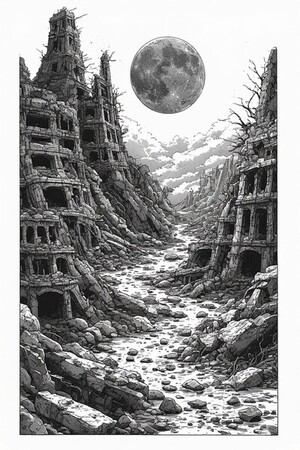
The city around them had softened in strange ways over the past decade. Vines crept along cracked facades where they had never before. The air tasted less of ash and more of dust and cold metal and, faintly, green.
The towers rose from this changed skin like deliberate scars.
“What are you trying to reach?” Anya asked Lysa when they reached the work site, more curious than critical now.
“The next storm line,” Lysa said without hesitation. “If we get our sensors just a bit higher, Tavi thinks we can get cleaner reads on the upper currents before they hit the shields. That gives us a few more minutes’ warning for the outer corridors. And…” She hesitated, then shrugged. “And higher is better.”
“Higher for what?” Noor asked.
Lysa’s gaze flicked, involuntarily, to the sky.
It was less bruised these days. Not clear, not blue—but the veil had thinned further. Sometimes, on the sharpest mornings, you could see a faint, pale circle if you knew where to look. Some said it was just an old satellite, still drifting in wreckage. Others said it was a trick of the atmosphere. A few, mostly Harrow’s older disciples, whispered other names.
None of them said Verene out loud as often as they once had.
“For everything,” Lysa said finally. “For weather. For signal. For stories.”
Anya followed her look upwards, then back down to the tower’s joints.
“Make sure those cross-braces are double-bolted,” she said. “If you want to touch the sky, you’d better start with decent grounding.”
“Yes, Aunt Anya,” Lysa said, grinning.
The enclave’s archive had outgrown its first room years ago.
What had begun as a cramped compartment down the south corridor was now three connected chambers, walls lined with old-world data cores and new-world slates, shelves of printed pages, and boxes of hand-written rolls so ancient the ink had begun to brown.
Tavi—no longer white-faced with terror at every equipment glitch, but still ink-stained as ever—sat cross-legged on the floor, surrounded by a halo of children.
“Again,” demanded a little boy with a crooked front tooth. “The one about the Broken Ring again.”
“You’ve heard this story seventy-two times, Kio,” Tavi said.
Kio squinted at him. “You didn’t say ‘dot dash’ in the same way on the last one. So it’s a different story.”
“That,” said Tavi, “is not how stories work.”
He picked up the old strip of yellowed paper from the low table beside him. The letters were almost ghosts now, the ink eaten at the edges, but the pattern remained.
V E R E N E R A.
Kio’s sister, a serious-eyed girl who had inherited too much of Noor’s concentration for her own social comfort, tapped the dots-and-dashes chart tattooed almost permanently into her memory.
“Verenera,” she said carefully. “The path between broken rings.”
“Very good,” Tavi said.
“But how can a path be between rings if we only ever had one?” another child asked. “We had Verene, but we never had a second ring. So where is the other one?”
“Who told you we only had one?” Tavi asked mildly.
They erupted into overlapping answers: Harrow, their parents, a scary old man in the north corridor who smelled like boiled filters.
Tavi listened, smiling faintly.
“When Harrow told this story,” he said, “she used to say that the rings were not just metal. A ring can be a station. A city. A generation. A way of living that thinks it is whole.”
He gestured around them.
“This was one ring,” he said. “Sera and Jun and the shuttle made another. Verenera was the path between. Not just in the sky. Here.” He tapped his chest. “In how we chose to live while we waited, and after we stopped waiting.”
Kio looked skeptical.
“That doesn’t sound like a place you can walk,” he said.
“Most of the important places aren’t,” Tavi said. “Now, do you want the story with dots and dashes, or the one with cursing and bad plumbing?”
“Cursing!” the children chorused.
Tavi sighed, purely for show, and began.
“Once there was a station that never closed its ring…”
In the doorway, Noor watched for a moment, unseen, then moved on. The archive was in good hands.
On certain clear evenings—clear by their standards—if you climbed to the top of the highest tower and let your eyes adjust, you could see it.
Not the station. Never that. Whatever had been of Verene was long gone from sight.
But sometimes, a faint, intermittent glimmer traced a shallow arc across the upper dark. Not steady, not rhythmic. A scratch of light where no natural star should be.
Lysa stood on the narrow observation platform, one hand braced on a guy-line, the other shading her eyes.
“Do you think it’s them?” she asked.
Mara would have been the one to ask, once. Anya, too. People still caught themselves turning toward the breach as if expecting to see a familiar silhouette there.
Now, they turned toward a slimmer figure: a woman with streaks of gray in her braid and a permanent notch of focus between her brows.
Rian—one of the first children born after the pulses stopped, now one of the enclave’s de facto coordinators—leaned against the railing beside Lysa.
“I think it’s debris,” Rian said. “Old metal, still falling in a very slow circle. I think if Sera were up there, she’d be screaming at us for romanticizing orbital decay.”
Lysa snorted.
“And Jun?” she asked.
“He’d be cursing the shielding,” Rian said. “And then he’d send down a list of parts we can’t possibly get.”
They watched the faint glimmer complete its arc and fade.
“What do you tell the kids when they ask?” Lysa said.
Rian thought about that.
“I tell them that we talked to the sky once,” she said. “That it answered. That sometimes it goes quiet, and sometimes it flares, but that we’re not the only story this world ever told. And I tell them that their job is not to finish our story. It’s to start their own and leave enough of it written down for whoever comes next.”
“That sounds like something Harrow would say,” Lysa said.
“Probably,” Rian said. “She infected all of us.”
The wind tugged at their coats. Below, the enclave glowed with pocket-lights and the muted hum of lives in motion. Above, the sky held its own counsel.
Lysa exhaled.
“We’re close to stabilizing the outer ring fields,” she said. “If we can extend the clean zone another block out, we’ll have space for two more grow rooms and a workshop.”
Rian raised an eyebrow. “What are you going to name them?”
Lysa smiled.
“Not after anyone,” she said. “Not this time.”
Rian nodded in approval.
“Good,” she said. “They should have their own names.”
The last of the elders went quietly.
Not all at once. Not in some dramatic wave. One by one, over the years: Harrow, who died mid-sentence during a lesson, her hand still drawing a loop in the dust; Noor, who slipped away with a datapad on her chest and a list of incomplete experiments beside her bed; Anya, grumbling that the new generation had no respect for proper brace inspections right up until her voice finally failed.
Mara had gone before most of them. That was another story—told in soft voices at the breach, and at the small alcove where her old coat hung like a faded banner.
In the enclave, their absence was a series of small blanks: a voice missing in arguments, a familiar figure no longer taking the same path every morning, a silence where a cough used to be.
But their threads remained, woven into routines, into jokes, into the layout of the grow rooms and the curve of the towers and the way people paused, even now, to listen when the wind shifted, just in case.
On the anniversary of the shuttle’s launch—which few now remembered as a specific date and more as a story-mark—the enclave gathered in the plaza.
There were more of them than ever.
Children overflowed the steps. Young adults who had never seen the world before the haze argued cheerfully about logistics. A handful of gray-haired survivors stood near the front, wearing expressions that mixed pride with bafflement at the sheer number of faces.
Rian stepped onto the same cracked plinth Mara had once used.
The makeshift PA was less makeshift now, but it still coughed once before steadying. Some things refused to change entirely.
“This is what we repaired this year,” Rian said. “Outer ring fields extended. Three more grow rooms online. Two new towers raised and, miraculously, not fallen.”
Laughter rippled through the crowd.
“This is what we lost,” she continued. “Heat in the north shaft twice. Three solar panels to a freak gust. People we loved, who taught us how to curse and how to patch and how to keep going when the sky went quiet.”
Heads bowed. A brief, collective breath.
“And this is what we still have,” Rian said. “Air that doesn’t taste as sharp as it used to. Water that holds. Seeds that take more often than they fail. A library that keeps finding new ghosts for us to learn from. Towers that reach higher. Children who think it’s normal to learn three different ways to fix a leak before they’re ten.”
She let her gaze sweep the crowd.
“We used to say we planned as if no one was coming,” she said. “We built as if we were the only ones we could count on. That was true then. It’s still partly true now. But look around you. We are not just holding the line anymore. We’re pushing it.”
A murmur of agreement.
“In the old stories, there was a word—Verenera,” she said. “The path between broken rings. Once, it meant a fragile bridge between a ruined earth and a half-finished station. Now, it means something else to us. It means this.”
She gestured: to patched walls, to lit windows, to the towers, to the faint smudge of green on the distant horizon.
“It means we know how to move through ruin without letting it define us. It means we know how to make use of broken things without worshipping the breaking. It means we remember those who held the first ends of the thread, and we keep weaving anyway, even when their hands are gone.”
In the second row, a child raised a hand, unselfconscious.
“Are we still waiting for the sky to answer?” they asked.
Rian smiled.
“We’re always listening,” she said. “But we’re not waiting. There’s a difference.”
The child frowned, thinking it through, then nodded slowly.
Rian stepped down.
The crowd broke apart into a hundred small tasks: meal lines, repair crews, lesson circles, tower teams. The plaza emptied of ceremony and filled with work.
Above, the sky deepened toward night.
For a brief, almost-imagined moment, a faint pattern of light flickered across the upper dark—too brief to decode, too soft to trust. A trick of orbiting scrap, most likely. A memory. Or something else.
No alarms sounded. No one scrambled for the monitor alcove.
Instead, a girl on tower duty looked up, smiled at the streak, and lifted a hand.
“Still here,” she said quietly.
Then she turned back to the console that told her wind speed and particulate levels and when the next gust would hit the western shield.
Work sounds drifted up from the enclave.
Between earth and sky, between old names and new ones, the thread held—not as a lifeline clutched in desperation, but as a network of crossings, a web of choices laid down over years.
The long night had become something else.
Not ended. Not forgotten.
Transformed.
In patched halls and stubborn gardens, in stories told in dots and dashes and in plain, tired words around heaters, the people of the enclave lived as if their actions still mattered.
They did.
That was not a promise from the sky, or a decree from any Weaver.
It was a decision.
And it was enough.



Please sign in to leave a comment.