Chapter 2:
Chapter Two - The Cost of Attention
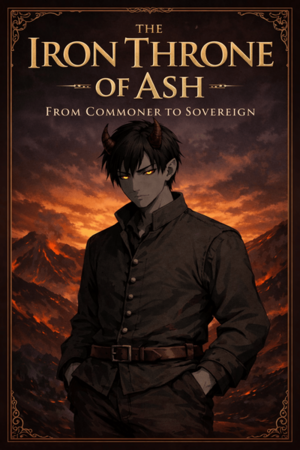
The Iron Throne of Ash - From Commoner to Sovereign
CHAPTER TWO
─────────────────────────
The Cost of Attention
The survivors had gathered in a ravine.
It was a natural choice — the ravine ran northeast along the base of the ridge, deep enough to conceal a standing man, narrow enough that anyone approaching along its length could be heard before they arrived. Whatever demon instinct had driven them here, it was sound. Caedron noted this without surprise. The problem with the Ashfel Dominion's warriors was never that they were stupid. It was that their intelligence had never been pointed at the right problems.
Gorrath led him down into the ravine through a cleft in the rock that required ducking and a degree of lateral movement that felt undignified and was probably necessary. The smell of the place hit first — blood, ash, sweat, the acrid tang of black powder that had drifted south on the evening wind from the valley floor. Then the sounds resolved: low voices, some labored breathing, the particular silence of people who have recently been through something and have not yet decided how to process it.
There were eleven of them.
He counted automatically, the way he always counted — not just the number but the condition. Three were injured: one seriously, a deep gash across the upper arm that had been wrapped in a strip of torn cloth that was already soaked through; one moderately, moving with the careful economy of someone nursing cracked ribs; one lightly, a cut above the left eye that had bled dramatically and stopped. The remaining eight were physically intact, varying degrees of exhausted and shaken. All of them were armed. None of them were wearing the expressions of people who intended to go back and fight tonight.
They looked at him when he entered the ravine behind Gorrath. The looks were not welcoming. They were the guarded, assessing looks of people who had just lost badly and were not in the mood to accept additional information about their situation from a stranger who appeared to have avoided the battle entirely.
One of them — large even by demon standards, with the scarred, heavy-boned face of someone who had been fighting since before most of the others were born — spoke first.
"Who's this?"
"His name is Caedron," Gorrath said. "He was on the ridge."
"The ridge." The large demon's tone communicated an entire paragraph of contempt in two syllables. "Watching."
"Yes," Caedron said. He didn't expand on it. Expanding on it would have converted the exchange into an argument about courage, which was the wrong argument to have and the one the large demon was inviting. Instead he moved to the wall of the ravine, sat down with his back against the stone, and looked at the group with the calm attention of someone who had not taken the bait and was not going to.
The large demon stared at him for a moment. Then he looked at Gorrath.
"He always like this?"
"I've known him for about two hours," Gorrath said. "But yes, so far."
A few of the others exchanged looks. The tension in the ravine did not dissolve — it shifted, slightly, from hostile to uncertain. Uncertain was workable.
Caedron let the silence run for a count of perhaps thirty seconds. Long enough for the immediate bristling to subside. Long enough for the exhaustion and the aftermath of the battle to reassert themselves over the territorial posturing. When he spoke, he did not raise his voice, because the ravine was not large and raising his voice would have communicated urgency, which would have communicated fear, which was the wrong signal entirely.
"How many went into the valley?" he asked.
Nobody answered immediately. Then the injured demon with the arm wound — younger than the others, his face still carrying the particular stunned quality of someone experiencing a significant defeat for the first time — said: "Our unit was forty. I don't know about the others."
"We were seventy in total from this district," said a demon near the back. Female, compact, with the watchful eyes of someone who had survived by paying attention. "Maybe more. I stopped counting when the third rank started firing."
Seventy. Eleven survivors in the ravine. Possibly others who had scattered in different directions, but even accounting for those — the arithmetic was not favorable. He did not say this. Everyone in the ravine already knew it.
"They held the choke point," the large demon said. His name, Caedron would learn later, was Brath. He said it the way someone states a fact they resent but cannot refute. "Every time we pushed, they just — held. It didn't matter how hard we hit. They just closed up and kept firing."
"Yes," Caedron said.
Brath looked at him. "Yes? That's all you have?"
"I have more. But yes is where it starts. They held the choke point because they were designed to hold choke points. The formation they were using — three ranks, rotating volley fire, flanks anchored on terrain — it's built specifically to absorb frontal pressure. The harder you push the front, the more efficiently it kills you. You were doing exactly what it was designed for you to do."
The ravine was quiet. Outside, in the distance, he could hear the human force conducting what sounded like post-battle consolidation — officers' voices, the movement of equipment, the particular busy sounds of an army that had won and was now managing its victory. It would not advance tonight. Darkness, unfamiliar terrain, and the possibility of ambush made night advances in volcanic highland bad doctrine. They had time.
"So what should we have done?" the watchful female demon asked. Her name was Vreth. He did not know this yet, but her question told him what he needed to know about her.
"Not that," he said. "But the better answer is longer than one sentence, and some of you look like you'd rather sleep than think right now, and I need you to think. So decide which it is."
Another silence. Then Gorrath sat down against the opposite wall of the ravine and said, "I'll think. Tell us."
One by one, with varying speeds and varying degrees of reluctance, the others settled. Brath was the last. He sat down with the deliberate, controlled movement of a man who was making clear that sitting was his own idea and not anyone else's. But he sat.
✦ ✦ ✦
"A military formation," Caedron said, "is a system. Not a group of people — a system. The difference matters because groups of people can be beaten by better individuals. Systems can only be beaten by other systems, or by finding the point where the system's assumptions break down."
He paused. Nobody spoke. He continued.
"The formation in the valley runs on three things: timing, visibility, and predictability. The timing is the volley rotation — you heard it. Twelve seconds between ranks, give or take. That means at any given moment, at least two of the three ranks are loaded and ready. You cannot rush through that gap because the gap is too small and you cannot cross sixty meters in under twelve seconds without wings. So timing works against a direct charge."
"Visibility means they can see you coming. The valley floor has no cover. You appear at one end, they see you, they prepare, they fire. By the time you are close enough to do damage, they have already done damage to you six or seven times. The terrain was chosen, or the position was chosen, specifically to maximize their visibility and minimize yours. This is not accident. This is planning."
"Predictability is the third leg, and it is the most important one." He looked at Brath as he said this, because Brath was the one most likely to push back, and making eye contact with the most resistant person in a room while making your most important point was a habit he had developed playing games where reading your opponent's reactions was half the battle. "They knew what you were going to do before you did it. Not because they are smart and you are not — because the demon approach to a defended position is always the same. Charge the front. Hit hard. Keep hitting. It is consistent to the point that they can build a defense around the assumption that it will happen. And they did."
Brath's jaw was tight. But he was listening. That was what mattered.
"When you charge the front of a formation built to hold the front, you are not fighting them. You are cooperating with them. You are doing the thing they built their entire system to respond to, and they are responding to it, and you are dying because you helped them do their job."
He let that sit for a moment.
"So what do you do instead?" Vreth asked again. She had asked this before. She would keep asking until she got the full answer, which told him she was the kind of thinker who needed complete structures rather than partial ones. Useful.
"You find what the system costs to run and you make running it expensive. Every system has resource requirements. The volley rotation requires that all three ranks stay in position — if any rank breaks, the timing collapses and there is a reload gap large enough to exploit. The flanks anchored on terrain require that the terrain remain impassable — if you find a path through terrain they thought was impassable, the anchor stops being an anchor. The visibility advantage requires that they can see what is threatening them — if the threat is in a place they are not looking, their visibility is irrelevant."
He described the creek bed. The approach he and Gorrath had made. The moment the mounted officer had turned his head and seen them standing in plain sight at the flank. He kept the account precise and without embellishment — what they had done, what the formation had done in response, what that response had cost in terms of rifles pulled from the line, and what it had proven.
When he finished, the ravine was quiet in a different way than it had been quiet before. The earlier silence had been the silence of exhaustion and defeat. This one had something working in it.
"Eight men," Gorrath said. He had heard this already. He was saying it for the others.
"Thirteen percent of their effective line," Caedron confirmed. "For ninety seconds. Not enough to change that battle. Enough to prove that the system responds to pressure in places other than the front, and that when it responds, it costs something. That is not a tactic. It is a principle. Tactics are built from principles. Once you have the principle, you can build tactics for any terrain, any formation, any situation."
"The principle being," Vreth said slowly, "don't hit the wall. Find what the wall needs to stay up."
"Yes."
She absorbed this. Then she said: "That sounds obvious when you put it that way."
"Most true things do," he said. "The difficulty is not understanding them. It is remembering to apply them when everything in you is screaming to charge."
Brath made a sound that was not quite a laugh. When Caedron looked at him, the large demon was studying the ground between his feet with an expression that suggested internal conflict conducted at high intensity.
"You're saying we've been doing it wrong," Brath said. "Every battle. All of us."
"Not wrong," Caedron said. "Incomplete. You have been fighting as if strength were enough. Strength is necessary. It is not sufficient. A blade that is only sharp is still useless if you do not know where to cut."
Brath looked up. His expression had moved from conflicted to something harder to read — the look of someone who has been handed information that requires them to revise a significant assumption, and is deciding whether to accept the revision or reject the information. Caedron had seen this look on enough faces, in enough games, to know that pushing at this moment was the wrong move. You made the argument. You let it work, or you let it fail. Pressure at the moment of decision produced resistance, not acceptance.
He said nothing. He waited.
After a long moment, Brath said: "What do we do tomorrow?"
✦ ✦ ✦
They did not stay in the ravine.
This was his first instruction, and it was the one he expected to face the most resistance on, because the ravine was cover and cover felt safe and feeling safe after a catastrophic defeat was a powerful human — demon — impulse. But the ravine was also a trap. One entrance, steep walls, no exit to the south. If the human force sent a scouting element northeast along the ridge line at first light, which a competent rear-area security officer would do as a matter of course, they would find the ravine within the first hour. And a group of eleven exhausted demons in a narrow ditch with one exit was not a tactical problem. It was a resolution.
He explained this in two sentences. Then he said: "We move now, while it's dark and they're consolidating, and we move north along the ridge where the terrain will mask our heat signatures from any observation post they establish on the valley rim."
"Heat signatures?" Gorrath asked.
He caught himself. Heat signatures were a concept from a different world, a different century, a different existence entirely. He filed the slip away and adjusted.
"Demons run warm," he said, which was true — he had noticed this about his own body in the hours since waking, a constant, low-level heat that the highland air barely touched. "On a cold night, from high ground, a careful observer can track movement by the warmth a body leaves on rock and ground. Ridge terrain breaks that — the volcanic rock holds its own heat and confuses the picture. We stay on the ridge."
Nobody questioned this. He noted that nobody questioned this, and noted further that it was because the reasoning was immediate and verifiable — anyone who put their hand on the volcanic stone could feel it radiating ambient heat, and the inference followed without difficulty. Good. He needed them to follow reasoning, not authority. Authority he did not have. Reasoning, he had in abundance.
They moved. Vreth took the point — she had volunteered without being asked, which confirmed his read of her as someone who processed anxiety through action rather than waiting. Gorrath managed the rear. The injured demon with the arm wound — his name was Desh, nineteen years old, on his second campaign — moved in the middle of the group where the pace could be managed around his limitation without slowing the whole column unnecessarily. Caedron moved in the second position, just behind the point, where he could observe the terrain ahead and the group behind simultaneously.
They traveled for the better part of an hour in near silence. The volcanic ridge was navigable in darkness if you moved carefully and trusted your footing, which demon physiology facilitated — the night vision was considerably better than he had been expecting, another data point about his new body that he was gradually integrating. The human position fell behind them, its lights visible as a distant cluster in the valley, organized and bright. A professional camp. Perimeter fires at intervals. Probably a watch rotation that changed every two hours. Not a force that was going to be surprised.
He did not intend to surprise them. Not yet. Not with eleven people, three of them injured, none of them with anything approaching the formation discipline required to exploit a surprised enemy before they recovered. Surprise was an accelerant. You needed something to burn before you added it.
They came down off the ridge on the northern side as the first grey of pre-dawn began softening the sky, into a shallow depression between two volcanic outcroppings that provided cover on three sides and a clear sightline north. He assessed it, found it acceptable, and called the halt.
"We rest here until midmorning," he said. "Then we move again."
"Move where?" Brath asked.
"Back toward the valley."
The silence that followed this had a specific texture to it. He recognized the texture: the silence of people who had just been told they would be returning to the place they had fled from, and were deciding whether to comply or argue.
"The valley," Vreth said. Not a challenge — a request for elaboration.
"Not into it. Along the western approach. There is a secondary ridge line on the far side that the human force almost certainly hasn't occupied because it offers no tactical advantage for a force holding a choke point from the east." He had mapped this during their movement, piecing it together from memory and observation. "From the western ridge, we can observe their supply movement. Their logistics element will have to resupply through the valley — they have artillery to maintain, and artillery eats powder and shot faster than infantry eats bread. We watch the supply line. We identify its timing and its protection."
"And then?" Gorrath asked.
"And then we decide whether we have enough to do something useful about it, or whether we need more people first." He looked at the group. Eleven demons, of wildly varying capability, in unfamiliar consolidated territory. "Right now we do not have enough. But we have enough to gather information. And information is what we were missing today."
✦ ✦ ✦
They did not make it to midmorning before the situation changed.
Vreth saw them first. She was on watch at the northern edge of the depression, lying flat against the rock with her eyes over the lip of the outcropping, when she hissed a single sharp sound that the group had designated as the signal for contact. Everyone was awake and moving before the hiss finished — even Desh, who moved too fast and had to suppress a sound of pain from his arm before pressing himself against the western wall of the depression.
Caedron moved to Vreth's position.
A patrol. Eight men, moving south along the ridge line in a file, equipped for reconnaissance rather than assault — lighter kit, no artillery support, moving at the pace of people who expected to cover significant ground and were conserving themselves accordingly. They were perhaps two hundred meters north and closing slowly. Their route would bring them within seventy meters of the depression's northern edge. Whether they would detect the depression depended on whether their patrol brief included a search of ground features or simply a route march.
He watched the patrol leader. The way a patrol leader moved told you almost everything about their brief. This one was moving with his eyes on the middle distance — the horizon, the ridge line, the terrain features a potential enemy force would use. He was not looking at his feet. He was not examining individual ground features. He was conducting a route sweep, not a search.
Route sweep. They're checking for large-scale movement, not small-scale concealment. They're looking for where a force went, not where eleven people are sleeping.
"Stay flat," he said, barely audible. "No weapons visible. Nothing reflective. Don't look at them directly — movement of the eyes is visible at distance in low light."
Gorrath, beside him, turned his head fractionally in what Caedron had already learned to read as a question.
"Looking directly at something creates micro-movement," he breathed. "Focus on a point near them, not on them. Peripheral vision picks up movement better anyway."
Gorrath didn't question it. He adjusted his gaze.
The patrol moved south. Sixty meters. Fifty. At forty meters, the patrol leader paused. Caedron's assessment of the situation recalculated instantly — a pause meant something had caught the leader's attention, and attention in this context was the precursor to investigation, which was the precursor to discovery.
He looked at what the patrol leader was looking at.
Desh. The injured demon's arm was seeping through his bandage, and the blood — dark, catching the early light — had dripped onto a pale section of volcanic rock at the depression's edge. A small thing. Barely visible. But patrol leaders were trained to notice small things, and this one had noticed.
Caedron made his decision in approximately one second.
"Brath," he said, still barely audible. "When I move, you move with me. We go over the north lip, we go loud, we run northeast. Not into them — past them, angled northeast. Gorrath — the moment we draw them, you get everyone else south through the depression's back exit. Move fast. Don't stop."
Gorrath absorbed this. "You're drawing them off us."
"Yes."
"That puts two of us in front of eight of them."
"The terrain northeast is broken. Volcanic field, multiple ridges, poor visibility. Eight men in file cannot maintain cohesion in broken terrain at a run. They'll spread, they'll slow, and a patrol that has lost cohesion stops pursuing and starts regrouping. Standard doctrine." He looked at Gorrath. "Two minutes. That's all we need. Get them out."
He did not wait for agreement. He moved.
Over the lip of the depression and immediately upright, making himself visible, moving at the diagonal northeast angle he had specified. Brath came over a half-second behind him — the large demon's instincts were good; he had processed the plan fast enough to execute it without hesitation, which was a more important data point than his size or his combat record.
The patrol saw them immediately. Of course they did — the whole point was to be seen.
"Contact!" The patrol leader's voice, sharp and controlled. Then, almost immediately: "Two — northeast — pursue!"
The patrol broke into a run.
Caedron ran northeast into the broken volcanic field and did not look back. He did not need to look back. He could hear the pursuit — eight sets of boots on volcanic rock, the particular sound of military kit in motion, the controlled breathing of trained men running in formation. He counted their pace against his own, calculated the gap, assessed the terrain ahead.
The volcanic field was exactly as he had mapped it from the ridge: a jumbled landscape of ancient lava flows that had cooled into a maze of ridges, pits, narrow channels, and sudden drops that the human patrol would have to navigate one at a time or risk a broken ankle. He moved through it without slowing, taking the path that appeared impassable until you were in it, which was the path that a pursuit — trying to maintain visual contact with a target — would lose cohesion attempting to follow.
Forty seconds in, the patrol had already fragmented. He could hear it — the single file of eight footfalls had separated into smaller clusters, different spacings, the breathing pattern breaking up as individuals took different routes through the terrain and lost the shared rhythm of a unit moving together. The patrol leader was calling adjustments — trying to reestablish the line — and the calling of adjustments meant the pursuit was no longer automatic. It had become a management problem.
At ninety seconds, he gave Brath the signal — a sharp lateral gesture — and they both dropped into a wide crevice in the lava field, pressing flat, letting the volcanic rock close over their profile.
The patrol passed. Four men visible from the crevice, moving cautiously now rather than at pursuit pace, eyes scanning the terrain rather than fixed on a target. A pursuit that has lost its target does not continue — it sweeps, which is slower and less directional, which means the pursued have time.
He waited for a full count of sixty before he moved.
✦ ✦ ✦
They found the group three hundred meters south, exactly where Gorrath had taken them — a secondary depression behind a lava ridge that Caedron had identified as the fallback point before the patrol arrived. Everyone was present. Everyone was intact. Desh's arm was worse — the movement had reopened the wound fully — but he was conscious and functional, which was the minimum requirement for the current situation.
Gorrath looked at him when he arrived. The look communicated several things simultaneously, the primary one being something between relief and a kind of reluctant reassessment.
"Standard doctrine," Gorrath said. It was not quite a question.
"They drilled for it," Caedron said. "Pursuits in broken terrain default to regroup-and-sweep when visual contact is lost. I knew they would stop. I didn't know exactly when, so I built in margin."
"The ninety seconds."
"Yes."
Brath was looking at him from across the depression. His expression had completed its journey through conflict and arrived somewhere new — a destination Caedron did not want to name yet, because naming it would create expectation, and expectation was a pressure he could not afford to apply to a group of eleven people who were still making up their minds about whether to follow or scatter.
"You knew the patrol would stop," Brath said. "Before we ran."
"I assessed it as highly probable," Caedron said. "Not certain. Their patrol leader was competent — he might have pushed the pursuit longer than doctrine suggested. I built the plan around what doctrine would tell him to do and accepted the risk that he might deviate from it."
"And if he had deviated?"
"Then we would have run further, and faster, and found different terrain." He met Brath's eyes steadily. "I do not tell you things are certain when they are not. I tell you what the probability is and what the contingency is. If you follow me, that is what you get — accurate information and a plan that accounts for the plan failing. Not guarantees."
The ravine was quiet. Outside, in the middle distance, he could hear the patrol reforming — the patrol leader calling his men back to the route, abandoning the sweep, making the rational calculation that two individuals on a broken volcanic field were not worth further fragmentation of his unit. Correct decision. Caedron would have made the same one.
Vreth spoke first. "What you did with the patrol — drawing them off. That was the same principle."
"Yes."
"Make the system look where you want it to look. Pay for it with attention instead of blood."
"Yes." He looked at her with the specific attention he reserved for people who were synthesizing correctly — not just receiving information but building the underlying structure from it. "We cost them one patrol's worth of attention and ninety seconds of pursuit time. Small. But we are still eleven people and they are still an army. Small is appropriate right now."
"For now," Gorrath said. It was not a challenge. It was a recognition of trajectory.
"For now," Caedron agreed.
✦ ✦ ✦
They moved again at midmorning, as he had planned. West along the southern ridge, then south along the approach to the valley's western flank — a route that kept them off the skyline and below the observation angles of any post the human force had established on the valley rim.
The supply route was where he had expected it to be.
A wagon train, four vehicles, moving north along the valley floor under escort — six mounted soldiers, armed with the short cavalry carbines that were the standard escort weapon for a force that needed firepower without the formation requirements of line infantry. The wagons were heavy. He could see it in the way the wheels bit into the volcanic dust, in the pace the horses maintained — deliberate, careful, the pace of animals carrying maximum load. Powder and shot, as he had predicted. Possibly food, though a force that had won the valley yesterday would have access to whatever the valley contained.
He observed for a long time. Longer than the others were comfortable with — he could feel the impatience in the group, the particular restlessness of people who had a target in view and were being held still. He let it run. Impatience was information too — it told him who needed management and in what order.
The escort pattern was consistent. Two riders front, two flanking, two rear. The flankers maintained a fixed distance from the wagons — close enough for immediate response, far enough to have a sightline. The timing was regular. The spacing was regular. They had done this route before, probably multiple times, and the regularity of it meant they had stopped treating it as a threat environment and started treating it as a commute.
"We don't hit it," he said, before anyone asked.
Brath turned to look at him. "Six escorts. We're eleven."
"Twelve counting Desh, and Desh is at about sixty percent. And the six escorts would send a signal back to the valley the moment contact was made, and the valley has a full regiment." He kept his eyes on the wagon train. "We don't hit it today. Today we count it, time it, and map the route. We come back when we know it well enough to hit it without a signal getting through."
"When is that?" Vreth asked.
"Two more observation cycles. Three if we want certainty. Then we decide whether we have enough people, or whether we need to find others first."
Gorrath made a sound. When Caedron glanced at him, the demon was almost smiling. "Others. You're already thinking about building something bigger."
"I am thinking about what the next problem requires and what resources it needs," Caedron said. "Right now the next problem is the supply line. After that the problem is the choke point. After that the problem is the officers commanding the district, whose doctrine produced the battle we watched yesterday. Each problem is larger than the last and requires more to solve." He paused. "So yes. We are going to need others."
"Who?" Brath asked. The question was genuine — not resistant, not challenging. He was asking because he was already thinking about it, which meant the shift in his orientation was complete. He was no longer assessing whether to follow. He was planning how.
"Survivors," Caedron said. "From other units. Other valleys. There will be more — there are always more, after this kind of engagement. People who made it back and don't know what to do next. People who are sitting in ravines or behind ridges, waiting for someone to tell them the fight isn't over."
"The fight is over," Brath said. "We lost."
"We lost a valley." Caedron finally looked away from the supply train and at the group assembled on the ridge behind him — eleven demons, ash-grey in the highland morning light, battered and tired and, increasingly, paying attention. "The Dominion has been losing valleys for thirty years. That is not the same as losing the war. It is the same as losing the war run the way the war has been run. Run differently — it is a different situation entirely."
The wagon train moved north below them, its timing logged, its escort pattern recorded, its route mapped in his memory with the particular fidelity of a mind that had spent decades treating the positions of units on a map as the most important information available.
He was beginning to think that this world was not so different from the games, after all.
The difference was that the units were real. The casualties were real. The consequences of a bad decision did not end at a reload screen — they ended in blood on volcanic rock, in ravines full of the survivors of something that should have been survivable, in a Dominion that had been telling itself for thirty years that the next charge would be the one that broke through.
That was the weight of it. He had felt it on the ridge, watching the volley fire. He felt it now, watching a supply train move through a valley his people had died failing to hold. It was not guilt — he had not built this system and he could not have prevented yesterday. But it was something. A kind of obligation that did not require sentiment to function. A problem that demanded a solution not because of what he felt about the dead, but because the problem was solvable and leaving solvable problems unsolved was the kind of thing he had never been able to tolerate.
He turned away from the valley.
"We start with this group," he said. "Eleven is enough to do what we need to do in the next week. After that, we find more. And after that — " He did not finish the sentence. He did not need to. The shape of the thing he was building was already visible to anyone looking in the right direction.
Gorrath was looking. Vreth was looking. Even Brath, who had entered the ravine last night with contempt written across his face and left it this morning with something more complicated in his eyes, was looking.
"After that," Gorrath said, completing it for him, "the Dominion learns what losing costs, and who it doesn't have to cost anymore."
Not quite. That was too clean, too complete, too much like the ending of something that was barely beginning.
But it was close enough. Close enough to start with.
"Move," Caedron said.
They moved.
Above the valley, on the far ridge that overlooked the western approach, a figure stood in the shadow of a volcanic outcropping and watched the small group of demons disappear north along the ridge line.
She had been watching since the patrol incident. She had seen the diversion. She had seen the controlled withdrawal, the maintenance of unit cohesion under pressure, the return to observation rather than flight. She had watched a demon who moved like he was counting things that no one else around him seemed to notice, giving instructions that were followed not because he could compel them but because they kept working.
Seraphine Valemora was not a soldier. She was something more dangerous: an observer with the authority to act on what she observed, and the intelligence to understand what she was seeing before it announced itself.
She had been assigned to this border district by her father to monitor the ongoing containment campaign. She had been monitoring for three weeks. In three weeks, she had not seen anything worth reporting.
She reached for the small journal she kept inside her coat. Opened it to the current page. Made a note — not a long one. She did not yet know enough to write at length.
A single line: Unidentified commoner. Non-standard tactical approach. Watch.
She closed the journal. Looked north along the ridge, where the small group had already vanished into the highland terrain.
She would watch.






Please sign in to leave a comment.